Last updated: April 24, 2026
Heparin sodium is a mature, high-volume injectable anticoagulant with pricing shaped by (1) supply concentration, (2) regulatory controls tied to raw-material sourcing and sterility/release testing, and (3) dense generics competition that typically compresses unit net prices while supporting stable demand. Financial trajectory is dominated by volume rather than innovation: growth tracks hospital utilization of perioperative and VTE prophylaxis/therapy workflows, with periodic revenue inflections driven by manufacturing capacity additions, shortages, and tender price resets.
What does the demand base look like for heparin sodium?
Heparin sodium demand is primarily institutional and procedure-linked. Typical use cases are medical settings where clinicians need rapid anticoagulation and established reversibility/monitoring workflows:
- Hospital inpatient use
- VTE prophylaxis (post-op and medical admissions)
- Treatment of DVT/PE
- Peri-procedural anticoagulation (e.g., certain cardiac/vascular contexts)
- Procedural and device-adjacent use
- Dialysis anticoagulation
- Catheter-related anticoagulation protocols (institution-dependent)
The demand base is sticky because heparin sodium is entrenched in standard-of-care pathways and formularies in many geographies, while alternative anticoagulants (notably DOACs and some LMWHs) compete at the margin rather than fully displacing it.
How do supply and manufacturing constraints shape pricing?
Heparin sodium’s market is highly sensitive to upstream supply and GMP manufacturing continuity because the active ingredient and purification processes depend on controlled sourcing and tight release criteria. In practice, this produces two recurring dynamics:
-
Shortage-to-price spikes
- When manufacturing capacity tightens, tender prices can reset upward due to procurement urgency and constrained supply.
- Hospitals often switch between suppliers only when product equivalence and availability are assured, which delays full reversion to pre-shortage pricing.
-
Capacity expansions-to-price compression
- Once additional supply enters, price pressure returns as payers and procurement teams normalize contract terms.
- Because the product is commoditized, price competition is usually sharper than for branded specialty drugs.
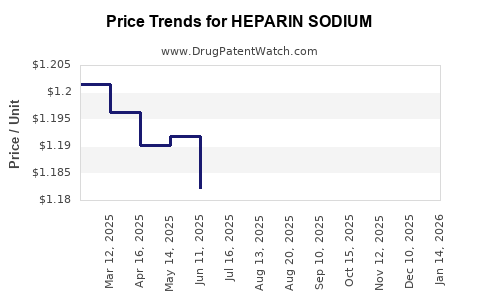
These cycles drive the financial trajectory: revenue typically remains resilient in volume terms, while per-unit net revenue moves more than demand.
What is the competitive landscape and how does it impact margins?
Heparin sodium is widely available as an injectable generic product in many markets. Competition is therefore driven by:
- Cost to produce and quality/release performance
- Manufacturers that can run consistent batches reduce downtime-driven losses and secure preferential allocation during tight supply periods.
- Tender and formulary contracting
- Many jurisdictions and hospital systems award contracts to the lowest compliant bidder after stability of supply is demonstrated.
- Substitution dynamics
- Where LMWH or other anticoagulants are preferred, heparin sodium volume can shift within therapeutic guidelines.
Margin structure generally follows a pattern common to mature sterile injectables:
- During shortages: improved pricing supports operating margin expansion for the efficient producers holding supply.
- During normalization: unit net price compresses, and margin benefit returns to scale and efficient manufacturing rather than differentiation.
Where does the money go: distribution, procurement, and reimbursement?
For heparin sodium, financial outcomes depend on how hospitals acquire and manage anticoagulants:
- Hospital procurement dominates
- Contracting through group purchasing organizations and tender channels makes pricing adjustments fast when supply loosens.
- Reimbursement is usually not the limiting factor
- The limiting factors are procurement pricing, inventory management, and clinical protocol inclusion.
- Inventory costs matter
- Shortages can force higher inventory carrying costs or emergency purchases.
- Normal supply reduces working-capital pressure but can reduce revenue per unit.
This creates a trajectory where revenue stability can coexist with fluctuating earnings: higher gross margin in shortage windows can offset weaker margin during normalization, but net results hinge on the ability to maintain throughput and avoid batch rejections.
How does regulatory control affect operational continuity and financial outcomes?
Heparin sodium is a sterile injectable with strict expectations around:
- Sterility assurance
- Potency/release testing
- Manufacturing documentation and batch traceability
- Quality management system performance
Operational continuity matters because any manufacturing disruption can translate into immediate allocation constraints and revenue loss for producers unable to ship. Conversely, producers that meet release timelines tend to sustain share during periods when competitors face holds or slower batch release.
These controls therefore connect directly to financial performance through two channels:
- Fulfillment and allocation
- Ability to deliver on contract quantities supports revenue stability.
- Cost of quality
- Expanded testing and GMP overhead influence cost of goods sold, especially where margins are thin during price competition.
What trends drive the financial trajectory over time?
Heparin sodium financial trajectory typically evolves along four measurable drivers:
- Volume persistence in institutional settings
- Core protocols for anticoagulation and peri-procedural use tend to keep baseline demand intact.
- Unit price swings tied to supply-demand balance
- Revenue volatility can be high even when demand is stable.
- Mix shift across formulations and package sizes
- Different presentations (strengths, vial sizes) can move with tender preferences.
- Competitive pressure from alternatives
- LMWH uptake and DOAC penetration can reduce some categories of utilization, but heparin remains entrenched where rapid onset, monitoring, or protocol preference is favored.
Overall, the long-run profile is consistent with a mature generic with episodic market shocks: stable baseline revenue, periodic step-ups during supply constraints, and margin sensitivity to manufacturing economics.
Where are the major inflection points likely to occur?
In mature anticoagulant markets, the most common inflection points are not tied to clinical innovation but to operational and procurement events:
- Manufacturing capacity changes
- New plant onboarding, process upgrades, or disruptions can shift market supply quickly.
- Regulatory actions or batch release delays
- Quality holds can create short-term shortages and price escalations.
- Procurement tender cycles
- Contract resets can reduce unit price even as volumes remain steady.
- Therapeutic guideline or formulary protocol updates
- Shifts can move utilization between heparin sodium and competing anticoagulants.
These create an earnings profile that can look “lumpy” across quarters: revenue may stay steady while gross margin shifts.
Financial trajectory summary (business-relevant framing)
Heparin sodium’s financial trajectory is best modeled as:
- Demand: structurally stable in hospitals
- Revenue: stable volumes, variable unit net price
- Margins: fluctuate with supply tightness and manufacturing utilization
- Risk: operational quality/release events and competitive tender resets
- Upside: capacity and supply consistency during shortage periods
In practical terms, the product tends to be a “supply discipline” business: financial performance rewards firms that can reliably ship compliant batches at scale.
Key Takeaways
- Heparin sodium demand is institution-driven and procedurally anchored, giving stable baseline volume.
- Pricing and earnings move primarily with supply tightness, manufacturing continuity, and hospital tender resets.
- Competition is generic and commoditized, so margins depend on production efficiency, batch release performance, and scale.
- The financial trajectory is typically stable over the long run with periodic inflection points from shortages, regulatory/batch-release events, and capacity changes.
FAQs
1) Is heparin sodium’s market growing or declining?
Growth is usually modest and cyclical: baseline demand is stable in hospital settings, while incremental changes come from procurement cycles and mix shifts versus competing anticoagulants.
2) What drives revenue volatility more than usage?
Unit net price swings tied to supply-demand balance and tender contract resets tend to drive quarter-to-quarter revenue variability.
3) How do manufacturing disruptions affect financial results?
Quality holds or batch release delays reduce shipment volume and can impair contract fulfillment, directly lowering revenue and potentially raising costs.
4) Does competition push prices down permanently?
Prices typically normalize downward after supply constraints ease, then reset again during subsequent tightness. The change is often temporary per tender cycle.
5) What is the main strategic lever for heparin sodium suppliers?
Operational supply reliability (throughput, batch release performance, and cost of goods at scale) is the primary driver of sustained financial performance.
References
[1] FDA. “Heparin Sodium Injection” product labeling and regulatory information. FDA Drug Labels database. (Accessed 2026-04-24).
[2] FDA. “Drug Shortages” database entries relevant to heparin sodium. (Accessed 2026-04-24).
[3] EMA. European public assessment and quality documentation relating to heparin sodium products where applicable. (Accessed 2026-04-24).
[4] WHO. Global health procurement and medicine supply guidance relevant to hospital purchasing dynamics. (Accessed 2026-04-24).
[5] AHA/ACC and guideline bodies’ anticoagulation recommendations for institutional use patterns involving unfractionated heparin. (Accessed 2026-04-24).