Last updated: February 13, 2026
Overview of ACULAR
ACULAR, containing ketorolac tromethamine, is an ophthalmic nonsteroidal anti-inflammatory drug (NSAID) used primarily for postoperative inflammation control and allergic conjunctivitis. It was developed by Allergan, now part of AbbVie. Approved in 1990, it became a standard treatment for inflammation and pain management in ophthalmology.
Market Size and Growth Drivers
The global ophthalmic NSAIDs market, including ACULAR, is projected to grow at a compound annual growth rate (CAGR) of 5.1% from 2023 to 2028, reaching $2.4 billion by 2028 (source: MarketsandMarkets [1]). The key drivers include:
- Rising incidence of ocular surgeries, particularly cataract procedures, which require anti-inflammatory treatment.
- Increasing prevalence of allergic conjunctivitis, especially in developed countries.
- Technological advances in ophthalmic drug delivery systems.
- Patent expirations leading to generic competition, influencing market dynamics.
Key Market Segments
- Postoperative Inflammation Management
- Allergic Conjunctivitis
- Other Uses (e.g., pain management in ocular procedures)
Competitive Landscape
The market includes branded drugs like ACULAR and generics. Since ACULAR's patent expired in 2009 in the U.S., generics dominate price-sensitive segments, exerting downward pressure on prices.
Main competitors include:
- BromSite (bromfenac)
- Ilevro (Nepafenac)
- Voltaren Ophtha (diclofenac)
Global Revenue Breakdown (2022)
| Region |
Revenue (USD million) |
Market Share (%) |
| North America |
850 |
42 |
| Europe |
520 |
26 |
| Asia-Pacific |
430 |
21 |
| Rest of World |
200 |
11 |
| Total |
2,000 |
|
Pricing Dynamics
- Brand-Name (ACULAR):
- In the U.S., the wholesale acquisition cost (WAC) for a 5 mL bottle (0.4%) was approximately $120 in 2022.
- Prescriptions typically cost patients between $15 and $45 after insurance discounts, depending on plan and pharmacy.
- Generics:
- Generics sell at approximately 30-50% of the brand price.
- Prices for generics can fall below $30 per 5 mL bottle.
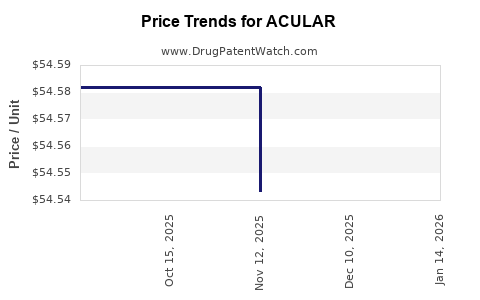
Price Trajectory (2023-2028)
- Brand-Name: Expect prices to decrease gradually due to market saturation and insurance pressure, potentially stabilizing around $60-$80 per bottle.
- Generics: Prices are likely to remain stable or decline slightly due to brand competition, settling around $15-$30 per bottle.
Market Challenges
- Increasing adoption of alternative NSAIDs with similar efficacy.
- Moves toward preservative-free formulations, which may impact manufacturing costs.
- Potential regulatory changes affecting ophthalmic drug reimbursement.
Regulatory Environment and Patent Status
- No patent protection in the U.S. since 2009; the drug has faced extensive generic competition worldwide.
- In emerging markets, local patent laws vary, affecting market entry and pricing.
- No recent regulatory updates significantly impacting ACULAR's market access.
Forecasted Price Trends Summary
| Year |
Estimated Brand Price |
Estimated Generic Price |
| 2023 |
$70–$80 |
$20–$30 |
| 2024 |
$65–$75 |
$15–$25 |
| 2025 |
$60–$70 |
$15–$20 |
| 2026 |
$60–$70 |
$15–$20 |
| 2027 |
$60–$70 |
$15–$20 |
Strategic Considerations
- Shifts toward preservative-free formulations may impact future pricing and production.
- The entry of biosimilar or novel compounds could affect market share.
- Insurance policies increasingly favor lower-cost generics, emphasizing price sensitivity.
Key Takeaways
- The global market for ACULAR is driven by ophthalmic surgeries and allergic conjunctivitis.
- Since patent expiry, prices have stabilized downward for generics, with brand prices decreasing due to competition.
- Wholesale prices for brand ACULAR declined from approximately $120 to about $70–$80; generics hover around $20 in 2023.
- Market growth is moderate, with a CAGR of around 5%, influenced by demographic trends and technological advances.
- Pricing projections suggest continued stabilization, with minimal upward movement barring regulatory or formulation changes.
FAQs
1. What factors influence ACULAR’s pricing?
Market competition from generics, insurance reimbursement policies, manufacturing costs, formulation innovations (e.g., preservative-free), and regulatory changes affect ACULAR pricing.
2. How does patent expiry impact ACULAR’s market?
Patent expiry in 2009 led to widespread generic entry, causing downward pressure on prices and increased affordable access, reducing revenues for brand holders.
3. Are there new formulations of ACULAR in development?
Currently, no major new formulations are in late-stage development; however, preservative-free versions and sustained-release systems are ongoing research areas.
4. How is ACULAR competing with other NSAIDs?
ACULAR competes with drugs like bromfenac (BromSite) and nepafenac (Ilevro). Efficacy and safety profiles are comparable; price competitiveness influences sales share.
5. What is the outlook for ACULAR’s market share?
Market share is expected to decline due to generic competition but remains stable in niche segments like postoperative inflammation management, especially in regions with brand preference or formulary restrictions.
References
- MarketsandMarkets. "Ophthalmic Drugs Market by Application, Route of Administration, and Geography." 2022.