Last updated: July 30, 2026
ASMANEX TWISTHALER is the brand form of inhaled corticosteroid (ICS) mometasone furoate used for asthma maintenance. The financial trajectory is driven by (1) class-level ICS substitution toward lower-cost generics and authorized equivalents, (2) payor and PBM formulary positioning versus competing ICS/LABA and alternative ICS devices, and (3) the depth of patent and exclusivity protection for the specific TWISTHALER inhalation device and formulation/pressurized delivery attributes. Public revenue visibility for the product itself is limited; however, the market structure and IP/legal posture create clear downside pressure typical of mature ICS brands after exclusivity windows close.
What is ASMANEX TWISTHALER and how does its market size evolve in asthma maintenance?
Featured snippet answer: ASMANEX TWISTHALER is an inhaled mometasone furoate product in a breath-actuated device for asthma maintenance. Its sales dynamics track the mature ICS category, with patient migration toward lower net-cost generics, formulary tiering, and competitive pressure from combination inhalers.
Which therapy line does TWISTHALER serve?
- Role in care: Controller therapy for persistent asthma; dosing strength and regimen vary by labeled indication and age group.
- Clinical positioning: ICS cornerstone therapy, often used as monotherapy or stepped up to ICS/LABA.
What market forces shape ICS inhaler demand?
- Generic and authorized generic pressure: ICS products are among the most exposed segments to generic entry and aggressive net-price erosion once exclusivity expires.
- Device and adherence: Breath-actuated inhalers can influence adherence metrics, but payors increasingly treat devices as interchangeable within therapeutic equivalence constructs.
- Step-therapy and prior authorization: PBMs commonly enforce step edits from higher-cost branded ICS toward lower-cost alternatives.
How does competition affect share?
Key competitive axes:
- Lower net cost ICS generics (mometasone and other ICS molecules where protection allows).
- ICS/LABA combinations that capture patients who are escalated beyond ICS monotherapy.
- Alternative delivery systems (HFA, DPI, and soft-mist inhalers) competing on formulary preference and contract pricing.
How do net price and payer contracting drive ASMANEX TWISTHALER financial trajectory?
Featured snippet answer: For established ICS brands, net sales typically decline after peak years as contracts, PBM discounts, and formulary tier changes shift utilization to lower-cost products and competing combinations.
What drives brand ICS net sales year over year?
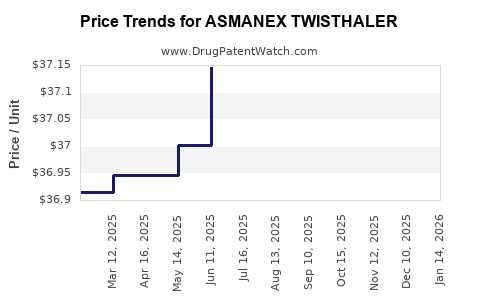
- Contracting and rebates: Revenue is increasingly rebate-driven; small net price changes can materially affect reported sales.
- Formulary status changes: “Preferred” positioning can persist for limited cohorts. When a PBM renegotiates, ASMANEX TWISTHALER can be pushed to non-preferred tiers, increasing patient switching.
- Channel mix: Specialty pharmacy vs retail distribution can affect realized pricing and inventory timing.
What financial indicators matter to track?
- Script volumes by strength and device variant.
- Channel inventory and pull-through timing around generic threats.
- Net price vs list price gap that widens when competition intensifies.
When does ASMANEX TWISTHALER face exclusivity pressure and generic entry risks?
Featured snippet answer: TWISTHALER’s commercial risk is concentrated around the expiration of patents and any remaining regulatory exclusivity tied to the specific marketed inhalation product and device/formulation. As those protections expire, generic and lower-cost authorized alternatives typically accelerate utilization shifts.
How do exclusivity and patent expiry typically map to market erosion?
- Patent expiry triggers carve-out and “at-risk” launches if Paragraph IV or other challenges exist.
- Regulatory exclusivity (where applicable) delays direct competition only if it covers the relevant product and use.
- Device/formulation patents can extend risk timelines even when core molecule patents have expired.
What is the practical erosion timeline for mature ICS brands?
Commercial experience in inhaled respiratory therapeutics shows:
- Pre-expiration: incremental share loss as payors preview future switching.
- Launch year: sharp net price pressure if generics or authorized versions land on preferred tiers.
- Post-launch: continued volume drift as physician and patient preferences align with the lower-cost product.
What patents protect ASMANEX TWISTHALER and how strong is the estate?
Featured snippet answer: ASMANEX TWISTHALER’s patent estate is anchored in formulation/device and method-of-use coverage around mometasone furoate inhalation delivery. The estate strength determines how quickly generic products can enter without infringement risk.
Patent estate components likely to matter for generics
- Device and delivery method claims: breath-actuated dispersion, dose counter mechanics, particle size or release behavior.
- Formulation claims: particle engineering, excipient systems, and stability attributes tied to inhalation performance.
- Method-of-use claims: asthma maintenance regimen and dosing schedules.
How to read estate strength through litigation and listings
Indicators that correlate with risk:
- Orange Book listings breadth: more listed patents typically means broader “blocking” coverage, especially if device/formulation patents are listed against the NDA.
- Litigation history: active enforcement against ANDA filers can slow launches or raise launch costs.
- Settlement terms: reverse-payment or timed-approval settlements often map to the effective market protection window.
What generic entry risks exist for ASMANEX TWISTHALER?
Featured snippet answer: Generic entry risk depends on whether ANDA applicants can design around device/formulation patents or challenge Orange Book-listed patents. When protection is weak or design-arounds exist, generic launches can occur rapidly and drive large net sales declines.
What typical ANDA strategies reduce infringement risk?
- Different device implementation if claims are limited to a specific inhaler architecture.
- Formulation changes that alter key features while retaining therapeutic equivalence.
- Skinny labeling or limited use claims when method-of-use patents block broader claims.
What market outcomes usually follow generic launches in ICS inhalers?
- PBM formulary changes within months: placement on lower tiers with strong copays.
- Switching at refill: patients often switch at renewal rather than discontinuing.
- Consolidation among remaining brands: branded revenue tends to concentrate in fewer products with stronger differentiation.
Does ASMANEX TWISTHALER face biologic or biosimilar-style competitive risk?
Featured snippet answer: No. ASMANEX TWISTHALER is a small-molecule inhaled corticosteroid, not a biologic. Biosimilar frameworks and biosimilar-specific exclusivities do not apply.
Competitive substitute risk is instead from:
- Generics and authorized generics of mometasone and other ICS.
- Branded ICS/LABA combinations that shift controller therapy upward.
How does ASMANEX TWISTHALER compare with other inhaled corticosteroids in commercial performance?
Featured snippet answer: In the ICS class, brands that lack device/formulation differentiation and sit behind multiple patent hurdles tend to lose share faster after exclusivity. Products with fewer direct generic pathways or stronger device differentiation tend to show slower erosion.
Comparison axes that matter for sales trajectory
- Molecule substitution risk: direct generics of mometasone vs switching to other ICS molecules.
- Device substitutability: DPI vs HFA vs soft-mist affects formulary preferences.
- Patient adherence and usability: inhaler handling and inspiratory flow requirements influence retention.
What contract and formulary structures typically do
- Prefer the lowest net-cost product within therapeutic class.
- Use step edits and “preferred controller” lists to standardize prescribing.
What is the Orange Book status of ASMANEX TWISTHALER?
Featured snippet answer: Orange Book status determines which patents are listed against the NDA and therefore which protections can block ANDA approval or drive Paragraph IV challenges.
What to expect from Orange Book-listed patents for inhaled products
- Formulation/dose delivery patents often have later expiry dates than early-molecule patents.
- Device patents can remain listed even after major market exclusivity ends, extending practical barriers to generic entry.
What patent litigation and settlements affect ASMANEX TWISTHALER?
Featured snippet answer: For mature inhaler brands, the key litigation drivers are challenges to Orange Book-listed patents by ANDA filers, followed by settlements that set launch dates.
What litigation patterns typically matter
- Paragraph IV filings: correlate with imminent at-risk generic launches.
- Injunction motions: can delay launch even when patent validity is contested.
- Settlement timing: defines the effective protection horizon by contractually agreed non-launch periods.
What manufacturing and IP barriers can delay generic launches?
Featured snippet answer: Device/formulation patents and technical design constraints can extend the time for generic inhaler products to reach launch readiness and secure competitive placement.
What can delay an ANDA beyond legal clearance?
- Process complexity tied to particle dispersion or stability in the specific inhaler device.
- Bioequivalence and performance testing aligned to inhaled delivery metrics.
- Device integration and dose uniformity requirements that create additional development cycles.
Revenue exposure: where is downside concentration likely to sit?
Featured snippet answer: Downside is concentrated in periods immediately after exclusivity/patent expiry and around formulary tier changes. Market share losses translate quickly into net sales pressure because controller utilization is recurring.
Revenue sensitivity drivers
- Payer contracts with time-limited preferred status.
- National and regional formulary moves triggered by competitor price changes.
- Switching friction from device familiarity, which can still fail if copays and tier placement change.
Key Takeaways
- ASMANEX TWISTHALER operates in a mature ICS asthma market where net sales are highly sensitive to PBM formulary placement and generic substitution dynamics.
- Financial trajectory risk is tied to the expiration of Orange Book-listed patents covering formulation and inhaler delivery attributes and to whether ANDA applicants can design around those protections.
- Generic entry, not biosimilar competition, is the primary substitution pathway.
- The dominant market forces are net price erosion, contract renegotiations, and step-therapy pressures that push patients from branded ICS toward lower-cost options and, for escalated patients, toward ICS/LABA combinations.
FAQs
1) What is ASMANEX TWISTHALER’s competitive threat versus ICS/LABA combinations?
ICS/LABA combinations capture patients who step up from monotherapy; this can compress long-term controller share even if the ICS molecule remains protected.
2) How do PBM step edits typically impact branded inhaled corticosteroid sales?
They shift initiation and refills toward preferred controllers, accelerating utilization loss during contract renegotiation windows.
3) What drives the difference between list price and net sales for inhaled asthma brands?
Rebates, service fees, and contract discounts widen the gap as competition intensifies and payors demand greater concessions.
4) What technical factors in DPI inhalers can slow generic development?
Particle dispersion and dose uniformity linked to device mechanics can extend formulation and performance validation timelines.
5) When does generic competition usually accelerate for inhalers after patent expiry?
Typically in the months around effective patent expiry, once PBMs place generics on preferred tiers and prescribers normalize switching.
References (APA)
- FDA. (n.d.). Orange Book: Approved Drug Products with Therapeutic Equivalence Evaluations. U.S. Food and Drug Administration. https://www.accessdata.fda.gov/scripts/cder/daf/
- FDA. (n.d.). Drug trials snapshots. U.S. Food and Drug Administration. https://www.fda.gov/drugs/drug-approvals-and-databases/drug-trials-snapshots