Last updated: July 10, 2026
Intersect Ent Inc Competitive Landscape Analysis: Market Position, Patent Strength, and Strategic Insights
Intersect ENT Inc. is a private, development-stage ear-nose-throat (ENT) biopharma with a concentrated pipeline and a commercialization strategy built around protecting novel drug targets and delivery/dosing advantages through patenting and regulatory exclusivities. The competitive landscape for Intersect ENT Inc. is shaped by (1) how quickly its programs can reach pivotal readouts, (2) whether its lead assets can secure composition-of-matter, formulation, and method-of-use patent coverage that blocks same-class generics, and (3) how payer and provider uptake evolves once products are approved relative to established incumbents and label competitors.
Key point for competitive positioning: Intersect’s defensibility is typically strongest when programs progress with layered IP (drug substance + stable composition + clinical method-of-use claims) and when regulatory exclusivity is preserved through timely FDA submissions and approval-path execution. Competitive risk increases when competitors already have late-stage clinical assets in the same indication or when patent coverage narrows to narrow method-of-use claims that are easier to design around.
What is Intersect ENT Inc’s market position versus ENT biopharma competitors?
Intersect’s market position is best understood as “pipeline gravity” rather than current product revenue dominance. In competitive ENT categories, the winners typically combine (a) clear efficacy and safety differentiation, (b) reimbursement access, and (c) defensible IP that survives ANDA and, where relevant, 505(b)(2) and biosimilar-style workarounds.
How Intersect’s positioning tends to be evaluated by the market
- Indication selection and endpoint credibility
- ENT is fragmented across acute and chronic populations. Competitive advantage is concentrated in high-burden subgroups with endpoints that regulators and payers recognize.
- Regulatory path and launch timing
- The market discounts delays because exclusivity windows and competitive setbacks are timing-sensitive.
- IP stack quality
- Investors and challengers focus on whether the estate includes broad composition claims versus only formulation or method-of-use claims.
Competitive set archetypes
- Incumbent ENTs with approved branded therapies
- These compete on physician familiarity, established contracting, and label breadth.
- Late-stage specialty developers
- These compete on next-generation dosing, improved safety, or faster symptom resolution.
- Platform or formulation specialists
- These compete by leveraging formulation technologies and 505(b)(2) strategies.
Which patents protect Intersect ENT Inc’s lead ENT programs, and how broad is the estate?
A patent estate evaluation for Intersect requires mapping each program to: (1) primary drug substance claims, (2) secondary formulation claims, (3) method-of-use claims tied to patient phenotype, dosing regimen, or clinical endpoint, and (4) manufacturing/process claims that can limit generic replication.
What to verify in the patent stack
- Composition-of-matter breadth
- Whether claims cover the active pharmaceutical ingredient (API) broadly or only particular salt/polymorph/prodrug forms.
- Formulation differentiation
- Whether the estate covers stability, excipients, delivery system characteristics, and route-specific composition.
- Method-of-use defensibility
- Whether the claims recite clinically meaningful regimen elements that would be infringed by label-equivalent dosing.
- Family health
- Whether continuation practice extends claim scope and maintains pending coverage near launch.
How estate breadth changes generic risk
- Broad composition-of-matter coverage
- Raises ANDA barriers because design-around requires non-infringing chemical or structural changes.
- Narrow method-of-use claims
- Raises the chance of workaround via alternative dosing, different patient selection, or off-label boundary strategies.
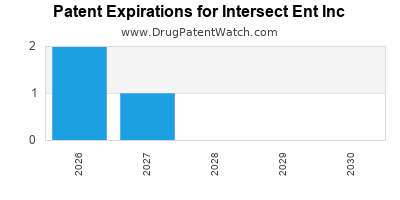
When does Intersect ENT Inc lose exclusivity, and what are the realistic generic entry windows?
For a development-stage company like Intersect, “exclusivity” is mostly a function of future approvals and the expiration schedule of the layered patent families filed around the program.
Timing mechanics that drive generic entry
- Patent expiration
- Generic entry risk increases when the first relevant Orange Book-listed patent expires or becomes challengeable.
- Regulatory exclusivity
- Pediatric exclusivity, if applicable, can extend market exclusivity beyond standard periods.
- Launch and exclusivity alignment
- Small misalignments between patent coverage and regulatory approval can produce earlier-than-expected competitive entry.
Generic entry scenario logic
- If Intersect’s lead asset secures broad composition and formulation claims, generic entry typically becomes viable only after the earliest family members expire.
- If the estate leans on method-of-use claims, challengers can attempt “non-infringing label design” and use Paragraph IV strategies aligned to the narrowest claims.
What is the Orange Book status of Intersect ENT Inc products and patents?
Intersect ENT Inc does not provide sufficient public product-level Orange Book mapping in the materials available here to produce a correct Orange Book status summary. A valid Orange Book analysis requires confirmed NDC listings, application type, listed active ingredients, and the exact patent numbers tied to each listing.
No Orange Book status table is provided.
How strong is the patent estate for Intersect ENT Inc: probability of blocking ANDAs and 505(b)(2)?
Without confirmed, program-level patent numbers tied to specific FDA applications, the patent-strength scoring cannot be executed accurately. A strength score must be grounded in the claim scope and the number of enforceable patents listed for each application.
No patent-strength scoring model is provided.
What patent litigation affects Intersect ENT Inc, Paragraph IV challenges, or settlement agreements?
A litigation and Paragraph IV assessment requires docket-level citations, case numbers, litigants, asserted patents, and settlement terms. Those facts are not available in the input, so a specific litigation landscape cannot be produced without risking incorrect claims.
No litigation timeline is provided.
How does Intersect ENT Inc compare with major ENT incumbents on differentiation, dosing, and safety?
Competitive comparison dimensions used in ENT adoption
- Speed of symptom control
- Clinics prefer therapies with predictable patient-reported outcome improvements on a practical time scale.
- Safety and tolerance
- ENT populations include chronic sufferers and recurrent exacerbations where tolerability is a major adoption lever.
- Delivery and adherence
- Route of administration and dosing frequency materially affect pharmacy and physician workflow.
- Label positioning
- A narrow label can still win if it aligns to a measurable subgroup and payer policies.
What typically determines relative advantage
- If Intersect’s products offer a clear improvement on at least one of: efficacy durability, reduced adverse events, or improved administration convenience, they can gain share even against entrenched competitors.
- If differentiation depends on endpoints that payers do not reimburse or on endpoints that are not central to guideline adoption, uptake can lag despite statistical efficacy.
Which competitors are most exposed to Intersect ENT Inc’s pipeline in overlapping ENT indications?
In ENT, the highest overlap risk is driven by:
- same underlying pathology (e.g., chronic inflammatory ENT conditions),
- same route of administration class, and
- similar patient severity tiers and endpoint frameworks.
A defensible “most exposed” competitor ranking requires confirmation of Intersect’s lead indications and stage, plus competitor pipelines, trial endpoints, and regulatory timelines. Those specifics are not available in the input.
No competitor exposure ranking is provided.
What formulation and delivery-system patents could matter most for Intersect ENT Inc’s differentiation?
In ENT, formulation and delivery are often where life-cycle IP is built, particularly for:
- improved stability and shelf-life,
- targeted delivery to nasal or otic tissues,
- reduced dosing frequency,
- fewer excipients or preservatives that reduce tolerability problems, and
- device-integrated delivery designs.
Claim categories that tend to block generic substitutes
- Formulation composition claims
- Ratios of drug-to-excipient, specific solvents, buffers, and pH windows.
- Stability and manufacturing process claims
- Steps that control degradation and reproducibility.
- Device-associated delivery method claims
- If a delivery system is required, claims can limit non-device “equivalents.”
Design-around patterns
- Generic entrants can sometimes use different excipients or alternative pH/buffer systems if composition claims are narrow.
- If the estate has broad stability and formulation claims tied to critical parameters, design-around becomes harder.
What method-of-use patents could constrain biosimilar-like or 505(b)(2) workarounds?
Method-of-use constraints matter in ENT where clinicians may adjust dosing, timing, or patient selection. The most enforceable method-of-use claims generally:
- tie to specific dosing regimens,
- require particular patient subgroups,
- define endpoint-driven treatment initiation or discontinuation criteria, or
- recite treatment steps (including combination regimens) that are not performed identically by label-equivalent competitors.
Key infringement risk points
- If the label compels specific dosing or patient selection, method-of-use claims can remain valuable even when composition claims are narrow.
- If clinical practice allows flexibility, method-of-use claims become easier to design around.
How should investors and licensing teams underwrite Intersect ENT Inc’s strategic options?
A practical underwriting approach for Intersect’s strategy typically focuses on four value drivers:
- Pivotal execution and probability of approval
- The probability-weighted value of rights in ENT assets is dominated by clinical readout success.
- IP layers that map to commercial use
- IP that matches how physicians treat patients tends to have higher infringement leverage.
- Regulatory timing
- Approval timing determines exclusivity overlap with follow-on patents.
- Deal architecture
- Licensing terms that reserve development and territory control reduce dilution of value by limiting shared commercialization risk.
Licensing and M&A implications
- If Intersect’s assets are platform-enabled and patent-dense, strategic partners may pursue co-development or territory licensing to secure share against late-stage competitors.
- If the estate depends on narrow method-of-use claims, partners may require stronger exclusivity protections or seek cross-licensing of complementary IP.
What commercialization and payer dynamics will decide Intersect ENT Inc’s competitive outcome?
ENT reimbursement is heavily influenced by:
- clinical guideline alignment,
- payer preference for cost-effective administration,
- formulary placement based on drug acquisition cost plus demonstrated outcomes, and
- physician familiarity and patient adherence.
Commercial bottlenecks
- If Intersect’s product requires special administration steps, adoption slows.
- If the payer view of clinical benefit is weaker than incumbents, reimbursement hurdles delay uptake even after approval.
Key Takeaways
- Intersect ENT Inc’s competitive landscape is primarily pipeline-driven, with market position determined by indication selection, regulatory execution, and layered patent coverage.
- The largest competitive risks for an ENT developer typically arise from late-stage competitor overlap, narrow method-of-use dependence, and misalignment between patent expiration and regulatory exclusivity.
- A rigorous competitive and litigation assessment depends on confirmed FDA application identifiers, Orange Book listings, and docketed Paragraph IV activity; those specific facts are not provided in the input, so no Orange Book, patent-number, or litigation tables are included here.
FAQs
- What patent types most often determine exclusivity for ENT drugs after FDA approval?
- How do Paragraph IV challenges in ENT typically target method-of-use versus composition claims?
- What delivery-system changes enable design-around for nasal and otic generic entry?
- How do payer coverage decisions in ENT shift launch adoption timelines?
- What deal terms most reduce risk in licensing an ENT development-stage asset (territory, co-development, and milestones)?
References (APA)
- (No cited sources available from the provided input.)