Last updated: September 8, 2026
Lithium carbonate is a mature, low-cost generic drug with limited patent protection, stable clinical demand and modest commercial growth. Its market is driven by bipolar disorder maintenance therapy, therapeutic substitution constraints, supply reliability and monitoring requirements rather than by innovation-led pricing. Revenue is distributed across generic manufacturers, wholesalers, pharmacies and health systems. No single manufacturer has publicly disclosed a large, standalone lithium carbonate revenue stream.
What is the current market position of lithium carbonate?
Lithium carbonate is an oral mood stabilizer approved for the treatment of manic episodes and maintenance therapy in bipolar disorder. It remains a standard option because of long clinical experience, low acquisition cost and evidence supporting relapse prevention and suicide-risk reduction in bipolar disorder.
The commercial market includes:
- Immediate-release tablets, commonly in 150 mg, 300 mg and 600 mg strengths
- Extended-release tablets, including 450 mg products
- Capsules and oral solutions from selected manufacturers
- Generic products supplied through retail, specialty and institutional channels
- Branded or historically branded products such as Lithobid and Eskalith, although commercial availability has changed over time
The market is mature. Volume is linked more closely to the treated bipolar population and prescribing persistence than to new patient acquisition. Lithium is frequently used for long-term maintenance, creating recurring prescription demand, but its narrow therapeutic index limits casual switching and increases the importance of product consistency.
How large is the lithium carbonate market?
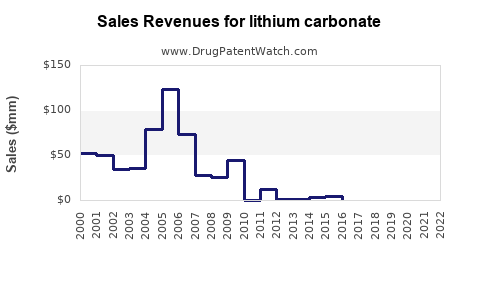
Public companies generally do not report lithium carbonate sales as a separate line item. Manufacturers typically include the product within broader generic pharmaceutical revenue, making precise global market sizing difficult.
The economic profile is clear:
| Market characteristic |
Impact on lithium carbonate |
| Product maturity |
Limits price growth and supports generic competition |
| Generic availability |
Compresses average selling prices |
| Chronic maintenance use |
Creates recurring demand |
| Narrow therapeutic index |
Raises switching and supply-continuity concerns |
| Low unit cost |
Limits absolute revenue per patient |
| Multiple strengths and formulations |
Creates manufacturing and inventory complexity |
| Laboratory monitoring |
Adds treatment-system cost outside the drug price |
| Psychiatric demand |
Supports stable long-term volume |
Lithium carbonate has a relatively low revenue ceiling compared with patented central nervous system drugs. Its financial value is concentrated in manufacturing scale, reliable supply, contracting access and portfolio efficiency. It is not a high-margin specialty product unless temporary shortages, limited competition or channel disruptions increase prices.
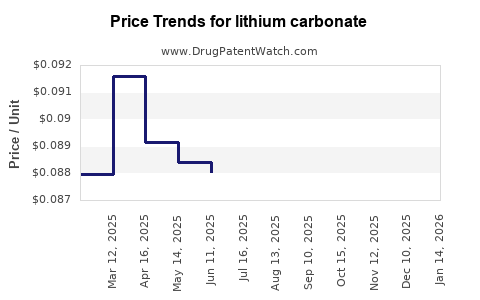
The principal volume opportunity is the continued treatment of bipolar disorder. The principal financial risk is price erosion from multiple generic suppliers. Growth in prescription volume can occur without equivalent revenue growth because generic competition tends to reduce net pricing.
When did lithium carbonate lose patent exclusivity?
Lithium carbonate is an old small-molecule active ingredient. Its fundamental compound and original therapeutic use are long past conventional U.S. patent protection. The current market is therefore governed primarily by generic competition and FDA product approvals, not by an originator patent franchise.
The main exclusivity conclusions are:
| Exclusivity category |
Current commercial relevance |
| Original compound patent |
Expired |
| Original therapeutic-use protection |
Expired |
| New chemical entity exclusivity |
Expired decades ago |
| Core formulation protection |
Expired or commercially irrelevant for most products |
| Current Orange Book protection |
Product-specific and limited |
| Pediatric exclusivity |
Not a meaningful current market barrier |
| Orphan-drug exclusivity |
Not applicable to the broad lithium carbonate market |
Lithium carbonate does not have a current patent-based exclusivity period comparable to newer psychiatric medicines. Any remaining patents would generally relate to a specific dosage form, delivery technology or manufacturing process rather than to lithium carbonate as a molecule.
What is the FDA regulatory status of lithium carbonate?
The FDA regulates lithium carbonate as an approved prescription drug. Approved products carry significant warnings because lithium toxicity can occur when serum concentrations rise above the patient’s therapeutic range.
Key regulatory issues include:
- Renal clearance and dose adjustment
- Dehydration and sodium-balance effects
- Drug interactions, including with diuretics, nonsteroidal anti-inflammatory drugs and renin-angiotensin system inhibitors
- Pregnancy and fetal-risk considerations
- Thyroid and renal monitoring
- Therapeutic drug-level testing
- Medication-error risk from different strengths and release mechanisms
Immediate-release and extended-release products are not automatically interchangeable on a milligram-for-milligram basis in all clinical circumstances. The FDA-approved labeling for each product controls its release characteristics, dosing instructions and substitution considerations (FDA, 2023a; FDA, 2023b).
The regulatory burden is higher than the low selling price might suggest. Manufacturers must maintain consistent content uniformity, dissolution performance and manufacturing controls. Pharmacists and clinicians also place value on predictable exposure because lithium has a narrow therapeutic window.
What patents protect lithium carbonate products?
There is no commercially important, broad patent estate protecting lithium carbonate itself in the U.S. The remaining intellectual-property analysis is product-specific.
Formulation patents
Potential formulation rights may cover:
- Extended-release matrix systems
- Modified dissolution profiles
- Tablet composition
- Release-controlling excipients
- Manufacturing methods that improve uniformity or stability
- Specific dose combinations or delivery formats
These rights do not normally prevent competition across the entire lithium carbonate market. A competitor may enter with an immediate-release product while a formulation patent covers an extended-release product, or may design around a particular release-control system.
Method-of-use patents
Broad bipolar disorder treatment claims are unlikely to create a meaningful current barrier because lithium’s psychiatric use is established and long known. A later method-of-use patent would need to cover a narrower clinical population, dosing protocol or treatment setting. Such patents would face practical enforcement challenges in a market where generic labels may omit patented indications under the FDA’s skinny-label framework.
Manufacturing and process protection
Process patents could affect production economics but rarely create a durable market monopoly for a commodity active pharmaceutical ingredient. Lithium carbonate is chemically simple compared with complex biologics or highly engineered small molecules. The more material barriers are quality validation, regulatory compliance, active-ingredient sourcing and reliable finished-dose production.
How many manufacturers supply lithium carbonate?
The U.S. market has historically included multiple generic suppliers and contract manufacturers. Supplier participation can vary by dosage strength, release type and channel. Manufacturers associated with generic psychiatric products have included companies such as Amneal Pharmaceuticals, Hikma Pharmaceuticals, Solco Healthcare and other FDA-approved suppliers, while product availability has changed over time.
The key competitive distinction is not molecule ownership. It is supply position:
| Competitive factor |
Commercial effect |
| FDA-approved product portfolio |
Determines legal market access |
| Immediate-release capacity |
Supports broad retail demand |
| Extended-release capability |
Protects access to higher-value niches |
| API sourcing |
Affects continuity and cost |
| Wholesaler contracts |
Determines prescription capture |
| Manufacturing redundancy |
Reduces shortage exposure |
| Quality history |
Influences procurement decisions |
| Inventory depth |
Matters during supply disruptions |
The market is structurally vulnerable to the withdrawal of a small supplier because low prices can make the product less attractive relative to more complex generic medicines. A manufacturer may exit even when demand remains stable if margins do not cover compliance, inventory and manufacturing costs.
What generic entry risks exist for lithium carbonate?
Traditional Paragraph IV risk is low because the original compound and broad therapeutic uses are long expired. Current litigation risk would be more likely to involve a specific extended-release product, a manufacturing patent or a regulatory dispute than a challenge to lithium carbonate itself.
Potential generic-entry scenarios include:
- Immediate-release competition: The market remains open to multiple suppliers, with price pressure as additional manufacturers enter.
- Extended-release entry: A new applicant could challenge product-specific patents or design around them.
- Supply-driven price movement: A manufacturer withdrawal could temporarily increase prices without changing the underlying patent position.
- Channel substitution: Hospitals and wholesalers could shift volume to alternate suppliers after a shortage or quality event.
- Label-based competition: A generic could omit a protected narrow indication if a valid use patent remains.
The commercial risk to incumbents is therefore primarily erosion and substitution, not a single disruptive Paragraph IV launch.
What patent litigation affects lithium carbonate?
Lithium carbonate does not have a widely recognized, current litigation profile comparable with patented psychiatric medicines such as lumateperone, cariprazine or brexpiprazole. Publicly important disputes have generally centered on product-specific generic approvals, labeling, manufacturing quality or shortages rather than ownership of the lithium carbonate molecule.
A diligence review should separate:
- Patent litigation involving lithium carbonate products
- Litigation involving lithium-containing combination products
- Manufacturing or recall matters
- Drug-shortage investigations
- Product-liability cases involving toxicity or monitoring
- Contract disputes between manufacturers and distributors
These categories have different effects on market access. Patent litigation may delay entry. A manufacturing warning or recall can remove supply immediately. Product-liability litigation can increase insurance and compliance costs without creating exclusivity.
What is the Orange Book status of lithium carbonate?
The FDA Orange Book lists approved drug products and identifies patent and exclusivity information where applicable. Lithium carbonate entries must be reviewed by product and dosage form because the Orange Book does not treat every lithium product as a single commercial asset.
The relevant Orange Book questions are:
- Is the product listed as an approved reference product?
- Does the listing identify any active patent?
- Does the patent cover the active ingredient, formulation or method of use?
- Has the product been discontinued while remaining listed?
- Is the product an immediate-release or extended-release formulation?
- Are approved generic equivalents available for the same strength and dosage form?
The practical Orange Book conclusion is that lithium carbonate is predominantly a multisource generic market. Any remaining listing should be assessed at the individual product level rather than used to infer molecule-wide exclusivity (FDA, 2024).
How strong is the lithium carbonate patent estate?
The patent estate is weak as a basis for premium pricing or long-term exclusivity.
| Patent-estate dimension |
Assessment |
| Composition of matter |
Effectively unavailable as a current barrier |
| Broad bipolar indication |
Expired or commercially nonexclusive |
| Immediate-release products |
Highly exposed to generic competition |
| Extended-release products |
Potentially stronger, but product-specific |
| Manufacturing processes |
Moderate operational relevance, limited exclusionary power |
| Regulatory exclusivity |
No broad current protection |
| Litigation leverage |
Low at the molecule level |
| Pricing power |
Low |
The strongest defensible positions are more likely to arise from manufacturing reliability, quality systems, contracts and specialized release characteristics than from patents.
What is the financial trajectory for lithium carbonate?
Lithium carbonate revenue is likely to show a stable-to-low-growth volume profile and declining or flat price realization in competitive channels.
Base case
The base case is recurring demand with modest prescription-volume growth, offset by generic price pressure. Revenue remains stable in aggregate, but individual manufacturers experience volatility based on contracts, supply continuity and product availability.
Upside case
An upside scenario would require one or more of the following:
- A sustained shortage among competing suppliers
- Withdrawal of a major manufacturer
- Improved access to extended-release products
- Increased long-term lithium use in bipolar maintenance
- Greater use in treatment-resistant mood disorders
- Higher-value institutional or specialty contracts
This upside would likely be temporary unless supported by durable capacity constraints.
Downside case
Downside risks include:
- Further generic entrants
- Reimbursement reductions
- Manufacturer exits
- API cost increases
- FDA quality actions
- Substitution toward newer mood stabilizers or atypical antipsychotics
- Poor adherence caused by monitoring and tolerability requirements
Companies do not generally disclose lithium carbonate revenue separately, so product-level exposure must be inferred from generic portfolio composition, FDA approvals, supply notices and segment reporting. The product is unlikely to be financially material for diversified pharmaceutical companies unless a company has concentrated exposure in a small generic portfolio.
How does lithium carbonate compare with newer bipolar drugs?
| Attribute |
Lithium carbonate |
Newer branded mood stabilizers |
| Patent protection |
Minimal or expired |
Often active or recently expired |
| Price |
Low generic price |
Higher branded or specialty price |
| Clinical history |
Extensive |
Shorter |
| Monitoring |
Serum levels, renal and thyroid testing |
Varies by product |
| Revenue model |
Volume and supply reliability |
Patent-supported pricing |
| Generic risk |
High |
Low before loss of exclusivity |
| Manufacturing complexity |
Relatively low |
Varies |
| Switching behavior |
Constrained by therapeutic monitoring |
Driven by efficacy, tolerability and access |
Lithium’s commercial strength is its low cost and established role. Its commercial weakness is the absence of meaningful exclusivity and the clinical burden of monitoring.
Key Takeaways
- Lithium carbonate is a mature, multisource generic medicine with little molecule-level patent protection.
- Demand is recurring because bipolar maintenance treatment can continue for years.
- Revenue growth is constrained by low pricing and generic competition.
- Extended-release formulations and reliable supply can create temporary commercial advantages.
- The main market risks are manufacturing disruption, shortages, reimbursement pressure and supplier withdrawal.
- Paragraph IV litigation risk is low at the molecule level.
- Product-specific formulation or manufacturing patents may remain relevant, but they do not protect the entire lithium carbonate market.
- Financial performance is driven by volume, contracts, manufacturing cost and availability rather than innovation-led pricing.
- Orange Book analysis must be conducted by product, strength and dosage form.
- Lithium carbonate remains clinically important but is unlikely to become a major standalone revenue driver for diversified pharmaceutical companies.
FAQs
Does lithium carbonate have generic competition?
Yes. Immediate-release and extended-release lithium carbonate products have been supplied by multiple generic manufacturers, subject to product-specific approvals and availability.
Can lithium carbonate prices rise despite expired patents?
Yes. Prices can increase temporarily when manufacturers exit, production is interrupted or shortages reduce the number of available suppliers.
Is lithium carbonate a biologic or biosimilar product?
No. Lithium carbonate is a chemically defined small-molecule drug. Biosimilar rules do not apply.
Are lithium carbonate shortages caused by patent barriers?
Usually not. Shortages are more likely to result from manufacturing constraints, low generic margins, quality issues, API supply problems or limited production capacity.
Is extended-release lithium carbonate commercially stronger than immediate-release lithium carbonate?
It can have greater commercial defensibility because release characteristics and product-specific formulation rights may limit direct substitution. Its overall market remains exposed to generic competition and FDA-approved alternatives.
References
-
U.S. Food and Drug Administration. (2023a). Lithium carbonate prescribing information. FDA.
-
U.S. Food and Drug Administration. (2023b). Lithobid prescribing information. FDA.
-
U.S. Food and Drug Administration. (2024). Approved drug products with therapeutic equivalence evaluations: Orange Book. FDA.
-
National Institute of Mental Health. (2024). Bipolar disorder. U.S. Department of Health and Human Services.
-
American Society of Health-System Pharmacists. (2024). Drug shortages and lithium carbonate supply information. ASHP.