Last updated: July 30, 2026
Digoxin Market Dynamics and Financial Trajectory (U.S. and Major Markets): Pricing, Volume, Competition, Patent/IP Risk, and Forecast Risks
Executive summary. Digoxin is an off-patent, long-cycle cardiovascular drug with a mature generic base, low unit pricing versus branded cardiovascular therapies, and demand driven by atrial fibrillation (AF) prevalence, heart-failure management patterns, and guideline adherence. Financial trajectory over the last decade has been shaped by (1) persistent generic competition, (2) intermittent supply and formulation substitution between oral solid and liquid forms, and (3) shifting clinical preference toward beta-blockers, rate-control agents, and newer heart-failure therapies that can reduce digoxin usage intensity per patient. Commercial growth is most likely to come from stable AF-related demand and geographic conversion from liquid to solid formulations or from constrained supply windows. Revenue upside is limited by near-universal generic availability and wholesale price compression.
What drives digoxin market demand in atrial fibrillation and heart failure?
Primary indications driving utilization
- Atrial fibrillation (rate control): Digoxin remains used for rate control, especially when patients have hypotension, reduced ejection fraction, or limited tolerance for beta-blockers and calcium channel blockers.
- Chronic heart failure: Digoxin is used for symptom reduction and hospitalization reduction in select patients, typically as add-on therapy rather than core guideline-directed therapy.
Key demand levers
- Patient mix: Older populations with AF and HFrEF support baseline demand. AF prevalence correlates with aging demographics.
- Clinical practice patterns: Use has trended toward more individualized dosing and monitoring due to narrow therapeutic index concerns.
- Formulation substitution: Prescriber preference can shift based on dosing convenience (tablets vs solutions), patient ability to swallow, and payer formularies.
- Tolerability and safety monitoring: Serum level monitoring and renal function management influence dosing persistence and discontinuation.
Market segmentation
- Oral tablets: Dominant share in many geographies due to cost and convenience.
- Oral solution: Important for pediatrics and patients who cannot take tablets. This segment can be more volatile where manufacturing lines face disruptions.
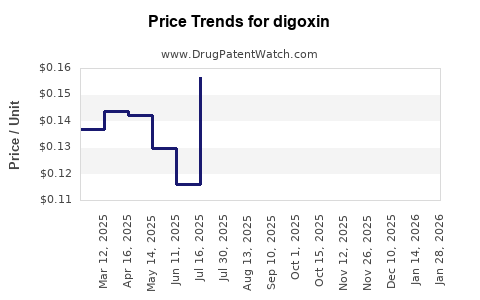
How has digoxin pricing and gross-to-net behavior evolved under generic competition?
Structural pricing dynamics
- Digoxin is broadly generic, which drives:
- Wholesale acquisition cost (WAC) compression toward low levels.
- Greater sensitivity to contract pricing and rebate structures (gross-to-net pressure).
- Limited branding leverage except for specific formulations or specialty packaging.
Observed market pattern for off-patent generics
- Price declines typically follow:
- Generic entry and multiple supplier competition,
- Pharmacy benefit manager (PBM) tendering cycles,
- Occasional upward moves during supply constraints.
Revenue implications
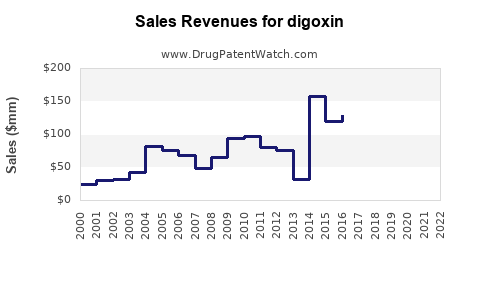
- Even with stable or modestly growing demand, revenue growth is difficult because unit price and net price are the primary profit determinants.
- Profit is concentrated in manufacturers with scale, consistent supply, and strong contracting access.
Which digoxin manufacturers dominate the competitive landscape?
Competitive model
- Digoxin markets typically show:
- Multiple generic manufacturers across tablets and solutions.
- Periodic consolidation around reliable suppliers.
- Local payer contracting that shifts share without changing total class demand much.
Practical implications for market entry or expansion
- Commercial differentiation is rarely clinical in digoxin.
- Differentiation is usually operational:
- manufacturing capacity,
- formulation bioavailability consistency,
- packaging and compliance with stability requirements,
- ability to keep supply uninterrupted.
What is the Orange Book status of digoxin in the U.S.?
Regulatory status
- Digoxin is widely marketed as approved generic drugs with multiple ANDA products.
- Orange Book classification for a mature drug typically shows:
- No meaningful remaining composition-of-matter exclusivities for standard forms,
- Potential for limited, product-specific patents tied to formulations or manufacturing processes in some holders.
Featured snippet answer
- Digoxin’s U.S. exclusivity footprint is generally minimal because the drug is off-patent; most listings reflect generic product approvals and formulation-specific IP that does not block generic entry at the class level.
How to interpret Orange Book listings for digoxin
- For each National Drug Code (NDC) product, check:
- whether patents are listed as “Orange Book” (30/31 or section-specific),
- whether those patents are tied to formulation, method, or device-like delivery details,
- whether any are still active versus expired.
When does digoxin lose exclusivity, and do any patents remain relevant for revenue?
Core reality
- Digoxin is an old active ingredient; the base drug has long since lost any composition-of-matter protection.
- Remaining patent relevance, if any, tends to be narrow and product-specific, such as:
- formulation changes,
- process improvements,
- specific strengths or dosage forms.
Business consequence
- If no broad method-of-use or formulation exclusivity is active, digoxin revenue trajectories are governed by:
- generic tender cycles,
- supply stability,
- and changes in clinical use intensity.
What generic entry risks exist for digoxin (Paragraph IV and litigation)?
Generic entry risk profile
- With digoxin’s long off-patent status, Paragraph IV pathways are less central than for newer drugs.
- Where patents exist for particular formulations (for example, a particular liquid concentration or stable formulation), generic entrants can still file ANDAs with Paragraph IV challenges.
Typical litigation effect
- Litigation in off-patent legacy drugs tends to be:
- infrequent at the active ingredient level,
- more frequent around a specific formulation patent that blocks one supplier’s product while another seeks entry.
Revenue exposure
- Financial risk for incumbents is mainly:
- the possibility of a new entrant undercutting net price,
- or a settlement/consent decree changing launch timing for a specific NDC.
How does digoxin financial performance compare with other cardiovascular rate-control drugs?
Market comparison
- Digoxin sits in a different commercial tier than:
- novel AF therapies (higher net prices, protected by active IP in recent years),
- new HFrEF agents (SGLT2 inhibitors, ARNI, MRAs) with distinct reimbursement and disease-model economics.
Relative revenue behavior
- Digoxin revenue is more likely to:
- track volume (population aging, AF incidence),
- and be constrained by price compression,
- while branded and newer therapies can add revenue through price and market penetration despite similar patient drivers.
Competitive substitutability
- Clinicians often choose:
- beta-blockers as first-line rate control,
- calcium channel blockers in certain contexts,
- digoxin when the clinical profile favors it.
- This substitution dynamic caps digoxin’s upside in rate-control markets.
What formulations are protected for digoxin, and how does this affect pricing by NDC?
Where formulation IP can matter
- Digoxin tablets and solutions can have:
- different excipient compositions,
- different manufacturing processes to maintain stability and bioavailability,
- different shelf-life and packaging requirements.
How formulation IP translates into market economics
- If a formulation has enforceable patents still in force (rare for standard digoxin but possible for specific NDCs), it can:
- delay generic competition for that NDC,
- support higher net pricing for the protected supplier,
- increase pricing volatility around patent-expiry windows.
Revenue trajectory implication
- The dominant determinant is whether the product is in a “protected NDC submarket” versus a fully interchangeable generic basket.
What manufacturing or supply-chain events most affect digoxin revenue?
Supply constraint dynamics
- For mature generics, revenue can spike during:
- manufacturing line outages,
- API or excipient supply disruptions,
- quality events that restrict distribution.
Inventory and distribution effects
- Hospitals and distributors can reorder aggressively during shortages.
- Long-term patient behavior may not change, but procurement timing shifts can impact quarterly revenue.
What is the FDA regulatory and labeling landscape for digoxin that shapes commercial adoption?
Key FDA considerations
- Digoxin labeling includes:
- dosing guidance tied to renal function and therapeutic drug monitoring practices,
- safety warnings reflecting narrow therapeutic index.
Commercial adoption implications
- Monitoring requirements increase clinician friction and can reduce persistence.
- Payers may prefer lower-cost alternatives where monitoring burdens are high and patient outcomes are similar with other rate-control options.
How does digoxin use trend affect long-term revenue exposure?
Clinical practice trend
- Over time, digoxin use intensity can decline if:
- guideline-directed rate-control preferences shift,
- beta-blocker tolerability improves,
- newer therapies reduce heart-failure symptom burden enough to reduce add-on digoxin use.
Offsetting factors
- Persistent AF prevalence supports baseline demand.
- Some patient subsets continue to favor digoxin in real-world care.
Net effect on financial trajectory
- Long-term class revenue tends to be:
- stable to slightly declining in many settings once price compression dominates,
- punctuated by occasional quarter-to-quarter volume changes due to substitution and supply.
Key timelines: where digoxin revenue can move over the next 3 to 5 years
Revenue-moving events for off-patent generics
- Tender cycles and PBM contract changes: quarterly net price movements.
- NDC-level supply interruptions: temporary price and volume swings.
- Formulation-specific patent expirations (if any): delayed generics can protect a subset of revenue.
Three scenarios for financial trajectory
- Stable volume, continued price pressure: modest revenue erosion, margin volatility.
- Stable net price, stable volume with intermittent shortages: revenue can rise temporarily but normalize.
- Downward clinical use intensity: volume decline offsets short-term supply-driven gains.
Key Takeaways
- Digoxin’s market dynamics are dominated by generic price compression and limited exclusivity scope, with revenue direction driven by volume stability (AF/HFrEF prevalence) and net pricing (tendering and contracts).
- The drug’s competitive landscape is operational, not clinical, with share sensitive to NDC-level supply reliability.
- Financial upside is typically constrained unless a supplier benefits from NDC-specific formulation protection or supply constraints.
- Over the next several years, the biggest revenue movers are PBM contracting, manufacturing/supply stability, and any residual formulation IP at the NDC level.
FAQs
- How do digoxin net prices typically behave versus other off-patent cardiovascular generics?
- What tends to happen to digoxin revenue during generic tender resets?
- Do digoxin tablets and oral solutions track the same demand and pricing drivers?
- How do renal impairment and therapeutic drug monitoring practices influence digoxin persistence and market volume?
- What supply-chain disruptions most often cause digoxin NDC shortages and price spikes?
References
- U.S. Food and Drug Administration. Orange Book: Approved Drug Products with Therapeutic Equivalence Evaluations. (Accessed 2026-07-30).
- DailyMed. Digoxin prescribing information and labeling for approved products. (Accessed 2026-07-30).
- American Heart Association. Guidelines for the management of atrial fibrillation and heart failure (latest available editions). (Accessed 2026-07-30).