Glaxosmithkline Llc Company Profile
✉ Email this page to a colleague
What is the competitive landscape for GLAXOSMITHKLINE LLC
GLAXOSMITHKLINE LLC has fifteen approved drugs.
There is one US patent protecting GLAXOSMITHKLINE LLC drugs.
Summary for Glaxosmithkline Llc
| US Patents: | 1 |
| Tradenames: | 14 |
| Ingredients: | 9 |
| NDAs: | 15 |
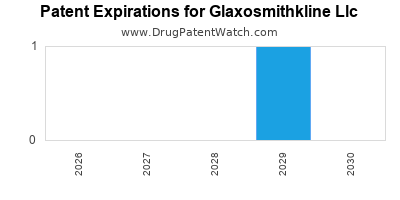
Drugs and US Patents for Glaxosmithkline Llc
| Applicant | Tradename | Generic Name | Dosage | NDA | Approval Date | TE | Type | RLD | RS | Patent No. | Patent Expiration | Product | Substance | Delist Req. | Exclusivity Expiration |
|---|---|---|---|---|---|---|---|---|---|---|---|---|---|---|---|
| Glaxosmithkline Llc | AMERGE | naratriptan hydrochloride | TABLET;ORAL | 020763-001 | Feb 10, 1998 | DISCN | Yes | No | ⤷ Start Trial | ⤷ Start Trial | |||||
| Glaxosmithkline Llc | FLOLAN | epoprostenol sodium | INJECTABLE;INJECTION | 020444-001 | Sep 20, 1995 | DISCN | Yes | No | ⤷ Start Trial | ⤷ Start Trial | |||||
| Glaxosmithkline Llc | LAMICTAL ODT | lamotrigine | TABLET, ORALLY DISINTEGRATING;ORAL | 022251-001 | May 8, 2009 | AB | RX | Yes | No | ⤷ Start Trial | ⤷ Start Trial | ||||
| Glaxosmithkline Llc | MEPRON | atovaquone | TABLET;ORAL | 020259-001 | Nov 25, 1992 | DISCN | Yes | No | ⤷ Start Trial | ⤷ Start Trial | |||||
| >Applicant | >Tradename | >Generic Name | >Dosage | >NDA | >Approval Date | >TE | >Type | >RLD | >RS | >Patent No. | >Patent Expiration | >Product | >Substance | >Delist Req. | >Exclusivity Expiration |
Expired US Patents for Glaxosmithkline Llc
| Applicant | Tradename | Generic Name | Dosage | NDA | Approval Date | Patent No. | Patent Expiration |
|---|---|---|---|---|---|---|---|
| Glaxosmithkline Llc | REQUIP | ropinirole hydrochloride | TABLET;ORAL | 020658-006 | Jan 27, 1999 | 4,452,808 | ⤷ Start Trial |
| Glaxosmithkline Llc | REQUIP | ropinirole hydrochloride | TABLET;ORAL | 020658-004 | Sep 19, 1997 | 4,824,860 | ⤷ Start Trial |
| Glaxosmithkline Llc | REQUIP XL | ropinirole hydrochloride | TABLET, EXTENDED RELEASE;ORAL | 022008-003 | Jun 13, 2008 | 8,303,986 | ⤷ Start Trial |
| Glaxosmithkline Llc | REQUIP XL | ropinirole hydrochloride | TABLET, EXTENDED RELEASE;ORAL | 022008-006 | Apr 10, 2009 | 5,422,123 | ⤷ Start Trial |
| >Applicant | >Tradename | >Generic Name | >Dosage | >NDA | >Approval Date | >Patent No. | >Patent Expiration |
Paragraph IV (Patent) Challenges for GLAXOSMITHKLINE LLC drugs
| Drugname | Dosage | Strength | Tradename | Submissiondate |
|---|---|---|---|---|
| ➤ Subscribe | Extended-release Tablets | 6 mg | ➤ Subscribe | 2009-07-22 |
| ➤ Subscribe | Orally Disintegrating Tablets | 25 mg, 50 mg, 100 mg, and 200 mg | ➤ Subscribe | 2009-12-21 |
| ➤ Subscribe | Tablets | 3 mg, 4 mg and 5 mg | ➤ Subscribe | 2005-02-04 |
| ➤ Subscribe | Extended-release Capsules | 325 mg | ➤ Subscribe | 2006-11-07 |
| ➤ Subscribe | Oral Suspension | 750 mg/5 mL | ➤ Subscribe | 2009-10-20 |
| ➤ Subscribe | Extended-release Tablets | 4 mg | ➤ Subscribe | 2008-10-31 |
| ➤ Subscribe | Extended-release Tablets | 3 mg | ➤ Subscribe | 2009-01-08 |
| ➤ Subscribe | Extended-release Tablets | 2 mg | ➤ Subscribe | 2008-10-14 |
| ➤ Subscribe | Extended-release Tablets | 3 mg | ➤ Subscribe | 2009-01-08 |
| ➤ Subscribe | Tablets | 0.25 mg, 0.5 mg, 1 mg and 2 mg | ➤ Subscribe | 2004-12-22 |
| ➤ Subscribe | Extended-release Capsules | 225 mg and 425 mg | ➤ Subscribe | 2006-10-11 |
| ➤ Subscribe | Extended-release Tablets | 25 mg, 50 mg, 100 mg, 200 mg, 250 mg, and 300 mg | ➤ Subscribe | 2014-02-12 |
| ➤ Subscribe | Extended-release Tablets | 8 mg | ➤ Subscribe | 2008-11-03 |
| ➤ Subscribe | Extended-release Tablets | 12 mg | ➤ Subscribe | 2009-02-05 |
International Patents for Glaxosmithkline Llc Drugs
| Country | Patent Number | Estimated Expiration |
|---|---|---|
| Norway | 20050948 | ⤷ Start Trial |
| China | 101229169 | ⤷ Start Trial |
| South Korea | 100882707 | ⤷ Start Trial |
| Russian Federation | 2007143372 | ⤷ Start Trial |
| >Country | >Patent Number | >Estimated Expiration |
Supplementary Protection Certificates for Glaxosmithkline Llc Drugs
| Patent Number | Supplementary Protection Certificate | SPC Country | SPC Expiration | SPC Description |
|---|---|---|---|---|
| 0123238 | SPC/GB95/004 | United Kingdom | ⤷ Start Trial | PRODUCT NAME: ATOVAQUONE OPTIONALLY IN THE FORM OF A PHYSIOLOGICALLY ACCEPTABLE SALT; REGISTERED: LU 0458/94/08/0741 19940803; UK 0003/0337 19940823 |
| 0502314 | C300095 | Netherlands | ⤷ Start Trial | PRODCUT NAME: TELMISARTAN, DESGEWENST IN DE VORM VAN EEN FYSIOLOGISCH VERDRAAGBAAR ZOUT, EN HYDROCHLOROTHIAZIDE; REGISTRATION NO/DATE: EU/1/02/213/001-010 20020419 |
| 0565634 | 06C0030 | France | ⤷ Start Trial | PRODUCT NAME: EPROSARTAN MESYLATE; HYDROCHLOROTHIAZIDE; NAT. REGISTRATION NO/DATE: NL 32075 20060623; FIRST REGISTRATION: LI - 55783 01 20020607 |
| 0299602 | 97C0036 | Belgium | ⤷ Start Trial | PRODUCT NAME: CHLORHYDRATE DE ROPINIROLE (=ROPINIROLE); NAT. REGISTRATION NO/DATE: 981 IS 120 F 3 19970414; FIRST REGISTRATION: GB PL 10592/0085 19960702 |
| >Patent Number | >Supplementary Protection Certificate | >SPC Country | >SPC Expiration | >SPC Description |
Similar Applicant Names
Applicants may be listed under multiple names.
Here is a list of applicants with similar names.
Here is a list of applicants with similar names.
