Last updated: June 16, 2026
Covis Group is a branded generics and specialty generics manufacturer with a scaled, multi-country portfolio concentrated in hard-to-source products, licensing-driven brand medicines, and high-complexity manufacturing. Its competitive position depends on (1) securing and sustaining supply contracts for key customers, (2) maintaining regulatory and quality execution across multiple manufacturing sites, and (3) defending product-level IP and market exclusivity where applicable through lifecycle extensions, distribution rights, and regulatory strategy.
How does Covis compete in branded generics and specialty generics markets?
Covis competes primarily on assortment breadth, manufacturing reliability, and customer conversion capacity. In most geographies, the company’s competitive set is less about a single “rival” and more about a pool of multinational generic and specialty-generic players that can deliver stable supply, meet regulatory expectations, and win tenders and long-term supply agreements.
What is Covis’s business model in competitive terms?
Covis typically wins by:
- Shipping regulated products into markets with tender economics, where incumbency and uninterrupted supply matter as much as price.
- Leveraging product sourcing and licensing deals to build portfolios faster than internal discovery pipelines.
- Scaling manufacturing for APIs/intermediates or finished dose forms with demonstrated compliance and batch consistency.
Who are Covis’s typical competitive peers?
Peer sets vary by dosage form and geography, but the recurring competitive pressure comes from:
- Large branded generics and specialty generic companies (portfolio breadth, tender power).
- Low-cost generic manufacturers (pricing pressure on mature segments).
- Niche sterile and complex injectables players (supply reliability and facility qualification).
What is Covis’s market position by geography and product type?
Covis is best characterized as a multi-market supplier rather than a single-asset niche operator. Market position tracks where it can combine regulatory approvals, manufacturing capacity, and commercial distribution reach.
How does Covis’s positioning differ across Europe, the US, and other regions?
Covis competes differently by region:
- In Europe, competition centers on tender participation, pharmacovigilance and quality record, and steady fulfillment.
- In the US, competitive outcomes hinge on FDA approval timelines, 505(b)(2) or ANDA pathways where applicable, and litigation outcomes tied to Orange Book-listed IP for reference products.
- In other markets, competition is often driven by import approvals, local distribution relationships, and ability to secure long-duration supply agreements.
What strengths support Covis’s competitive advantage?
Covis’s observable competitive strengths map to execution and defensibility at product level.
Which manufacturing and quality factors reduce supply-risk competition?
For specialty and complex generic portfolios, the differentiator is usually operational:
- Batch reliability and documentation quality to avoid regulatory disruptions.
- Ability to manage change controls and tech transfers without losing market access.
- Capacity planning for ramp-up at launch and consistent replenishment.
How do licensing and partnerships shape Covis’s defensibility?
Where portfolios include licensed medicines or brand-related rights, Covis can reduce pure commodity exposure by:
- Bringing forward launches through acquired dossiers or development programs.
- Securing distribution or commercialization rights that support pricing stability.
- Capturing lifecycle advantages that delay full generic erosion.
Does Covis have scale advantages in procurement and logistics?
Competitive outcomes in regulated generics often depend on procurement:
- API/intermediate sourcing resilience reduces downtime from supplier constraints.
- Logistics discipline matters in tender-heavy markets with service-level requirements.
How strong is Covis’s patent estate and IP defensibility?
For generic and specialty generic players, “patent strength” is rarely a single number. It is a product-by-product map of:
- Listed Orange Book patents for the reference drug.
- The scope of method-of-use versus composition-of-matter protections.
- The feasibility of “design-around” routes (different polymorph, salt, formulation, dosing regimen).
What patents protect Covis products in practice?
Covis competes against reference-product estates. For each product in its portfolio, the relevant IP protection typically includes:
- Composition or formulation patents covering active ingredient and specific excipients or dosage forms.
- Device or combination-product patents where applicable.
- Method-of-use claims tied to specific populations or dosing regimens.
- Process and impurity specifications where the manufacturing route can overlap with protected methods.
How does Covis approach lifecycle extension challenges?
In competitive terms, lifecycle extension works when Covis:
- Selects product versions with defensible regulatory pathways.
- Times launches after key exclusivity windows expire.
- Uses paragraph IV or other certification strategies only where design-around and litigation exposure are manageable.
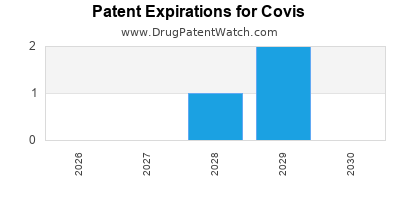
When does exclusivity expire for key Covis portfolio categories?
Exclusivity timing depends on each reference product and each US NDA/BLA. In competitive terms, launch windows matter because they determine:
- Whether Covis can launch at risk under paragraph IV.
- Whether it must wait for patent expiration or for exclusivity end dates.
- How quickly pricing erosion accelerates once multiple ANDA entries occur.
What drives launch timing in generic/specialty generics?
Key timing levers include:
- US patent expirations for Orange Book-listed patents.
- US regulatory exclusivities tied to the reference product (new chemical entity, new therapeutic biologic, orphan drug, pediatric, and other forms).
- Market exclusivity and exclusivity extensions from patent term adjustments and extensions.
What generic entry risks exist for Covis launches?
Entry risks arise from three sources: IP, regulatory, and supply.
What is the litigation and settlement risk profile?
The most material risk is a paragraph IV challenge or a patent dispute that delays FDA approval or imposes launch barriers via settlement terms. Competitive effects include:
- Indefinite or time-limited “stay” provisions on launch.
- Contractual launch date restrictions from settlements.
- Injunction risk tied to patent infringement theories.
What regulatory risks affect launch and continuity?
- Facility or process validation failures.
- Recalls or deviations that suspend distribution.
- Delays in labeling finalization tied to reference-product litigation or FDA correspondence.
What supply risks affect competitiveness?
- Insufficient capacity during ramp-up.
- Quality excursions that eliminate tender qualification.
- Input shortages, especially for sterile or controlled temperature products.
What formulations and delivery systems are most important to Covis’s competitive edge?
In specialty generics, the formulation and delivery system often determine whether the product is “substitutable” from a clinical standpoint and whether it can pass bioequivalence and stability requirements.
Which dosage forms tend to have higher competitive barriers?
Competitive barriers typically increase for:
- Sterile injectables and complex inhalation products.
- Controlled-release and extended-release formulations.
- Products with narrow therapeutic index requirements.
- Oncology supportive care where timing and availability can be critical.
How does formulation strategy affect competition?
Formulation affects competition by:
- Enabling differentiation that supports higher pricing versus pure generics.
- Improving stability and reducing variability that can trigger pharmacy returns or regulatory scrutiny.
- Reducing clinical switching resistance where equivalence is contested.
What patent litigation affects Covis and its competitors?
Patent litigation affects Covis indirectly through:
- The reference drugs that anchor its competitive product opportunities.
- The settlement terms and launch calendars for competing ANDAs.
- The rate at which markets switch from branded reference products to multiple generic entrants.
How do Covis competitors shape market entry timing?
Competitors can constrain Covis’s opportunity set through:
- Earlier ANDA approvals and faster market uptake.
- Litigation-driven launch delays imposed on follow-on entrants through stays or settlements.
- Design-around strategies that narrow the window for Covis’s targeted product variants.
What settlement structures are typical in this segment?
In the US, settlement terms often function as launch-delay mechanisms that can:
- Push entry beyond initial earliest-dated approval.
- Create “first-filer” or “agreed entry” calendars.
- Limit immediate competitive price erosion.
What is the Orange Book status of Covis products?
Orange Book status is product-specific and is determined by the reference drug’s listed patents and exclusivity. A rigorous analysis requires per-drug Orange Book mapping tied to each Covis NDA/ANDA or 505(b)(2) listing.
How does Orange Book status impact Covis’s strategy?
- If the Orange Book lists multiple patents, Covis’s ability to launch depends on claim scope and certification outcomes.
- If patents are method-of-use, Covis can sometimes change labeling strategy to reduce infringement exposure, subject to FDA labeling rules.
- If composition patents are broad, design-around feasibility becomes the critical determinant of litigation risk.
How does Covis compare with major generic and specialty generic competitors?
Covis’s comparison lens is portfolio shape and execution, not just revenue scale.
How does Covis’s portfolio composition affect its risk-reward profile?
- A higher share of complex specialty generics increases regulatory and manufacturing barrier, which can reduce pure pricing erosion.
- A higher share of tender-driven commodity generics increases margin volatility but improves volume stability when contracts refresh.
What does competitive advantage look like versus large diversified players?
Relative to diversified incumbents, Covis often competes more effectively where it can:
- Secure supply contracts that reward continuity.
- Win products with high complexity where smaller players struggle.
- Move fast on licensing or lifecycle extensions.
What does competitive advantage look like versus low-cost producers?
Versus low-cost producers, Covis tends to emphasize:
- Reliability and lower disruption risk.
- Compliance track record.
- Product selection where quality is a gating factor to tender qualification.
What commercial factors determine Covis’s growth and margin trajectory?
Commercial outcomes in regulated generics are driven by:
- Tender dynamics and customer concentration.
- Contract duration and indexation or pricing caps.
- Portfolio refresh rate and discontinuation risk.
Which revenue drivers typically matter most for Covis?
- New product launches under regulatory approval cycles.
- Replacement of discontinued products and supply gaps from competitors.
- Expansion into higher complexity dosage forms that command steadier pricing.
How does customer concentration affect competitiveness?
Where Covis supplies major distributors or health systems, negotiation power depends on:
- Alternative suppliers available for substitute SKUs.
- Quality and supply record.
- Lead times and ability to withstand surge demand.
Key takeaways
- Covis’s competitive position is built on supply reliability, multi-country regulatory execution, and a portfolio mix that includes specialty-generics characteristics.
- IP defensibility in this space is product-by-product and depends on Orange Book patent landscapes, exclusivity timelines, and the feasibility of design-around.
- Launch risk is driven by patent litigation and settlement calendars in the US, while Europe is more tender and continuity-driven.
- Competitive outcomes are shaped as much by manufacturing performance and regulatory stability as by pricing.
FAQs
- What launch calendar risks does a “first filer” environment create for Covis’s follow-on generics?
- How do paragraph IV certifications typically influence Covis’s earliest possible generic entry dates?
- What Orange Book patent categories (composition vs method-of-use) most constrain design-around strategies for specialty generics?
- How do FDA facility inspections and batch failures translate into lost tender eligibility for specialty generics suppliers?
- Which contract terms in European tendering most affect long-term margin stability for generic and specialty generic companies like Covis?
References
- FDA. “Orange Book: Approved Drug Products with Therapeutic Equivalence Evaluations.” US FDA.
- FDA. “ANDA Regulations and Guidance.” US FDA.
- FDA. “Drug Competition and Patent Term Restoration Act of 1984 (Hatch-Waxman).” US FDA.
- FDA. “Exclusivity.” US FDA.