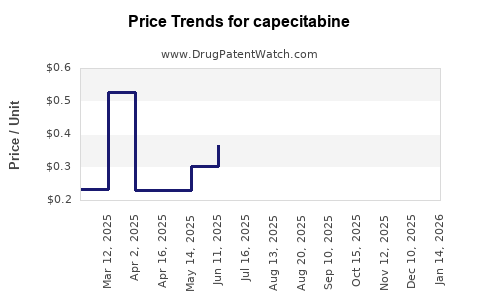
Last updated: August 11, 2026
Capecitabine is a mature oral fluoropyrimidine marketed originally as Xeloda by Roche. Its U.S. and major-market composition and formulation protection have expired or become commercially ineffective, leaving generic manufacturers to compete primarily on price, supply reliability, regulatory approvals, and oncology distribution. The financial profile has shifted from high-margin branded sales to fragmented, lower-priced generic volume.
What is the current market position of capecitabine?
Capecitabine is an oral prodrug of 5-fluorouracil, or 5-FU. It is used in colorectal, metastatic breast, and gastric or gastroesophageal cancers, depending on jurisdiction and labeling. The drug was approved by the FDA in 1998 and became a major alternative to some intravenous fluoropyrimidine regimens because it can be administered orally.[1]
The market has four defining characteristics:
- The originator brand has lost effective exclusivity.
- Generic capecitabine is widely available in the United States and international markets.
- Demand remains substantial because the drug is embedded in established oncology protocols.
- Price competition limits revenue growth even when prescription volume remains stable.
Capecitabine is not a biologic. Biosimilar competition does not apply. The relevant competitive threats are generic tablets, alternate oral fluoropyrimidines in selected markets, intravenous 5-FU, and newer combination regimens that displace chemotherapy use in specific tumor segments.
Capecitabine commercial profile
| Attribute |
Market status |
| Active ingredient |
Capecitabine |
| Original brand |
Xeloda |
| Originator |
Roche |
| Drug class |
Oral fluoropyrimidine antimetabolite |
| FDA approval |
1998 |
| Main dosage forms |
150 mg and 500 mg tablets in the U.S. label |
| Primary market |
Oncology |
| Exclusivity model |
Expired small-molecule patent and regulatory exclusivity |
| Current competition |
Multiple generic manufacturers |
| Biosimilar exposure |
None |
| Main commercial risk |
Price erosion and commoditization |
| Main demand support |
Continued use in colorectal, breast, and gastrointestinal cancer treatment |
When did capecitabine lose exclusivity?
Capecitabine lost meaningful U.S. market exclusivity during the early 2010s. The core Xeloda patent estate did not create a durable barrier after that period, and generic approvals followed through abbreviated new drug application, or ANDA, filings.
The original U.S. patent most closely associated with capecitabine was U.S. Patent No. 5,472,949. The patent covered capecitabine and related fluoropyrimidine compounds. Its effective term ended in the 2010s, with the commercial protection period affected by patent-term adjustments and pediatric exclusivity.[2]
Generic entry accelerated after FDA approval of ANDAs for capecitabine tablets. The FDA’s approval history lists multiple generic applicants and dosage strengths.[3]
Capecitabine exclusivity timeline
| Period |
Event |
Commercial effect |
| 1998 |
FDA approves Xeloda |
Roche establishes the branded U.S. market |
| Early 2000s |
Additional indications and clinical adoption |
Use expands in colorectal and breast cancer |
| 2010-2013 |
Core patent protection approaches expiration |
ANDA challenges and generic preparation increase |
| 2013 onward |
Generic approvals and launches |
Brand pricing power declines |
| Mid-to-late 2010s |
Broad generic availability |
Market shifts to price and supply competition |
| 2020s |
Mature generic market |
Revenue becomes volume-driven and fragmented |
The exact timing of generic commercial entry differed by manufacturer and jurisdiction. Patent settlements, certifications, regulatory review, and launch decisions affected individual products.
What patents protect capecitabine?
The principal patent value was concentrated in the composition-of-matter and pharmaceutical-use protection developed around capecitabine. That protection is no longer a meaningful barrier to standard generic capecitabine tablets in the United States.
Core patent categories
Composition patents
Composition patents protected capecitabine itself and related fluoropyrimidine compounds. The core U.S. patent commonly associated with the drug was U.S. Patent No. 5,472,949. Its commercial relevance has ended for ordinary capecitabine tablet competition.
Formulation patents
Formulation patents may cover tablet composition, excipients, coating systems, dissolution characteristics, or manufacturing processes. For a mature immediate-release tablet, these patents generally have lower strategic value than the active-ingredient patent because generic applicants can design around a particular excipient combination.
A formulation patent can still delay one applicant or create litigation costs. It normally does not preserve broad market exclusivity once multiple noninfringing formulations are available.
Method-of-use patents
Method-of-use patents may cover treatment of particular cancers, dosing schedules, combinations with other agents, or patient subgroups. Their practical value depends on:
- Whether the indication appears in the generic label
- Whether the indication is protected by a valid patent
- Whether physicians prescribe the product for the protected use
- Whether the generic applicant uses a skinny label
- Whether the patent is enforceable and commercially material
Capecitabine’s primary oncology indications are old and extensively disclosed. Later method-of-use patents may affect a narrow use but do not generally prevent broad generic competition for the underlying product.
What is the Orange Book status of capecitabine?
Capecitabine’s Orange Book position is consistent with a mature generic drug. The Orange Book identifies approved reference products, therapeutic-equivalence information, and listed patent or exclusivity data where applicable.[4]
The relevant commercial conclusion is that capecitabine does not have an unexpired composition patent that blocks ordinary generic tablet competition in the U.S. market. Any remaining listed patent issue must be evaluated patent by patent, including the specific dosage form, indication, expiration date, and certification position.
Generic capecitabine applicants typically rely on ANDA approval and may use Paragraph III or Paragraph IV certifications depending on the status of listed patents.
Which companies challenged capecitabine patents?
Capecitabine experienced the standard generic challenge pattern for a successful small-molecule oncology product. Generic companies filed ANDAs as patent expiry approached, and some applicants used Paragraph IV certifications to assert that listed patents were invalid, unenforceable, or not infringed.
Publicly identified generic suppliers have included major U.S., Indian, and international manufacturers. The supplier group has included companies such as Teva, Mylan or Viatris, Dr. Reddy’s Laboratories, Sun Pharmaceutical, Zydus, Cipla, and Hikma, although product availability and approved applicants vary by dosage strength and market.
A Paragraph IV filing does not itself establish generic launch. The commercial outcome depends on patent litigation, settlement terms, FDA approval, manufacturing readiness, and the applicant’s decision to launch.
What does Paragraph IV competition mean for capecitabine?
Paragraph IV competition mattered before broad patent expiry because the first successful challenger could obtain 180-day generic exclusivity under the Hatch-Waxman framework. Once several generic manufacturers entered, that advantage diminished rapidly.
For capecitabine, the current market question is no longer whether one challenger can unlock the market. It is whether a supplier can retain volume and margin in a crowded generic category.
How strong is the capecitabine patent estate?
The current patent estate is weak for the standard active ingredient and immediate-release tablet.
| Patent category |
Current barrier strength |
Commercial assessment |
| Core compound patent |
Low or expired |
Does not block standard generic entry |
| Basic tablet formulation |
Low |
Design-around risk is high |
| Narrow formulation claims |
Low to moderate |
May affect individual products |
| Method-of-use claims |
Low to moderate |
Depends on indication and label strategy |
| Manufacturing-process claims |
Low to moderate |
Can create supplier-specific risk |
| Combination-treatment claims |
Moderate in narrow use |
Does not protect the whole capecitabine market |
| Device or delivery-system claims |
Not central |
Capecitabine is primarily an oral tablet product |
Patent strength is therefore concentrated in narrow, product-specific claims rather than in a broad exclusionary estate. Any diligence should separate the active ingredient from later patents covering a particular regimen, formulation, or manufacturing step.
What are the main capecitabine market dynamics?
Oral administration supports persistent demand
Capecitabine allows patients to receive fluoropyrimidine treatment orally, although dosing requires adherence and monitoring. Its use can reduce infusion-related logistics in some treatment settings. This convenience supports continued demand even after patent expiry.
The drug is not a universal substitute for intravenous 5-FU. Treatment decisions depend on cancer type, regimen, renal function, toxicity, adherence, biomarker status, and physician preference.
Oncology protocols create recurring volume
Capecitabine is used in established regimens such as CAPOX or XELOX, which combines capecitabine with oxaliplatin. It is also used in breast and gastrointestinal cancer treatment. Protocol-based demand creates a relatively resilient volume base compared with drugs used only in short-term or discretionary settings.
Generic pricing has compressed revenue
After generic entry, the market typically experiences:
- Lower average selling prices
- Reduced brand share
- Greater use of hospital and specialty-pharmacy purchasing contracts
- More frequent supplier switching
- Increased buyer focus on backorders and allocation
- Lower gross margins for undifferentiated manufacturers
The high-volume, low-price structure favors manufacturers with efficient API sourcing, reliable tablet production, and established oncology distribution.
Supply reliability is a competitive differentiator
Capecitabine is an established product with several global suppliers, but oncology drug shortages can occur when manufacturing sites, active pharmaceutical ingredient suppliers, quality systems, or contract manufacturers face disruption.
Supply risk is higher when a company depends on one API site, one tableting facility, or a concentrated regional distribution network. FDA drug-shortage data and manufacturer notices are more informative than patent status for evaluating near-term product availability.[5]
What is capecitabine’s financial trajectory?
Roche’s financial trajectory for Xeloda followed the standard lifecycle of a blockbuster small-molecule oncology drug:
- Rapid sales growth after launch and label expansion.
- Mature branded revenue before patent expiry.
- Declining sales as generic competition emerged.
- Continued residual brand sales in selected channels and markets.
- Loss of strategic importance relative to Roche’s newer oncology portfolio.
Roche’s annual reports reported Xeloda as part of its established oncology portfolio, with sales declining as generic competition affected major markets.[6] The company’s financial exposure became progressively smaller relative to products such as Herceptin, Avastin, Perjeta, Kadcyla, Tecentriq, and newer targeted therapies.
Financial lifecycle
| Lifecycle phase |
Revenue pattern |
Margin profile |
| Launch and indication expansion |
Fast growth |
High |
| Mature brand |
Stable or moderate growth |
High |
| Pre-generic period |
Volume stable, pricing strong |
High |
| Initial generic entry |
Rapid brand decline |
Compressing |
| Mature generic phase |
Market volume persists |
Low to moderate |
| Current market |
Fragmented revenue by supplier |
Commodity-like |
Exact global market-size estimates vary materially by dataset because analysts may count only active pharmaceutical ingredient sales, finished-dose sales, hospital procurement, retail prescriptions, or all formulations. Public company reports do not provide a single consolidated global capecitabine market figure.
The more reliable financial conclusion is directional: branded Xeloda revenue declined after loss of exclusivity, while aggregate capecitabine treatment volume remained supported by oncology demand. Revenue migrated from Roche to a group of generic manufacturers, wholesalers, hospitals, and specialty pharmacies.
What generic entry risks exist for capecitabine?
Price erosion
The largest risk is continued price compression. Additional ANDA approvals can reduce the price available to all suppliers, especially for high-volume 500 mg tablets.
Customer concentration
Manufacturers that rely heavily on large group purchasing organizations, hospital systems, or government tenders may face abrupt price resets when contracts renew.
API dependence
Active pharmaceutical ingredient sourcing from a limited number of facilities can create supply and regulatory exposure. A supplier with redundant qualified sources has a stronger commercial position.
Regulatory compliance
FDA warning letters, import alerts, manufacturing observations, product recalls, or data-integrity findings can remove a supplier from the market even when patent risk is minimal.
Therapeutic substitution
Capecitabine can lose volume when oncologists shift toward targeted therapies, immunotherapy, antibody-drug conjugates, or intravenous regimens. This risk is indication-specific and depends on clinical guidelines and payer coverage.
What litigation and settlement issues affect capecitabine?
The main historical litigation involved ANDA applicants and patents associated with Xeloda. These disputes were relevant during the transition from branded exclusivity to generic entry. They had less significance after the core patents expired and multiple generic suppliers received approval.
For current diligence, the highest-value legal checks are:
- Active district-court or Federal Circuit cases involving a specific manufacturer
- Orange Book-listed patents for the specific reference product
- Patent-term adjustment or pediatric-extension calculations
- Paragraph IV settlement restrictions
- Product-specific formulation or process claims
- Antitrust exposure arising from delayed entry or supply agreements
No biosimilar litigation pathway applies because capecitabine is a chemically synthesized small molecule. Current legal risk is more likely to arise from manufacturing, labeling, product liability, quality, or procurement disputes than from broad compound exclusivity.
How does capecitabine compare with 5-FU and competing fluoropyrimidines?
| Factor |
Capecitabine |
Intravenous 5-FU |
Tegafur-based products |
| Administration |
Oral tablets |
Infusion or injection |
Usually oral, jurisdiction-dependent |
| Patent position |
Mature generic |
Mature generic |
Varies by product |
| Main advantage |
Convenience and outpatient use |
Established control and flexibility |
Market-specific alternative |
| Main limitation |
Adherence, hand-foot syndrome, renal dosing |
Infusion burden and administration logistics |
Availability and clinical adoption |
| Pricing |
Generic and compressed |
Generic and compressed |
Varies |
| Competitive threat |
Protocol substitution and newer therapies |
Oral regimen substitution |
Regional formulary competition |
Capecitabine’s commercial position is stronger where oral administration and established protocols matter. Its position is weaker where intravenous control, combination flexibility, or newer targeted treatment has clinical or reimbursement advantages.
What licensing deals affect capecitabine?
Capecitabine’s original commercial development and global marketing were associated with Roche and its regional affiliates. The product does not have the licensing economics of a recently launched specialty drug with a large royalty-bearing platform.
Current commercial arrangements are more likely to involve:
- Generic marketing authorizations
- Contract manufacturing
- API supply agreements
- Regional distribution licenses
- Hospital procurement contracts
- Co-marketing arrangements
The value of new licensing transactions is constrained by generic pricing. A regional license can still be attractive where a company has regulatory access, oncology sales infrastructure, or reliable supply, but the economics are generally based on volume and manufacturing efficiency rather than exclusivity.
What is the outlook for capecitabine revenue?
Capecitabine revenue should remain stable to modestly declining in aggregate nominal terms, with substantial variation by country and supplier.
The expected trajectory is:
- Continued demand from colorectal and breast cancer treatment
- Stable use in selected gastrointestinal cancer protocols
- Further price erosion in competitive markets
- Low likelihood of meaningful branded revenue recovery
- Periodic supply-driven price increases during shortages
- Ongoing displacement in selected indications by newer therapies
The strongest generic manufacturers will be those with low cost of goods, multiple qualified sites, strong regulatory records, and dependable delivery to oncology channels. Patent ownership is no longer the principal source of value.
Key Takeaways
- Capecitabine is a mature oral fluoropyrimidine with FDA approval dating to 1998.
- Roche’s Xeloda lost meaningful market exclusivity during the early 2010s.
- U.S. Patent No. 5,472,949 is the core historical compound patent associated with capecitabine.
- Generic competition now determines pricing, volume share, and supplier profitability.
- Biosimilar risk does not apply because capecitabine is a small-molecule drug.
- Formulation, method-of-use, and manufacturing patents may affect individual products but do not broadly protect the market.
- Roche’s Xeloda revenue declined as generic products entered, while underlying treatment demand persisted.
- Current commercial value is concentrated in manufacturing efficiency, API security, regulatory compliance, and oncology distribution.
- The principal risks are price erosion, supply disruption, quality actions, and therapeutic substitution by newer cancer treatments.
FAQs
Is capecitabine still protected by patents?
The broad compound protection associated with capecitabine has expired or no longer blocks standard generic tablet entry in the United States. Narrow formulation, method-of-use, or manufacturing patents must be reviewed separately.
Can a generic manufacturer launch capecitabine without a Paragraph IV challenge?
Yes. An ANDA applicant can rely on a Paragraph III certification after relevant patent expiry, or use another legally available certification strategy. Paragraph IV is not required when no blocking unexpired patent applies to the proposed product.
Does capecitabine have pediatric exclusivity?
Any pediatric exclusivity associated with historical listed patents must be determined from the applicable Orange Book records and patent-term calculations. It does not restore broad market exclusivity after generic entry.
Which capecitabine strength is most commercially important?
The 500 mg tablet is generally the principal commercial strength because it is used extensively in adult oncology dosing. Actual volume differs by regimen, country, pack size, and dose adjustment requirements.
Can capecitabine become commercially attractive during a shortage?
Yes. A shortage can temporarily improve pricing and supplier margins, but the opportunity is operational rather than patent-based. It depends on FDA approval, available inventory, qualified manufacturing capacity, and the ability to meet oncology-channel demand.
References
-
U.S. Food and Drug Administration. (1998). Xeloda (capecitabine) approval history and prescribing information. https://www.accessdata.fda.gov/drugsatfda_docs/label/
-
United States Patent and Trademark Office. (1995). U.S. Patent No. 5,472,949, fluoropyrimidine carbamates. https://patents.google.com/patent/US5472949
-
U.S. Food and Drug Administration. (n.d.). Drugs@FDA: FDA-approved drugs, capecitabine ANDA approval history. https://www.accessdata.fda.gov/scripts/cder/daf/
-
U.S. Food and Drug Administration. (n.d.). Approved drug products with therapeutic equivalence evaluations, Orange Book. https://www.fda.gov/drugs/drug-approvals-and-databases/approved-drug-products-therapeutic-equivalence-evaluations-orange-book
-
U.S. Food and Drug Administration. (n.d.). Drug shortages database. https://www.accessdata.fda.gov/scripts/drugshortages/
-
Roche Holding AG. (2013-2019). Annual reports and financial statements. https://www.roche.com/investors/reports.htm