Last updated: November 11, 2026
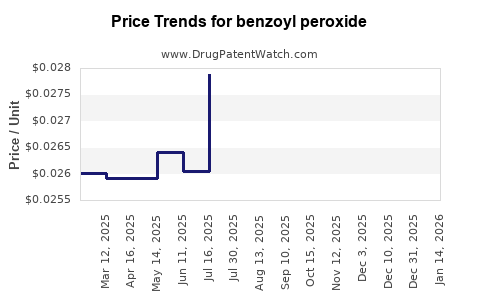
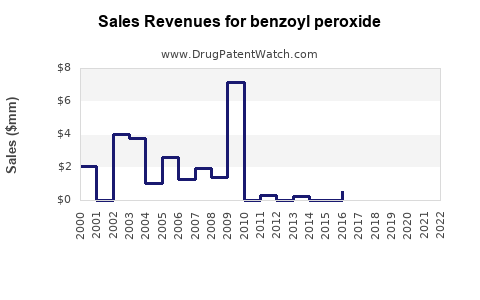
Benzoyl peroxide is a mature, low-cost acne active with broad U.S. OTC availability, limited standalone patent protection, and strong competition from private-label and branded products. Its financial trajectory is driven by volume, retail distribution, combination products, and premium formulations rather than exclusivity or high pricing. Drug-level revenue is generally not reported separately because benzoyl peroxide is sold across thousands of OTC products and is used in prescription combinations.
What is the current market position of benzoyl peroxide?
Benzoyl peroxide is one of the principal topical acne actives recognized by the FDA for OTC use. Products commonly contain 2.5%, 5%, or 10% concentrations and are sold as washes, gels, creams, lotions, foams, and spot treatments.[1]
The market has four major commercial tiers:
| Segment |
Typical products |
Commercial profile |
| Mass-market OTC |
Acne washes, gels, spot treatments |
High volume, low price, retailer-driven |
| Branded OTC |
PanOxyl, Neutrogena, CeraVe, Clean & Clear |
Premium pricing based on brand and formulation |
| Prescription combinations |
Adapalene/BPO, clindamycin/BPO, tretinoin/BPO |
Higher reimbursement and pricing, but greater substitution risk |
| Dermatology and specialty formulations |
Lower-irritation vehicles, foams, controlled-release products |
Smaller volume and higher margin |
Benzoyl peroxide has a durable position because it is inexpensive, familiar to clinicians, and effective against acne-associated bacteria. It is also used with topical retinoids and antibiotics, where it can reduce the risk of antibiotic resistance associated with topical antibiotic treatment.
The active ingredient has low switching costs. Consumers can move between brands, concentrations, delivery forms, and retailers without changing the underlying therapy. This makes distribution, packaging, tolerability, and consumer marketing more important than molecule-level differentiation.
How does benzoyl peroxide generate revenue?
Benzoyl peroxide revenue is generated through product-level sales rather than a centralized branded franchise. Manufacturers and brand owners typically earn revenue from:
- OTC acne washes and leave-on products.
- Prescription combination products.
- Private-label and store-brand products.
- Contract manufacturing and licensing arrangements.
- Premium delivery systems, including foams, microsphere gels, and lower-irritation vehicles.
- International products subject to local regulatory classifications.
Public companies generally do not disclose benzoyl peroxide revenue as a separate line item. Financial reports typically aggregate it within skin care, consumer health, dermatology, or over-the-counter portfolios. This prevents a reliable standalone revenue estimate for the active ingredient.
The economic structure is therefore different from that of a patented prescription medicine. There is no single originator company collecting royalties across the market. Value accrues to the companies that control brands, retail placement, physician promotion, formulation technology, and manufacturing scale.
What is the financial trajectory for benzoyl peroxide?
The financial trajectory is mature and volume-oriented.
Near-term trajectory
Near-term growth is likely to come from:
- Increased use of OTC acne treatment.
- Expansion of facial skin-care routines into acne-prevention products.
- Growth in e-commerce and direct-to-consumer sales.
- Premiumization of low-irritation and dermatologist-positioned formulations.
- Continued use in combination products.
- Private-label expansion by pharmacy, grocery, and mass retailers.
Price competition limits revenue growth for basic benzoyl peroxide products. A standard 5% wash has few defensible barriers against a lower-priced competitor. Branded products can maintain higher prices through packaging, consumer recognition, clinical positioning, and retailer relationships, but the active itself does not support substantial pricing power.
Medium-term trajectory
Over the medium term, the category should remain stable rather than experience pharmaceutical-style growth. Benzoyl peroxide is unlikely to produce a sharp revenue increase through patent-driven price expansion because the core active is long established and broadly substitutable.
Growth is more likely in differentiated formats:
| Product characteristic |
Financial effect |
| 2.5% formulation with comparable efficacy and lower irritation |
Supports premium positioning |
| Cream or lotion vehicle |
Expands use among sensitive-skin consumers |
| Foaming wash |
Increases convenience and consumer appeal |
| Combination with adapalene or tretinoin |
Raises product value but faces generic competition |
| Dermatologist recommendation |
Improves conversion and repeat use |
| Private-label presentation |
Increases volume but compresses margins |
Long-term trajectory
Long-term revenue will depend on whether manufacturers create meaningful differentiation around tolerability, adherence, delivery systems, or combination therapy. The active ingredient itself is unlikely to become a high-growth pharmaceutical asset.
A manufacturer with a low-cost supply chain can maintain attractive operating economics even at low prices. The principal financial risks are commodity competition, retailer bargaining power, product recalls, manufacturing disruption, and consumer migration to non-benzoyl peroxide acne products such as salicylic acid, retinoids, azelaic acid, and newer dermatology products.
What is the FDA regulatory status of benzoyl peroxide?
Benzoyl peroxide is an FDA-recognized OTC acne active under the FDA acne drug monograph framework. The FDA permits benzoyl peroxide in concentrations of 2.5% to 10% for topical acne products when the product meets applicable monograph conditions, labeling, and manufacturing requirements.[1][2]
The current U.S. regulatory structure includes:
| Regulatory issue |
Status |
| OTC acne active |
Recognized under FDA OTC acne regulations |
| Common concentrations |
2.5%, 5%, and 10% |
| Dosage forms |
Washes, gels, creams, lotions, foams, and related topical forms |
| Prescription use |
Used alone and in combinations |
| FDA approval required for monograph-compliant OTC products |
Generally no individual NDA required |
| Drug Facts labeling |
Required for covered OTC products |
| Pediatric and pregnancy considerations |
Product-specific labeling and clinical assessment apply |
The FDA’s OTC monograph system reduces regulatory barriers for compliant products. A manufacturer does not need to establish a new molecular entity or obtain exclusivity for a standard monograph product. It must comply with the applicable conditions, including active ingredient concentration, indications, warnings, directions, labeling, and quality requirements.
Prescription combination products remain subject to individual approval and may have separate labeling and patent positions.
What patents protect benzoyl peroxide products?
No active foundational patent broadly controls ordinary benzoyl peroxide use in acne treatment. The core molecule and basic therapeutic use are long established, leaving the principal commercial opportunities in formulation and delivery technology.
Potentially relevant patent categories include:
- Combination compositions with retinoids or antibiotics.
- Stabilized formulations.
- Controlled-release or encapsulated benzoyl peroxide.
- Low-irritation vehicles.
- Foams, emulsions, and specialized topical carriers.
- Packaging systems that improve stability or dosing.
- Methods for treating specific acne populations.
- Manufacturing processes and particle-size control.
Patent protection is product-specific. A patent covering a branded combination product does not automatically prevent sale of a conventional benzoyl peroxide wash. Conversely, a formulation patent may restrict a close substitute even when the active ingredient is unprotected.
Are benzoyl peroxide patents still enforceable?
Some later-filed formulation and combination patents may remain enforceable, but basic benzoyl peroxide acne products generally face no meaningful composition-of-matter barrier. The relevant question is whether a particular product practices claims directed to a formulation, delivery system, combination, or manufacturing process.
Patent strength is usually moderate to weak for ordinary OTC products and stronger for narrowly defined delivery systems. Narrow claims can be vulnerable to design-around strategies because manufacturers can change the vehicle, concentration, particle characteristics, packaging, or combination partner.
What is the Orange Book status of benzoyl peroxide?
Standalone OTC benzoyl peroxide products are generally not treated like conventional NDA products in the Orange Book. Orange Book relevance is greater for approved prescription combinations and branded prescription formulations containing benzoyl peroxide.
Examples of prescription product categories include:
- Adapalene and benzoyl peroxide.
- Clindamycin phosphate and benzoyl peroxide.
- Tretinoin and benzoyl peroxide.
For these products, Orange Book-listed patents may support Paragraph IV challenges and patent litigation. The patent position must be reviewed at the specific product level because the active ingredient may be generic while the combination formulation remains protected.
When does benzoyl peroxide lose exclusivity?
Benzoyl peroxide has already lost practical molecule-level exclusivity. Standard OTC products can be marketed by multiple manufacturers under the FDA monograph framework, subject to compliance with regulatory conditions.
There is no single future “loss of exclusivity” date for benzoyl peroxide as an active ingredient. Exclusivity questions arise only for:
- A specific prescription combination.
- A branded formulation.
- A new delivery system.
- A patented manufacturing process.
- A drug-device presentation.
- A product with regulatory exclusivity independent of the active ingredient.
For ordinary OTC benzoyl peroxide, market entry is controlled by regulatory compliance, manufacturing capacity, retailer access, and brand positioning rather than patent expiration.
How do Paragraph IV challenges affect benzoyl peroxide products?
Paragraph IV litigation is relevant primarily to prescription benzoyl peroxide combination products approved under an NDA. An ANDA applicant may certify that listed patents are invalid, unenforceable, or will not be infringed. The NDA holder can then bring an infringement action, potentially triggering a 30-month stay under the Hatch-Waxman framework.[3][4]
Standalone monograph-compliant OTC benzoyl peroxide products generally do not present the same Paragraph IV pathway because the market does not depend on a single branded NDA with listed patents.
The principal generic-entry risks for prescription combinations are:
- Formulation patents.
- Combination patents.
- Method-of-use patents.
- Orange Book-listed patents covering dosing or administration.
- Regulatory exclusivity attached to a recently approved product.
- Commercial complexity caused by separate generic approval requirements for each combination.
A Paragraph IV challenge can affect the prescription segment without materially changing the broader OTC benzoyl peroxide market.
What formulation patents protect benzoyl peroxide?
Formulation patents are the main potential source of commercial differentiation.
Stabilization patents
Benzoyl peroxide can degrade under unsuitable conditions. Patents may claim stabilizers, pH control, solvents, emulsions, particle characteristics, packaging, or storage conditions that improve product stability.
Delivery-system patents
Manufacturers may seek protection for:
- Microsphere formulations.
- Encapsulated benzoyl peroxide.
- Controlled-release carriers.
- Water-based gels.
- Foaming systems.
- Oil-in-water emulsions.
- Low-irritation topical vehicles.
Combination patents
Combination products can claim benzoyl peroxide with adapalene, tretinoin, clindamycin, or other acne actives. These patents may protect a specific ratio, formulation, dosing schedule, or treatment method rather than benzoyl peroxide generally.
Formulation patents can support premium pricing, but their commercial value depends on whether the product demonstrates better tolerability or adherence. A technically distinct product without a visible consumer benefit may not justify a sustained price premium.
Which companies compete in the benzoyl peroxide market?
Competition spans consumer health, dermatology, specialty generics, and contract manufacturing.
| Company or brand group |
Competitive position |
| Crown Laboratories / PanOxyl |
Strong OTC acne positioning and high-concentration benzoyl peroxide products |
| Kenvue / Neutrogena and Clean & Clear |
Broad consumer distribution and established skin-care brands |
| L'Oréal / CeraVe and La Roche-Posay |
Dermatologist-oriented positioning and premium skin-care distribution |
| Galderma / Differin portfolio |
Acne expertise and prescription-to-OTC brand recognition |
| Generic manufacturers |
Low-cost supply and pharmacy-channel competition |
| Retail private labels |
Price pressure and retailer control |
| Prescription dermatology companies |
Combination products and physician-directed treatment |
Competitive intensity is high because the product is easy to understand and consumers can compare products by concentration, price, and brand. Manufacturing quality and stability remain important, but they are not usually visible to consumers unless a product develops discoloration, odor, irritation, or performance problems.
What patent litigation and settlement risks affect benzoyl peroxide?
Patent litigation risk is concentrated in prescription combinations and proprietary formulations. Ordinary OTC benzoyl peroxide products have limited exposure to molecule-level patent claims.
Potential disputes may involve:
- Infringement of formulation claims.
- Orange Book-listed patents.
- Generic substitution of prescription combinations.
- Trade dress and trademark rights.
- Advertising claims concerning efficacy or irritation.
- Product quality, contamination, or stability.
- Contract manufacturing and supply agreements.
Settlement agreements are most commercially relevant when a generic manufacturer challenges a prescription combination product. A settlement can establish an agreed launch date, license terms, or restrictions on the generic product. Such agreements do not ordinarily affect the broader monograph OTC market.
Does benzoyl peroxide have biosimilar risk?
No. Biosimilar risk does not apply because benzoyl peroxide is a small-molecule chemical active, not a biologic. The relevant competition comes from generic drugs, OTC monograph products, private labels, and alternative acne therapies.
What manufacturing and geographic barriers affect benzoyl peroxide?
Manufacturing barriers are operational rather than patent-based. Producers must manage:
- Active-ingredient sourcing.
- Oxidizing-agent handling and safety controls.
- Stability and degradation.
- Formulation uniformity.
- Packaging compatibility.
- Temperature and storage conditions.
- Quality-control testing.
- Cross-border regulatory classification.
Geographic coverage varies by jurisdiction. In the United States, benzoyl peroxide has a well-established OTC pathway. Other markets may classify products as cosmetics, nonprescription medicines, pharmacy medicines, or prescription products depending on concentration, indication, and claims.
International manufacturers must also address local labeling, import controls, product registration, pharmacovigilance, and permitted concentrations. A U.S. monograph position does not automatically establish market access elsewhere.
How strong is the benzoyl peroxide patent estate?
The patent estate is weak for standard benzoyl peroxide products and potentially stronger for narrow proprietary formulations.
| Patent category |
Relative strength |
| Benzoyl peroxide composition of matter |
Very weak or exhausted |
| Basic acne treatment use |
Very weak or exhausted |
| Standard OTC wash or gel |
Weak |
| Prescription combination |
Moderate, product-specific |
| Stabilized or controlled-release formulation |
Moderate to potentially strong |
| Packaging and manufacturing process |
Narrow and design-around risk |
| Brand and trade dress |
Potentially meaningful, but not patent exclusivity |
Commercial defensibility is therefore based more on brand, retail placement, product performance, manufacturing scale, and customer loyalty than on the active ingredient.
Key Takeaways
- Benzoyl peroxide is a mature OTC acne active with no meaningful molecule-level exclusivity.
- The U.S. market is governed primarily by FDA OTC monograph requirements for standard products.
- Drug-level revenue is not separately reported because benzoyl peroxide is distributed across many brands and formulations.
- Financial growth is likely to come from volume, premium vehicles, combination products, and e-commerce.
- Private-label and generic competition limit pricing power.
- Prescription combinations may have Orange Book patents and Paragraph IV litigation risk.
- Formulation, stabilization, delivery-system, and packaging patents are the main remaining IP opportunities.
- Biosimilar risk does not apply.
- Manufacturing, quality, stability, retailer access, and brand recognition are more important than basic composition patents.
- The strongest commercial positions are likely to remain with companies that combine benzoyl peroxide with dermatologist credibility, differentiated vehicles, or large-scale consumer distribution.
FAQs
Is benzoyl peroxide a generic drug?
Benzoyl peroxide is a long-established active ingredient used in generic prescription products and FDA-compliant OTC monograph products. Individual branded products may still have proprietary formulations or combination claims.
Can a company patent a new benzoyl peroxide product?
Yes. A company may patent a new formulation, delivery system, stabilized composition, combination, manufacturing process, or treatment method. It generally cannot obtain meaningful new exclusivity over the basic use of benzoyl peroxide for acne.
Is benzoyl peroxide more commercially valuable than salicylic acid?
The answer depends on the product segment. Benzoyl peroxide has strong clinical recognition for inflammatory acne and antibacterial activity, while salicylic acid has broad appeal in cleansing and exfoliation products. Neither active generally provides substantial molecule-level pricing power.
Are benzoyl peroxide washes covered by insurance?
Most OTC benzoyl peroxide washes are purchased directly by consumers and are not reimbursed. Prescription combination products may be reimbursed subject to formulary, prior authorization, and generic substitution rules.
What is the main investment risk in benzoyl peroxide products?
The main risks are commoditization, retailer price pressure, weak brand differentiation, formulation tolerability problems, quality failures, and substitution by retinoids or other acne therapies. Patent expiration is usually not the central risk because standard benzoyl peroxide products are already broadly genericized.
References
- U.S. Food and Drug Administration. (2021). Acne drug products for over-the-counter human use: Final administrative order OTC000006. https://www.fda.gov
- Electronic Code of Federal Regulations. (2024). 21 C.F.R. Part 333, Subpart D: Acne drug products for over-the-counter human use. https://www.ecfr.gov
- U.S. Food and Drug Administration. (2023). Approved drug products with therapeutic equivalence evaluations. https://www.fda.gov
- U.S. Code. (2024). 21 U.S.C. § 355: New drugs. https://uscode.house.gov
- U.S. Food and Drug Administration. (2024). Over-the-counter drug review and monograph reform. https://www.fda.gov
- National Library of Medicine. (2024). DailyMed: Benzoyl peroxide drug labels. https://dailymed.nlm.nih.gov