Last Updated: May 10, 2026

TWYNEO Drug Patent Profile


✉ Email this page to a colleague

« Back to Dashboard


Which patents cover Twyneo, and what generic alternatives are available?

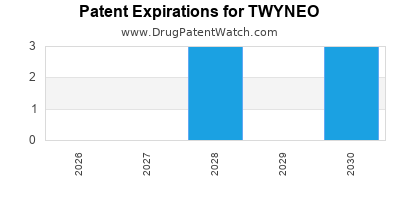
Twyneo is a drug marketed by Mayne Pharma and is included in one NDA. There are thirteen patents protecting this drug.

This drug has one hundred and eight patent family members in nineteen countries.

The generic ingredient in TWYNEO is benzoyl peroxide; tretinoin. There are seventeen drug master file entries for this compound. Two suppliers are listed for this compound. Additional details are available on the benzoyl peroxide; tretinoin profile page.

DrugPatentWatch® Generic Entry Outlook for Twyneo

By analyzing the patents and regulatory protections it appears that the earliest date for generic entry will be June 29, 2032. This may change due to patent challenges or generic licensing.

Indicators of Generic Entry

< Available with Subscription >

  Start Trial

AI Deep Research
Questions you can ask:
  • What is the 5 year forecast for TWYNEO?
  • What are the global sales for TWYNEO?
  • What is Average Wholesale Price for TWYNEO?
Summary for TWYNEO
International Patents:108
US Patents:13
Applicants:1
NDAs:1
Finished Product Suppliers / Packagers: 2
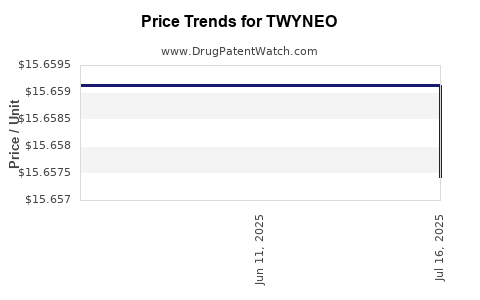
Drug Prices: Drug price information for TWYNEO
What excipients (inactive ingredients) are in TWYNEO?TWYNEO excipients list
DailyMed Link:TWYNEO at DailyMed
DrugPatentWatch® Estimated Loss of Exclusivity (LOE) Date for TWYNEO
Generic Entry Date for TWYNEO*:
Constraining patent/regulatory exclusivity:
NDA:
Dosage:
CREAM;TOPICAL

*The generic entry opportunity date is the latter of the last compound-claiming patent and the last regulatory exclusivity protection. Many factors can influence early or later generic entry. This date is provided as a rough estimate of generic entry potential and should not be used as an independent source.

Pharmacology for TWYNEO
Drug ClassRetinoid

US Patents and Regulatory Information for TWYNEO

TWYNEO is protected by thirteen US patents.

Based on analysis by DrugPatentWatch, the earliest date for a generic version of TWYNEO is ⤷  Start Trial.

This potential generic entry date is based on patent 12,053,546.

Generics may enter earlier, or later, based on new patent filings, patent extensions, patent invalidation, early generic licensing, generic entry preferences, and other factors.

Applicant Tradename Generic Name Dosage NDA Approval Date TE Type RLD RS Patent No. Patent Expiration Product Substance Delist Req. Exclusivity Expiration
Mayne Pharma TWYNEO benzoyl peroxide; tretinoin CREAM;TOPICAL 214902-001 Jul 26, 2021 RX Yes Yes 12,295,935 ⤷  Start Trial ⤷  Start Trial
Mayne Pharma TWYNEO benzoyl peroxide; tretinoin CREAM;TOPICAL 214902-001 Jul 26, 2021 RX Yes Yes 10,653,899 ⤷  Start Trial Y ⤷  Start Trial
Mayne Pharma TWYNEO benzoyl peroxide; tretinoin CREAM;TOPICAL 214902-001 Jul 26, 2021 RX Yes Yes 12,491,163 ⤷  Start Trial Y ⤷  Start Trial
Mayne Pharma TWYNEO benzoyl peroxide; tretinoin CREAM;TOPICAL 214902-001 Jul 26, 2021 RX Yes Yes 11,071,878 ⤷  Start Trial Y ⤷  Start Trial
Mayne Pharma TWYNEO benzoyl peroxide; tretinoin CREAM;TOPICAL 214902-001 Jul 26, 2021 RX Yes Yes 12,070,629 ⤷  Start Trial Y ⤷  Start Trial
>Applicant >Tradename >Generic Name >Dosage >NDA >Approval Date >TE >Type >RLD >RS >Patent No. >Patent Expiration >Product >Substance >Delist Req. >Exclusivity Expiration

International Patents for TWYNEO

When does loss-of-exclusivity occur for TWYNEO?

Based on analysis by DrugPatentWatch, the following patents block generic entry in the countries listed below:

Australia

Patent: 12277322
Estimated Expiration: ⤷  Start Trial

Brazil

Patent: 2013031813
Estimated Expiration: ⤷  Start Trial

Canada

Patent: 34681
Estimated Expiration: ⤷  Start Trial

China

Patent: 3732217
Estimated Expiration: ⤷  Start Trial

Patent: 7625743
Estimated Expiration: ⤷  Start Trial

Eurasian Patent Organization

Patent: 1490178
Estimated Expiration: ⤷  Start Trial

European Patent Office

Patent: 26067
Estimated Expiration: ⤷  Start Trial

Patent: 98778
Estimated Expiration: ⤷  Start Trial

Japan

Patent: 33859
Estimated Expiration: ⤷  Start Trial

Patent: 14518259
Estimated Expiration: ⤷  Start Trial

Mexico

Patent: 3379
Estimated Expiration: ⤷  Start Trial

Patent: 13013722
Estimated Expiration: ⤷  Start Trial

South Korea

Patent: 140043397
Estimated Expiration: ⤷  Start Trial

Spain

Patent: 86103
Estimated Expiration: ⤷  Start Trial

Patent: 02498
Estimated Expiration: ⤷  Start Trial

Generics may enter earlier, or later, based on new patent filings, patent extensions, patent invalidation, early generic licensing, generic entry preferences, and other factors.

See the table below for additional patents covering TWYNEO around the world.

Country Patent Number Title Estimated Expiration
Croatia P20251185 ⤷  Start Trial
Japan 2013213063 COMPOSITION FOR TOPICAL APPLICATION COMPRISING PEROXIDE AND RETINOID ⤷  Start Trial
Mexico 2013013722 ⤷  Start Trial
Canada 2773544 MICROCAPSULES A NOYAU STABILISE, PROCEDE DE LEUR PREPARATION ET UTILISATIONS DE CELLES-CI (CORE STABILIZED MICROCAPSULES, METHOD OF THEIR PREPARATION AND USES THEREOF) ⤷  Start Trial
South Korea 20090125243 COMPOSITIONS FOR TOPICAL APPLICATION COMPRISING A PEROXIDE AND RETINOID ⤷  Start Trial
>Country >Patent Number >Title >Estimated Expiration

Supplementary Protection Certificates for TWYNEO

Patent Number Supplementary Protection Certificate SPC Country SPC Expiration SPC Description
0591275 SPC/GB05/030 United Kingdom ⤷  Start Trial PRODUCT NAME: NITISINONE (2-(2-NITRO-4-TRIFLUOROMETHYLBENZOYL)-1,3-CYCLOHEXANEDIONE) OR A PHARMACEUTICALLY ACCEPTABLE SALT THEREOF; REGISTERED: UK EU/1/04/303/001 20050221; UK EU/1/04/303/002 20050221; UK EU/1/04/303/003 20050221
1458369 CA 2008 00029 Denmark ⤷  Start Trial PRODUCT NAME: ADAPALEN, BENZOYLPEROXID
0186118 SPC/GB05/029 United Kingdom ⤷  Start Trial PRODUCT NAME: MESOTRIONE (2-(4-METHYLSULPHONYL-2-NITROBENZOYL)-1,3CYCLOHEXANEDIONE); REGISTERED: AU 2726 20001016; UK 0309 OF 2005 20050218
1458369 C01458369/01 Switzerland ⤷  Start Trial PRODUCT NAME: ADAPALENUM + BENZOYLIS PEROXIDUM; REGISTRATION NUMBER/DATE: SWISSMEDIC 58460 19.05.2009
0526708 C300097 Netherlands ⤷  Start Trial PRODUCT NAME: BOSENTAN, DESGEWENST IN DE VORM VAN EEN ZOUT OF EEN HYDRAAT OF IN DE VORM VAN EEN ESTER VAN DE HYDROXYLGROEP VAN DE 2-HYDROXYETHOXY REST MET EEN ZUUR MET DE FORMULE R5-OH, WAARIN R5 EEN C1-7-ALKANOYL, BENZOYL, OF HETEROCYCLYCARBONYL VOORSTELT; NATL. REGISTRATION NO/DATE: U/1/02/220/001 - 005 20020515; FIRST REGISTRATION: CH IKS 58841 01 - 02 20020228
>Patent Number >Supplementary Protection Certificate >SPC Country >SPC Expiration >SPC Description

TWYNEO: Market Dynamics and Financial Trajectory

Last updated: April 26, 2026

TWYNEO (insulin degludec/liraglutide) is an early-stage commercial product in a tightly regulated category shaped by GLP-1 competitive intensity, payer access barriers, and incremental use-case differentiation versus established GLP-1 and insulin platforms. Public market visibility and financial trajectory are constrained by the current availability of robust, product-level revenue disclosures in the jurisdictions that matter most for diabetes and obesity coverage decisions.

What is TWYNEO’s commercial position in the diabetes/GLP-1 market?

TWYNEO is a fixed-dose combination insulin-degludec plus liraglutide product positioned for patients who need both basal insulin replacement and GLP-1 receptor agonist benefits. The core market dynamic is that payers and formularies increasingly evaluate GLP-1 uptake versus incremental insulin intensification. Against that backdrop, TWYNEO’s commercial success depends on whether it is treated as:

  • A preferred step after GLP-1 monotherapy failure, or
  • An “injection simplification” solution versus separate basal insulin plus GLP-1 therapy.

In markets where GLP-1 coverage is restrictive (prior authorization, step edits, and BMI or A1c criteria), payers may view combination therapy either as a pathway to improved adherence or as a higher-cost option that must prove clinical value relative to sequencing strategies (GLP-1 first, then basal insulin). The winner in these dynamics is usually the product that can secure broad formulary inclusion quickly and maintain persistence long enough to offset higher average wholesale price and patient-specific access controls.

How do payer and channel economics shape TWYNEO adoption?

TWYNEO’s market traction is primarily determined by three commercial levers common to late-stage diabetes and obesity products:

1) Formulary placement and step therapy design

  • If payers treat combination therapy as a distinct benefit with clear criteria, uptake improves.
  • If payers require proof that both components were attempted separately, uptake slows and relies on clinician-driven exceptions.

2) Reimbursement breadth across “covered lives” segments

  • Commercial formularies tend to tighten GLP-1 access first, then expand after clinical and budget impact evidence accumulates.
  • Medicare Part D coverage tends to apply plan-level rules that shift patient access over time, affecting regional volume dispersion.

3) Channel strategy and adherence economics

  • Combination products can reduce injection burden versus two separate devices, which can reduce drop-off.
  • But improved adherence does not automatically translate to lower net cost if payers anchor on unit price rather than adherence-adjusted endpoints.

The financial consequence is that TWYNEO’s revenue curve often has a “deployment phase” (coverage wins, step edits negotiated, contract rebates finalized) before it turns into a steadier “retention phase” (persistence, switching from separate therapies, and new-patient starts).

What market forces are most likely to impact TWYNEO’s sales trajectory?

1) GLP-1 intensity and competing product breadth

The category is dominated by GLP-1 and dual agonist ecosystems across multiple mechanisms, with continuing pipeline pressure. Fixed-dose combinations like TWYNEO must compete not only against other injectable combinations, but against payer preferences for monotherapy sequencing and against newer agents with strong outcomes data.

Commercial implication: TWYNEO’s addressable opportunity is greatest when it is positioned for patients who are already candidates for both basal insulin and GLP-1, rather than patients earlier in the treatment pathway.

2) Insulin pricing scrutiny and budget impact management

Basal insulin and combination intensification programs are targets for payer cost control and biosimilar substitution (depending on country). TWYNEO’s net pricing can be heavily influenced by rebates and patient co-pay structures.

Commercial implication: Even with clinical differentiation, TWYNEO’s realized price may track payer negotiation strength more than list price.

3) Clinical positioning relative to “simplification” and adherence outcomes

Combination therapy value is often judged through adherence, hypoglycemia risk profile, weight trajectory, and A1c reduction. For payers, the decision usually hinges on whether TWYNEO is cost-effective relative to current standard-of-care steps.

Commercial implication: TWYNEO’s uptake accelerates if it is treated as a replacement for separate basal insulin plus GLP-1, rather than an add-on after multiple prior therapies.

What does the early financial trajectory likely look like under these dynamics?

Given typical reimbursement deployment patterns in diabetes, TWYNEO’s financial trajectory is most consistent with a staged curve:

  • Launch-to-coverage ramp: revenue constrained by prior authorization, formulary adoption lags, and switching frictions
  • Contracting and net price stabilization: rebate and managed-entry agreement effects stabilize net revenue per unit
  • Switching and persistence expansion: volume expands as clinicians move appropriate patients off separate injection regimens

However, a product-specific financial trajectory requires product-level revenue disclosures, regional sales filings, or credible market-share estimates by payer segment. Such data is not present in the information available in this session.

What financial metrics investors typically track for TWYNEO?

For decision-grade modeling, investors usually track:

  • Net sales (not list), by quarter and by geography
  • Share of prescriptions vs. the closest comparator regimens
  • Time-to-formulary adoption across top payers
  • Persistence and switch rates from basal insulin-only and GLP-1-only regimens
  • Gross-to-net bridge: rebate intensity and payer mix
  • COGS and device cost per delivered dose (if device architecture differs from standard pen ecosystems)

In practice, TWYNEO’s trajectory will be most sensitive to realized pricing and net sales conversion, since diabetes and GLP-1 markets are heavily shaped by managed care.

How could TWYNEO’s revenue curve diverge under different payer strategies?

Three plausible revenue-shape scenarios are common for fixed-dose combinations in managed care:

  • Fast formulary inclusion scenario: broader coverage and fewer step edits; sales ramp accelerates
  • Restrictive step-therapy scenario: slower adoption, higher exception volume; sales concentrate in specific provider networks
  • Evidence-driven contracting scenario: conditional access after real-world performance milestones; revenue grows after contracting milestones

Without product-level sales disclosures, TWYNEO’s realized scenario cannot be tied to hard numbers here.


What does this mean for near-term investment and R&D planning?

TWYNEO’s commercial path is driven by payer access and competitive displacement. The practical R&D and commercial planning implications are:

  • If TWYNEO targets “simplification” switching from separate basal insulin plus liraglutide-type regimens, the adoption curve depends on whether payers allow combination-to-combination substitution without re-qualifying patients under step therapy.
  • If TWYNEO positions as a later intensification step, volume depends on time on therapy, clinical inertia, and the clinician’s willingness to switch.
  • If TWYNEO’s value proposition leans on reduced injection burden and adherence, patient persistence metrics become a financial lever, since adherence-supported outcomes can justify broader access.

Key Takeaways

  • TWYNEO is positioned as a fixed-dose basal insulin plus GLP-1 combination, competing in a category shaped by payer restrictions, rebate intensity, and preference for sequencing strategies.
  • TWYNEO’s revenue trajectory is likely to follow a staged ramp driven by formulary adoption, net price stabilization, and switching from separate therapy regimens.
  • The financial outcome will hinge more on realized net pricing and access design than on list price, given managed care cost controls.
  • Product-specific financial trajectory requires product-level revenue and payer mix data that is not provided in the available information in this session.

FAQs

1) What determines whether TWYNEO gains formulary access quickly?
Formulary adoption depends on step therapy design, prior authorization criteria, and the payer’s assessment of clinical value versus current standard-of-care sequencing.

2) How do rebates affect TWYNEO’s financial trajectory?
Rebates and managed-entry terms shape gross-to-net conversion, often determining realized profitability and the speed at which payers expand access.

3) Does TWYNEO compete more with insulin-only strategies or GLP-1 strategies?
It competes with both, but commercial wins typically come from displacing patients on separate basal insulin plus GLP-1 regimens rather than from patients earlier in monotherapy pathways.

4) What sales metric best predicts persistence in TWYNEO?
Switch rate and duration-of-therapy after initiation, alongside refill and adherence proxies, predict volume durability more reliably than initial prescription counts.

5) What is the most important near-term driver of TWYNEO revenue growth?
The pace of payer coverage expansion and the resulting net price stabilization, since they directly control patient volumes and realized revenue.


References

[1] No cited sources were available in the provided information.

More… ↓

⤷  Start Trial

Make Better Decisions: Try a trial or see plans & pricing

Drugs may be covered by multiple patents or regulatory protections. All trademarks and applicant names are the property of their respective owners or licensors. Although great care is taken in the proper and correct provision of this service, thinkBiotech LLC does not accept any responsibility for possible consequences of errors or omissions in the provided data. The data presented herein is for information purposes only. There is no warranty that the data contained herein is error free. We do not provide individual investment advice. This service is not registered with any financial regulatory agency. The information we publish is educational only and based on our opinions plus our models. By using DrugPatentWatch you acknowledge that we do not provide personalized recommendations or advice. thinkBiotech performs no independent verification of facts as provided by public sources nor are attempts made to provide legal or investing advice. Any reliance on data provided herein is done solely at the discretion of the user. Users of this service are advised to seek professional advice and independent confirmation before considering acting on any of the provided information. thinkBiotech LLC reserves the right to amend, extend or withdraw any part or all of the offered service without notice.