You're using a free limited version of DrugPatentWatch: Upgrade for Complete Access

Last Updated: December 15, 2025

Drug Sales Trends for benzoyl peroxide


✉ Email this page to a colleague
« Back to Dashboard


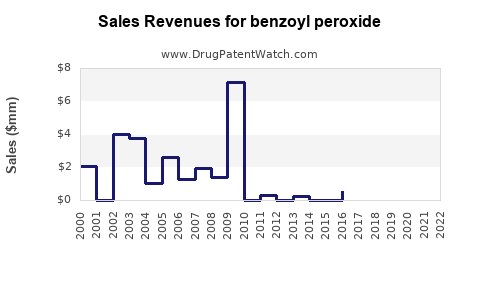
Drug Sales Revenue Trends for benzoyl peroxide
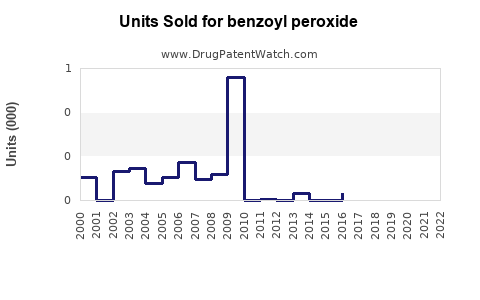
Drug Units Sold Trends for benzoyl peroxide

Annual Sales Revenues and Units Sold for benzoyl peroxide

These sales figures are drawn from a US national survey of drug expenditures
Drug Name Revenues (USD) Units Year
BENZOYL PEROXIDE ⤷  Get Started Free ⤷  Get Started Free 2022
BENZOYL PEROXIDE ⤷  Get Started Free ⤷  Get Started Free 2021
BENZOYL PEROXIDE ⤷  Get Started Free ⤷  Get Started Free 2020
BENZOYL PEROXIDE ⤷  Get Started Free ⤷  Get Started Free 2019
BENZOYL PEROXIDE ⤷  Get Started Free ⤷  Get Started Free 2018
>Drug Name >Revenues (USD) >Units >Year

Market Analysis and Sales Projections for Benzoyl Peroxide

Last updated: July 28, 2025

Introduction

Benzoyl peroxide remains a cornerstone of dermatological treatments, particularly for acne vulgaris. Its longstanding efficacy, over-the-counter (OTC) availability, and established safety profile underpin its sustained market relevance. This analysis examines the current market landscape, key drivers influencing demand, competitive dynamics, regulatory considerations, and future sales projections.


Market Overview

Benzoyl peroxide is a topical antibacterial and keratolytic agent predominantly used for mild to moderate acne. Its broad accessibility—both OTC and prescribed—has cemented its position as a first-line therapy globally. The global acne treatment market, estimated at approximately USD 4.5 billion in 2022, features benzoyl peroxide as a significant segment, valued around USD 1.2 billion, and expected to maintain its share owing to its affordability, proven efficacy, and minimal resistance issues.


Key Market Drivers

  1. High Consumer Demand for OTC Acne Treatments
    The increasing preference for at-home skincare solutions spurs demand for OTC benzoyl peroxide formulations. Consumers favor quick, cost-effective, and accessible medications, bolstered by digital marketing and teledermatology trends.

  2. Rising Acne Prevalence among Millennials and Gen Z
    Urbanization, dietary shifts, and stress-related factors contribute to increasing acne incidences, especially among adolescents and young adults. This demographic shift significantly boosts benzoyl peroxide sales, particularly via retail channels.

  3. Advancements in Formulation Technologies
    Innovations, including improved delivery systems and reduced irritation formulations, expand market reach by addressing previous tolerability issues and enhancing patient compliance.

  4. Expanding Markets in Emerging Economies
    Rapid urbanization and rising healthcare awareness in Asia-Pacific, Latin America, and Africa enlarge the customer base. Countries such as India, Brazil, and China exhibit burgeoning demand, driven by greater OTC product penetration.

  5. COVID-19 Pandemic Impact
    The pandemic has catalyzed increased skincare product use, including benzoyl peroxide, as consumers focus on skin health amid reduced access to dermatology clinics.


Competitive Landscape

Major players include Johnson & Johnson (Proactiv), The Ordinary, Neutrogena, and La Roche-Posay. Market consolidation and product diversification strategies—such as combining benzoyl peroxide with other active ingredients—enhance competitive positioning. Patents are limited, given benzoyl peroxide's long-standing patent expiry, fostering generic proliferation and price competition.

Emerging brands focusing on sensitive skin formulations and innovative delivery systems—e.g., microencapsulation—are gaining market share. Additionally, private-label brands leveraging e-commerce sales channels capitalize on trends toward online shopping.


Regulatory and Patent Considerations

Benzoyl peroxide’s OTC status in many jurisdictions reduces regulatory barriers, expediting market access. Nonetheless, jurisdictions like the US require clear labeling, safety warnings, and formulation standards. Patent landscapes are largely open, but formulation patents related to delivery mechanisms may offer temporary exclusivities. Regulatory changes, such as restrictions on certain concentrations, could influence future sales.


Sales Forecasts and Market Projections

Short-Term Outlook (2023-2025):
The benzoyl peroxide segment is anticipated to grow at a compound annual growth rate (CAGR) of 4-6%, driven by expanding consumer awareness, product innovation, and developing markets. Existing demand is robust, with OTC formulations accounting for approximately 70% of sales.

Medium to Long-Term Outlook (2026-2030):
Projected CAGR of 3-5%, maintaining steady growth, is expected as new formulations targeting specific demographics (e.g., sensitive skin formulations) enter the market. The proliferation of combination products—e.g., benzoyl peroxide with salicylic acid or topical antibiotics—may stimulate incremental sales.

Market Penetration and Revenue Estimates:
Assuming an industry valuation of USD 1.2 billion in 2022, with a compounded growth rate of 5%, sales could reach approximately USD 1.53 billion by 2025, and roughly USD 2.00 billion by 2030. Asia-Pacific and Latin America markets are forecasted to outperform others, with annual growth rates approaching 7-8% owing to demographic expansion and increasing product access.


Emerging Trends Impacting Future Sales

  • Personalized Skincare: Custom formulations cater to specific skin types, broadening the consumer base.
  • Digital Marketing & E-commerce: Growth in online sales channels accelerates distribution, especially among younger demographics.
  • Sustainability and Eco-Friendly Packaging: Brands adopting eco-conscious practices appeal to environmentally aware consumers, potentially expanding market share.
  • Combination and Adjunctive Therapies: Rise in combination products may shift sales from pure benzoyl peroxide formulations to multi-agent therapies.

Potential Challenges and Risks

  • Tolerance and Side Effects: Irritation and dryness remain concerns; adverse effects may limit use or lead to discontinuation.
  • Market Saturation: High OTC penetration could lead to price competition and marginal growth.
  • Regulatory Restrictions: Future regulations on concentrations or formulations may impact product availability.
  • Emerging Competitors: Novel acne therapies, including oral alternatives and laser treatments, could reduce dependence on topical benzoyl peroxide.

Key Takeaways

  • Benzoyl peroxide commands a significant share within the acne treatment market, driven by its proven efficacy, cost-effectiveness, and OTC availability.
  • Growing demand in emerging markets, coupled with innovation in formulations and marketing strategies, sustains positive growth forecasts.
  • The industry is expected to grow at a CAGR of approximately 4-6% over the next three years, with potential acceleration in emerging economies.
  • Competitive dynamics favor both established giants and innovative niche brands, emphasizing formulation improvements and digital distribution.
  • Regulatory environments are generally supportive, but ongoing monitoring for potential restrictions remains essential for strategic planning.

Frequently Asked Questions

  1. What is the current market size for benzoyl peroxide globally?
    The global market for benzoyl peroxide-based acne products is valued around USD 1.2 billion as of 2022, a substantial portion of the broader USD 4.5 billion acne treatment market.

  2. Which regions are expected to see the highest growth for benzoyl peroxide sales?
    Asia-Pacific and Latin America are forecasted to exhibit the highest CAGR (7-8%) owing to expanding middle class populations, increased skincare awareness, and greater OTC product access.

  3. How do product innovations influence market growth?
    Innovations such as controlled-release formulations, combined therapies, and irritation-reducing systems expand consumer appeal, improve compliance, and open new niche markets, thus positively impacting sales.

  4. What are the key challenges facing the benzoyl peroxide market?
    Major challenges include side effect management, market saturation, potential regulatory restrictions, and competition from newer treatments like oral antibiotics and laser therapies.

  5. Are patent expirations affecting the benzoyl peroxide market?
    Since benzoyl peroxide is a long-established compound, most formulations are off patent, fostering generic competition and price sensitivity, but formulation-specific patents related to delivery systems can offer temporary exclusivity for innovators.


References

[1] Market Research Future. "Acne Treatment Market Industry Analysis, Share, Growth, Trends, and Forecast 2022-2030."
[2] Grand View Research. "Acne Treatment Market Size, Share & Trends Analysis Report."
[3] U.S. Food and Drug Administration. "Regulations on Acne Medications."
[4] Allied Market Research. "OTC Skincare Market Global Opportunities and Forecast, 2021–2028."
[5] Euromonitor International. "Skincare Industry Trends and Insights."

More… ↓

⤷  Get Started Free

Make Better Decisions: Try a trial or see plans & pricing

Drugs may be covered by multiple patents or regulatory protections. All trademarks and applicant names are the property of their respective owners or licensors. Although great care is taken in the proper and correct provision of this service, thinkBiotech LLC does not accept any responsibility for possible consequences of errors or omissions in the provided data. The data presented herein is for information purposes only. There is no warranty that the data contained herein is error free. We do not provide individual investment advice. This service is not registered with any financial regulatory agency. The information we publish is educational only and based on our opinions plus our models. By using DrugPatentWatch you acknowledge that we do not provide personalized recommendations or advice. thinkBiotech performs no independent verification of facts as provided by public sources nor are attempts made to provide legal or investing advice. Any reliance on data provided herein is done solely at the discretion of the user. Users of this service are advised to seek professional advice and independent confirmation before considering acting on any of the provided information. thinkBiotech LLC reserves the right to amend, extend or withdraw any part or all of the offered service without notice.