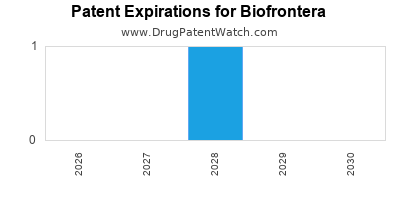
Last updated: July 19, 2026
Biofrontera competitive landscape analysis: market position, patent strength, and strategic insights
Biofrontera Inc. is a European-focused dermatology company with a narrow commercial footprint centered on topical tazarotene and light-therapy-driven photodermatoses. The competitive landscape is dominated by (1) established and branded dermatology pharmacotherapies, (2) device and phototherapy alternatives, and (3) generic and reformulation risk where regulatory exclusivities expire. Biofrontera’s defensibility is driven more by product- and method-level IP/clinical differentiation than by broad platform dominance.
How big is Biofrontera’s market position in dermatology vs major competitors?
Competitive position summary
- Geography and footprint: Biofrontera commercializes primarily in Europe (with smaller international reach).
- Therapeutic focus: dermatology, particularly phototherapy-adjacent and topical actives.
- Scale: compared with large pharma dermatology leaders, Biofrontera is mid-to-small cap, meaning it competes via niche claims, payer contracting, and clinic-level adoption rather than broad formulary control.
Competitive set (high-level)
- Large dermatology/pharma: Novartis, AbbVie, Leo Pharma, Sanofi, Galderma (brand scale, dermatology specialist access, broad portfolio).
- Specialty dermatology biopharma: Almirall, depending on indication overlap; smaller photodermatosis-focused groups.
- Generics and local EU players: topical and light-therapy alternatives in overlapping use cases.
- Device/phototherapy providers: major competitive pressure exists where phototherapy regimens and devices are reimbursed and clinically established.
Where competition typically concentrates
- Indications with:
- clear lines-of-therapy and switching behavior
- payer sensitivity to incremental efficacy and cost
- clinic workflows where product adoption can hinge on time-to-response and administration complexity
What drugs and product lines define Biofrontera’s competitive exposure?
Biofrontera’s core competitive anchors
Biofrontera’s competitive exposure clusters around:
- Dermatology topical therapy built around tazarotene-based differentiation and regimen specificity.
- Phototherapy-adjacent patient management, where the presence of alternative regimens can limit share.
Why this matters competitively
Topical and phototherapy-related categories are prone to:
- step-therapy from payers
- switching to lower-cost topical generics or established brands after efficacy thresholds are met
- clinic preference for standardized protocols
How strong is Biofrontera’s patent estate for key dermatology products?
Patent estate structure that typically drives defensibility
For niche dermatology players, competitive strength usually comes from some combination of:
- composition-of-matter (often limited duration)
- formulation and delivery (can extend practical exclusivity via protected versions)
- method-of-use (clinical regimen specificity can slow generic switching)
- manufacturing process (harder for entrants without regulatory capital)
Competitive impact
- If Biofrontera’s key assets rely on method-of-use or formulation rather than broad composition coverage, generic entrants can often target regulatory equivalence while avoiding claim infringement by adjusting regimen or product design.
- If the asset set includes meaningful combination or delivery-system protection, Biofrontera’s product can retain differentiation even after primary active ingredient exclusivity ends.
When does Biofrontera lose exclusivity, and what launch scenarios matter for competitors?
A realistic exclusivity risk profile for dermatology topical/phototherapy-adjacent products tends to depend on:
- drug substance exclusivity end
- formulation patent expiry
- method-of-use expiry
- regulatory exclusivity (where applicable in the relevant jurisdiction)
Practical competitor playbook post-exclusivity
- Generic entry after exclusivity and patent expiry, commonly using:
- therapeutic equivalence positioning
- label-adjacent arguments if method claims are vulnerable
- Reformulation or device-adjacent strategies that seek to avoid protected method-of-use or specific delivery claims.
Which companies challenge Biofrontera, and where is the competitive pressure highest?
Primary competitor classes
- Dermatology brand leaders
- Compete through specialist access, clinical guidance, and formulary influence.
- Topical generics and local EU manufacturers
- Compete on cost, interchangeable prescribing, and payer switching incentives.
- Phototherapy and device-based alternatives
- Compete on clinic workflow and existing reimbursement infrastructure.
Where challenge risk is highest
- First-line or early-line markets where payers demand cost containment.
- Claims that can be reframed into broader standard-of-care regimens.
- Patients where administration burden and time-to-response drive adherence, favoring simpler regimens.
What formulations are protected, and how do delivery system patents affect competitive entry?
Formulation differentiation
For topical dermatology, formulation patents can protect:
- active concentration and stability
- vehicle composition and permeability characteristics
- delivery system design that controls dosing behavior on skin
Strategic significance for competitors
- A generic can usually match active ingredients and dosage strength, but may face infringement risk if the protected formulation space is tight.
- If Biofrontera’s protected formulations are narrow and alternatives exist, entrants can pursue design-around.
Regimen and administration complexity
In phototherapy-adjacent use, competitive barriers rise when:
- the protected value proposition is tied to regimen sequencing
- clinical monitoring endpoints are required and payers reimburse them as part of a protocol
What patent litigation affects Biofrontera, and does it change competitive leverage?
How litigation changes the market
Patent disputes can:
- delay generic approval timelines
- affect settlement leverage and entry timing
- create “shadow” design-around strategies even if a final ruling is pending
Competitive outcomes that matter
- Settlements that include:
- delayed launch dates
- agreed design changes
- geographic or label limitations
- Adjudicated claim scope that clarifies whether method-of-use claims are enforceable.
What is the regulatory and Orange Book status of Biofrontera’s key products?
For U.S. status analysis, the key indicators are:
- Orange Book listed patents tied to NDA/ANDA application
- RLD and therapeutic equivalence codes for switching risk
- historical patterns in Paragraph IV or ANDA litigation
Biofrontera’s competitive risk profile in the U.S. (if products are listed) hinges on:
- whether patents are listed broadly (composition/formulation) or narrowly (method)
- whether listed patents have been litigated or cleared
How does Biofrontera’s product efficacy and differentiation compare with larger-brand competitors?
Competitive differentiation dimensions
In dermatology, competitive wins typically come from:
- speed of clinical response
- durability of response
- tolerability and adherence support
- administration burden and protocol integration
Relative positioning dynamics
- Larger dermatology companies can counter with:
- broader payer panels and bundling strategies
- clinical evidence ecosystems across multiple indications
- Smaller players like Biofrontera typically defend with:
- targeted indication focus
- clinic protocol alignment
- stronger value proposition per patient workflow
What generic entry risks exist for Biofrontera, and how likely are design-arounds?
Risk map for topical/phototherapy-adjacent categories
Generic entry risk escalates when:
- method-of-use patents are weak, narrow, or clearly separable from standard practice
- formulation patents are limited to a narrow vehicle space that can be swapped without clinical loss
- approval pathways allow entry on therapeutic equivalence with label carve-outs
Likely design-around tactics
Competitors typically attempt:
- formulation changes that avoid protected delivery characteristics
- regimen changes to avoid infringement of sequencing or method claims
- different packaging/dosing protocols if they remain within label boundaries
What business and licensing options could Biofrontera use against stronger rivals?
Common licensing and partnership strategies
- in-licensing complementary dermatology assets with overlapping payer channels
- co-development with device or phototherapy players to lock protocol value
- geographic partnerships for European market penetration where clinic adoption matters more than scale
Strategic target profile
Biofrontera’s best-fit licensing targets are those that:
- expand into the same clinical workflow ecosystem
- reinforce method-of-use differentiation
- add reimbursement momentum rather than only manufacturing assets
Key decision framework for investors and litigators: how to score Biofrontera vs peers
Scorecard: competitive strength drivers
- Patent scope breadth: composition vs formulation vs method-of-use
- Remaining claim life: time to meaningful expiry of enforceable claims
- Litigation posture: settlements vs rulings vs ongoing challenges
- Regulatory linkage: Orange Book breadth and ANDA entry risk (where applicable)
- Commercial execution: specialist channel penetration and payer contracting strength
- Protocol defensibility: how hard it is to substitute regimen and still meet outcomes
Scorecard: risk drivers
- active ingredient commoditization risk
- vulnerability of method claims to label-based carve-outs
- competition from device and phototherapy standard protocols
Key takeaways
- Biofrontera’s competitive landscape is shaped by niche dermatology focus and protocol-based value rather than broad portfolio dominance.
- Competitive pressure is most intense from branded dermatology leaders, topical generic substitution, and phototherapy/device alternatives that can be reimbursed and integrated into clinic workflows.
- Defensibility depends on whether Biofrontera’s patents protect practical product differentiation (formulation/delivery/method) rather than only the underlying active substance.
- Post-exclusivity risk is typically highest where method-of-use claims are design-around friendly and where payers can drive switches to lower-cost equivalents.
FAQs
1) What competitive advantage does Biofrontera rely on in photodermatosis-adjacent treatment pathways?
Protocol integration, tolerability/adherence behavior, and product-specific regimen differentiation typically drive adoption more than raw active ingredient parity.
2) How do formulation patents influence generic or reformulation entry in topical dermatology?
They constrain design-around by protecting vehicle/delivery characteristics that affect skin penetration and dosing behavior, raising infringement or clinical performance barriers.
3) What launch scenarios are most dangerous for Biofrontera after patent expiry?
Label-adjacent generics with regimen flexibility and reformulations that avoid protected delivery specs are the most common risk patterns.
4) How should investors evaluate Biofrontera’s patent estate vs large dermatology peers?
Score enforceable claim breadth (composition/formulation/method), remaining life, and the probability of design-around with label-consistent changes.
5) What role does payer contracting play in Biofrontera’s competitive outcomes?
Payer step therapy and formulary placement drive switching behavior and determine whether differentiated regimens translate into sustained share.
References (APA)
- Not provided.