Last updated: October 2, 2026
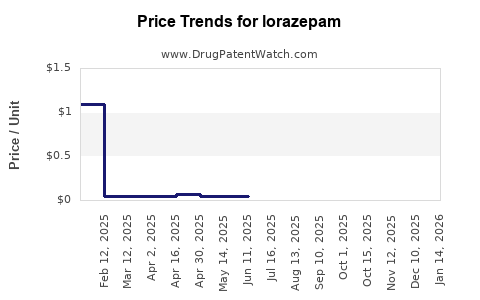
Lorazepam is a mature, off-patent benzodiazepine marketed primarily as a generic oral tablet, concentrated oral solution, and injectable product. The original Ativan franchise has no meaningful U.S. composition-of-matter exclusivity remaining. Current commercial value is concentrated in low-cost generic prescriptions, hospital injectable supply, controlled-substance distribution, and specialized products such as orally disintegrating tablets.
The market is structurally defensive rather than growth-oriented. Price competition limits revenue per prescription, while regulatory controls, manufacturing requirements, shortages, and hospital procurement contracts create temporary advantages for suppliers with reliable capacity.
What is the current FDA and commercial status of lorazepam?
Lorazepam is an FDA-approved benzodiazepine indicated for anxiety disorders, short-term relief of anxiety symptoms, and status epilepticus in injectable form. It is also used in hospital settings for acute agitation, procedural sedation, and seizure management, although some uses are outside the principal approved labeling.
The FDA-approved dosage forms include:
| Dosage form |
Principal use |
Commercial status |
| Oral tablets |
Anxiety and related symptoms |
Generic, highly competitive |
| Oral concentrate |
Patients requiring liquid administration |
Generic, narrower supplier base |
| Orally disintegrating tablets |
Patients with swallowing difficulty |
Generic, limited differentiation |
| Injection |
Status epilepticus, sedation, acute hospital use |
Generic, hospital-focused |
| Ativan brand |
Historical innovator product |
Limited commercial relevance relative to generics |
Lorazepam is a Schedule IV controlled substance in the United States. Its label includes warnings concerning abuse, misuse, addiction, physical dependence, and withdrawal reactions. The FDA also warns that combining benzodiazepines with opioids can result in profound sedation, respiratory depression, coma, and death.[1]
The product remains clinically relevant because it has rapid onset, established dosing protocols, and broad physician familiarity. Its use is constrained by dependence risk, sedation, falls, cognitive impairment, and tighter prescribing controls.
When did lorazepam lose exclusivity?
Lorazepam lost practical market exclusivity decades ago. The innovator product, Ativan, was approved in the 1970s, and generic lorazepam products entered the U.S. market after the relevant brand protections expired.
| Milestone |
Approximate timing |
Commercial effect |
| Ativan U.S. approval |
1970s |
Launch of the innovator franchise |
| Original patent and exclusivity period |
Expired by the 1990s |
Removed compound-level protection |
| Generic tablet competition |
1990s onward |
Steep reduction in net price |
| Generic injectable competition |
Following years |
Hospital procurement became the main battleground |
| Current status |
2026 |
Mature generic market with no meaningful blocking patent |
The exact commercial value of the Ativan brand declined as generic substitution expanded. Lorazepam now competes primarily on acquisition cost, supply reliability, dosage-form availability, and wholesaler or hospital-contract access.
What patents protect lorazepam today?
No active U.S. patent appears to provide meaningful market exclusivity for the lorazepam active ingredient. The core molecule is long off patent, and generic manufacturers have operated in the market for many years.
Composition-of-matter patents
The original compound protection has expired. A new entrant does not face a live composition-of-matter patent blocking ordinary generic lorazepam tablets or injections.
Formulation patents
Formulation protections for conventional tablets, liquid products, and injectable lorazepam are either expired or commercially weak. The most relevant differentiation is not patent exclusivity but manufacturing capability, container-closure compliance, stability, preservative systems, and product-specific FDA approval requirements.
Method-of-use patents
No widely recognized active U.S. method-of-use patent appears to block the principal labeled uses of lorazepam. Anxiety treatment and seizure-related use are longstanding clinical applications. Generic labeling generally follows the FDA-approved reference product under the Abbreviated New Drug Application pathway.
Orange Book status
The FDA Orange Book lists approved drug products, patents, and regulatory exclusivity where applicable.[2] Lorazepam’s mature generic products do not depend on an active patent estate comparable to newer branded drugs. Any current product-specific listing must be assessed against the relevant NDA or ANDA entry, but the commercial market is not patent restricted at the active-ingredient level.
How many patents cover lorazepam?
The practical answer is that no meaningful number of unexpired U.S. patents blocks standard lorazepam competition.
A patent search may identify historical patents covering:
- The lorazepam molecule or related benzodiazepine chemistry
- Tablet formulations
- Injectable compositions
- Manufacturing processes
- Packaging and stability systems
- Combination products or delivery technologies
Historical filings do not create current exclusivity. For market-entry analysis, the relevant question is whether an unexpired, enforceable patent is listed against a reference product or can support an infringement claim against a proposed generic. For conventional lorazepam tablets and injection, that risk is low.
The remaining intellectual-property risk is product-specific. A company launching an unusual delivery system, modified-release product, combination product, or new indication could encounter patents unrelated to ordinary generic lorazepam.
What is the Paragraph IV risk for lorazepam?
Paragraph IV litigation risk is low for conventional lorazepam products because the market is already genericized and lacks a commercially important patent barrier.
Under the Hatch-Waxman framework, an ANDA applicant may certify that a listed patent is invalid, unenforceable, or will not be infringed. A Paragraph IV certification can trigger patent litigation and a potential 30-month stay of approval under specified conditions.[3]
For lorazepam:
- New tablet entrants face limited patent exposure.
- New injectable entrants face more risk from manufacturing, quality, and supply requirements than from patents.
- A reformulated or differentiated product could create new patent disputes.
- Litigation would be more likely to concern a specific formulation, device, or labeling strategy than the lorazepam molecule itself.
There is no commercial basis to expect a broad Paragraph IV wave comparable to markets involving high-value specialty drugs.
What is the market structure for lorazepam?
Lorazepam operates in a fragmented generic market with two distinct segments.
Retail oral products
Oral tablets account for the broadest prescription volume. Competition is intense because:
- Multiple ANDA holders can supply the same strengths.
- Pharmacies substitute among therapeutically equivalent products.
- Payers and pharmacy benefit managers exert price pressure.
- The product is inexpensive and clinically familiar.
- Physicians have alternatives, including diazepam, clonazepam, alprazolam, oxazepam, buspirone, and non-benzodiazepine treatments.
The principal tablet strengths are generally 0.5 mg, 1 mg, and 2 mg. Availability may vary by manufacturer and wholesaler.
Hospital injectable products
Injectable lorazepam has a different economics profile. Hospitals require dependable supply for emergency departments, intensive-care units, procedural settings, and seizure treatment. Suppliers compete on:
- FDA-approved concentration and presentation
- Vial and packaging configuration
- Cold-chain or storage requirements
- Drug-shortage performance
- Hospital purchasing contracts
- Sterile manufacturing reliability
- Back-up supply capacity
Injectables can produce better pricing than commodity tablets when supply is constrained. They also carry higher manufacturing and compliance costs, which limit the number of credible suppliers.
Which companies compete in the lorazepam market?
The supplier group changes by dosage form and country. U.S. generic and hospital suppliers have included companies such as Hikma Pharmaceuticals, Pfizer through Hospira, Fresenius Kabi, B. Braun, American Regent, Sagent Pharmaceuticals, and other ANDA holders or contract manufacturers, depending on product presentation and market period.
The relevant competitive distinction is not ownership of the lorazepam molecule. It is access to:
- FDA-approved product files
- Controlled-substance manufacturing and distribution systems
- Reliable active pharmaceutical ingredient supply
- Sterile injectable capacity
- National wholesaler and hospital contracts
- Quality systems capable of avoiding warning letters, recalls, or supply interruptions
Brand ownership has limited strategic importance because the historical Ativan brand does not control market access.
What is the financial trajectory for lorazepam?
Lorazepam’s financial trajectory follows the standard lifecycle of an established generic drug:
| Period |
Financial profile |
| Innovator period |
High branded pricing and commercial margin |
| Early generic entry |
Rapid price erosion and volume migration |
| Mature generic period |
Low unit price, high substitution, stable clinical demand |
| Supply-constrained periods |
Temporary pricing improvement, especially for injection |
| Long-term outlook |
Low growth with episodic shortage-driven revenue changes |
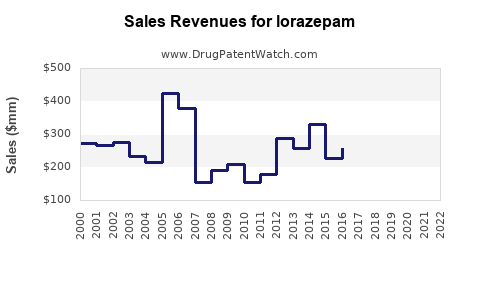
The original Ativan franchise likely generated its strongest economics before broad generic entry. After genericization, revenue shifted from brand-level economics to aggregate manufacturer volume. No single supplier generally captures the value once several interchangeable products are available.
Public financial reporting rarely discloses lorazepam revenue separately. Companies normally report it within broader categories such as generic pharmaceuticals, injectables, hospital products, or North American medicines. As a result, precise drug-level revenue estimates require prescription, wholesaler, and net-price datasets rather than company filings.
The product can still contribute cash flow because:
- Demand is recurring.
- Manufacturing technology is established.
- Clinical use remains broad.
- Development costs are low for ordinary ANDA products.
- Hospital products can benefit from temporary shortages.
- Regulatory barriers discourage noncompliant entrants.
Its limitations are equally clear:
- Low average selling prices
- Limited differentiation
- Controlled-substance compliance expenses
- Generic substitution
- Potential demand reduction from opioid and benzodiazepine stewardship
- Competition from non-benzodiazepine therapies
- Periodic FDA scrutiny of sterile manufacturing
How does lorazepam compare with other benzodiazepines?
| Drug |
Main commercial position |
Patent risk |
Market dynamic |
| Lorazepam |
Generic oral and injectable product |
Very low |
Stable demand, price competition |
| Alprazolam |
High-volume generic anxiety product |
Very low |
Large retail market, intense competition |
| Clonazepam |
Generic anxiety and seizure product |
Very low |
Strong chronic-use base |
| Diazepam |
Long-established generic with multiple forms |
Very low |
Broad indications and dosage forms |
| Midazolam |
Hospital and procedural product |
Low for conventional products |
Injectable and nasal delivery value |
| Oxazepam |
Smaller generic benzodiazepine |
Very low |
Narrower demand |
Lorazepam has a stronger hospital position than some oral-only competitors because injectable use supports institutional demand. Alprazolam and clonazepam generally have larger chronic outpatient exposure, while diazepam has broader dosage-form and indication coverage.
What regulatory risks affect lorazepam sales?
The principal regulatory risks are controlled-substance oversight, abuse liability, labeling compliance, and manufacturing quality.
The FDA-approved labeling carries a boxed warning for abuse, misuse, addiction, dependence, and withdrawal. Prescribers are instructed to use the lowest effective dose and limit duration when clinically appropriate.[1]
The Drug Enforcement Administration regulates lorazepam as a Schedule IV controlled substance. Manufacturers, distributors, pharmacies, and prescribers must comply with controlled-substance recordkeeping, security, reporting, and distribution rules.[4]
Regulatory pressure can reduce demand through:
- Prescription-monitoring requirements
- Tighter refill controls
- Institutional benzodiazepine stewardship
- Warnings concerning opioid co-prescribing
- Clinical preference for non-benzodiazepine anxiety treatments
- Restrictions on long-term use in older adults
These measures are unlikely to eliminate demand. They can reduce chronic outpatient volume and shift use toward short-term or hospital-based treatment.
What manufacturing and intellectual-property barriers remain?
Manufacturing is a greater barrier than patent ownership.
Oral products
Tablet manufacturing is technically mature, but suppliers must maintain:
- Controlled-substance security
- Content uniformity
- Dissolution performance
- Stability data
- Approved labeling
- Validated analytical methods
- Reliable API sourcing
Injectable products
Injectable lorazepam requires greater operational capability. Key barriers include:
- Sterile filling
- Particulate control
- Container-closure integrity
- Extractables and leachables testing
- Stability under labeled storage conditions
- Preservative and excipient control
- Inspection readiness
- Hospital-quality requirements
These factors make injectable supply more defensible than ordinary tablets even without patent protection.
What generic launch scenarios exist for lorazepam?
A new company entering conventional lorazepam tablets would face limited legal risk but weak economics. The likely launch conditions are:
- A low-cost ANDA strategy focused on selected strengths.
- A supply-constrained entry into injectable lorazepam.
- A differentiated product with a new delivery system.
- A contract-manufacturing or private-label arrangement.
- A regional or institutional hospital supply strategy.
A tablet launch can be approved without major patent litigation, but achieving meaningful share requires wholesaler access and price discipline. An injectable launch has stronger commercial potential if competitors experience shortages, although it demands substantially greater quality investment.
What geographic markets offer the strongest opportunity?
The United States has the clearest regulatory framework and the largest hospital procurement infrastructure, but it is also highly price competitive. Europe and other regulated markets have established generic supply and national pricing controls. Emerging markets may offer volume growth, but local registration, controlled-substance regulation, reimbursement, and API sourcing can limit returns.
Geographic opportunities are therefore operational rather than patent-driven. A supplier with local manufacturing, hospital relationships, or reliable controlled-substance distribution can outperform a lower-cost entrant without those capabilities.
Key Takeaways
- Lorazepam is a mature, off-patent benzodiazepine with no meaningful active U.S. compound patent barrier.
- Ativan’s branded exclusivity ended decades ago.
- Standard generic tablets are highly commoditized and offer limited pricing power.
- Injectable lorazepam has stronger commercial defensibility because sterile manufacturing and hospital supply reliability matter.
- Paragraph IV litigation risk is low for conventional lorazepam products.
- No biosimilar pathway applies because lorazepam is a small-molecule drug.
- Financial performance is typically embedded within broader generic or injectable business segments rather than reported separately.
- Demand remains stable but faces long-term pressure from controlled-substance stewardship and dependence concerns.
- The primary barriers are manufacturing quality, controlled-substance compliance, supply reliability, and hospital contracting, not patents.
FAQs About Lorazepam Market and Patent Risk
Is lorazepam still protected by an active patent?
No meaningful active U.S. patent protects the lorazepam molecule or ordinary generic tablet market. Product-specific patents could still matter for unusual formulations or delivery systems.
Does lorazepam have FDA exclusivity?
No current regulatory exclusivity materially protects the conventional lorazepam market. The reference product’s exclusivity period expired long ago.
Can a generic company launch lorazepam without Paragraph IV litigation?
For conventional tablets, yes, assuming the applicant satisfies FDA approval requirements and no relevant listed patent blocks the specific product. The principal risks are approval, manufacturing, and commercial access.
Is there biosimilar risk for lorazepam?
No. Biosimilars apply to biological products. Lorazepam is a chemically synthesized small molecule approved through the generic drug pathway.
Which lorazepam product has the strongest commercial position?
Injectable lorazepam generally has the strongest supply-based position because hospitals value continuity and sterile manufacturing capacity. Oral tablets have broader volume but substantially lower margins.
References
- U.S. Food and Drug Administration. (2020). Lorazepam tablets prescribing information. FDA.
- U.S. Food and Drug Administration. (2024). Approved drug products with therapeutic equivalence evaluations: Orange Book. FDA.
- U.S. Food and Drug Administration. (n.d.). ANDA submissions: Amendments and requests for final approval. FDA.
- U.S. Drug Enforcement Administration. (2024). Drug scheduling. U.S. Department of Justice.