Last updated: August 28, 2026
Ativan is the brand name for lorazepam, a Schedule IV benzodiazepine used for anxiety, insomnia associated with anxiety, status epilepticus, and preanesthetic medication. Its commercial position is mature and largely genericized. The brand has no meaningful U.S. market exclusivity, no identified active Orange Book patent protection, and no biosimilar exposure because lorazepam is a small-molecule drug. Financial value is concentrated in generic lorazepam volume, hospital injection demand, controlled-substance distribution, and any residual branded or authorized-generic sales rather than in the Ativan brand itself.
What is Ativan and who markets lorazepam?
Ativan contains lorazepam, a benzodiazepine that enhances gamma-aminobutyric acid activity through the GABA-A receptor complex. Oral tablets and injectable formulations are the principal dosage forms.
| Product |
Active ingredient |
Main dosage form |
U.S. regulatory status |
Commercial status |
| Ativan |
Lorazepam |
Tablets |
FDA-approved NDA product |
Mature branded product |
| Ativan injection |
Lorazepam |
Injectable solution |
FDA-approved NDA product |
Hospital and acute-care use |
| Generic lorazepam |
Lorazepam |
Tablets, concentrate, injection |
Multiple ANDA products |
Primary volume source |
The original Ativan product was approved in the United States in 1977. FDA labeling identifies lorazepam tablets for short-term relief of anxiety symptoms and lorazepam injection for status epilepticus, preanesthetic use, and other acute-care indications.[1][2]
The brand has historically been associated with Wyeth and later Pfizer-related commercial rights. Product ownership and marketing arrangements have changed across jurisdictions and over time. Current U.S. prescription sales are dominated by generic manufacturers rather than by the Ativan brand.
What is the FDA and Orange Book status of Ativan?
Ativan is an established FDA-approved drug with no remaining new-drug exclusivity of commercial significance in the United States.
The key regulatory facts are:
| Regulatory item |
Ativan status |
| Original approval |
1977 |
| Drug class |
Benzodiazepine |
| Controlled-substance schedule |
Schedule IV |
| FDA pathway |
NDA |
| Generic pathway |
ANDA |
| Current new-drug exclusivity |
None |
| Orphan-drug exclusivity |
None identified |
| Biosimilar pathway |
Not applicable |
| Orange Book patent protection |
No material active patent protection identified |
| Generic competition |
Extensive |
The Orange Book lists patents and exclusivity relevant to approved drug products. For a product as old as Ativan, the commercial barrier is not patent protection but generic substitution, controlled-substance regulation, manufacturing compliance, and distribution access.[3]
FDA approval of generic lorazepam products means an ANDA applicant can generally rely on the reference product's safety and efficacy findings while demonstrating pharmaceutical equivalence and bioequivalence. The absence of a meaningful patent or exclusivity barrier reduces the time and cost required for generic entry.
When does Ativan lose exclusivity?
Ativan lost practical exclusivity decades ago. The product's 1977 approval date places it well beyond the five-year new chemical entity exclusivity period and beyond the standard patent life associated with its original approval.
Exclusivity timeline
| Event |
Approximate timing |
Commercial impact |
| Original FDA approval |
1977 |
Initial branded launch |
| Early branded patent and regulatory period |
Late 1970s to 1980s |
Limited competition |
| Generic lorazepam entry |
Historical, prior to current market maturity |
Progressive price erosion |
| Current period |
2020s |
Generic-dominated market |
| Expected future loss of exclusivity |
Already occurred |
No major future cliff |
Ativan does not present the typical near-term loss-of-exclusivity profile associated with a recently approved specialty drug. The relevant commercial question is whether residual brand demand persists, not when exclusivity will expire.
What patents protect Ativan and lorazepam?
No material active U.S. patent estate appears to protect the core Ativan product or ordinary lorazepam tablets. The original compound and basic tablet formulation are long past the normal patent term.
Potentially relevant intellectual-property categories include:
- Historical compound patents covering lorazepam.
- Historical pharmaceutical-composition patents.
- Manufacturing or process patents.
- Formulation patents for specific injectable or modified-release products.
- Device or packaging rights in selected markets.
These categories do not create a meaningful barrier to standard generic lorazepam tablets. A process patent could affect a particular manufacturing route without blocking manufacture through alternative processes. A formulation patent could apply to a specific dosage form without protecting the active ingredient broadly.
How strong is the Ativan patent estate?
The Ativan patent estate is weak from a modern commercial-defense perspective.
| Patent-strength factor |
Assessment |
| Core active ingredient protection |
Expired |
| Basic oral tablet protection |
Expired or commercially irrelevant |
| Product-specific formulation protection |
Limited |
| Method-of-use protection |
Limited |
| Manufacturing barriers |
Potentially relevant to individual suppliers |
| Patent-based generic delay |
Low |
| Litigation leverage |
Low |
The economic moat is therefore operational rather than patent-based. Suppliers must meet FDA current good manufacturing practice requirements, maintain controlled-substance handling systems, secure reliable active pharmaceutical ingredient supply, and satisfy hospital and pharmacy procurement requirements.
Are there Paragraph IV challenges to Ativan?
Paragraph IV challenges are not a significant current issue for Ativan because the product lacks a commercially meaningful active patent barrier.
A Paragraph IV certification states that a listed patent is invalid, unenforceable, or would not be infringed by the proposed generic product. Generic companies use this pathway mainly when an Orange Book patent remains listed and an early launch opportunity exists. For mature lorazepam products with no relevant blocking patent, ordinary ANDA filings and paragraph III or patent-free certifications are more commercially relevant than Paragraph IV litigation.
No major current Paragraph IV dispute is associated with the core Ativan product in the commonly cited U.S. regulatory record.[3][4]
What patent litigation affects Ativan?
Ativan has no widely recognized active patent litigation that materially changes generic entry or U.S. market structure.
Historic pharmaceutical litigation may involve:
- Generic approval procedures.
- Product liability allegations involving benzodiazepines.
- Controlled-substance marketing and distribution.
- Manufacturing quality issues.
- Personal injury claims related to dependence, withdrawal, sedation, or misuse.
These matters are distinct from patent litigation. For investment analysis, the principal legal risks are regulatory compliance, product liability, controlled-substance enforcement, and supply-chain quality rather than patent infringement.
What is the competitive landscape for Ativan?
The competitive market has three layers:
- Generic lorazepam tablets and oral concentrates.
- Generic lorazepam injection supplied to hospitals and emergency departments.
- Other anxiolytics and sedatives competing for the same clinical use.
Direct drug competition
| Competitor |
Therapeutic role |
Competitive effect |
| Alprazolam |
Anxiety and panic disorder |
Competes in outpatient anxiety |
| Diazepam |
Anxiety, seizures, muscle spasm |
Broad substitute across indications |
| Clonazepam |
Panic disorder and seizures |
Competes in chronic use |
| Midazolam |
Procedural sedation and seizures |
Stronger acute-care substitute |
| Oxazepam |
Anxiety and alcohol withdrawal |
Alternative benzodiazepine |
| Buspirone |
Chronic anxiety |
Non-benzodiazepine alternative |
| SSRIs and SNRIs |
Anxiety disorders |
Long-term treatment alternatives |
| Hydroxyzine |
Anxiety and sedation |
Non-controlled alternative in some cases |
Lorazepam retains clinical utility because of its intermediate duration of action, established injectable form, predictable sedative effects, and use in status epilepticus and acute agitation. Its limitations include dependence, withdrawal, respiratory depression when combined with opioids or other central nervous system depressants, cognitive impairment, and abuse potential.[1][2]
Market segmentation
The oral market is highly price sensitive and exposed to generic substitution. The injectable market is less interchangeable in practice because hospitals evaluate supply reliability, vial sizes, shortage history, contract pricing, and wholesaler availability. Hospital purchasing can support better unit economics than retail tablets, but volumes are smaller and tender competition is intense.
What formulations are protected by Ativan patents?
Standard Ativan tablet formulations have little remaining patent-based protection. The primary commercial differentiation comes from dosage form, strength, manufacturing quality, and distribution.
| Formulation |
Commercial position |
Patent significance |
| 0.5 mg tablet |
Generic-dominated |
Low |
| 1 mg tablet |
Generic-dominated |
Low |
| 2 mg tablet |
Generic-dominated |
Low |
| Injectable lorazepam |
Hospital-focused |
Low core patent protection; higher manufacturing and supply requirements |
| Oral concentrate |
Niche formulation |
Limited product differentiation |
| Modified-release products |
Not the core Ativan product |
Any protection would be product-specific |
The injectable form has greater technical and regulatory complexity than tablets. Sterility, particulate control, container closure, stability, and supply continuity create practical barriers. These barriers can support temporary pricing during shortages, but they do not restore brand exclusivity.
What is the financial trajectory for Ativan?
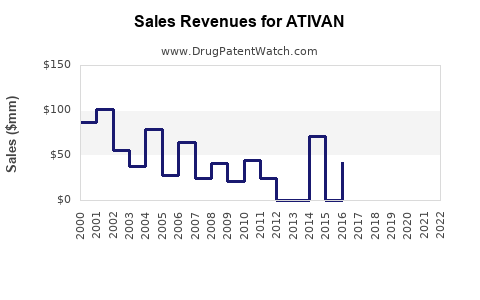
Ativan's standalone financial performance is not transparently disclosed by major commercial rights holders. Public company filings generally report broader pharmaceutical segments rather than a separate Ativan revenue line. As a result, the brand's exact annual sales, gross margin, and operating profit cannot be reliably isolated from public filings.
The financial trajectory is nevertheless clear:
| Period |
Financial dynamic |
| Initial launch period |
Branded pricing and limited competition |
| Generic-entry period |
Rapid unit-price and share erosion |
| Mature generic period |
High volume, low price, fragmented supply |
| Current period |
Residual brand value; generic and institutional economics dominate |
| Forward outlook |
Stable demand with limited pricing power and episodic supply-driven upside |
Revenue exposure
Revenue exposure is most likely concentrated in:
- Generic lorazepam tablet sales.
- Institutional injectable lorazepam.
- Contract manufacturing or distribution arrangements.
- Residual branded prescriptions where physicians or pharmacies retain brand preference.
- Export or non-U.S. markets with different substitution rules.
The Ativan brand itself is unlikely to represent a material growth asset for a large pharmaceutical company. Any residual revenue is vulnerable to generic substitution, formulary controls, pharmacy benefit manager pricing, and therapeutic substitution.
Pricing and margin dynamics
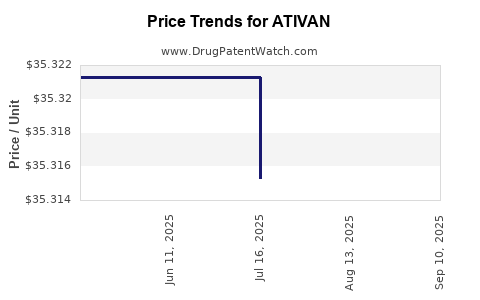
Tablet pricing is structurally compressed because several suppliers can offer therapeutically equivalent products. Margins depend on manufacturing cost, channel mix, wholesaler contracts, and supply availability. Injectable lorazepam can produce better pricing during shortages, but supply disruptions also increase regulatory and operational risk.
The drug's controlled-substance status raises compliance costs. Manufacturers and distributors must manage quotas, recordkeeping, diversion controls, security procedures, suspicious-order monitoring, and DEA requirements.[5] These costs can reduce the attractiveness of low-volume participation even when demand is stable.
What generic launch risks exist for Ativan?
Generic entry risk is already realized rather than prospective. The main risk to a residual Ativan franchise is continued substitution by lower-priced lorazepam products.
Generic manufacturers face several practical risks:
- FDA inspection findings.
- Injectable sterility failures.
- Active ingredient shortages.
- Controlled-substance quota constraints.
- Product recalls.
- Supply interruptions.
- Competition from other generic suppliers.
- Pricing pressure from wholesalers and group purchasing organizations.
A generic launch would not need to overcome a significant patent barrier. Its primary hurdle would be FDA approval and commercial execution.
Generic launch scenarios
| Scenario |
Likely outcome |
| Additional tablet supplier enters |
Lower prices and share fragmentation |
| Injectable supplier enters during stable supply |
Lower contract pricing |
| Injectable shortage occurs |
Temporary price increases and allocation |
| Brand retains physician preference |
Narrow residual brand niche |
| Controlled-substance restrictions tighten |
Higher compliance costs and possible supply friction |
| Hospital demand remains stable |
Predictable but low-growth volume |
How does Ativan compare with other benzodiazepine franchises?
Ativan has a weaker commercial position than newer or differentiated sedative products but retains broader clinical utility than some older oral-only benzodiazepines because of its injectable presentation.
| Drug |
Core strength |
Patent position |
Commercial profile |
| Ativan / lorazepam |
Acute anxiety, seizures, preanesthesia |
Expired |
Mature generic market |
| Xanax / alprazolam |
Panic disorder and anxiety |
Expired |
Large historical outpatient franchise |
| Valium / diazepam |
Broad indications and rectal formulations |
Expired |
Mature generic market |
| Klonopin / clonazepam |
Panic disorder and seizures |
Expired |
Generic-dominated |
| Versed / midazolam |
Procedural and emergency sedation |
Expired for core products |
Hospital-focused |
| Buspar / buspirone |
Non-benzodiazepine anxiety treatment |
Expired |
Lower dependence concern |
Ativan's differentiators are clinical familiarity, multiple strengths, injectable availability, and a substantial evidence base. These attributes support continued demand but do not support premium pricing at scale.
What licensing deals affect Ativan?
No major recent licensing transaction appears to have changed the economics of the core U.S. Ativan franchise. Historical ownership and marketing rights have moved through pharmaceutical-company transactions, but the product's mature generic status limits the value of a conventional exclusive license.
Potential transaction value would be more likely to arise from:
- Regional distribution rights.
- Hospital injectable supply contracts.
- Authorized-generic arrangements.
- Portfolio acquisitions involving multiple mature products.
- Manufacturing or supply agreements.
A standalone Ativan licensing deal would have limited strategic value unless it included scarce injectable capacity, a strong hospital distribution network, or rights in a market with restricted generic substitution.
What FDA risks and regulatory issues affect Ativan?
The main FDA and public-health issues are safety and controlled-substance management.
FDA labeling warns about abuse, misuse, addiction, physical dependence, and withdrawal. Combined use with opioids can result in profound sedation, respiratory depression, coma, and death. The label also warns against abrupt discontinuation after repeated use because withdrawal can include seizures and other severe symptoms.[1][2]
For manufacturers, the regulatory risk profile includes:
- cGMP compliance.
- Accurate potency and dissolution testing.
- Sterile manufacturing controls for injection.
- Labeling and medication-guide compliance.
- DEA registration and controlled-substance records.
- Diversion prevention.
- Adverse-event reporting.
- Supply continuity.
These risks can affect cost and availability even when no patent risk exists.
Key Takeaways
- Ativan is lorazepam, an FDA-approved benzodiazepine first approved in 1977.
- U.S. exclusivity expired decades ago, and generic lorazepam dominates the market.
- No material active Orange Book patent estate protects the core Ativan tablets.
- Paragraph IV litigation is not a central current risk for the product.
- There is no biosimilar risk because lorazepam is a small molecule.
- Injectable lorazepam has greater operational complexity and may have better pricing than tablets.
- Public filings do not generally disclose standalone Ativan revenue or profit.
- The financial outlook is mature and low growth, with value tied to volume, supply reliability, and hospital distribution.
- The principal legal and regulatory risks involve controlled-substance compliance, product liability, manufacturing quality, and supply disruption.
- Any residual branded value is likely narrow and vulnerable to generic substitution.
FAQs About Ativan Market and Patent Economics
Does Ativan still have brand-name market exclusivity?
No. Ativan has been exposed to generic competition for many years, and no current U.S. exclusivity period materially protects the brand.
Can a generic company launch lorazepam without a Paragraph IV lawsuit?
Yes. If no blocking Orange Book patent applies, a generic applicant can proceed through the applicable ANDA certification without creating a conventional Paragraph IV litigation event.
Is injectable Ativan more commercially valuable than tablet Ativan?
It can have higher practical value because sterile manufacturing and hospital supply requirements limit participation. Its market remains generic and contract-price sensitive.
Is lorazepam covered by biosimilar regulation?
No. Lorazepam is a chemically synthesized small molecule approved through the conventional generic-drug framework, not the biologics and biosimilar framework.
What could increase the value of a lorazepam manufacturer?
Value could improve through reliable injectable supply, shortage-period availability, efficient controlled-substance compliance, hospital contracts, and manufacturing scale. Patent extension is not a realistic primary value driver.
References
-
U.S. Food and Drug Administration. (2020). Ativan (lorazepam) tablets prescribing information. FDA.
-
U.S. Food and Drug Administration. (2020). Lorazepam injection prescribing information. FDA.
-
U.S. Food and Drug Administration. (2024). Approved drug products with therapeutic equivalence evaluations: Orange Book. FDA.
-
U.S. Food and Drug Administration. (2024). Drugs@FDA: FDA-approved drugs database. FDA.
-
U.S. Drug Enforcement Administration. (2024). Controlled substances schedules and regulatory requirements. U.S. Department of Justice.