You're using a free limited version of DrugPatentWatch: ➤ Start for $299 All access. No Commitment.

Last Updated: December 11, 2025

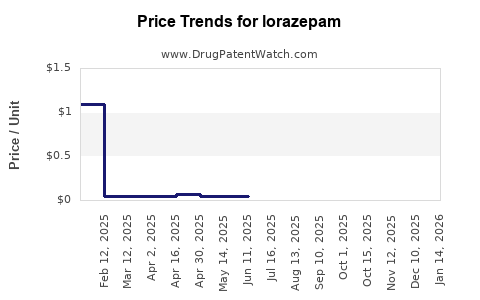
Drug Price Trends for lorazepam


✉ Email this page to a colleague

« Back to Dashboard


Drug Price Trends for lorazepam

Average Pharmacy Cost for lorazepam

These are average pharmacy acquisition costs (net of discounts) from a US national survey
Drug Name NDC Price/Unit ($) Unit Date
LORAZEPAM 0.5 MG TABLET 60687-0820-01 0.04299 EACH 2025-12-10
LORAZEPAM 2 MG TABLET 60687-0842-11 0.07593 EACH 2025-12-10
LORAZEPAM 2 MG TABLET 60687-0842-01 0.07593 EACH 2025-12-10
LORAZEPAM 1 MG TABLET 60687-0831-01 0.04930 EACH 2025-12-10
LORAZEPAM 1 MG TABLET 60687-0831-11 0.04930 EACH 2025-12-10
LORAZEPAM 0.5 MG TABLET 60687-0820-11 0.04299 EACH 2025-12-10
LORAZEPAM 0.5 MG TABLET 13107-0083-05 0.04299 EACH 2025-11-19
>Drug Name >NDC >Price/Unit ($) >Unit >Date

Best Wholesale Price for lorazepam

These are wholesale prices available to the US Federal Government which, by law, must be the best prices available to any customer under comparable terms and conditions
Drug Name Vendor NDC Count Price ($) Price/Unit ($) Unit Dates Price Type
LORAZEPAM 0.5MG TAB AvKare, LLC 69315-0904-01 100 7.17 0.07170 EACH 2023-06-15 - 2028-06-14 FSS
LORAZEPAM 2MG/ML CONC,ORAL Golden State Medical Supply, Inc. 00121-0770-01 30ML 8.27 0.27567 ML 2023-06-15 - 2028-06-14 FSS
LORAZEPAM 1MG TAB AvKare, LLC 69315-0905-05 500 39.39 0.07878 EACH 2023-06-15 - 2028-06-14 FSS
LORAZEPAM 2MG/ML CONC,ORAL Golden State Medical Supply, Inc. 00121-0770-01 30ML 8.83 0.29433 ML 2023-06-23 - 2028-06-14 FSS
LORAZEPAM 2MG/ML INJ Amphastar Pharmaceuticals, Inc. 76329-8261-01 10X10ML 47.74 2022-01-15 - 2027-01-14 FSS
LORAZEPAM 20MG/10ML INJ Hikma Pharmaceuticals USA Inc. 00641-6046-10 10X10ML 96.29 2024-01-01 - 2026-08-14 FSS
ATIVAN 2MG/ML INJ Hikma Pharmaceuticals USA Inc. 00641-6001-25 25X1ML 34.05 2024-01-01 - 2026-08-14 Big4
>Drug Name >Vendor >NDC >Count >Price ($) >Price/Unit ($) >Unit >Dates >Price Type
Price type key: Federal Supply Schedule (FSS): generally available to all Federal Govt agencies / 'BIG4' prices: VA, DoD, Public Health & Coast Guard only / National Contracts (NC): Available to specific agencies

Market Analysis and Price Projections for Lorazepam

Introduction
Lorazepam, a benzodiazepine primarily used to manage anxiety, insomnia, and seizures, remains a critical therapeutic agent within the psychopharmacology sector. Its widespread use across various healthcare settings makes it a significant product in the global pharmaceutical market. This report offers an in-depth analysis of the current market landscape for Lorazepam, along with future price projections informed by regulatory, manufacturing, and competitive dynamics.

Market Overview
The global Lorazepam market encompasses authorized generic formulations, brand-name products such as Ativan (AbbVie), and off-label usages spanning hospitals, clinics, and pharmacies. The demand is driven by the prevalence of anxiety disorders, sleep disturbances, and epilepsy, with epidemiological data supporting a consistent need for benzodiazepine therapy. The World Health Organization (WHO) reports that anxiety disorders affect over 264 million people worldwide [1], underpinning steady consumption patterns.

Regulatory Environment and Patent Landscape
Lorazepam's patent protections have largely expired globally, facilitating generic entry. As a result, the market has transitioned to a predominantly generic landscape, intensifying price competition. Regulatory agencies, including the FDA and EMA, maintain strict approval procedures. However, the off-patent status has reduced barriers to manufacturing and distribution, leading to increased market penetration.

Manufacturers and Competitive Dynamics
A handful of generic pharmaceutical firms dominate the Lorazepam market, including Teva, Mylan (now part of Viatris), Sandoz, and Sun Pharmaceutical. These companies benefit from established manufacturing processes, broad distribution channels, and price competitiveness. Brand-name manufacturers like AbbVie continue to hold a niche due to existing brand loyalty and established supply chains.

Market Size and Trends
The global market size for Lorazepam was valued at approximately USD 200 million in 2022, reflecting consistent demand patterns. The Asia-Pacific region, accounting for roughly 40% of the market, exhibits significant growth potential due to expanding healthcare infrastructure and increasing mental health awareness [2]. North America remains the largest single market, driven by higher prescription rates and extensive insurance coverage.

Pricing Dynamics
Historically, Lorazepam prices have declined owing to generic competition, regulatory approvals, and procurement policies favoring cost-effective medications. Retail prices for generic Lorazepam tablets vary across regions, typically ranging from USD 0.10 to 0.50 per tablet in bulk purchase settings. In the United States, retail prices for brand-name formulations at pharmacies hover around USD 5–10 per tablet, whereas generics are generally available at USD 0.10–0.50 per tablet.

Factors Influencing Future Price Trends

  • Regulatory Changes: Potential restrictions or guidelines targeting benzodiazepine prescribing could impact demand.
  • Manufacturing Costs: Advances in synthesis and scale economies may further lower production costs, exerting downward pressure on prices.
  • Market Penetration: Expansion into emerging markets with increasing healthcare budgets could stabilize or slightly elevate prices due to brand establishment.
  • Supply Chain Dynamics: Disruptions, such as logistical issues or raw material shortages, could temporarily increase prices.

Price Projections (2023–2030)

Last updated: July 27, 2025

Short-Term Outlook (2023–2025)
In the immediate future, Lorazepam prices are expected to decline marginally, driven by intensified generic competition and procurement efficiencies, especially in healthcare systems emphasizing cost savings. Average retail prices for generics in the US are anticipated to hover around USD 0.05–0.20 per tablet, with minimal fluctuations due to bulk purchasing strategies. In emerging markets, prices remain comparatively lower, with potential for slight increases driven by regulatory reforms and increased demand.

Medium to Long-Term Outlook (2026–2030)
Over the next five years, the market may experience stabilization or negligible price fluctuations barring significant regulatory shifts. Market maturity suggests prices will plateau, with incremental decreases predicted primarily through manufacturing efficiencies. The expansion of generic manufacturing capacity in Asia is projected to sustain low pricing levels globally. Notably, as awareness around benzodiazepine dependence grows, prescriber caution may moderate demand, indirectly influencing prices.

Potential Catalysts for Price Changes:

  • Increased Competition: Entry of biosimilars or alternative anxiolytic agents could challenge Lorazepam’s pricing.
  • Supply Disruptions: Raw material shortages or geopolitical tensions could cause short-term price elevations.
  • Regulatory Restrictions: Implementing stricter prescribing guidelines may diminish demand, influencing pricing downward.
  • Innovations: Development of formulations with improved safety profiles might command premium pricing, although unlikely given the drug’s off-patent status.

Price Volatility and Regional Differences
While developed markets tend towards stable, low-cost generic prices, markets in developing regions may witness more volatility influenced by local regulatory policies, affordability, and healthcare infrastructure development.


Strategic Implications for Stakeholders

Manufacturers:

  • Emphasize cost reduction through manufacturing efficiencies and supply chain optimization.
  • Explore formulation innovations capturing niche markets, such as extended-release variants.
  • Monitor regulatory trends and adapt to regional prescribing policies to maintain market share.

Healthcare Providers:

  • Prioritize guideline adherence to prevent over-prescription amid rising awareness of dependency risks.
  • Consider generic options as cost-effective alternatives without compromising quality.

Investors and Payers:

  • Recognize the declining price trends and adjust valuation models accordingly.
  • Focus on market expansion opportunities in emerging markets with rising healthcare expenditures.

Key Takeaways

  • The Lorazepam market is characterized by a mature, highly competitive landscape dominated by generics.
  • Pricing has trended downward, with stable low-cost options available worldwide, particularly in regions with strong generic manufacturing bases.
  • Price projections indicate continued slight declines and stabilization through 2030, barring major regulatory or supply chain disruptions.
  • Market expansion into emerging economies presents growth opportunities, albeit with price sensitivity.
  • Stakeholders should focus on manufacturing efficiencies, regulatory intelligence, and formulary positioning to optimize profitability.

FAQs

  1. What is the typical price range for generic Lorazepam tablets globally?

    • In bulk purchase settings, prices range from USD 0.10 to 0.50 per tablet, with retail prices in certain markets varying from USD 0.10–0.50 for generics and USD 5–10 for brand-name versions.
  2. How will increasing regulatory restrictions impact Lorazepam prices?

    • Stricter prescribing guidelines and control measures could reduce demand, leading to price stabilization or decline. Conversely, bans or severe restrictions could diminish the market significantly.
  3. Are new formulations or derivatives of Lorazepam expected to emerge soon?

    • No significant new formulations are anticipated in the near term due to the drug’s patent expiry and market maturity. Focus remains on generic manufacturing and supply chain optimization.
  4. What regions hold the most growth potential for Lorazepam?

    • The Asia-Pacific region presents notable growth potential owing to expanding healthcare infrastructure and rising mental health awareness.
  5. How might supply chain disruptions affect Lorazepam prices in the future?

    • Disruptions could cause short-term price hikes due to raw material shortages or logistical issues, but these are unlikely to have a long-term impact on overall prices given the broad manufacturing base.

Sources

[1] WHO. “Mental health: strengthening our response.” World Health Organization, 2022.
[2] MarketWatch. “Global Benzodiazepine Market Analysis and Forecast, 2022-2030.”

More… ↓

⤷  Get Started Free

Make Better Decisions: Try a trial or see plans & pricing

Drugs may be covered by multiple patents or regulatory protections. All trademarks and applicant names are the property of their respective owners or licensors. Although great care is taken in the proper and correct provision of this service, thinkBiotech LLC does not accept any responsibility for possible consequences of errors or omissions in the provided data. The data presented herein is for information purposes only. There is no warranty that the data contained herein is error free. We do not provide individual investment advice. This service is not registered with any financial regulatory agency. The information we publish is educational only and based on our opinions plus our models. By using DrugPatentWatch you acknowledge that we do not provide personalized recommendations or advice. thinkBiotech performs no independent verification of facts as provided by public sources nor are attempts made to provide legal or investing advice. Any reliance on data provided herein is done solely at the discretion of the user. Users of this service are advised to seek professional advice and independent confirmation before considering acting on any of the provided information. thinkBiotech LLC reserves the right to amend, extend or withdraw any part or all of the offered service without notice.