Last updated: September 28, 2026
Apixaban, marketed primarily as Eliquis by Bristol Myers Squibb and Pfizer, is the leading direct oral anticoagulant by revenue. Its commercial position rests on broad atrial-fibrillation and venous-thromboembolism indications, extensive clinical adoption, and a large installed patient base. The principal U.S. generic-entry date established through patent settlements is April 1, 2028, although earlier entry provisions may apply in defined circumstances. Medicare price negotiation began affecting Eliquis economics on January 1, 2026.
What is the market position of apixaban?
Apixaban is an oral, direct factor Xa inhibitor approved in the United States under NDA 202155. Eliquis is marketed through the Bristol Myers Squibb-Pfizer alliance.
| Metric |
Apixaban and Eliquis |
| Active ingredient |
Apixaban |
| Drug class |
Direct factor Xa inhibitor |
| Originator brands |
Eliquis |
| U.S. NDA |
202155 |
| Original U.S. approval |
December 28, 2012 |
| Principal U.S. marketers |
Bristol Myers Squibb and Pfizer |
| Main indications |
Nonvalvular atrial fibrillation, DVT and PE treatment, reduction of recurrent DVT/PE, hip and knee replacement prophylaxis |
| Dosage forms |
2.5 mg and 5 mg tablets |
| U.S. product type |
Small-molecule prescription drug |
| Biosimilar exposure |
None; generic-drug exposure applies |
| Primary competitors |
Rivaroxaban, warfarin, dabigatran, edoxaban |
| Principal commercial risk |
U.S. generic erosion after settlement-protected entry |
Eliquis has displaced warfarin in many treatment settings because it avoids routine INR monitoring and has a comparatively favorable bleeding profile in major clinical studies. Its principal branded competitor is Xarelto, or rivaroxaban, marketed by Janssen and Bayer.
The market is concentrated around stroke prevention in nonvalvular atrial fibrillation and treatment or prevention of venous thromboembolism. A large share of demand is chronic, which gives Eliquis a recurring-revenue profile until generic substitution expands.
How have apixaban and Eliquis sales developed?
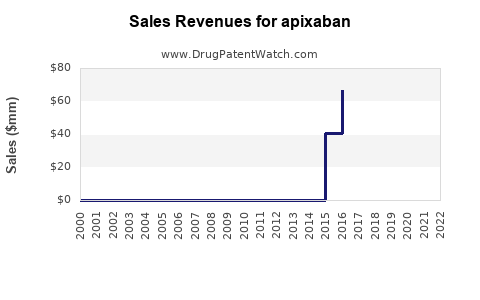
Bristol Myers Squibb reported worldwide Eliquis revenue of approximately $13.3 billion in 2024, up from about $12.6 billion in 2023 and $11.6 billion in 2022 (Bristol Myers Squibb, 2025).
| Year |
Reported worldwide Eliquis revenue, approximately |
| 2015 |
$2.0 billion |
| 2016 |
$3.4 billion |
| 2017 |
$4.9 billion |
| 2018 |
$6.4 billion |
| 2019 |
$7.9 billion |
| 2020 |
$9.2 billion |
| 2021 |
$10.2 billion |
| 2022 |
$11.6 billion |
| 2023 |
$12.6 billion |
| 2024 |
$13.3 billion |
The growth curve reflects increased anticoagulant adoption, expansion of the atrial-fibrillation market, greater use after venous thromboembolism, and continued replacement of warfarin. Eliquis became one of Bristol Myers Squibb’s largest products and a material contributor to Pfizer’s alliance revenue.
Revenue growth is now approaching maturity. The main financial variables are:
- U.S. prescription volume and refill persistence.
- Net price after rebates and payer discounts.
- Medicare Part D restructuring.
- The negotiated Medicare price effective in 2026.
- International generic penetration.
- Timing and breadth of U.S. generic launches.
- Patient switching between apixaban and other anticoagulants.
Bristol Myers Squibb faces a steep post-exclusivity exposure because Eliquis has unusually high sales concentration and a large chronic-use population. A rapid generic conversion could produce a multibillion-dollar annual decline in originator revenue.
When does apixaban lose U.S. exclusivity?
Apixaban’s U.S. market protection has several separate components. Regulatory exclusivity and patent protection do not end on the same date.
U.S. regulatory exclusivity
The FDA approved Eliquis in 2012. Its five-year new chemical entity exclusivity expired in 2017. That period blocked submission of an abbreviated new drug application for the same active ingredient, subject to statutory exceptions.
The product also received pediatric exclusivity associated with FDA-approved pediatric use. Pediatric exclusivity can extend relevant listed patent and regulatory protection by six months, but its practical impact depends on the patents and regulatory periods to which it attaches.
The commercial constraint is therefore patent protection, not remaining NCE exclusivity.
U.S. patent protection
The principal compound patent commonly associated with Eliquis is U.S. Patent No. 6,967,208. Public Orange Book data identify a listed expiration date of December 22, 2026, before any applicable pediatric extension. The relevant pediatric extension and patent-specific listing status must be read together with the current FDA Orange Book.
The main U.S. patent timeline is:
| Event |
Date |
| Apixaban compound patent filing priority |
1990s-era priority chain |
| U.S. Eliquis approval |
December 28, 2012 |
| Five-year NCE exclusivity |
Expired in 2017 |
| Principal listed compound patent expiration |
December 22, 2026 |
| Anticipated settlement-protected generic entry |
April 1, 2028 |
| Medicare negotiated price effective date |
January 1, 2026 |
The 2028 date is commercially more important than the nominal 2026 patent expiration because patent settlements can delay launch by agreement with specific ANDA applicants.
What patents protect Eliquis and apixaban formulations?
The core patent estate includes compound, formulation and use-related protection. The compound patent provides the central barrier, while formulation and method-of-use patents support litigation positions and can affect the scope of a generic applicant’s Paragraph IV certification.
Compound protection
U.S. Patent No. 6,967,208 covers apixaban-related chemical matter. It is the most commercially significant patent in the U.S. estate because it covers the active pharmaceutical ingredient rather than a narrow formulation or indication.
Formulation protection
Eliquis is supplied as immediate-release tablets at 2.5 mg and 5 mg strengths. Formulation-related patents may address tablet composition, solid dosage forms, manufacturing characteristics or pharmaceutical compositions. Their practical value depends on:
- Whether the patent is listed in the Orange Book.
- Whether the generic applicant seeks approval for the same formulation.
- Whether a design-around is commercially feasible.
- Whether the patent survives validity and infringement challenges.
- Whether the patent expires before the compound patent.
Formulation patents generally provide a narrower barrier than a compound patent. They can still delay a launch if the ANDA applicant cannot certify non-infringement or formulate around the claims without changing the approved product profile.
Method-of-use protection
Eliquis patents and regulatory labeling cover uses including prevention of stroke and systemic embolism in nonvalvular atrial fibrillation and treatment or prevention of DVT and PE. Method-of-use patents can create partial barriers when a generic applicant uses a section viii “skinny label” that omits a patented indication.
Their commercial effect is limited when the major unprotected indications generate substantial volume or when physicians prescribe the generic for all clinically accepted uses. Courts and regulators examine whether labeling, marketing and distribution practices induce infringement.
What is the Orange Book status of apixaban?
The FDA Orange Book identifies patents associated with approved Eliquis products and provides patent expiration information used by ANDA applicants. Generic applicants must address listed patents through one of four principal certifications:
- Paragraph I: no patent information is listed.
- Paragraph II: the patent has expired.
- Paragraph III: the applicant will wait for patent expiration.
- Paragraph IV: the patent is invalid, unenforceable or will not be infringed.
A Paragraph IV certification creates litigation risk for the applicant and can trigger a 30-month stay of FDA approval if the patent holder files suit within the statutory period. The stay does not itself guarantee patent validity or prevent settlement.
The relevant Orange Book analysis must separate:
- Listed patents for the 2.5 mg and 5 mg tablets.
- Expiration dates before and after pediatric extension.
- Patents that are compound claims versus formulation or use claims.
- Whether individual ANDAs have Paragraph IV certifications.
- Whether settlement agreements restrict launch timing.
Which companies have challenged apixaban patents?
Multiple generic manufacturers have pursued or prepared ANDA challenges to Eliquis patents. Publicly reported challengers and settlement counterparties have included major generic companies such as Teva Pharmaceuticals, Sandoz, Zydus Pharmaceuticals, Sigmapharm Laboratories and other ANDA applicants.
The litigation structure has involved coordinated or parallel actions by Bristol Myers Squibb and Pfizer against ANDA filers. The originators have sought to preserve the compound patent and related listed patents until the settlement-protected launch date.
The number and identity of ANDA filers can change as applications are transferred, acquired or withdrawn. The economic significance is less the number of challengers than the number capable of launching simultaneously. A broad multi-manufacturer launch normally accelerates price erosion.
What is the status of apixaban patent litigation and settlements?
Bristol Myers Squibb and Pfizer reached settlements with numerous generic applicants. Those agreements generally provide a license for entry on April 1, 2028, subject to potential earlier entry under specified conditions, such as loss of patent protection, authorized generic arrangements or other contractual triggers.
| Litigation issue |
Commercial effect |
| Paragraph IV certifications |
Created invalidity and non-infringement disputes |
| Originator patent suits |
Supported statutory approval stays |
| Generic settlements |
Reduced near-term litigation uncertainty |
| April 1, 2028 license date |
Establishes a principal generic launch target |
| Multiple licensed entrants |
Raises risk of rapid price erosion |
| Possible earlier-entry clauses |
Create launch-date uncertainty for forecasts |
The settlements reduce binary litigation risk but do not eliminate market risk. Generic companies may still compete aggressively after the licensed date. The originators also remain exposed to potential patent invalidity findings, at-risk launches, authorized-generic strategies and regulatory changes.
How does apixaban compare with rivaroxaban and warfarin?
| Factor |
Apixaban |
Rivaroxaban |
Warfarin |
| Brand |
Eliquis |
Xarelto |
Coumadin and generics |
| Mechanism |
Factor Xa inhibitor |
Factor Xa inhibitor |
Vitamin K antagonist |
| Routine INR monitoring |
No |
No |
Usually required |
| Dosing profile |
Often twice daily |
Often once daily, indication-dependent |
Variable |
| Generic status |
U.S. launch expected after settlement period |
Generic competition emerging or established in some markets |
Generic |
| Main commercial strength |
Broad clinical adoption and safety profile |
Once-daily convenience and broad indications |
Low cost |
| Main commercial weakness |
Twice-daily dosing and high branded cost |
Bleeding and adherence considerations |
Monitoring burden and drug-food interactions |
Apixaban’s twice-daily schedule is a competitive disadvantage against once-daily rivaroxaban for some patients. Its clinical evidence and perceived bleeding profile have supported premium positioning. Once generic apixaban becomes widely available, payer formularies are likely to favor it over branded Eliquis and may use it to pressure other direct oral anticoagulants.
How does Medicare price negotiation affect Eliquis revenue?
Eliquis was among the first 10 drugs selected for Medicare price negotiation under the Inflation Reduction Act. The negotiated maximum fair price took effect January 1, 2026. CMS reported a negotiated price of approximately $231 for a 30-day supply, compared with a 2023 list price of approximately $521, representing a reduction of about 56% (Centers for Medicare & Medicaid Services, 2024).
The impact is material because Medicare beneficiaries represent a large share of chronic atrial-fibrillation patients. The price reduction affects:
- Manufacturer net sales.
- Part D plan economics.
- Patient out-of-pocket costs.
- Generic substitution incentives.
- The value of delaying generic entry.
Medicare negotiation and generic competition are separate pressures. Negotiation lowers the branded net price before broad generic entry. Generic launch then creates additional substitution and rebate pressure.
What generic entry risks exist for apixaban?
The base-case U.S. scenario is a coordinated launch beginning April 1, 2028, followed by rapid price erosion. A practical forecast should include three scenarios.
| Scenario |
Launch timing |
Expected commercial outcome |
| Base case |
April 1, 2028 |
Multiple generic entrants; rapid branded volume and price decline |
| Earlier-entry case |
Before April 1, 2028 |
Accelerated erosion if a settlement trigger or patent event permits launch |
| Delayed-entry case |
After April 1, 2028 |
Delay caused by regulatory, manufacturing or litigation issues |
The first 12 to 24 months after launch are likely to determine the long-term revenue curve. A single authorized generic could moderate initial erosion, while an unrestricted multi-player launch could produce steep discounts. Pharmacy benefit managers may move generic apixaban to preferred tiers rapidly because the product is therapeutically substitutable and used by a large population.
Is there biosimilar risk for apixaban?
No. Apixaban is a chemically synthesized small molecule, not a biologic. It is subject to the ANDA generic pathway under section 505(j) of the Federal Food, Drug, and Cosmetic Act. The relevant regulatory risks are bioequivalence, formulation equivalence, manufacturing quality, labeling and patent certification.
Manufacturing barriers are meaningful but manageable. Generic manufacturers must control:
- Active pharmaceutical ingredient purity.
- Polymorphic or solid-state characteristics.
- Tablet dissolution.
- Content uniformity.
- Stability.
- High-volume supply reliability.
- Regulatory inspection compliance.
These requirements can delay an individual applicant but are unlikely to preserve long-term U.S. exclusivity for the originator once several suppliers are approved.
How strong is the apixaban patent estate?
The estate is commercially strong through the settlement-protected period but weaker after the principal compound patent expires.
| Strength factor |
Assessment |
| Compound patent |
Strongest protection; central to generic challenges |
| Formulation patents |
Potentially useful but narrower and more vulnerable to design-around |
| Method-of-use patents |
Can protect selected indications but may not block all generic use |
| Regulatory exclusivity |
Expired |
| Settlement coverage |
Broad, with principal entry date in 2028 |
| Biosimilar protection |
Not relevant |
| Manufacturing protection |
Supports supply control but is unlikely to block all generic production |
| Post-2028 durability |
Low relative to the pre-entry period |
The key risk is timing rather than the existence of additional patents. Once several generic companies receive launch rights, patent claims covering secondary formulations or indications are unlikely to preserve the full branded market.
What licensing deals support apixaban commercialization?
Bristol Myers Squibb and Pfizer established the Eliquis global alliance in 2007. Bristol Myers Squibb originated the program, while Pfizer contributed development and commercialization capabilities. The companies share commercial economics under their alliance arrangements, with regional accounting and profit allocations affecting reported revenue.
The alliance has two financial consequences:
- Eliquis revenue is divided between the companies rather than reported entirely by one originator.
- The product’s post-generic exposure affects both companies, although the accounting impact differs by region and revenue line.
The alliance increases global commercialization reach but does not remove the U.S. patent cliff.
What geographic coverage protects apixaban?
Apixaban has been approved in major markets including the United States, European Union, Japan and other jurisdictions. Patent expiry and generic-launch timing vary by country because protection depends on national filings, supplementary protection certificates, pediatric extensions, litigation and local regulatory rules.
| Region |
Principal market issue |
| United States |
Settlement-protected generic entry targeted for April 1, 2028 |
| European Union |
National and SPC timelines differ by country |
| Japan |
Local regulatory and patent timing govern entry |
| Emerging markets |
Generic competition may precede U.S. entry |
| China and other regulated markets |
Local approval, patent linkage and reimbursement rules affect launch |
International erosion can begin before U.S. entry. Global revenue forecasts should therefore avoid treating April 2028 as a universal apixaban loss-of-exclusivity date.
What is the financial outlook for apixaban?
Eliquis should remain a high-revenue product through 2026 and 2027, but growth is likely to slow because of Medicare price negotiation, mature penetration and payer pressure. The major decline is expected after broad U.S. generic entry.
A reasonable commercial sequence is:
- 2025: mature branded growth with rising policy and payer pressure.
- 2026: Medicare negotiated pricing reduces U.S. net revenue.
- 2027: continued branded demand, but generic preparations and formulary planning intensify.
- 2028: licensed generic launch creates sharp U.S. erosion.
- 2029 onward: branded Eliquis becomes a smaller maintenance product, with residual demand from brand-loyal patients, restricted formularies and markets with slower substitution.
The revenue decline could exceed the simple percentage loss in prescriptions because price reductions, rebates and mandatory generic substitution may occur simultaneously.
Key Takeaways
- Apixaban is marketed as Eliquis by Bristol Myers Squibb and Pfizer.
- Worldwide Eliquis sales reached approximately $13.3 billion in 2024.
- The five-year NCE exclusivity period expired in 2017.
- U.S. Patent No. 6,967,208 is the principal compound patent, with a publicly listed expiration date of December 22, 2026.
- Generic settlements establish April 1, 2028 as the principal U.S. entry date for participating applicants.
- Eliquis is subject to generic, not biosimilar, competition.
- Medicare’s negotiated price became effective January 1, 2026.
- The most significant value risk is rapid multi-player generic substitution after U.S. launch.
- Formulation and method-of-use patents may narrow generic strategies but are unlikely to preserve the full market after compound protection ends.
- International generic erosion can precede the U.S. launch date.
FAQs About Apixaban Patent Expiration and Market Competition
When will generic Eliquis be available in the United States?
The principal settlement-protected date is April 1, 2028, subject to contractual provisions that may permit earlier entry in defined circumstances.
Is apixaban the same as Eliquis?
Yes. Apixaban is the active pharmaceutical ingredient. Eliquis is the originator brand marketed by Bristol Myers Squibb and Pfizer.
Will Medicare negotiation eliminate Eliquis exclusivity?
No. Medicare negotiation reduces the negotiated price for eligible Medicare sales. It does not invalidate patents or authorize generic entry.
Can a generic company launch apixaban with a skinny label?
Potentially. A section viii statement may omit patented indications, but the generic applicant must avoid infringement and inducement risks associated with labeling, marketing and distribution.
Does apixaban have biosimilars?
No. Apixaban is a small-molecule drug. Future competitors will use the abbreviated generic-drug pathway rather than the biosimilar pathway.
References
-
Bristol Myers Squibb. (2025). 2024 annual report. Bristol Myers Squibb Company.
-
Centers for Medicare & Medicaid Services. (2024). Medicare drug price negotiation program: Negotiated prices for the first 10 Medicare Part D drugs. U.S. Department of Health and Human Services.
-
U.S. Food and Drug Administration. (2012). Eliquis (apixaban) prescribing information, NDA 202155. FDA.
-
U.S. Food and Drug Administration. (2025). Approved drug products with therapeutic equivalence evaluations: Orange Book. FDA.
-
U.S. Patent and Trademark Office. (2005). U.S. Patent No. 6,967,208: Pyridone derivatives as factor Xa inhibitors. USPTO.
-
Pfizer Inc. (2025). 2024 annual report. Pfizer Inc.