Last updated: August 12, 2026
Tretinoin is a mature, largely generic retinoid with two distinct commercial markets: topical dermatology and oral oncology. Topical tretinoin has broad demand for acne, photoaging, and hyperpigmentation, while oral tretinoin is used for acute promyelocytic leukemia (APL). The molecule has limited remaining composition-of-matter protection, weak traditional patent barriers, and substantial generic competition. Commercial value is shifting from the active ingredient to branded formulations, delivery systems, patient adherence, distribution, and specialty dermatology marketing.
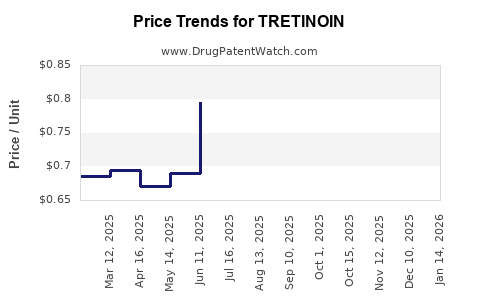
The financial trajectory is therefore mixed. Unit volumes can remain durable or expand, but conventional generic pricing is under pressure. Branded topical products can sustain premium pricing when they improve tolerability, cosmetic acceptability, stability, or convenience.
What is tretinoin and how is it used?
Tretinoin, also known as all-trans retinoic acid or ATRA, is a vitamin A derivative available in topical and oral dosage forms.
| Segment |
Main indications |
Commercial product types |
Competitive profile |
| Topical dermatology |
Acne vulgaris, fine wrinkles, mottled facial hyperpigmentation |
Cream, gel, lotion, microsphere gel |
Highly generic, with branded formulation niches |
| Oral oncology |
Induction of remission in APL |
10 mg capsules |
Generic and specialty oncology competition |
| Compounded use |
Dermatology and cosmetic applications |
Pharmacy-compounded creams and gels |
Fragmented, limited traditional patent protection |
The FDA approved oral tretinoin for APL in 1995. APL treatment is usually combined with arsenic trioxide or chemotherapy depending on risk category and treatment protocol. The National Cancer Institute describes ATRA as a core component of APL therapy because it induces differentiation of malignant promyelocytes [1].
Topical tretinoin products are approved for acne. Use for photoaging and other cosmetic or dermatologic conditions is widespread but does not create a single uniform regulatory market because some uses are prescription, some are off-label, and some products are marketed for cosmetic skin-care purposes.
How large is the tretinoin market?
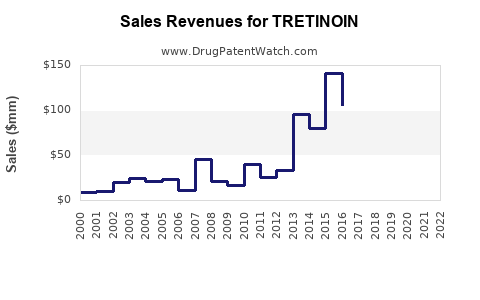
No single public financial database captures all prescription, generic, branded, compounded, international, and cosmetic tretinoin sales. Public-company reporting generally does not disclose tretinoin revenue separately. The market is best analyzed by commercial segment rather than by one consolidated global figure.
Topical dermatology market
Topical tretinoin has the larger addressable patient population. Demand is supported by:
- Persistent acne prevalence among adolescents and adults.
- Long-term maintenance treatment.
- Dermatology telehealth and online prescribing.
- Expansion of aesthetic dermatology.
- Consumer awareness of retinoids for photoaging.
- Availability of low-cost generic products.
The market has several price tiers:
- Commodity generic creams and gels.
- Generic microsphere or lotion products with improved tolerability.
- Branded prescription formulations with proprietary vehicles.
- Compounded products.
- Nonprescription cosmetic retinoids, primarily retinol or retinaldehyde rather than tretinoin.
The commercial distinction between tretinoin and retinol is important. Tretinoin is a prescription active pharmaceutical ingredient with stronger clinical and regulatory positioning. Retinol products compete for consumers interested in anti-aging but do not generally offer the same active ingredient or prescription-level positioning.
Oral oncology market
The oral oncology market is smaller in patient volume but strategically important because APL treatment is medically necessary and diagnosis is concentrated within specialty care. Product demand is linked to leukemia incidence, treatment protocols, hospital purchasing, and generic availability.
Oral tretinoin is not a high-growth oncology asset. It is a mature supportive or disease-directed therapy within established APL regimens. Revenue is constrained by:
- Low disease incidence relative to common cancers.
- Generic competition.
- Limited differentiation among capsule products.
- Institutional purchasing pressure.
- Treatment substitution or combination with arsenic trioxide.
Its commercial value is based on reliable supply and regulatory compliance rather than durable premium pricing.
When did tretinoin lose exclusivity?
Tretinoin’s original active-ingredient protection expired decades ago. The molecule entered generic competition in both topical and oral markets well before the current period.
| Protection category |
Status |
| Original active-ingredient patent |
Expired |
| Original oral product exclusivity |
Expired |
| Original topical product exclusivity |
Expired |
| Topical formulation patents |
Historically used, but most major foundational barriers have expired or weakened |
| Current product-specific formulation protection |
Potentially relevant for newer branded lotions, vehicles, or delivery systems |
| Regulatory exclusivity for established products |
Generally expired |
The key commercial issue is that tretinoin is no longer protected as a molecule. Any defensible premium must come from a formulation, manufacturing process, delivery system, label, brand, or distribution channel.
What is the FDA regulatory status of tretinoin?
The FDA regulates tretinoin differently according to dosage form and indication.
Oral tretinoin
The FDA approved Vesanoid, an oral tretinoin product, for APL. Generic versions are approved through abbreviated new drug applications, or ANDAs, when they demonstrate pharmaceutical equivalence and bioequivalence to the reference product [2].
The oral product is subject to oncology labeling, dosing, safety monitoring, and significant adverse-event warnings. Key risks include differentiation syndrome, leukocytosis, intracranial hypertension, hepatotoxicity, and teratogenicity [3].
Topical tretinoin
Topical tretinoin is approved for acne in several dosage forms and concentrations, including:
- Cream
- Gel
- Microsphere gel
- Lotion
Common strengths include 0.025%, 0.05%, and 0.1%, although product availability differs by manufacturer and dosage form.
Topical products can receive regulatory and commercial differentiation through:
- Reduced irritation.
- Improved spreadability.
- Better moisturization.
- Controlled release.
- Improved stability.
- Lower transfer or staining.
- More convenient once-daily administration.
The FDA’s approval of newer lotion products shows that delivery technology can support a branded product even when the active ingredient is generic [4].
What patents protect tretinoin products?
The primary patent value in tretinoin is formulation protection rather than molecule protection.
Formulation patents
Potentially protectable features include:
- Oil-in-water or water-based emulsions.
- Microsphere delivery systems.
- Controlled-release particles.
- Stabilized tretinoin compositions.
- Combination formulations.
- Preservative systems.
- Solubilization techniques.
- Packaging that limits light or oxygen exposure.
- Manufacturing methods that improve uniformity or stability.
Older microsphere and controlled-release technologies have faced generic competition. Newer branded products may still rely on formulation patents, but the strength of those patents depends on claim scope, prosecution history, prior art, and whether an ANDA applicant can design around them.
Method-of-use patents
Method-of-use protection is narrower for tretinoin than for many newer specialty medicines. Acne treatment is an established use with extensive prior art. Potentially differentiated claims may relate to:
- Specific dosing schedules.
- Combination treatment.
- Patient subgroups.
- Treatment sequencing.
- Reduction of irritation.
- Adjunctive use with other dermatologic agents.
Such patents usually provide less protection than composition-of-matter patents and can be vulnerable to obviousness and written-description challenges.
Orange Book status
The FDA Orange Book lists approved drug products and certain patents or exclusivity information for eligible products. For mature generic tretinoin products, the Orange Book generally does not create a broad, molecule-level barrier to competition [5].
The commercial review should be product-specific. A branded lotion may have listed formulation patents even though generic tretinoin cream remains widely available. The existence of a patent listing does not establish that the patent will block market entry; enforceability, infringement, validity, and the applicant’s certification must be assessed separately.
How many patents cover tretinoin?
There is no meaningful single patent count for “tretinoin” because the relevant universe changes by:
- Topical versus oral product.
- Brand versus generic product.
- Jurisdiction.
- Formulation.
- Patent family.
- Expired versus unexpired claims.
- Product-specific Orange Book listings.
At the active-ingredient level, the estate is effectively exhausted. At the formulation level, the estate is fragmented and uneven. A commercial diligence review should count patent families by product and remove expired, abandoned, terminally disclaimed, and non-infringed claims before estimating exclusivity.
A practical strength assessment is:
| Patent layer |
Strength |
Commercial implication |
| Active ingredient |
Very low |
No meaningful barrier to generic tretinoin |
| Basic topical dosage forms |
Low |
Broad generic substitution |
| Microsphere or controlled-release delivery |
Low to moderate |
May delay or complicate specific product launches |
| New lotion or emulsion vehicle |
Moderate, product-dependent |
Can support premium pricing if claims survive |
| Manufacturing and packaging |
Low to moderate |
More useful as a secondary barrier |
| Method of use |
Low to moderate |
Narrow scope and litigation vulnerability |
Which companies compete in tretinoin?
Competition is fragmented across manufacturers, contract suppliers, specialty dermatology companies, and compounding pharmacies.
Branded and specialty dermatology companies
Ortho Dermatologics, a division associated with Bausch Health, commercialized Altreno lotion, a 0.05% tretinoin formulation for acne. Its commercial proposition is based on the lotion vehicle and tolerability profile rather than a new active ingredient [4].
Historically, Valeant and Bausch-affiliated businesses also commercialized several dermatology products, including branded tretinoin formulations and combination products. Product ownership and commercialization rights can vary by jurisdiction and over time.
Generic manufacturers
Generic topical tretinoin has been marketed by multiple manufacturers, including large generic drug companies and smaller dermatology-focused suppliers. Generic competition typically concentrates on:
- 0.025%, 0.05%, and 0.1% strengths.
- Cream and gel products.
- Pharmacy benefit manager formularies.
- Retail and mail-order distribution.
- Wholesale acquisition cost and reimbursement.
The market is more competitive for standard cream and gel products than for newer lotion or microsphere formats.
Compounding pharmacies
Compounding pharmacies can supply customized tretinoin concentrations and combination products. They compete on price, personalization, and direct-to-consumer distribution. Their products generally do not provide the same FDA-approved product status as approved drug products, and their role varies by state and prescribing channel.
What generic entry risks exist for branded tretinoin?
Generic entry risk is high for conventional products and moderate for differentiated formulations.
| Product type |
Generic entry risk |
Main reason |
| Standard tretinoin cream |
Very high |
Long-established formulation and multiple suppliers |
| Standard tretinoin gel |
Very high |
Mature generic market |
| Microsphere gel |
High |
Technology has been available for years |
| Branded lotion |
Moderate to high |
Formulation patents and possible bioequivalence complexity |
| Oral 10 mg capsules |
Very high |
Mature APL product with generic supply |
| Combination or specialty formulation |
Product-specific |
May depend on formulation and use patents |
An ANDA applicant can challenge listed patents through a Paragraph IV certification, asserting that a patent is invalid, unenforceable, or will not be infringed. The brand may file an infringement action within the statutory period, triggering a potential 30-month stay of approval under the Hatch-Waxman framework [6].
For tretinoin, Paragraph IV risk is most relevant to branded formulation products. It is less relevant to ordinary generic creams and capsules because the foundational patents have expired.
What patent litigation and settlement agreements affect tretinoin?
Tretinoin has had historical formulation and generic-competition disputes, but it is not currently comparable to a high-value protected specialty drug with extensive active Paragraph IV litigation.
For a branded product, the principal litigation questions are:
- Whether the listed patent claims cover the ANDA formulation.
- Whether the generic has made a permitted design-around.
- Whether the patent is valid over prior microsphere, emulsion, or lotion technology.
- Whether the brand has listed patents in the relevant jurisdiction.
- Whether a settlement permits an agreed launch date.
- Whether the generic can launch at risk before final judgment.
Publicly visible evidence does not indicate a current, molecule-wide litigation barrier that would materially restrict generic tretinoin supply. Any settlement analysis must be conducted at the product level because a settlement involving one lotion or microsphere product does not protect the broader tretinoin market.
How does tretinoin compare with competing retinoids?
| Drug |
Primary market |
Patent position |
Commercial status |
| Tretinoin |
Acne, photoaging, APL |
Mature and largely expired |
Low-cost generic base with branded formulation niches |
| Adapalene |
Acne |
Mature; nonprescription and generic competition |
Strong consumer reach |
| Tazarotene |
Acne, plaque psoriasis |
Product-specific formulation protection in some products |
More differentiated prescription segment |
| Trifarotene |
Acne |
Newer product with stronger active and formulation protection |
Higher branded price, lower generic risk |
| Retinol |
Cosmetic anti-aging |
Cosmetic formulation and brand protection |
Large consumer market, weaker drug positioning |
| Isotretinoin |
Severe acne |
Generic oral product |
Distinct safety and monitoring requirements |
Tretinoin competes most directly with adapalene and tazarotene in prescription acne therapy. Trifarotene has a newer product profile and a stronger opportunity for active patent protection. Retinol competes for the broader anti-aging consumer but is not a direct regulatory substitute for prescription tretinoin.
What is the financial trajectory for tretinoin?
Tretinoin’s financial trajectory is best characterized as stable-to-mature for the active ingredient and selectively positive for differentiated topical products.
Revenue drivers
- Persistent prescription demand.
- Broad generic availability.
- Repeat use in acne and maintenance therapy.
- Dermatology telehealth growth.
- Expansion of branded skin-care channels.
- Premium pricing for better-tolerated vehicles.
- Oncology demand for APL treatment.
Revenue constraints
- Generic price erosion.
- Pharmacy benefit manager substitution.
- Limited differentiation for standard dosage forms.
- Low treatment cost for ordinary products.
- Competition from adapalene and cosmetic retinoids.
- Small oral oncology patient population.
- Manufacturing and supply-chain risks for low-margin generics.
The strongest commercial opportunity is not a new tretinoin molecule. It is a differentiated dermatology platform that improves adherence or tolerability and can maintain reimbursement or cash-pay pricing. The weakest opportunity is an undifferentiated standard cream or capsule without a supply, cost, or distribution advantage.
What manufacturing and intellectual-property barriers exist?
Manufacturing barriers are modest for standard tretinoin but higher for advanced topical formulations.
Tretinoin is light-sensitive and susceptible to degradation. Manufacturers must control:
- Raw-material quality.
- Assay and impurity profile.
- Particle size.
- Homogeneity.
- Photostability.
- Oxidative stability.
- Packaging compatibility.
- Microbiological quality.
- Batch-to-batch consistency.
For standard creams and gels, contract manufacturing capacity is broadly available. For microsphere, lotion, or controlled-release formulations, process know-how can be more important than the patent estate. Regulatory comparability and topical bioequivalence requirements can also delay generic approval, particularly where local drug delivery is difficult to characterize.
What is the outlook for investors and licensees?
Tretinoin is unlikely to produce large growth through molecule-level exclusivity. Commercial value is concentrated in assets with one or more of the following characteristics:
- A defensible proprietary vehicle.
- Strong dermatologist adoption.
- High adherence or tolerability.
- Exclusive pharmacy or telehealth distribution.
- Favorable reimbursement.
- Low-cost, reliable generic manufacturing.
- Combination therapy with a differentiated clinical label.
- International licensing rights in markets with weaker generic penetration.
Licensing value should be discounted heavily where the asset depends only on the tretinoin name or standard cream formulation. A branded formulation may justify a higher valuation, but the analysis must account for Paragraph IV exposure, patent expiry, formulary substitution, and the availability of generic alternatives.
Key Takeaways
- Tretinoin is a mature generic molecule with no meaningful remaining composition-of-matter exclusivity.
- Topical dermatology is the larger commercial market; oral APL treatment is smaller and more specialized.
- Standard creams, gels, and 10 mg capsules face high generic competition.
- Formulation, delivery-system, manufacturing, and packaging patents provide the main potential barriers.
- Branded lotions can support premium pricing, but product-specific patent durability is critical.
- Paragraph IV risk is concentrated in newer branded formulations rather than ordinary tretinoin products.
- Public-company revenue disclosure is generally not granular enough to isolate tretinoin sales.
- The most attractive commercial opportunities involve differentiated topical delivery, adherence, tolerability, or distribution.
- The financial profile is mature and cash-generative at scale, but unlikely to support molecule-level growth without formulation innovation.
Frequently Asked Questions About Tretinoin Market and Exclusivity
Is tretinoin still patent protected?
The tretinoin molecule is no longer protected by meaningful active-ingredient exclusivity. Some branded formulations may have product-specific patents.
Can a generic company launch tretinoin without a Paragraph IV challenge?
Yes. Standard tretinoin products can generally rely on expired foundational protection or file against any remaining product-specific patents through the applicable ANDA certification pathway.
Does Altreno have stronger protection than generic tretinoin cream?
Potentially. Altreno’s commercial differentiation is its lotion formulation, but the strength and duration of protection depend on the specific patent claims, expiration dates, and generic product design.
Is oral tretinoin a biosimilar-risk product?
No. Tretinoin is a chemically synthesized small molecule, not a biologic. Competition proceeds through generic-drug pathways rather than biosimilar approval.
Will tretinoin prices continue to decline?
Standard generic prices are likely to remain under pressure. Branded formulation prices may remain higher if the product demonstrates adherence, tolerability, reimbursement, or distribution advantages.
References
-
National Cancer Institute. (n.d.). Acute promyelocytic leukemia treatment. U.S. National Institutes of Health.
-
U.S. Food and Drug Administration. (1995). Vesanoid (tretinoin) prescribing information. FDA.
-
U.S. Food and Drug Administration. (2024). Tretinoin capsules prescribing information. FDA.
-
U.S. Food and Drug Administration. (2018). Altreno (tretinoin) lotion prescribing information. FDA.
-
U.S. Food and Drug Administration. (2024). Approved drug products with therapeutic equivalence evaluations: Orange Book. FDA.
-
U.S. Food and Drug Administration. (2023). Hatch-Waxman amendments and abbreviated new drug applications. FDA.