Last updated: August 15, 2026
RETIN-A is the original branded topical tretinoin product for acne vulgaris. Its core composition patents and regulatory exclusivity have expired, leaving the product exposed to generic competition. The commercial franchise remains relevant because tretinoin is a standard topical retinoid, but the brand’s financial trajectory is constrained by low-cost generics, limited differentiation, and the absence of publicly reported RETIN-A-specific revenue.
What is RETIN-A and who markets it?
RETIN-A contains tretinoin, a topical retinoid derived from vitamin A. The product was originally developed and commercialized by Ortho Pharmaceutical. The brand is now associated with Bausch Health’s dermatology business, generally marketed through Ortho Dermatologics and related Bausch entities.
RETIN-A has historically been sold in several topical forms:
| Product |
Active ingredient |
Dosage form |
Primary use |
Commercial status |
| RETIN-A |
Tretinoin |
Cream, gel, liquid |
Acne vulgaris |
Mature branded product with generic competition |
| RETIN-A Micro |
Tretinoin |
Microsphere gel |
Acne vulgaris |
Branded formulation with generic competition |
| Altreno |
Tretinoin 0.05% |
Lotion |
Acne vulgaris |
Newer branded tretinoin product, separate from original RETIN-A |
| Generic tretinoin |
Tretinoin |
Cream, gel, lotion, microsphere gel |
Acne vulgaris and other dermatologic uses |
Broad generic availability |
The FDA approved tretinoin topical products for acne decades ago. RETIN-A’s market position depends less on regulatory exclusivity than on brand recognition, physician familiarity, distribution, formulation preferences, and patient willingness to pay for a branded product.[1]
What is the FDA regulatory status of RETIN-A?
RETIN-A is an FDA-approved prescription topical drug. Tretinoin products are regulated as small-molecule drugs, not biologics. The principal regulatory pathway for competing products is an abbreviated new drug application, or ANDA, rather than a biosimilar application.
The FDA-approved indication for the original RETIN-A franchise is treatment of acne vulgaris. Tretinoin is also widely used in dermatology for photoaging, dyschromia, and skin texture, although the regulatory status of those uses varies by product, label, and jurisdiction.
The relevant regulatory characteristics are:
- Prescription-only status in the United States.
- Small-molecule active ingredient.
- Multiple approved topical dosage forms.
- Generic substitution at the pharmacy level, subject to state law and product-specific substitution rules.
- No biologic exclusivity period.
- No biosimilar pathway applicable to tretinoin.
The existence of several approved formulations matters commercially. Creams, gels, lotions, and microsphere products differ in vehicle, tolerability, spreadability, drying effects, and patient adherence. Those differences create some room for branded positioning even after active-ingredient patents expire.
What patents protect RETIN-A?
The original RETIN-A composition and use patents are expired. The remaining intellectual-property value is concentrated in later formulation patents, delivery systems, manufacturing processes, trademarks, and brand recognition.
Original tretinoin patents
The foundational patents covering tretinoin for topical dermatologic use date from the early commercial development of RETIN-A. Those patents expired many years ago. They no longer prevent generic manufacturers from selling equivalent tretinoin products.
The expired core estate means that a competitor generally does not need to invent a new active ingredient to enter the market. It can develop a product with the same active ingredient and demonstrate pharmaceutical equivalence and bioequivalence or other applicable requirements under the FDA’s ANDA framework.
RETIN-A Micro formulation patents
RETIN-A Micro used a microsphere delivery system intended to control tretinoin release and improve tolerability. The microsphere technology created a second layer of intellectual-property protection beyond the original cream and gel products.
That protection has also aged substantially. Generic tretinoin microsphere products have entered the U.S. market, reducing the exclusivity value of the branded product. Any remaining formulation claims must be evaluated patent by patent, including claim scope, expiration, terminal disclaimers, pediatric extensions, and whether the patent is listed in the FDA Orange Book.[2]
What formulations are protected by RETIN-A patents?
The commercial formulation categories historically associated with RETIN-A include:
- Conventional tretinoin cream.
- Conventional tretinoin gel.
- Liquid or solution formulations.
- Microsphere gel formulations.
- Later lotion-based tretinoin products, including Altreno.
Formulation patents can protect excipient combinations, particle size, delivery systems, release profiles, stability, and manufacturing methods. They do not automatically block every generic tretinoin product. A generic manufacturer can avoid a formulation patent by using a different vehicle or by challenging the patent’s validity or infringement position.
What is the Orange Book status of RETIN-A?
The Orange Book is the principal FDA reference for approved drug products, therapeutic equivalence codes, and certain listed patents. RETIN-A’s core commercial problem is that its foundational patents are expired and generic tretinoin products have received FDA approval.
The Orange Book analysis should separate three questions:
- Whether the branded product has an active listed patent.
- Whether an ANDA applicant must make a Paragraph IV certification.
- Whether the generic product has an AB therapeutic-equivalence rating.
For mature tretinoin products, the relevant competitive pathway is generally an ANDA with certifications addressing listed patents. Once blocking patents expire or are removed, generic launch risk becomes substantially higher.
The precise Orange Book status can differ by product, strength, dosage form, and NDA. RETIN-A, RETIN-A Micro, and Altreno should not be treated as a single legal asset. Each product may have a separate NDA, label, patent listing history, and generic competition profile.[2]
When did RETIN-A lose exclusivity?
RETIN-A lost effective market exclusivity in stages rather than on one date.
| Exclusivity layer |
Approximate status |
| Original active-ingredient and acne-treatment patents |
Expired |
| Original branded product exclusivity |
Expired |
| Conventional tretinoin generic entry |
Established |
| Microsphere formulation differentiation |
Eroded by generic competition |
| Trademark protection for RETIN-A name |
Potentially continuing |
| Brand-level commercial differentiation |
Continuing but limited |
The brand may retain trademark rights even though patent rights have expired. Trademark protection does not prevent competitors from selling tretinoin under different names. It protects the RETIN-A designation and related brand identifiers.
A later product such as Altreno may have had its own regulatory and patent strategy. That strategy should not be conflated with the patent position of legacy RETIN-A. A new formulation can obtain patent protection for its vehicle or delivery characteristics, but it remains exposed to design-around risk and eventual generic entry.
Which companies are challenging or competing with RETIN-A?
RETIN-A competes with both generic tretinoin manufacturers and branded topical retinoid products.
Generic competitors
Generic manufacturers commonly active in topical dermatology include:
- Perrigo and related generic businesses.
- Taro Pharmaceuticals.
- Actavis, now part of Teva.
- Mylan, now part of Viatris.
- Fougera and related dermatology manufacturers.
- Prasco and other authorized or branded-generic distributors.
- Contract manufacturers supplying pharmacy and telehealth channels.
The exact competitor set changes by dosage form and strength. Not every company markets every tretinoin concentration.
Branded retinoid competitors
RETIN-A also competes with:
- Differin, containing adapalene.
- Tazorac and generic tazarotene.
- Aklief, containing trifarotene.
- Winlevi, containing clascoterone, which is not a retinoid but competes in acne treatment.
- Combination products such as clindamycin/tretinoin.
- Compounded tretinoin products distributed through dermatology and telehealth platforms.
Adapalene has a significant commercial advantage because Differin 0.1% gel became available over the counter in the United States. Tretinoin remains primarily prescription-based, which supports physician control but creates access and price friction.
How strong is the RETIN-A patent estate?
The estate is weak as a barrier to conventional generic tretinoin and stronger only in narrow formulation or brand-specific areas.
| Patent factor |
Assessment |
| Core active ingredient protection |
Expired |
| Conventional cream and gel protection |
Largely expired |
| Microsphere delivery protection |
Materially eroded |
| Newer lotion formulation protection |
Product-specific and potentially stronger |
| Manufacturing know-how |
Potentially useful but difficult to quantify |
| Trademark and brand recognition |
Continuing |
| Generic entry barrier |
Low for conventional products |
| Litigation leverage |
Limited for legacy RETIN-A |
The principal remaining competitive assets are formulation know-how, physician familiarity, commercial distribution, patient loyalty, and the ability to differentiate tolerability. Those assets can support a premium but do not provide the market power associated with an unexpired composition patent.
What generic entry risks exist for RETIN-A?
Generic entry risk is high for legacy RETIN-A products. The main risks are price compression, pharmacy substitution, formulary displacement, and loss of new prescriptions to lower-cost alternatives.
Generic products can compete through:
- Lower acquisition cost.
- Broad wholesaler distribution.
- Multiple strengths and dosage forms.
- Pharmacy substitution.
- Insurance formulary preference.
- Online pharmacy and teledermatology channels.
- Authorized generic or branded-generic arrangements.
The strongest residual brand opportunity is in patients who experience different tolerability or cosmetic characteristics across vehicles. A cream may be preferred for dry skin, while a gel or lotion may be preferred for oilier skin. These differences can preserve some demand, but they rarely support the margins of a protected specialty drug.
What is the financial trajectory of RETIN-A?
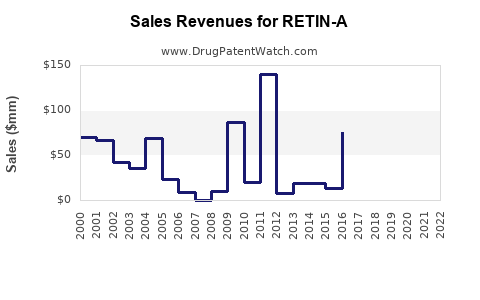
No publicly disclosed financial statements appear to report RETIN-A revenue as a standalone line item. Bausch Health reports at segment and portfolio levels, not with a separate audited revenue figure for legacy RETIN-A. Any precise RETIN-A revenue estimate should therefore be treated as a third-party market model rather than company-reported financial data.[3]
The likely financial trajectory is:
- Initial premium pricing during the protected branded period.
- Revenue decline after conventional generic entry.
- Margin compression as pharmacy substitution expands.
- Stabilization as a mature dermatology brand with residual direct-pay and physician-prescribed demand.
- Portfolio value shifting from the original product to differentiated formulations and newer products.
Revenue drivers
RETIN-A’s remaining revenue is shaped by:
- Acne prevalence and diagnosis rates.
- Dermatology visits and prescription volume.
- Insurance coverage and copay levels.
- Availability of generic strengths and dosage forms.
- Brand loyalty among dermatologists.
- Direct-to-consumer advertising and digital prescribing.
- Patient sensitivity to irritation and vehicle characteristics.
- Demand for off-label cosmetic use.
Revenue constraints
The main constraints are:
- Low-cost generic substitution.
- Limited patent protection.
- OTC access to competing adapalene.
- High patient discontinuation caused by irritation and dryness.
- Reduced willingness to pay for an older active ingredient.
- Increasing use of subscription telehealth products.
- Retail pharmacy and payer pressure.
RETIN-A is more likely to produce stable, mature-brand cash flow than high-growth pharmaceutical revenue. The growth opportunity sits in newer formulations, combination products, and digital dermatology channels rather than in the legacy product itself.
How does RETIN-A compare with competing topical retinoids?
| Product |
Active ingredient |
Access |
Differentiation |
Generic pressure |
| RETIN-A |
Tretinoin |
Prescription |
Original tretinoin brand |
High |
| Generic tretinoin |
Tretinoin |
Prescription |
Low price; multiple vehicles |
Very high |
| Differin |
Adapalene |
OTC at 0.1% strength |
Consumer access and tolerability |
Moderate to high |
| Tazarotene |
Tazarotene |
Prescription |
Potent retinoid activity |
High for legacy products |
| Aklief |
Trifarotene |
Prescription |
Newer retinoid positioning |
Lower while patents remain active |
| Altreno |
Tretinoin lotion |
Prescription |
Lotion vehicle and tolerability positioning |
Product-specific |
RETIN-A has the strongest historical brand recognition among tretinoin products. It does not have the strongest exclusivity position. Newer products can command higher prices when they offer differentiated tolerability, delivery, or clinical positioning.
What patent litigation and settlement issues affect RETIN-A?
Legacy RETIN-A litigation risk is limited compared with currently patented specialty drugs. The main historical disputes involved generic entry, formulation patents, ANDA certifications, and alleged infringement of microsphere or delivery-system claims.
For current competitive analysis, the relevant legal questions are:
- Whether a generic applicant made a Paragraph IV certification.
- Whether the NDA holder sued within the statutory 45-day period.
- Whether a 30-month stay applied.
- Whether the parties entered a settlement governing launch timing.
- Whether an authorized generic or license arrangement changed the launch economics.
- Whether the asserted patent covered the exact dosage form and strength.
A settlement can delay entry for a particular product, but it does not restore exclusivity across the entire tretinoin market. A competitor using a different formulation may enter independently.
What manufacturing and IP barriers remain?
Manufacturing barriers are modest for conventional tretinoin but higher for specialized delivery systems.
Tretinoin is sensitive to light, oxidation, and formulation conditions. Manufacturers must control:
- Active-ingredient uniformity.
- Stability and degradation.
- Packaging and light protection.
- Particle size or microsphere characteristics.
- Viscosity and spreadability.
- Microbial quality for topical products.
- Scale-up consistency.
These requirements can slow entry or create product-quality problems, but they are not equivalent to a patent barrier. A company with established topical manufacturing, dermatology distribution, and regulatory experience has an advantage over a new entrant.
Geographically, the patent and regulatory analysis differs by jurisdiction. U.S. patents may have expired while separate national rights once applied in Europe, Canada, Japan, or other markets. Trademark ownership and prescription status also vary by country. Global market access therefore depends on local approvals, national patent registers, reimbursement, and product classification.
What are the likely generic launch scenarios?
The most probable scenario for legacy RETIN-A is continued generic erosion with a residual branded market.
| Scenario |
Commercial effect |
| Continued generic substitution |
Lower brand volume and price |
| Brand maintains physician recognition |
Stable residual prescriptions |
| New lotion or vehicle gains adoption |
Partial premium retention |
| Payers favor generics more aggressively |
Faster revenue decline |
| Telehealth expands branded access |
Volume support but higher marketing costs |
| New formulation patents survive challenge |
Temporary protection for the specific product |
The original RETIN-A product is unlikely to regain material exclusivity. Financial upside depends on formulation innovation, channel strategy, and portfolio management rather than on the legacy patent estate.
Key Takeaways
- RETIN-A is a mature branded tretinoin product with expired core patent protection.
- Generic tretinoin creates high substitution and price-compression risk.
- RETIN-A Micro’s microsphere differentiation has been materially weakened by generic competition.
- No biosimilar risk applies because tretinoin is a small-molecule drug.
- The Orange Book analysis must distinguish RETIN-A, RETIN-A Micro, Altreno, strengths, dosage forms, and separate NDAs.
- Bausch Health does not publicly disclose RETIN-A-specific revenue, preventing a company-reported standalone financial forecast.
- Residual value comes from brand recognition, physician familiarity, formulation preference, and distribution.
- The most attractive growth opportunities are newer vehicles, combination products, and digital dermatology channels.
- Conventional generic entry barriers are low; specialized formulation and manufacturing barriers are higher but limited.
- RETIN-A’s likely financial profile is mature and cash-generative rather than high-growth.
FAQs
Is RETIN-A still patent protected?
The original tretinoin patents are expired. Any remaining protection is product-specific and may relate to later formulations, delivery systems, manufacturing methods, or trademarks.
Can a pharmacy substitute generic tretinoin for RETIN-A?
Substitution depends on the specific product, therapeutic-equivalence rating, prescription instructions, and state pharmacy law. Pharmacies commonly dispense generic tretinoin when the approved generic is therapeutically equivalent and substitution is permitted.
Is RETIN-A more effective than generic tretinoin?
Approved generic tretinoin products contain the same active ingredient and are required to meet FDA standards applicable to their approval pathway. Patients may perceive differences because vehicles, excipients, irritation, and cosmetic feel vary.
Does RETIN-A have cosmetic-use revenue potential?
Yes. Tretinoin is widely used in dermatology for photoaging-related concerns, but commercial use must be separated from the FDA-approved acne indication. Cosmetic demand can support prescriptions, but it does not restore patent exclusivity.
Which RETIN-A product has the strongest commercial defense?
A differentiated formulation with superior tolerability, patient adherence, and surviving formulation claims has a stronger defense than conventional RETIN-A cream or gel. The original products face the highest generic pressure.
References
-
U.S. Food and Drug Administration. (n.d.). Drugs@FDA: FDA-approved drugs. https://www.accessdata.fda.gov/scripts/cder/daf/
-
U.S. Food and Drug Administration. (2024). Approved drug products with therapeutic equivalence evaluations, 44th edition. https://www.fda.gov/drugs/drug-approvals-and-databases/approved-drug-products-therapeutic-equivalence-evaluations-orange-book
-
Bausch Health Companies Inc. (2024). Annual report pursuant to Section 13 or 15(d) of the Securities Exchange Act of 1934. https://ir.bauschhealth.com/financial-information/annual-reports-and-proxy-statements
-
U.S. Food and Drug Administration. (n.d.). Orange Book patent and exclusivity information. https://www.fda.gov/drugs/drug-approvals-and-databases/orange-book-data-files
-
National Library of Medicine. (n.d.). DailyMed: Tretinoin topical drug labels. https://dailymed.nlm.nih.gov/dailymed/