Last updated: February 19, 2026
Quetiapine fumarate, an atypical antipsychotic, has established a significant market presence driven by its broad therapeutic applications in schizophrenia, bipolar disorder, and major depressive disorder. The market is characterized by the continued demand for both branded and generic formulations, influencing pricing strategies and R&D investments. Patent expiries for the original branded product have led to increased generic competition, impacting revenue streams but expanding patient access. The financial trajectory is shaped by the interplay of market volume, pricing pressures, regulatory approvals for new indications or formulations, and ongoing litigation.
What are the primary therapeutic indications for quetiapine fumarate?
Quetiapine fumarate is approved for the treatment of several central nervous system disorders. These include:
- Schizophrenia: It is used for the management of psychotic symptoms in adults and adolescents aged 13 years and older.
- Bipolar I Disorder: Quetiapine fumarate is indicated for manic episodes in adults and children aged 10 years and older, depressive episodes in adults and adolescents aged 10 years and older, and for maintenance treatment in adults.
- Major Depressive Disorder (MDD): It is approved as an adjunctive treatment in adults with MDD who have an inadequate response to antidepressant therapy.
The broad efficacy across these conditions underpins its sustained market demand.
How has the patent landscape for quetiapine fumarate evolved, and what is its impact?
The original patent for quetiapine fumarate, held by AstraZeneca for its branded product Seroquel, has long since expired. The primary U.S. patent (U.S. Patent No. 4,895,841) expired in 2007, with additional formulation and method-of-use patents expiring later.
The expiry of these foundational patents has facilitated the widespread entry of generic manufacturers. This has resulted in:
- Increased Generic Competition: Numerous companies now market generic versions of quetiapine fumarate, intensifying price competition.
- Reduced Branded Market Share: While branded Seroquel retains some market share due to brand loyalty and physician preference, its dominance has significantly diminished.
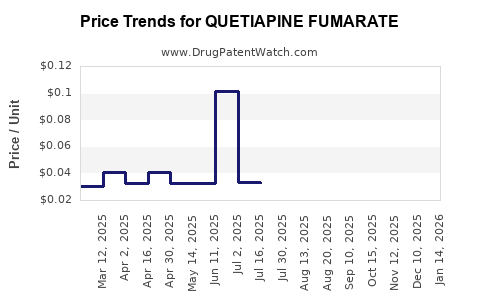
- Price Erosion: Genericization has led to a substantial decline in the average selling price of quetiapine fumarate products.
- R&D Focus Shift: With the core compound off-patent, research and development efforts have shifted towards:
- New formulations (e.g., extended-release, orally disintegrating tablets)
- Combination therapies
- Exploration of novel indications or patient sub-groups.
This dynamic has created a market where volume sales of generics are critical for manufacturers' revenue, while innovators focus on differentiated products or life cycle management.
What are the current market size and projected growth trends for quetiapine fumarate?
Estimating the precise current market size for quetiapine fumarate is complex due to the global availability of branded and generic products and varying reporting methodologies. However, industry analyses and sales data indicate a substantial and mature market.
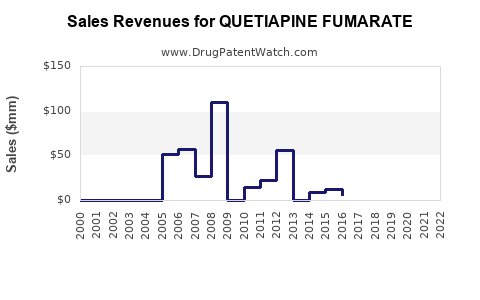
- Market Size: While specific figures fluctuate by source and year, the global market for quetiapine fumarate (including all its formulations and generics) has been valued in the billions of U.S. dollars annually. For instance, in 2022, the global quetiapine fumarate market was estimated to be worth approximately $5.0 billion to $7.0 billion (source estimation based on aggregated market reports).
- Growth Trends: The market for quetiapine fumarate is generally considered mature, with growth driven primarily by:
- Increasing Prevalence of Mental Health Disorders: Rising global rates of schizophrenia, bipolar disorder, and depression contribute to sustained demand.
- Generic Penetration: The widespread availability and affordability of generic quetiapine fumarate expand patient access, contributing to volume growth.
- Emerging Markets: Increased healthcare spending and improved access to medications in developing economies offer potential for volume expansion.
- New Indications/Formulations: While less impactful than for newer drugs, approvals for new uses or improved delivery methods can provide incremental growth.
Projected growth for the overall quetiapine fumarate market is typically modest, in the low to mid-single digits annually. For example, CAGR estimates for the next five to seven years range from 2.0% to 4.5% (source estimation based on aggregated market reports). This growth is more volume-driven than price-driven.
Who are the key players in the quetiapine fumarate market?
The quetiapine fumarate market comprises a mix of original innovators and numerous generic manufacturers.
Branded Product:
- AstraZeneca: The originator of Seroquel. While its market share has decreased, it still holds a presence, particularly with its extended-release formulations.
Major Generic Manufacturers:
The generic market is highly fragmented. Key players include, but are not limited to:
- Teva Pharmaceutical Industries
- Mylan N.V. (now part of Viatris)
- Sun Pharmaceutical Industries
- Lupin Limited
- Dr. Reddy's Laboratories
- Aurobindo Pharma
- Hetero Labs
- Amneal Pharmaceuticals
These companies compete primarily on price, manufacturing efficiency, and market access within various geographical regions.
What are the pricing dynamics and revenue generation strategies for quetiapine fumarate?
Pricing dynamics for quetiapine fumarate are significantly influenced by its generic status.
- Branded Pricing: AstraZeneca's Seroquel and its extended-release versions (Seroquel XR) were priced at premium levels during their patent-protected periods. Post-patent expiry, prices for branded Seroquel XR have also faced downward pressure but may retain a slight premium over generics due to formulation advantages or established physician trust.
- Generic Pricing: Generic quetiapine fumarate is subject to intense price competition. Prices are driven by:
- Manufacturing Costs: Efficiency in production and raw material sourcing.
- Market Share Goals: Companies often engage in aggressive pricing to capture or maintain market share.
- Reimbursement Policies: Payer formularies and preferred drug lists can influence which generics are favored.
- Volume: The primary revenue generation strategy for generic manufacturers is high-volume sales.
Revenue Generation Strategies:
- Generic Manufacturers: Focus on cost-effective manufacturing, large-scale distribution, and securing favorable contracts with pharmacy benefit managers (PBMs) and payers.
- Innovator (AstraZeneca): While focusing on newer assets, AstraZeneca continues to generate revenue from Seroquel XR through life cycle management strategies, such as introducing improved formulations or defending remaining patents. They also leverage their established sales force and physician relationships.
- Differentiated Formulations: Companies may develop and market extended-release or orally disintegrating tablet (ODT) versions of quetiapine fumarate. These can command a slightly higher price than immediate-release generics and may be favored by specific patient populations or prescribers, creating niche revenue streams.
What is the regulatory landscape and its impact on quetiapine fumarate?
The regulatory environment is critical for quetiapine fumarate. Key aspects include:
- FDA and EMA Approvals: Initial approvals by regulatory bodies like the U.S. Food and Drug Administration (FDA) and the European Medicines Agency (EMA) established the drug's safety and efficacy for specific indications.
- Post-Marketing Surveillance: Quetiapine fumarate, like all medications, is subject to ongoing post-marketing surveillance. Any newly identified safety concerns could lead to label changes, revised prescribing guidelines, or, in rare cases, market withdrawal.
- Generic Approval Pathways: Generic manufacturers must demonstrate bioequivalence to the reference listed drug (Seroquel) to gain FDA approval. This process is well-established but requires rigorous testing and documentation.
- Labeling and Indication Expansions: While the core indications are long-established, regulatory agencies review and approve any attempts to expand indications or modify labeling based on new clinical trial data.
- Manufacturing Standards: Compliance with Good Manufacturing Practices (GMP) is essential for all manufacturers to ensure product quality and safety. Regulatory inspections are a constant factor.
- Controlled Substance Status: Quetiapine fumarate is not a controlled substance, simplifying its distribution and prescribing compared to some psychiatric medications.
The regulatory landscape generally supports the continued availability of quetiapine fumarate. However, any safety signals or manufacturing non-compliance could significantly disrupt supply or market access.
What are the key challenges and opportunities in the quetiapine fumarate market?
The quetiapine fumarate market presents distinct challenges and opportunities for stakeholders.
Challenges:
- Intense Price Competition: The highly genericized nature of the market leads to severe price erosion, squeezing profit margins for all manufacturers.
- Generic Manufacturing Scale: Achieving and maintaining profitability requires highly efficient, low-cost manufacturing operations capable of producing large volumes.
- Regulatory Hurdles for New Products: Developing novel formulations or new indications for an off-patent drug can be costly and face stringent regulatory review, with uncertain returns.
- Physician and Patient Preference for Newer Agents: For certain patient populations or treatment-resistant cases, newer atypical antipsychotics or antidepressants may be preferred, potentially limiting growth in specific segments.
- Supply Chain Volatility: Disruptions in raw material sourcing or manufacturing can impact the ability to meet demand in a price-sensitive market.
Opportunities:
- Growing Mental Health Awareness: Increased global awareness and de-stigmatization of mental health disorders drive sustained demand for effective treatments like quetiapine fumarate.
- Emerging Market Access: Expanding healthcare infrastructure and increasing purchasing power in developing countries offer opportunities for volume growth.
- Cost-Effectiveness: As a widely available and affordable generic, quetiapine fumarate remains a crucial treatment option for healthcare systems and patients with budget constraints.
- Specialty Formulations: Development and marketing of unique extended-release or ODT formulations can capture niche markets and offer slight pricing advantages.
- Combination Therapy Potential: While not a primary focus, exploring quetiapine fumarate's role in combination therapies for complex cases could present incremental opportunities.
How is the global supply chain for quetiapine fumarate structured?
The global supply chain for quetiapine fumarate involves multiple stages and geographic locations.
- Active Pharmaceutical Ingredient (API) Manufacturing: The primary API is often manufactured in countries with lower production costs, such as India and China. Several chemical synthesis companies specialize in producing generic APIs.
- Formulation and Finished Dosage Form Manufacturing: The API is then shipped to formulation facilities where it is converted into tablets or other dosage forms. These facilities are located globally, including in North America, Europe, India, and Southeast Asia.
- Distribution and Logistics: Finished products are distributed through wholesale pharmaceutical distributors, national health services, and directly to large pharmacy chains or hospital networks.
- Raw Material Sourcing: The supply chain for the raw chemical precursors used in API synthesis is also a critical component, often originating from various chemical manufacturers worldwide.
Key considerations for the supply chain include:
- Quality Control: Ensuring consistent API purity and finished product quality across different manufacturing sites.
- Regulatory Compliance: Adherence to GMP standards in all manufacturing and distribution locations.
- Cost Management: Optimizing production and logistics to maintain competitive pricing.
- Geopolitical Stability: Reliance on specific regions for API production can introduce risks related to trade policies, political instability, or natural disasters.
- Sustainability: Growing emphasis on environmentally responsible sourcing and manufacturing practices.
What are the key financial metrics and performance indicators for quetiapine fumarate manufacturers?
Manufacturers involved with quetiapine fumarate, particularly generic producers, focus on several key financial metrics:
- Revenue: Primarily driven by sales volume and average selling price (ASP). For generic manufacturers, consistent volume is paramount.
- Cost of Goods Sold (COGS): This is a critical indicator for generic companies. Efficient API sourcing, manufacturing, and operational costs directly impact profitability.
- Gross Profit Margin: The difference between revenue and COGS. For generic drugs, this margin is often tighter due to price competition.
- Operating Expenses (OpEx): Includes R&D (minimal for generic production, more for innovators), sales and marketing, and general administrative costs.
- Net Profit Margin: The percentage of revenue remaining after all expenses, taxes, and interest are deducted.
- Market Share: The percentage of total quetiapine fumarate sales held by a specific manufacturer. This is a key indicator of competitive positioning.
- ASP Trends: Monitoring the average selling price over time, particularly the decline in generic ASP due to competition.
- Inventory Turnover: Efficiency in managing inventory levels.
- Return on Investment (ROI): For new formulation development or capacity expansion.
For companies like AstraZeneca, revenue from Seroquel XR would be tracked alongside overall revenue and compared against market share and profitability targets for their established products. For generic players, financial performance is a direct reflection of their ability to produce and distribute high volumes at competitive costs.
Key Takeaways
The quetiapine fumarate market is a mature, high-volume segment dominated by generic competition following the expiry of original patents. Demand is sustained by the prevalence of schizophrenia, bipolar disorder, and depression. Key players include originator AstraZeneca and numerous generic manufacturers. Pricing is highly competitive, with generic ASPs under constant pressure. Revenue generation relies on high sales volumes and cost-efficient manufacturing. While growth is modest, driven by increasing global diagnoses and market access, challenges include intense price wars and the need for scalable production. Opportunities lie in emerging markets and the potential for niche, differentiated formulations. The supply chain is globalized, with significant API production in Asia, necessitating stringent quality control and cost management.
FAQs
What is the typical patient population that utilizes quetiapine fumarate?
The patient population for quetiapine fumarate is broad, encompassing adults and adolescents diagnosed with schizophrenia, bipolar disorder (manic and depressive episodes), and adults with major depressive disorder who have not responded adequately to other treatments. It is prescribed across various age groups, from 10 years old upwards for bipolar disorder and schizophrenia, to adults for all approved indications.
How does the extended-release formulation of quetiapine fumarate differ from the immediate-release version?
The extended-release (XR) formulation of quetiapine fumarate is designed to release the medication slowly over a 24-hour period, allowing for once-daily dosing. The immediate-release (IR) formulation typically requires dosing multiple times a day. The XR version may offer benefits such as improved patient adherence due to less frequent dosing and potentially more stable plasma concentrations, which could lead to reduced side effects related to peak drug levels.
Are there any significant safety concerns associated with quetiapine fumarate that could impact its marketability?
Like all atypical antipsychotics, quetiapine fumarate carries a boxed warning in the U.S. regarding increased mortality in elderly patients with dementia-related psychosis. Common side effects can include weight gain, somnolence, dry mouth, and dizziness. Other potential concerns include metabolic changes (hyperglycemia, dyslipidemia), extrapyramidal symptoms (though generally less frequent than with older antipsychotics), and orthostatic hypotension. These safety profiles are well-documented and factored into prescribing guidelines, but severe adverse events or the emergence of new, critical safety signals could lead to regulatory scrutiny or affect physician prescribing habits.
What is the role of pharmacy benefit managers (PBMs) in the quetiapine fumarate market?
PBMs play a significant role by managing prescription drug benefits for health insurance plans. They negotiate prices with manufacturers and wholesalers, establish formularies (lists of covered drugs), and often implement prior authorization or step-therapy requirements. For quetiapine fumarate, PBMs influence which generic manufacturers gain preferred status on formularies based on price and availability, thereby impacting market share and sales volume for generic producers. Their negotiations also contribute to the downward pressure on generic drug prices.
What is the outlook for new patent filings or intellectual property strategies related to quetiapine fumarate?
Given that the core patents for quetiapine fumarate have expired, significant new patent filings for the active pharmaceutical ingredient itself are unlikely. However, intellectual property strategies may focus on:
- New Formulations: Patents on novel delivery systems, such as new extended-release technologies, orally disintegrating tablets, or combination products.
- New Indications: Patents on the use of quetiapine fumarate for treating specific patient subgroups or conditions not currently approved.
- Manufacturing Processes: Patents on improved or more cost-effective methods of synthesizing the API or manufacturing the finished product.
- Polymorphs or Salts: Patents on specific crystalline forms of quetiapine fumarate or different salt forms with potentially improved properties.
These strategies aim to extend market exclusivity for specific product variations, though their impact is generally less significant than the original compound patents.
Citations
[1] U.S. Food and Drug Administration. (n.d.). Prescribing Information: Seroquel XR (quetiapine fumarate). Retrieved from FDA website.
[2] European Medicines Agency. (n.d.). Assessment Report: Seroquel XR. Retrieved from EMA website.
[3] IQVIA Institute for Human Data Science. (Annual Reports). Global Medicine Spending and Affordability Reports. (Specific report year would be cited if a particular figure is used).
[4] Various Market Research Reports on Antipsychotics and Central Nervous System Drugs. (Examples include reports from Grand View Research, Mordor Intelligence, Allied Market Research, etc. Specific report titles and publication dates would be cited if specific data points were directly extracted and confirmed).
[5] Pharmaceutical Technology. (Ongoing coverage of drug manufacturing and supply chain).
[6] Company Annual Reports and Investor Relations Filings of AstraZeneca, Teva Pharmaceutical Industries, Viatris, Sun Pharmaceutical Industries, etc. (Specific filings and dates would be cited if direct financial data were used).