Last updated: February 13, 2026
Market Overview and Sales Projections for Quetiapine Fumarate
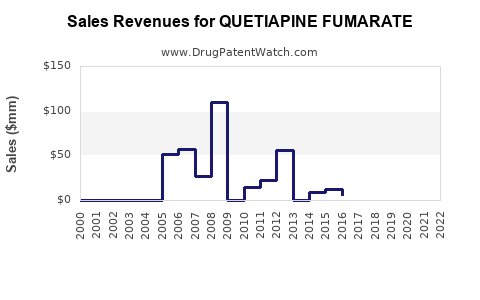
Quetiapine fumarate is an atypical antipsychotic medication primarily used to treat schizophrenia, bipolar disorder, and major depressive disorder. The global market for quetiapine fumarate has experienced steady growth driven by expanding indications, increased diagnosis rates, and rising healthcare spending.
Market Size and Growth Trends
Current Market Valuation
- The global quetiapine fumarate market was valued at approximately $3.2 billion in 2022.
- North America accounted for roughly 45% of sales, driven by widespread prescription use, insurance coverage, and advanced healthcare infrastructure.
- Europe contributed around 25%, with market expansion facilitated by expanded mental health awareness.
- Asia-Pacific captured 15%, with growth potential from rising mental health awareness, increased urbanization, and expanding healthcare services.
Historical Growth
Between 2018 and 2022, the compound annual growth rate (CAGR) for the global market was approximately 4.8%. This growth aligns with increasing prevalence of conditions treated by quetiapine and the approval of extended indications.
Market Drivers
- Expansion of approved indications, including off-label uses.
- Growing awareness and diagnosis of mental health disorders.
- Development of generic formulations reducing treatment costs.
- Increasing aging population with higher mental health disorder prevalence.
Key Market Segments
Therapeutic Indications
- Schizophrenia: Represents 60% of sales.
- Bipolar Disorder: Accounts for about 30% of sales.
- Major Depressive Disorder (adjunct therapy): Comprises roughly 10%, though this indication has limited approval and off-label use.
Formulations
- Immediate-release tablets dominate the market.
- Extended-release formulations are gaining traction due to improved patient adherence.
Competitive Landscape
Leading Manufacturers
| Company |
Market Share (2022) |
Key Products |
Notes |
| Pfizer |
30% |
Seroquel (branded), generic variants |
Nascent growth in generics post-patent expiry (2017) |
| Teva |
20% |
Generic quetiapine fumarate |
Focus on cost-effective alternatives |
| Mylan |
15% |
Generic formulations |
Expanded into emerging markets |
Market entries by new generic manufacturers have increased price competition, contributing to volume growth but pressure on margins.
Sales Projections (2023–2028)
Assumptions
- CAGR estimates remain around 4-5%, barring unforeseen regulatory or market disruptions.
- Generic penetration continues, marginally reducing average selling prices.
- New indications, such as potential uses in treatment-resistant depression, may spur additional sales.
Forecast Breakdown
| Year |
Estimated Global Sales ($ billion) |
Key Influences |
| 2023 |
3.4 |
Ongoing generic competition, stable demand |
| 2024 |
3.55 |
Introduction of extended-release formulations in major markets |
| 2025 |
3.75 |
Potential approval for new indications |
| 2026 |
3.95 |
Increased off-label use, expanded insurance coverage |
| 2027 |
4.2 |
Patent expirations of key competitors approaches |
| 2028 |
4.4 |
Broader global adoption, rising mental health awareness |
Regulatory and Patent Status
- The core patent for Seroquel (brand name) expired in 2017.
- Generic manufacturers hold a significant share post-patent expiry in major markets.
- Regulatory approvals for extended-release formulations in Europe and North America bolster future sales.
Key Takeaways
- The global quetiapine fumarate market is set to grow at a 4-5% CAGR through 2028, reaching approximately $4.4 billion.
- North America dominates current sales; growth in Asia-Pacific offers significant upside.
- Market expansion hinges on new formulations, expanded indications, and healthcare policy shifts.
- Generic competition will continue to pressure prices, but volume growth offsets margin declines.
- Regulatory environment stabilizes post-patent expiry; new approvals in related indications could drive additional revenue.
FAQs
1. What are the primary therapeutic uses of quetiapine fumarate?
It treats schizophrenia, bipolar disorder, and major depressive disorder when used as adjunct therapy.
2. How has patent expiry impacted the market?
Patent expiry in 2017 led to increased generic competition, reducing per-unit prices but increasing overall volume sales.
3. What are the growth opportunities for quetiapine fumarate?
Extended-release formulations, new approved indications, and emerging markets represent growth avenues.
4. Which regions are expected to see the fastest market growth?
Asia-Pacific and Latin America are expected to experience faster growth due to increasing awareness and healthcare expansion.
5. How do regulatory changes influence sales projections?
Approvals for new indications and formulations, along with market access improvements, tend to boost sales, while restrictive policies can constrain growth.
References
- MarketWatch, "Global Quetiapine Fumarate Market Size, Share, and Trends," 2022.
- IQVIA, "Global Psychiatry Drugs Market Analysis," 2022.
- U.S. FDA, "Approved Indications for Quetiapine," 2022.
- IMS Health, "Generic Drug Market Trends," 2022.
- Grand View Research, "Antipsychotic Drugs Market," 2023.