Last updated: August 25, 2026
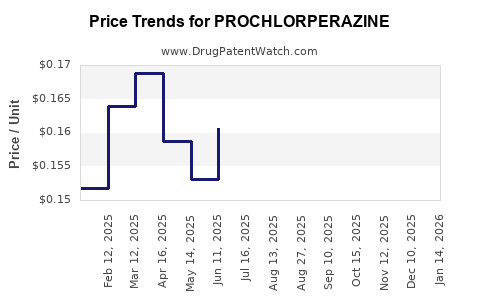
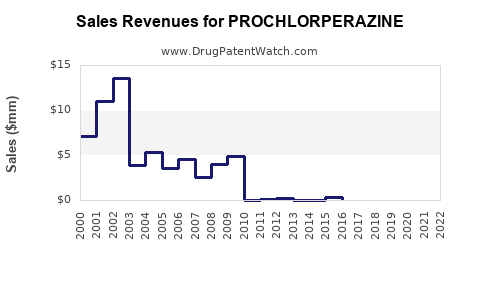
Prochlorperazine is a mature, predominantly generic phenothiazine drug with limited commercial growth potential. Its market is driven by low-cost treatment of severe nausea and vomiting, migraine-associated nausea, vertigo-related symptoms, and selected psychiatric indications. Oral, buccal, rectal, and injectable products remain available, but branded revenue has largely disappeared and public company filings rarely report prochlorperazine sales separately.
The financial profile is defined by high generic substitution, low unit prices, limited patent protection, hospital procurement pressure, and intermittent supply constraints for injectable products. Growth is more likely to come from supply reliability, contract manufacturing, and niche dosage forms than from pricing power or new indications.
What is prochlorperazine and how is it used?
Prochlorperazine is a dopamine D2-receptor antagonist in the phenothiazine class. It is marketed primarily as a generic prescription drug and was historically sold under the brand name Compazine.
The principal approved uses include:
| Use |
Commercial relevance |
| Severe nausea and vomiting |
Core demand driver across outpatient and hospital settings |
| Schizophrenia |
Limited relative contribution because of competition from newer antipsychotics |
| Migraine-associated nausea |
Common off-label or protocol-based use |
| Vertigo and vestibular symptoms |
Used in selected emergency and outpatient settings |
| Radiation- or chemotherapy-related nausea |
Competes with newer antiemetic regimens |
U.S. labeling includes oral tablets, buccal tablets, suppositories, and injectable formulations, depending on the approved product and manufacturer. Product availability is not uniform across all dosage forms. [1][2]
Prochlorperazine is generally less attractive than newer antiemetics for routine use because of extrapyramidal symptoms, sedation, hypotension, anticholinergic effects, and other phenothiazine-related risks. The FDA label warns against use in children under two years of age and in children undergoing surgery. [1]
What is the current FDA regulatory status of prochlorperazine?
Prochlorperazine is an FDA-approved generic drug with multiple abbreviated new drug application products. The original branded product is not the primary commercial channel in the current U.S. market.
The FDA regulatory position has four characteristics:
- The active ingredient is well established.
- Generic products are approved through the ANDA pathway.
- No biosimilar pathway applies because prochlorperazine is a small-molecule drug.
- Most commercial products rely on legacy approvals rather than recent clinical innovation.
The principal regulatory risks relate to manufacturing quality, labeling compliance, and supply continuity. Generic manufacturers must demonstrate pharmaceutical equivalence and bioequivalence or meet the applicable requirements for injectable and other dosage forms. [3]
What patents protect prochlorperazine?
No meaningful active U.S. composition-of-matter patent estate remains for prochlorperazine. The compound and its principal therapeutic uses have been known for decades.
| Protection category |
Current position |
| Original compound patent |
Expired |
| Original branded formulation protection |
Expired |
| New chemical entity exclusivity |
Expired |
| Generic product exclusivity |
No material current exclusivity identified |
| Method-of-use patents |
No commercially significant current estate identified |
| Formulation patents |
Potentially relevant only if tied to a new proprietary delivery system |
| Orange Book-listed patents |
No significant current patent barrier is generally associated with standard generic products |
The Orange Book is relevant for identifying patents and exclusivities tied to approved drug products, but standard prochlorperazine generics do not have a modern patent barrier comparable with protected branded medicines. [4]
When did prochlorperazine lose exclusivity?
The original prochlorperazine exclusivity period ended many years ago. The drug is now a mature generic product, and generic competition has been established for decades.
Because the commercial market is fragmented across dosage forms and suppliers, the relevant economic question is not the expiration of one remaining patent. It is whether a manufacturer can maintain an approved, profitable supply position in a low-price market.
How many patents cover prochlorperazine?
No material number of active U.S. patents is known to prevent generic competition for standard prochlorperazine tablets, buccal tablets, suppositories, or injections.
Potential patent activity could arise from:
- Extended-release delivery systems
- Abuse-deterrent or taste-masked formulations
- Combination products
- Novel buccal or transmucosal systems
- New medical devices for administration
- A proprietary formulation with improved tolerability
Those products would require separate analysis. A manufacturer selling conventional prochlorperazine under an ANDA generally faces a mature, low-barrier patent environment.
What formulations are protected by prochlorperazine patents?
Conventional formulations are not protected by a commercially important active patent estate. The main dosage forms are:
| Dosage form |
Market role |
Commercial assessment |
| Oral tablets |
Widely used, low-cost outpatient therapy |
Highly commoditized |
| Buccal tablets |
Alternative administration when swallowing is difficult |
Smaller niche, potentially less crowded |
| Suppositories |
Alternative for patients unable to take oral medication |
Limited-volume niche |
| Injection |
Emergency department and hospital use |
Supply-chain sensitive |
| Compounded products |
Limited pharmacy use |
Subject to compounding and state/federal requirements |
The buccal and rectal products may have greater commercial defensibility than ordinary tablets because they serve specific administration needs. That defensibility is operational rather than patent-based unless a manufacturer has obtained protection for a particular formulation or delivery technology.
What is the competitive landscape for prochlorperazine?
Prochlorperazine competes against both generic antiemetics and newer branded therapies.
| Competitor |
Class |
Competitive effect |
| Ondansetron |
5-HT3 antagonist |
Major substitute for nausea and vomiting |
| Metoclopramide |
Dopamine antagonist and prokinetic |
Competes in nausea, gastroparesis, and migraine protocols |
| Promethazine |
Phenothiazine-related antiemetic |
Competes in outpatient and emergency use |
| Droperidol |
Butyrophenone |
Competes in emergency medicine and refractory nausea |
| Haloperidol |
Butyrophenone |
Used in selected nausea and vomiting protocols |
| Scopolamine |
Anticholinergic |
Stronger position in motion sickness |
| Aprepitant and related agents |
NK1 antagonists |
Used in chemotherapy-related nausea |
| Palonosetron and other 5-HT3 products |
5-HT3 antagonists |
Compete in perioperative and chemotherapy settings |
Ondansetron is usually the strongest commercial substitute because it has broad use, extensive generic availability, and a relatively familiar safety profile. Prochlorperazine retains demand where clinicians value its low price, injectable availability, rectal or buccal administration, or use in migraine and vestibular protocols.
How does prochlorperazine compare with ondansetron financially?
Ondansetron has a larger and more diversified commercial market. It is used across hospitals, emergency departments, oncology, surgery, pediatrics, and outpatient care. Prochlorperazine has a narrower market and greater exposure to phenothiazine safety concerns.
| Factor |
Prochlorperazine |
Ondansetron |
| Market maturity |
Mature generic |
Mature generic |
| Demand breadth |
Moderate and indication-specific |
Broad |
| Safety perception |
More limited because of neurologic and sedative effects |
Generally more favorable for many patients |
| Generic competition |
High |
High |
| Pricing power |
Very low |
Very low |
| Injectable supply sensitivity |
Meaningful |
Meaningful |
| Growth potential |
Limited |
Higher because of wider use |
| Patent-driven upside |
Minimal |
Minimal for standard products |
Prochlorperazine can remain commercially relevant despite lower market scale because hospitals and pharmacies often maintain multiple antiemetic options. Its low acquisition cost supports formulary retention, but low price also limits manufacturer margins.
What is the financial trajectory for prochlorperazine?
The financial trajectory is mature to declining in branded terms, with stable but low-value generic demand.
Revenue drivers
Demand is supported by:
- Persistent emergency department use
- Hospital antiemetic protocols
- Low acquisition cost
- Multiple dosage forms
- Use in migraine and vestibular disorders
- Continued need for injectable antiemetics
- Limited clinical requirements for new trials
Revenue constraints
Revenue is constrained by:
- Generic price competition
- Pharmacy benefit manager and hospital purchasing pressure
- Substitution by ondansetron and metoclopramide
- Limited prescriber preference for older phenothiazines
- Adverse-effect concerns
- Small market size for non-oral products
- Lack of patent exclusivity
- Potential manufacturing interruptions
Public companies generally do not disclose prochlorperazine revenue as a standalone product line. It is usually aggregated within broader generic pharmaceutical, hospital products, or contract-manufacturing revenue. As a result, a precise global market size or manufacturer-level revenue ranking cannot be established from public filings alone.
The most likely industry pattern is a low-revenue, low-margin product with occasional margin expansion during supply shortages. Those gains tend to attract additional suppliers, which can later restore price competition.
Which companies manufacture or distribute prochlorperazine?
The U.S. market has historically included multiple generic manufacturers and labelers across oral and injectable presentations. Availability can differ by dosage, route, national drug code, and procurement channel.
Manufacturers and distributors active in generic hospital and oral products may include large generic companies, specialty suppliers, and contract manufacturers. The relevant commercial entity may be the ANDA holder, a private-label distributor, or a contract manufacturing organization rather than a consumer-facing brand owner.
For diligence purposes, the key variables are:
- Current ANDA ownership
- Product-specific NDC status
- Whether the company manufactures or outsources production
- FDA inspection history
- Injectable capacity
- Institutional contracts
- Wholesaler inventory
- Current shortage status
The FDA Drugs@FDA database and DailyMed provide product-level regulatory and labeling information, while the FDA Drug Shortages database provides current supply information. [2][3][5]
What generic entry risks exist for prochlorperazine?
Generic entry risk is high because standard products have no meaningful patent barrier. The remaining barriers are commercial and technical.
Highest-risk product categories
Conventional oral tablets have the lowest entry barriers. A new entrant can face:
- Low development costs
- Established reference standards
- Existing manufacturing knowledge
- Broad clinical familiarity
- Limited differentiation
Injectable products have higher operational barriers because they require sterile manufacturing, validated processes, container-closure controls, and reliable quality systems. Regulatory approval is still feasible, but manufacturing failures can create material exposure.
Buccal and suppository products have smaller markets. They may support better pricing than tablets in some channels, but demand is limited and market access depends on pharmacy and institutional purchasing patterns.
What patent litigation and Paragraph IV challenges affect prochlorperazine?
No significant current patent litigation or Paragraph IV dispute is generally associated with standard prochlorperazine products.
A Paragraph IV certification would have limited strategic value against an expired or nonblocking patent estate. Litigation risk could arise only if a company introduced a newly patented formulation, delivery system, or combination product. In that case, the dispute would concern the specific innovation rather than conventional prochlorperazine.
The absence of major litigation reduces legal uncertainty but also removes a path to market exclusivity. Manufacturers compete primarily on cost, reliability, regulatory execution, and distribution.
Are there biosimilar risks for prochlorperazine?
No. Prochlorperazine is a small-molecule drug, not a biologic. Biosimilar competition under the Public Health Service Act does not apply.
The relevant competition is generic competition under the Federal Food, Drug, and Cosmetic Act. The economic effect is similar to biosimilar erosion in one respect: multiple products can enter after exclusivity expires. The legal pathway and technical requirements are different. [3]
What manufacturing and intellectual-property barriers affect prochlorperazine?
The principal barrier is sterile manufacturing for injection. Injectable prochlorperazine requires:
- Sterile process control
- Validated aseptic operations
- Reliable active pharmaceutical ingredient supply
- Container and closure compatibility
- Stability data
- Inspection-ready quality systems
- Hospital-grade distribution
For oral products, manufacturing barriers are lower. The major risks are supply interruptions, raw-material qualification, batch failures, and low economic incentives for maintaining excess capacity.
Intellectual property is weak for standard products. A company seeking stronger protection would need to develop a differentiated formulation, delivery system, or combination therapy. Such a strategy would also require evidence that the product improves adherence, tolerability, onset, or clinical utility.
What is the Orange Book status of prochlorperazine?
The Orange Book remains the relevant FDA source for identifying approved drug products, therapeutic equivalence evaluations, patents, and regulatory exclusivities. Standard generic prochlorperazine products generally have therapeutic-equivalence listings where applicable, but they do not rely on active branded patent protection.
The commercial implication is direct: an ANDA applicant is more likely to face ordinary generic competition than a patent-based launch delay. Orange Book review is still necessary for a specific product and dosage form because listings can differ among tablet, buccal, suppository, and injectable products. [4]
How does prochlorperazine compare across geographic markets?
The United States has a mature generic market with strong substitution and aggressive purchasing controls. European markets also treat prochlorperazine as an established generic medicine, but product availability and approved indications vary by country.
Key geographic differences include:
| Market |
Primary commercial issue |
| United States |
Generic price pressure and injectable supply continuity |
| United Kingdom |
National formulary positioning and limited brand relevance |
| European Union |
Country-level reimbursement and authorization differences |
| Canada |
Provincial reimbursement and supplier concentration |
| Emerging markets |
Lower prices but wider variability in regulatory and distribution access |
A manufacturer with global ambitions must manage different approved routes, labeling requirements, pharmacovigilance obligations, and reimbursement systems. The active ingredient itself offers little geographic exclusivity.
What licensing deals affect prochlorperazine?
No major current licensing transaction is broadly associated with conventional prochlorperazine. The drug’s commercial model is based on generic supply agreements, private-label distribution, hospital contracts, and wholesaler relationships rather than high-value originator licensing.
A transaction involving prochlorperazine would more likely concern:
- Acquisition of an ANDA portfolio
- Purchase of an injectable manufacturing line
- Contract manufacturing
- Regional commercialization rights
- Hospital supply agreements
- A proprietary delivery technology
The economic value of such a deal would depend on manufacturing capacity and contract coverage, not on the underlying molecule’s patent estate.
What is the outlook for prochlorperazine revenue?
The base case is stable-to-declining revenue in nominal product terms, with periodic volatility caused by shortages and supplier exits.
| Period |
Expected market behavior |
| Near term |
Stable generic demand; price competition remains intense |
| Medium term |
Gradual substitution by ondansetron and other antiemetics |
| Shortage periods |
Temporary price and volume gains for available suppliers |
| Longer term |
Continued availability in hospitals and selected outpatient niches |
| Innovation scenario |
Upside only from differentiated delivery or combination products |
The strongest commercial position belongs to suppliers that can maintain uninterrupted production, particularly for injection. Tablet manufacturers face the greatest commoditization. A new entrant can gain share, but the likely result is volume redistribution rather than market expansion.
Key Takeaways
- Prochlorperazine is a mature, low-cost generic phenothiazine.
- Standard tablets, buccal tablets, suppositories, and injections have no meaningful remaining original patent barrier.
- The Orange Book is relevant for product-level status, but standard prochlorperazine products generally do not carry a modern exclusivity moat.
- No biosimilar risk applies; the market is exposed to conventional generic competition.
- Ondansetron and metoclopramide are major substitutes.
- Injectable manufacturing and supply reliability create the main commercial barriers.
- Public filings generally do not disclose prochlorperazine revenue separately.
- The financial outlook is stable-to-declining, with temporary upside during supply shortages.
- New value would require a differentiated formulation, delivery system, combination product, or superior supply position.
FAQs
Is Compazine still sold in the United States?
The original Compazine brand has largely been replaced by generic prochlorperazine products. Current availability depends on dosage form, manufacturer, and distributor inventory.
Is prochlorperazine stronger than ondansetron?
The drugs have different pharmacologic profiles. Prochlorperazine may be selected for severe nausea, migraine-associated nausea, or vertigo, while ondansetron is widely used where clinicians prefer a 5-HT3 antagonist and a different adverse-effect profile.
Can a generic manufacturer obtain exclusivity for prochlorperazine?
A conventional ANDA manufacturer generally does not obtain meaningful market exclusivity for an old generic product. Limited exclusivity could arise from a qualifying new formulation, new indication, or other statutory pathway.
Is injectable prochlorperazine commercially attractive?
It can be strategically useful because sterile injectable supply is more difficult to maintain than tablet supply. Its profitability remains constrained by hospital purchasing pressure and low generic prices.
Does prochlorperazine have a future in migraine treatment?
Prochlorperazine is likely to remain a low-cost option in emergency and acute-care migraine protocols. Its role is limited by adverse-effect concerns and competition from other antiemetic and migraine therapies.
References
-
U.S. Food and Drug Administration. (2023). Prochlorperazine edisylate injection prescribing information. FDA.
-
National Library of Medicine. (2024). DailyMed: Prochlorperazine drug labels. U.S. National Library of Medicine.
-
U.S. Food and Drug Administration. (2024). Abbreviated new drug application requirements and generic drug guidance. FDA.
-
U.S. Food and Drug Administration. (2024). Approved drug products with therapeutic equivalence evaluations: Orange Book. FDA.
-
U.S. Food and Drug Administration. (2024). FDA drug shortages database. FDA.