Last updated: September 8, 2026
Prochlorperazine maleate is a mature, low-cost generic antiemetic and antipsychotic with limited branded revenue, no meaningful remaining regulatory exclusivity, and a fragmented supplier base. Its commercial value is driven by low acquisition cost, hospital and pharmacy availability, and periodic supply constraints rather than innovation or premium pricing. The main competitive risks are ondansetron, metoclopramide, promethazine, and newer antiemetic regimens.
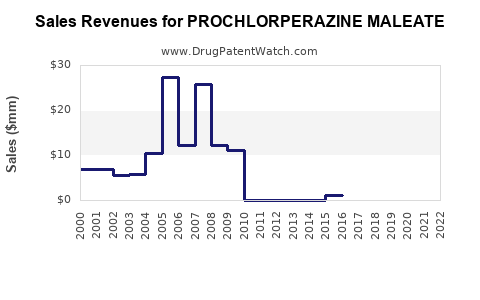
Product-level revenue for prochlorperazine maleate is generally not disclosed because manufacturers report it within broader generic portfolios. Public data support a qualitative financial trajectory: the product moved from branded revenue to commodity generic pricing, followed by declining unit economics and intermittent shortage-driven pricing opportunities.
What is prochlorperazine maleate used for?
Prochlorperazine maleate is an oral phenothiazine drug used mainly for severe nausea and vomiting. The FDA-approved label also includes schizophrenia and short-term treatment of generalized nonpsychotic anxiety when other treatments have failed or are unsuitable (FDA, 2023).
Approved and common dosage forms
| Dosage form |
Common strengths |
Commercial relevance |
| Oral tablets, prochlorperazine maleate |
5 mg, 10 mg |
Primary generic outpatient form |
| Buccal tablets, where marketed |
3 mg |
Regional product, particularly outside the U.S. |
| Injection, prochlorperazine edisylate |
5 mg/mL |
Hospital product; different salt and regulatory product |
| Suppositories, where marketed |
2.5 mg, 25 mg |
Limited regional use |
The maleate salt is primarily associated with oral tablets. Prochlorperazine edisylate injection should not be treated as the same commercial product for market sizing, patent analysis, or manufacturer comparisons.
The drug carries major class risks, including extrapyramidal symptoms, tardive dyskinesia, neuroleptic malignant syndrome, sedation, orthostatic hypotension, and QT-related cardiac risk. The label includes a boxed warning against use in elderly patients with dementia-related psychosis because of increased mortality risk (FDA, 2023).
When did prochlorperazine maleate lose exclusivity?
U.S. exclusivity for prochlorperazine maleate expired decades ago. The original Compazine brand was commercialized before the modern Hatch-Waxman generic framework and no longer has a commercially meaningful patent or exclusivity position.
The relevant commercial milestones are:
| Milestone |
Approximate timing |
Effect on market |
| Original Compazine commercialization |
Mid-20th century |
Established branded phenothiazine market |
| U.S. generic pathway |
After Hatch-Waxman implementation |
Enabled ANDA competition |
| Branded exclusivity loss |
Decades ago |
Shifted demand to low-cost generic supply |
| Current market |
Mature generic phase |
Price competition and supply concentration |
The FDA Orange Book is the relevant source for listed patents and regulatory exclusivity. Current generic prochlorperazine maleate tablets do not have a material Orange Book patent barrier comparable to recently approved small-molecule products (FDA, 2024a).
What patents protect prochlorperazine maleate?
No commercially relevant active U.S. patent estate is associated with the basic prochlorperazine maleate molecule or conventional 5 mg and 10 mg oral tablets.
Patent status by protection category
| Protection category |
Current commercial position |
| Active ingredient patent |
Expired |
| Salt-specific composition patent |
No meaningful active barrier identified |
| Conventional tablet formulation patent |
No material active barrier identified |
| Method-of-use patent |
Historical claims are expired or commercially ineffective |
| FDA regulatory exclusivity |
None associated with the mature generic product |
| Orange Book-listed patent blocking generic entry |
None of practical significance for standard tablets |
Patent risk is therefore low for a manufacturer seeking to produce conventional prochlorperazine maleate tablets. The main barriers are regulatory compliance, API sourcing, manufacturing economics, and market access.
Patent protection could still arise for a newly developed delivery system, combination product, abuse-deterrent design, or clinically differentiated formulation. Such protection would apply to the new product, not to ordinary prochlorperazine maleate tablets.
What is the Orange Book status of prochlorperazine maleate?
The Orange Book treats approved products and their patent or exclusivity records at the product level. Prochlorperazine maleate tablets are mature prescription products generally supplied through abbreviated new drug applications rather than a protected new drug application.
The commercial implication is direct:
- An ANDA applicant does not face a live branded patent blocking ordinary tablet entry.
- Paragraph IV litigation is not a central current risk.
- The market is governed more by FDA approval status and supplier economics than by patent enforcement.
- Discontinued brand records should not be confused with active commercial exclusivity.
The original Compazine label remains relevant for clinical indications and warnings, while current generic labeling is based on approved FDA records for prochlorperazine products (FDA, 2023; FDA, 2024b).
How many patents cover prochlorperazine maleate?
For conventional U.S. prochlorperazine maleate tablets, the number of commercially meaningful blocking patents is effectively zero.
That conclusion does not mean historical patents never existed. It means expired patents do not restrict current generic production. Patent owners cannot use an expired composition or formulation patent to delay an ANDA launch.
The absence of patent barriers also reduces the likelihood of:
- Paragraph IV certification disputes
- Hatch-Waxman settlement payments
- Authorized-generic strategies
- Patent-based licensing transactions
- Patent-driven product withdrawals
What is the FDA regulatory status of prochlorperazine maleate?
Prochlorperazine maleate is an FDA-approved prescription drug with long-established safety and efficacy information. The relevant approval pathway for current products is generally ANDA approval demonstrating pharmaceutical equivalence and bioequivalence to the reference product.
Regulatory characteristics
| Regulatory issue |
Assessment |
| FDA status |
Approved generic prescription drug |
| NDA exclusivity |
None of current commercial significance |
| ANDA pathway |
Standard route for generic tablets |
| REMS requirement |
No prominent product-specific REMS identified |
| Controlled-substance status |
Not a controlled substance |
| Label complexity |
Moderate, due to phenothiazine class warnings |
| Bioequivalence difficulty |
Generally manageable for immediate-release tablets |
Regulatory risk is not zero. Manufacturers must control content uniformity, dissolution, impurities, stability, packaging, and pharmacovigilance. The product’s age does not eliminate FDA manufacturing scrutiny.
How does prochlorperazine maleate compare with competing antiemetics?
Prochlorperazine competes across different clinical settings rather than through a single direct substitute market.
| Drug |
Main advantages |
Main disadvantages |
Competitive effect |
| Ondansetron |
Strong demand in acute nausea, chemotherapy, and postoperative care; generally familiar tolerability profile |
QT risk, constipation, higher cost than legacy generics in some settings |
Major share pressure |
| Metoclopramide |
Low cost; useful in gastroparesis and migraine-related nausea |
Extrapyramidal symptoms and tardive dyskinesia risk |
Strong clinical substitute |
| Promethazine |
Broad availability and low cost |
Sedation, anticholinergic burden, tissue-injury risk with injection |
Competes in emergency and outpatient use |
| Prochlorperazine |
Low cost; antipsychotic and antiemetic activity; established hospital familiarity |
Sedation, extrapyramidal symptoms, tardive dyskinesia, QT concerns |
Retains price-sensitive and selected acute-use demand |
| Haloperidol |
Low cost and use in selected nausea protocols |
Extrapyramidal and QT risks |
Niche hospital substitute |
| Olanzapine |
Increasing role in chemotherapy-induced nausea protocols |
Higher cost and metabolic effects |
Relevant in oncology, not ordinary generic substitution |
Prochlorperazine remains useful where clinicians value low acquisition cost and established antiemetic efficacy. Its use is constrained by adverse-effect concerns and the availability of drugs with more favorable prescribing profiles in certain patient groups.
What is the financial trajectory for prochlorperazine maleate?
The financial trajectory is mature-to-declining, with limited upside outside supply disruptions or differentiated formulations.
Revenue profile
Branded Compazine revenue is no longer the central economic driver. Current sales are distributed across generic manufacturers, wholesalers, retail pharmacies, hospitals, and government purchasers. Manufacturers typically do not report prochlorperazine maleate revenue as a standalone line item.
The product’s financial profile has four characteristics:
- Low average selling prices for standard tablets.
- High price sensitivity among pharmacy and institutional buyers.
- Limited differentiation between approved generic versions.
- Potential short-term price increases when suppliers exit or experience production problems.
Generic profitability depends on volume, manufacturing utilization, API cost, packaging, distribution contracts, and the number of approved suppliers. A company with a small portfolio may view the product as strategically useful for maintaining pharmacy or hospital relationships, even when absolute revenue is modest.
Revenue exposure by channel
| Channel |
Economic profile |
| Retail pharmacy |
High substitution and reimbursement pressure |
| Hospital purchasing |
Contract-driven, price-sensitive, vulnerable to shortages |
| Long-term care |
Recurring demand but strict formulary and reimbursement controls |
| Government programs |
Low pricing and compliance burden |
| International markets |
Variable brand recognition and country-specific reimbursement |
No reliable public source provides a consolidated global revenue figure for prochlorperazine maleate. Company filings generally aggregate it with other generic products. Market forecasts that assign a precise standalone revenue value should be treated as model-based estimates rather than reported manufacturer revenue.
Which companies are challenging or supplying prochlorperazine maleate?
The U.S. market has historically included multiple generic manufacturers and contract suppliers. Supplier participation can change because of portfolio rationalization, manufacturing transfers, wholesaler agreements, and FDA compliance actions.
The relevant competitive set includes:
- Large generic manufacturers with broad oral-solid portfolios
- Specialty generic companies supplying low-volume legacy products
- Contract manufacturers
- Distributor-owned or private-label suppliers
- Regional manufacturers outside the U.S.
Because the product is mature and patent-free, competition is based on reliable supply, approved manufacturing capacity, commercial relationships, and price. There is no significant current patent challenger landscape comparable to protected drugs facing Paragraph IV litigation.
What generic entry risks exist for prochlorperazine maleate?
Generic entry risk is structurally high because the product has no meaningful exclusivity barrier. For an incumbent, the principal risks are:
- New ANDA approvals
- Loss of a hospital or wholesaler contract
- Price concessions demanded by pharmacy benefit managers
- API cost increases
- FDA manufacturing observations
- Product discontinuation by a major supplier
- Substitution by ondansetron or metoclopramide
For a new entrant, the principal risk is economic rather than legal. A technically approvable ANDA may still fail commercially if the entrant cannot achieve adequate scale or secure distribution.
Generic launch scenarios
| Scenario |
Likely market effect |
| Additional entrant with standard tablets |
Lower prices and reduced incumbent share |
| Supplier exit |
Temporary price increases and possible shortage |
| Hospital contract win |
Volume growth with narrow margins |
| New buccal or rapid-delivery formulation |
Potential premium pricing if clinically differentiated |
| Manufacturing warning or recall |
Short-term redistribution of demand |
| Greater ondansetron use |
Long-term erosion of prochlorperazine volume |
What manufacturing and intellectual-property barriers remain?
The intellectual-property barrier is low. Manufacturing barriers are more important.
API and production considerations
Prochlorperazine maleate is a conventional small-molecule pharmaceutical ingredient. Production does not require biologic facilities, complex delivery technology, or specialized cold-chain infrastructure. The main requirements are:
- Qualified API supply
- Impurity control
- Consistent tablet compression
- Dissolution and stability performance
- Validated cleaning and cross-contamination controls
- Compliance with current good manufacturing practice
- Reliable packaging and serialization
Small market size can make the product unattractive to manufacturers with higher-margin alternatives. This creates a paradox: low technical complexity supports entry, while low commercial value can reduce the number of committed suppliers.
What litigation and settlement agreements affect prochlorperazine maleate?
There is no prominent current U.S. patent litigation or settlement framework affecting ordinary prochlorperazine maleate tablets. The product’s patent age makes a new Hatch-Waxman settlement unlikely to influence market access.
Potential disputes are more likely to concern:
- Manufacturing defects
- Product liability
- Labeling and failure-to-warn claims
- Supply contracts
- FDA compliance
- Trademark or trade dress issues involving legacy branding
Those disputes would not create durable market exclusivity for a standard generic tablet.
How strong is the prochlorperazine maleate patent estate?
The patent estate is weak for conventional products and irrelevant to current generic entry.
| Factor |
Assessment |
| Composition-of-matter protection |
Expired |
| Formulation protection |
Weak or expired for standard tablets |
| Method-of-use protection |
No meaningful blocking position |
| Regulatory exclusivity |
None |
| Manufacturing know-how |
Moderate operational value, low legal exclusivity |
| Supply-chain defensibility |
Potentially meaningful during shortages |
| Litigation leverage |
Low |
The commercial moat is therefore operational rather than intellectual property-based. A supplier can gain temporary leverage through reliable availability, but that position can disappear when competitors return.
Key Takeaways
- Prochlorperazine maleate is a mature, low-price generic drug with no meaningful current U.S. patent or exclusivity barrier.
- Conventional 5 mg and 10 mg tablets have low legal entry risk and high price competition.
- Public companies generally do not disclose standalone product revenue, preventing a reliable product-level global sales figure.
- Financial performance depends on volume, supplier concentration, contracts, API costs, and shortages.
- Ondansetron, metoclopramide, promethazine, and selected antipsychotics provide substantial competitive pressure.
- Manufacturing reliability is more important than patent protection.
- New commercial upside would require a differentiated delivery system, combination product, or shortage-related supply advantage.
- The base-case trajectory is stable-to-declining unit economics, punctuated by temporary pricing opportunities during supply disruptions.
FAQs
Is prochlorperazine maleate still commercially available?
Yes. It remains available as a generic prescription product, although availability varies by strength, supplier, country, and distribution channel.
Is prochlorperazine maleate the same as prochlorperazine edisylate?
No. They are different salts used in different dosage forms. Prochlorperazine maleate is mainly associated with oral tablets, while prochlorperazine edisylate is commonly used in injectable products.
Can a company launch generic prochlorperazine maleate without a Paragraph IV challenge?
Generally, yes. For a mature product without blocking patents, an applicant would not need to rely on a Paragraph IV challenge to gain market access. The precise certification depends on the applicable FDA product and Orange Book record.
Does prochlorperazine maleate have biosimilar competition?
No. It is a chemically synthesized small molecule, not a biologic. Competition comes from conventional generic drugs, not biosimilars.
Could a new prochlorperazine formulation receive patent protection?
Yes. A genuinely novel formulation, delivery system, combination, or manufacturing process could potentially receive patent protection if it satisfies statutory requirements. That protection would not restore exclusivity to ordinary prochlorperazine maleate tablets.
References
- U.S. Food and Drug Administration. (2023). Compazine (prochlorperazine maleate) prescribing information. https://www.accessdata.fda.gov
- U.S. Food and Drug Administration. (2024a). Approved drug products with therapeutic equivalence evaluations: Orange Book. https://www.accessdata.fda.gov/scripts/cder/ob/
- U.S. Food and Drug Administration. (2024b). Drugs@FDA: FDA-approved drugs database. https://www.accessdata.fda.gov/scripts/cder/daf/
- U.S. Food and Drug Administration. (2024c). Generic drugs: Questions and answers. https://www.fda.gov/drugs/questions-answers/generic-drugs
- National Library of Medicine. (2024). DailyMed: Prochlorperazine maleate drug labeling. https://dailymed.nlm.nih.gov/dailymed/