Last updated: September 7, 2026
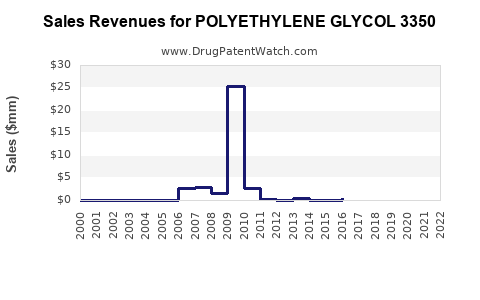
Polyethylene glycol 3350, or PEG 3350, is a mature osmotic laxative sold primarily as MiraLAX, generic polyethylene glycol 3350, and private-label store brands. The U.S. market is largely generic and over-the-counter, with low regulatory barriers, limited patent protection, and price competition among branded, generic, and retailer products. Product-level revenue is not publicly disclosed, so the financial trajectory must be assessed through market structure, channel pricing, volume demand, and the performance of parent consumer-health businesses rather than a verified PEG 3350 revenue series.
What is polyethylene glycol 3350 and how is it regulated?
PEG 3350 is a synthetic, water-soluble polymer that retains water in the stool and increases bowel-movement frequency. It is used mainly for occasional constipation and is also used in bowel-preparation products, often with electrolytes.
| Attribute |
PEG 3350 without electrolytes |
| Active ingredient |
Polyethylene glycol 3350 |
| Primary U.S. use |
Occasional constipation |
| Dosage form |
Powder for oral solution |
| Typical OTC dose |
17 grams dissolved in 4 to 8 ounces of beverage |
| Regulatory category |
OTC laxative |
| U.S. reference brand |
MiraLAX |
| Main competitors |
Generic PEG 3350, store brands, lactulose, senna, bisacodyl, magnesium hydroxide |
| Biosimilar exposure |
None |
| Current market structure |
Mature, genericized, retailer-driven |
The FDA approved PEG 3350 prescription products before authorizing the OTC switch for MiraLAX. The FDA later added PEG 3350 to the OTC monograph framework for laxatives. The current regulatory framework permits compliant products to be marketed without a product-specific new drug approval when they meet applicable monograph requirements (U.S. Food and Drug Administration [FDA], 2006; FDA, 2023).
PEG 3350 bowel-preparation products are a separate commercial category. Products such as GoLYTELY, NuLYTELY, and generic PEG-electrolyte solutions contain larger quantities of PEG 3350 and electrolytes. Their clinical use, packaging, prescribing, and reimbursement differ from the low-dose constipation products.
How large is the polyethylene glycol 3350 market?
The U.S. PEG 3350 market is a high-volume, low-growth consumer-health category. Published market-research estimates differ substantially because they may include only PEG 3350 without electrolytes, combine all osmotic laxatives, include bowel-preparation products, or measure retail sales rather than manufacturer revenue.
No authoritative public source reports total global PEG 3350 sales or the standalone revenue of MiraLAX. Bayer does not separately report MiraLAX revenue in its public financial statements. Retailer sales, wholesaler revenue, manufacturer net sales, and consumer spending are different measures and should not be compared directly.
The market is driven by:
- A large and recurring constipation population.
- OTC self-care and high consumer familiarity.
- Growth in older populations.
- Chronic use despite labeling focused on occasional constipation.
- Retailer expansion of private-label products.
- Low manufacturing complexity.
- Continued substitution from branded MiraLAX to generic and store-brand products.
The category has limited unit-volume growth. Revenue growth is more likely to come from price increases, larger pack sizes, packaging changes, and channel mix than from new clinical demand.
What is the financial trajectory for PEG 3350?
PEG 3350 revenue has likely followed a mature-category trajectory: strong expansion during the branded prescription and OTC adoption phases, followed by margin pressure as generic and private-label products gained share.
Historical trajectory
| Period |
Market event |
Financial effect |
| 1990s |
Prescription PEG 3350 products reached the U.S. market |
Created an approved laxative category with prescription pricing |
| 1999 |
MiraLAX received U.S. approval as a prescription product |
Established the leading consumer brand |
| 2006 |
FDA approved OTC marketing for MiraLAX |
Expanded household penetration and retail distribution |
| 2010s |
Generic and store-brand availability increased |
Reduced branded pricing power |
| 2020-2024 |
Pandemic-related retail and supply-chain volatility |
Increased demand variability and input-cost pressure |
| Current phase |
Mature OTC category |
Volume stability, low innovation, and price competition |
MiraLAX benefits from brand recognition and physician familiarity, but its commercial position is constrained by the simplicity of the formulation. A consumer can generally switch to a generic product containing the same active ingredient without changing the administration method.
Bayer’s consumer-health business is large and diversified. The company reports segment-level results for Consumer Health but does not isolate MiraLAX sales, units, gross margin, or market share. Product-level financial modeling therefore requires retail audit data, distributor data, or proprietary transaction datasets rather than public company filings (Bayer AG, 2024).
Revenue and margin implications
The economic profile is different for branded PEG 3350 and generic PEG 3350:
| Factor |
Branded MiraLAX |
Generic or store-brand PEG 3350 |
| Price |
Higher retail price |
Lower retail price |
| Consumer acquisition |
Brand advertising and recognition |
Retail placement and price |
| Gross-margin potential |
Higher per unit |
Lower per unit, offset by scale |
| Switching risk |
High |
Limited once product is established |
| Patent dependence |
Low |
Low |
| Manufacturing differentiation |
Limited |
Limited |
| Retailer bargaining power |
Moderate to high |
High |
The principal financial risk is share erosion rather than abrupt loss of exclusivity. The category does not depend on a single patent expiration event. It has already transitioned into a competitive OTC market where multiple suppliers can sell substantially equivalent products.
What patents protect polyethylene glycol 3350 and MiraLAX?
PEG 3350 has weak current patent protection in the U.S. The active ingredient is an old polymer with broad historical use. The principal commercial product is an aqueous powder formulation containing PEG 3350, not a newly discovered molecular entity.
Patent position
| IP category |
Current relevance |
| PEG 3350 composition patents |
Generally expired or commercially immaterial |
| Basic laxative-use patents |
Expired or difficult to enforce against generic OTC products |
| MiraLAX product-specific patents |
No material current barrier to ordinary generic substitution |
| Formulation patents |
Limited value for a simple PEG 3350 powder product |
| Packaging patents |
Potentially narrow and easy to design around |
| Manufacturing process patents |
May protect a supplier process but do not block all competing PEG 3350 products |
| Method-of-use patents |
Limited commercial value for ordinary constipation treatment |
| Trade secrets |
Possible relevance to sourcing, quality control, and supply reliability |
MiraLAX’s commercial protection is based mainly on brand equity, distribution, consumer trust, shelf placement, and regulatory compliance. It is not based on a robust, enforceable composition-of-matter patent estate.
When did polyethylene glycol 3350 lose exclusivity?
PEG 3350 did not experience a single, current loss-of-exclusivity event comparable to a patented prescription drug. Its market moved through several stages:
- Prescription approval created initial regulatory exclusivity.
- FDA approval of OTC MiraLAX expanded the addressable market.
- Generic prescription and OTC products entered the category.
- Retailers introduced private-label equivalents.
- The category became structurally commoditized.
FDA OTC monograph treatment is especially important. Once a product conforms to the applicable monograph, a manufacturer may compete without obtaining a new product-specific approval for the same basic OTC indication and dosage form. This reduces the importance of Orange Book patents and weakens the ability of a brand owner to control market entry.
What is the Orange Book status of PEG 3350 products?
The Orange Book is most relevant to approved prescription drug products. It is less important for PEG 3350 products marketed under the OTC monograph system.
MiraLAX’s commercial history began with an approved prescription application, but the current consumer market is dominated by OTC products. OTC monograph products generally do not create the same Orange Book patent-certification framework as conventional prescription products.
Paragraph IV challenges
Paragraph IV litigation is not the main competitive mechanism for current OTC PEG 3350 products. Generic competition has generally developed through:
- OTC monograph compliance.
- Abbreviated regulatory pathways where applicable.
- Private-label manufacturing arrangements.
- Product listings and retail distribution.
- Commercial substitution rather than patent litigation.
A conventional Paragraph IV case would require an Orange Book-listed patent and a generic applicant certifying that the patent is invalid, unenforceable, or not infringed. The commercial importance of that pathway for basic OTC PEG 3350 constipation products is low.
What formulations are protected by PEG 3350 patents?
The basic 17-gram PEG 3350 powder formulation has limited differentiation. Potentially protectable features include:
- Flavor systems.
- Dissolution properties.
- Powder flow characteristics.
- Sachet or single-dose packaging.
- Combination products.
- Electrolyte-balanced bowel-preparation solutions.
- Pediatric formulations.
- Novel delivery systems.
- Stability and manufacturing processes.
These features can create narrower intellectual-property positions, but they do not necessarily prevent competitors from selling standard PEG 3350 powder. A formulation patent covering a particular flavor, package, or excipient system would have less economic value than a patent covering the active ingredient itself.
PEG-electrolyte bowel-preparation products have a different competitive profile. Their formulations must manage electrolyte balance, palatability, preparation volume, stability, and clinical tolerability. That complexity can raise manufacturing and regulatory barriers, although multiple generic products remain available.
How does PEG 3350 compare with competing laxatives?
PEG 3350 competes across several therapeutic and retail segments.
| Product class |
Examples |
Main advantage |
Main limitation |
| PEG 3350 |
MiraLAX, generic PEG 3350 |
Effective osmotic action with limited flavor and odor |
Delayed onset; price competition |
| Stimulant laxatives |
Senna, bisacodyl |
Faster perceived action and low price |
Cramping and tolerability concerns |
| Magnesium products |
Magnesium hydroxide, magnesium citrate |
Familiarity and rapid action for some users |
Electrolyte and renal-function concerns |
| Stool softeners |
Docusate |
Strong consumer awareness |
Questions about clinical effectiveness |
| Lactulose |
Generics |
Prescription use and established clinical role |
Taste, gas, and gastrointestinal effects |
| Secretagogues |
Linaclotide, plecanatide |
Disease-specific treatment for chronic conditions |
Prescription cost and payer controls |
| Peripheral opioid antagonists |
Naloxegol, naldemedine |
Opioid-induced constipation indications |
Narrower use and higher cost |
PEG 3350 is positioned between low-cost stimulant and mineral laxatives and higher-cost prescription therapies. Its strongest attributes are familiarity, once-daily dosing, broad availability, and a generally acceptable tolerability profile.
What generic entry risks exist for MiraLAX?
The principal generic-entry risk is already realized. MiraLAX competes with numerous PEG 3350 products, including pharmacy brands and retailer-owned labels.
The main commercial risks are:
- Retailers replacing branded shelf space with private-label PEG 3350.
- Consumers trading down during periods of inflation.
- Online price transparency.
- Club-store bulk packaging.
- Pharmacy benefit managers favoring low-cost products where reimbursement applies.
- Limited clinical differentiation.
- Retail promotions by large consumer-health companies.
- Concentration of manufacturing among active-ingredient and finished-dose suppliers.
MiraLAX can retain a price premium if consumers associate the brand with predictable quality and physician recommendation. That premium is vulnerable when retailers place equivalent products directly beside the branded product.
Which companies compete in polyethylene glycol 3350?
Competition is fragmented across branded consumer health, generic pharmaceuticals, and retail private labels.
Relevant participants include:
- Bayer, through MiraLAX in the U.S.
- Perrigo, a major supplier of store-brand and consumer-health products.
- Viatris and other generic manufacturers, depending on product and market.
- CVS, Walgreens, Walmart, Target, Costco, Amazon, and grocery retailers through private-label products.
- Contract manufacturers supplying retailer-branded PEG 3350.
- Suppliers of PEG-electrolyte bowel-preparation products, including generic manufacturers and established prescription brands.
The competitive center of gravity is retail distribution rather than molecular innovation. Shelf position, pack-size architecture, supply reliability, consumer reviews, and price determine performance more than clinical differentiation.
What manufacturing and supply-chain barriers affect PEG 3350?
PEG 3350 is not difficult to manufacture at the level of active-ingredient chemistry, but commercial supply requires consistent molecular-weight specifications, low contamination, appropriate packaging, and validated quality systems.
Key barriers include:
- Pharmaceutical-grade polymer sourcing.
- Consistent molecular-weight distribution.
- Control of impurities and residual solvents.
- Powder blending and filling.
- Moisture control.
- High-volume packaging.
- FDA-compliant manufacturing.
- Retailer qualification.
- Supply continuity during demand spikes.
The active ingredient is available from multiple industrial and pharmaceutical suppliers, reducing the likelihood that one supplier can maintain durable market control. Manufacturing risk is more relevant to gross margin and product availability than to long-term patent exclusivity.
What FDA regulatory issues affect PEG 3350?
The principal FDA issues concern labeling, age restrictions, duration of use, product quality, and the distinction between constipation products and bowel-preparation products.
OTC PEG 3350 products are generally labeled for occasional constipation and short-term use. Chronic constipation, pediatric use, pregnancy, drug interactions, and persistent symptoms may require medical evaluation. These labeling boundaries influence marketing claims and limit the ability of manufacturers to reposition a basic OTC product as a broad chronic-disease therapy without additional regulatory support.
The FDA also distinguishes products containing PEG 3350 alone from PEG-electrolyte solutions used for colon cleansing. The latter have different dosing, risks, packaging, and clinical labeling.
What licensing deals affect PEG 3350?
Publicly disclosed, material licensing transactions centered specifically on PEG 3350 are limited. The active ingredient is old, widely available, and not dependent on a current proprietary platform. Commercial arrangements are more likely to involve:
- Brand distribution.
- Contract manufacturing.
- Retailer private-label supply.
- Regional rights.
- Consumer-health portfolio acquisitions.
- Co-marketing or store-brand arrangements.
The absence of major recent PEG 3350 licensing announcements is consistent with a mature, commodity-like market. Value is concentrated in distribution and brand ownership rather than exclusive technology rights.
What patent litigation and settlement agreements affect PEG 3350?
There is no major current patent-litigation narrative comparable to those surrounding protected specialty drugs, biologics, or complex generics. The basic PEG 3350 constipation market has many suppliers and little apparent patent leverage.
Litigation exposure is more likely to involve:
- Product liability.
- Labeling and advertising.
- Manufacturing quality.
- Consumer-protection claims.
- Trade dress or trademark disputes.
- Patent disputes involving a specialized formulation or bowel-preparation system.
Settlement agreements are not a central market driver for standard PEG 3350 products.
Does PEG 3350 face biosimilar risk?
No. Biosimilars apply to biological products. PEG 3350 is a synthetic polymer and competes through generic-drug, OTC-monograph, and consumer-health channels rather than the biologic reference-product pathway.
A separate issue is the use of PEG chemistry in modified biologics, such as PEGylated proteins. Those products have different patents, regulatory standards, and commercial markets. Their IP does not create protection for ordinary PEG 3350 laxatives.
What is the geographic coverage of PEG 3350?
The United States is the most commercially important market for MiraLAX and equivalent OTC PEG 3350 products. International markets use different brand names, regulatory classifications, and reimbursement systems.
Geographic differences include:
- OTC versus prescription status.
- Permitted indications and age labeling.
- Availability of generic products.
- National reimbursement policies.
- Local manufacturing requirements.
- Retail pharmacy concentration.
- Use of PEG 3350 versus lactulose or other laxatives.
A global revenue estimate must therefore define whether it includes prescription PEG 3350, OTC products, bowel preparations, hospital use, and industrial or nonpharmaceutical PEG applications.
Key Takeaways
- PEG 3350 is a mature, genericized osmotic laxative market.
- MiraLAX remains the leading U.S. consumer brand, but its commercial protection is based on brand and distribution rather than a strong current patent estate.
- Product-level MiraLAX and PEG 3350 revenue are not separately disclosed by Bayer or most competitors.
- The market has no meaningful biosimilar risk and limited current Paragraph IV exposure.
- OTC monograph competition is more important than Orange Book litigation.
- Private-label products and retailer bargaining power are the main threats to branded revenue.
- Growth is likely to be modest and driven mainly by population aging, pricing, pack-size changes, and channel expansion.
- PEG-electrolyte bowel-preparation products should be analyzed separately because they have different formulations and regulatory economics.
- Manufacturing is scalable, but pharmaceutical-grade sourcing, quality control, packaging, and retail qualification remain operational barriers.
- Long-term financial upside is limited without a differentiated formulation, new indication, combination product, or stronger brand platform.
FAQs
Is polyethylene glycol 3350 still patent protected?
The basic PEG 3350 laxative product is not protected by a commercially meaningful, broad patent barrier. Any remaining formulation, packaging, or manufacturing patents would generally be narrower and easier to design around.
Is MiraLAX a prescription drug or an OTC drug?
MiraLAX was initially approved as a prescription product and later approved for over-the-counter marketing. Current consumer use is primarily OTC.
Can a generic manufacturer launch PEG 3350 without a Paragraph IV filing?
For products marketed under the applicable OTC monograph framework, a manufacturer may compete without following the conventional Orange Book Paragraph IV process used for many prescription generics, provided the product complies with FDA requirements.
Why does MiraLAX cost more than generic PEG 3350?
The price premium reflects brand recognition, advertising, consumer trust, retail positioning, packaging, and perceived quality. The underlying active ingredient is widely available.
Is PEG 3350 a high-growth pharmaceutical market?
No. It is a mature consumer-health category. Volume demand is stable, while revenue growth is constrained by generic substitution, private-label competition, and limited product differentiation.
References
-
Bayer AG. (2024). Annual report 2023. Bayer AG.
-
U.S. Food and Drug Administration. (2006). FDA approves MiraLAX for over-the-counter use. U.S. Department of Health and Human Services.
-
U.S. Food and Drug Administration. (2023). OTC monograph M017: Laxative products for over-the-counter human use. U.S. Department of Health and Human Services.
-
U.S. Food and Drug Administration. (2024). Drugs@FDA: FDA-approved drugs database. U.S. Department of Health and Human Services.
-
U.S. National Library of Medicine. (2024). DailyMed: Polyethylene glycol 3350 drug labels. National Institutes of Health.