Last updated: September 4, 2026
Methylphenidate is a mature, high-volume central nervous system stimulant with a fragmented commercial structure. Generic immediate-release and extended-release products supply most prescriptions, while branded formulations monetize delivery technology, dosing convenience, pediatric usability, abuse-deterrence positioning, and nighttime or longer-duration administration.
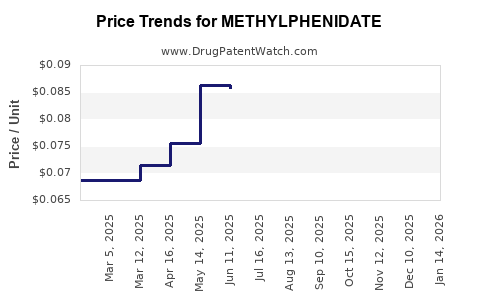
The market’s financial trajectory is bifurcated. Base methylphenidate products face price compression and limited patent protection. Branded products such as Concerta, Daytrana, Quillivant XR, Quillichew ER, Jornay PM, and newer combination products preserve revenue through formulation patents, regulatory exclusivities, and differentiated delivery systems. Growth is constrained by controlled-substance quotas, manufacturing shortages, generic competition, and payer pressure.
What is the methylphenidate market?
Methylphenidate is marketed in immediate-release, extended-release, transdermal, chewable, liquid, orally disintegrating, and evening-dosed formulations. It is approved primarily for attention-deficit/hyperactivity disorder, or ADHD, and narcolepsy in selected products.
The principal commercial markets are the United States, Canada, Europe, Japan, and selected Latin American jurisdictions. The United States has the most developed branded formulation market and the greatest exposure to patent litigation and Paragraph IV challenges.
Major methylphenidate products
| Product |
Active ingredient |
Dosage form |
Primary commercial differentiator |
Principal company or marketer |
| Ritalin |
Methylphenidate HCl |
Immediate-release tablet, solution |
Established immediate-release product |
Novartis historically; multiple generic manufacturers |
| Concerta |
Methylphenidate HCl |
OROS extended-release tablet |
Long-duration osmotic delivery |
Janssen, a Johnson & Johnson company, historically |
| Daytrana |
Methylphenidate |
Transdermal patch |
Wear-time flexibility and nonoral delivery |
Noven Pharmaceuticals |
| Quillivant XR |
Methylphenidate HCl |
Extended-release oral suspension |
Liquid extended-release delivery |
Tris Pharma |
| Quillichew ER |
Methylphenidate HCl |
Extended-release chewable tablet |
Pediatric administration |
Tris Pharma |
| Aptensio XR |
Methylphenidate HCl |
Extended-release capsule |
Biphasic release |
Rhodes Pharmaceuticals |
| Cotempla XR-ODT |
Methylphenidate HCl |
Extended-release orally disintegrating tablet |
No-water administration |
Neos Therapeutics, acquired by Aytu Bioscience |
| Jornay PM |
Methylphenidate HCl |
Delayed-release and extended-release capsule |
Evening dosing for next-day symptom control |
Ironshore Therapeutics, acquired by Endo |
| Relexxii |
Methylphenidate HCl |
Extended-release tablet |
Generic or authorized-generic competition to Concerta |
Various manufacturers |
| Azstarys |
Serdexmethylphenidate/d-methylphenidate |
Capsule |
Prodrug plus immediate-release methylphenidate |
Corium |
The market also includes dexmethylphenidate products, such as Focalin and Focalin XR. Dexmethylphenidate is the pharmacologically active d-enantiomer of methylphenidate and competes within the same ADHD stimulant category, although it is not the same active ingredient.
How large is the methylphenidate market?
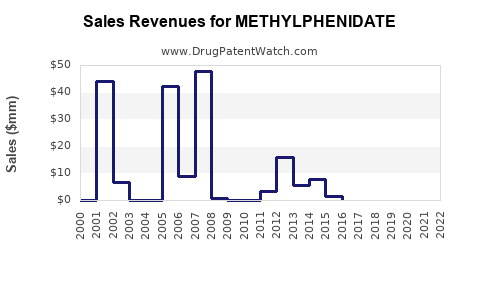
There is no single audited global revenue figure for methylphenidate because the market includes generic products, private-label supply, branded formulations, hospital and retail channels, and combination products. Public companies generally report product revenue rather than a consolidated methylphenidate category total.
The commercial market is best analyzed in three layers:
- Generic immediate-release and extended-release methylphenidate.
- Branded delivery-system products.
- Adjacent stimulant products, including amphetamine salts, lisdexamfetamine, dexmethylphenidate, and serdexmethylphenidate combinations.
Generic methylphenidate generates substantial prescription volume but relatively low revenue per prescription. Branded extended-release products generate a disproportionate share of category profit despite lower unit volume.
Market value drivers
| Driver |
Effect on market |
| Growth in ADHD diagnosis and treatment |
Expands prescription demand |
| Generic substitution |
Increases volume but reduces price and brand revenue |
| Extended-release preference |
Supports branded formulation economics |
| Pediatric liquid and chewable formats |
Creates niche pricing power |
| Telehealth prescribing |
Historically expanded access; regulatory scrutiny raises compliance costs |
| Controlled-substance quotas |
Constrains supply regardless of demand |
| Product shortages |
Redirects prescriptions among manufacturers and formulations |
| Payer restrictions |
Favors low-cost generics and preferred products |
| Abuse-deterrence and diversion concerns |
Support investment in prodrug and controlled-delivery technologies |
| School-age treatment seasonality |
Creates demand concentration around academic calendars |
The market is demand-positive but supply-constrained. FDA shortage records have repeatedly identified methylphenidate and other stimulant products as affected by manufacturing delays, active pharmaceutical ingredient constraints, and demand exceeding available supply. The FDA has also emphasized that a shortage of one formulation does not necessarily mean that every methylphenidate product is unavailable. (U.S. Food and Drug Administration [FDA], 2024a)
What is the financial trajectory for methylphenidate products?
Methylphenidate revenue is moving from conventional tablets toward differentiated delivery systems, although generic products retain the largest prescription base.
Mature generic segment
Immediate-release methylphenidate is a mature generic market. Multiple manufacturers compete on price, wholesaler access, manufacturing reliability, and pharmacy supply. The segment has limited ability to sustain premium pricing unless a manufacturer has a temporary supply advantage or a contract position.
Extended-release tablets face similar erosion after loss of exclusivity. Authorized generics and multiple abbreviated new drug applications reduce branded market share. Concerta illustrates the pattern: its OROS technology created a strong initial franchise, but generic and authorized-generic competition reduced the economic value of the original brand over time.
Branded formulation segment
Branded products retain higher pricing when they solve a specific treatment problem:
- Jornay PM addresses next-morning symptom control through evening administration.
- Quillivant XR and Quillichew ER address pediatric administration barriers.
- Daytrana provides a transdermal option and allows treatment duration to be adjusted by patch wear time.
- Azstarys combines immediate-release dexmethylphenidate with the prodrug serdexmethylphenidate.
- Cotempla XR-ODT offers administration without water.
These products generally have stronger revenue potential than generic tablets, but their commercial performance depends on formulary placement, copay support, physician familiarity, shortage dynamics, and the ability to maintain patent protection.
Financial profile by product category
| Category |
Revenue profile |
Margin profile |
Long-term outlook |
| Generic immediate-release |
High volume, low price |
Low to moderate |
Stable volume, continued price pressure |
| Generic extended-release |
High volume, moderate price |
Moderate |
Competitive erosion after patent expiry |
| Branded extended-release tablet |
Historically high revenue |
High before generic entry |
Declines after loss of exclusivity |
| Pediatric liquid or chewable |
Niche volume, premium pricing |
Moderate to high |
Defensible while manufacturing and payer access remain strong |
| Transdermal patch |
Niche volume, differentiated economics |
Potentially high |
Limited by adherence, tolerability, and competition |
| Delayed-release capsule |
Lower volume, high price |
High if coverage is favorable |
Growth opportunity with reimbursement risk |
| Prodrug combination |
Premium category |
High potential |
Dependent on clinical differentiation and access |
Which companies are competing in the methylphenidate market?
The competitive landscape includes originator pharmaceutical companies, specialty CNS companies, generic manufacturers, and contract or vertically integrated drug developers.
Principal branded competitors
Janssen developed Concerta using the OROS delivery system and established one of the strongest historical methylphenidate franchises. Novartis has been associated with Ritalin and other methylphenidate products. Tris Pharma commercializes Quillivant XR and Quillichew ER and has built a formulation-oriented CNS portfolio. Ironshore developed Jornay PM, which was acquired by Endo as part of Ironshore’s portfolio. Corium commercializes Azstarys through a combination of serdexmethylphenidate and d-methylphenidate. Noven markets Daytrana.
The relevant competition is not limited to methylphenidate. Amphetamine-based products, including Vyvanse, Adderall XR, Mydayis, and newer formulations, compete for the same ADHD treatment population. Atomoxetine, viloxazine, guanfacine, and clonidine compete as nonstimulant alternatives.
Generic manufacturers
Generic methylphenidate competition includes Teva Pharmaceutical Industries, Mallinckrodt, Rhodes Pharmaceuticals, Trigen Laboratories, Actavis or its successor operations, Hikma Pharmaceuticals, Amneal Pharmaceuticals, and other FDA-approved manufacturers. Manufacturer participation varies by dosage form and strength.
Generic supply is concentrated in some presentations. That concentration increases shortage risk when a major manufacturer experiences production, regulatory, or quota constraints.
What patents protect methylphenidate products?
Patent protection is product-specific. The methylphenidate molecule itself is long off patent. Current protection generally covers release profiles, delivery systems, dosage forms, combinations, manufacturing processes, and methods of use.
Patent categories
| Patent category |
Commercial purpose |
| Osmotic delivery patents |
Protect controlled release over an extended period |
| Delayed-release patents |
Protect evening administration and next-day release |
| Transdermal delivery patents |
Protect patch composition, adhesion, and drug flux |
| Liquid suspension patents |
Protect particle size, suspension stability, and release behavior |
| Chewable formulation patents |
Protect taste masking and extended release |
| Prodrug patents |
Protect chemical conversion and pharmacokinetic profile |
| Combination patents |
Protect use of multiple methylphenidate-related components |
| Manufacturing patents |
Protect particle engineering, coating, compression, or process controls |
| Method-of-use patents |
Protect dosing schedules, patient populations, or symptom-control timing |
Concerta-related patents and its OROS platform generated extensive generic litigation and regulatory disputes. The FDA has previously revised its therapeutic-equivalence evaluations for certain extended-release methylphenidate products after determining that some generics did not demonstrate equivalent clinical performance to the reference product across the full dosing day. (FDA, 2014)
Jornay PM has patent protection directed to delayed-release and extended-release methylphenidate administration. The commercial value of that estate depends on patent scope, Orange Book listing, pediatric exclusivity, Paragraph IV outcomes, and whether competing products can design around the release profile.
Azstarys has protection associated with the combination of serdexmethylphenidate and d-methylphenidate, its formulation, and its use. Because the product contains a prodrug and an active methylphenidate component, its patent estate is structurally different from conventional methylphenidate hydrochloride products.
What is the Orange Book status of methylphenidate products?
FDA Orange Book protection varies by listed product and dosage form. The Orange Book can include patents covering active ingredients, drug products, and methods of use. Patent listings do not guarantee that every listed claim will survive litigation or that a generic applicant cannot launch after a successful Paragraph IV certification.
The practical Orange Book questions are:
- Whether a patent is listed against the reference listed drug.
- Whether the patent expiration date includes pediatric exclusivity.
- Whether a generic applicant filed a Paragraph IV certification.
- Whether the reference sponsor sued within the 45-day period.
- Whether a 30-month stay applies.
- Whether the generic received tentative or final approval.
- Whether an authorized generic is available.
For methylphenidate, formulation and method-of-use patents are more commercially relevant than molecule patents. The product with the greatest patent risk is usually a branded extended-release or specialized dosage form rather than immediate-release methylphenidate.
When does methylphenidate lose exclusivity?
The base methylphenidate molecule lost exclusivity decades ago. Each branded product has a separate loss-of-exclusivity profile.
Exclusivity timeline
| Product or segment |
Exclusivity position |
| Immediate-release methylphenidate |
Long generic availability |
| Conventional extended-release methylphenidate |
Generic competition established |
| Concerta OROS formulation |
Generic and authorized-generic competition established |
| Daytrana patch |
Product-specific formulation and delivery patents |
| Quillivant XR |
Product-specific suspension patents and regulatory exclusivity |
| Quillichew ER |
Product-specific chewable formulation patents |
| Jornay PM |
Delayed-release and extended-release patent estate |
| Azstarys |
Combination and prodrug-related patent estate |
| New generic formulations |
Often vulnerable to price erosion after multiple approvals |
The financial impact of loss of exclusivity is not uniform. A tablet with several approved generics can experience rapid price decline. A liquid, patch, or delayed-release product may retain brand share if generic substitution is limited or if the product has a distinct clinical use.
How many patents cover methylphenidate products?
There is no meaningful single patent count for methylphenidate because the count changes by product, jurisdiction, patent-family treatment, and inclusion of expired or abandoned applications. A product-level analysis should separate:
- Unexpired U.S. patents listed in the Orange Book.
- Unexpired patent-family members not listed in the Orange Book.
- Pediatric exclusivity periods.
- Pending applications.
- Process and manufacturing patents.
- Foreign patents.
- Litigation outcomes affecting claim scope.
A broad patent count can overstate competitive protection. The key metric is enforceable claim coverage of the commercial dosage form, strength, release profile, and proposed generic design.
Which companies are challenging methylphenidate patents?
Generic manufacturers have challenged branded methylphenidate products through ANDA filings and Paragraph IV certifications. Concerta generated some of the most consequential generic disputes because of the technical difficulty of reproducing its release profile and the FDA’s therapeutic-equivalence findings.
For newer products, generic challenges are more likely to target:
- Delayed-release and extended-release profiles.
- Drug-layer and coating architecture.
- Particle-size distribution.
- Liquid suspension stability.
- Prodrug composition.
- Dosing methods that control early-morning symptom coverage.
- Transdermal flux and patch adhesion.
Litigation risk is highest when a product has substantial annual revenue, limited therapeutic substitutes, and a patent estate that can delay generic approval. Litigation risk is lower when several design-around pathways exist or when commercial sales are concentrated in a narrow pediatric segment.
What patent litigation and settlement risks affect methylphenidate?
Methylphenidate litigation can affect revenue through three channels:
- Delayed generic approval.
- Earlier authorized or licensed generic entry.
- Launch under litigation risk before final judgment.
Settlements may establish a licensed entry date, manufacturing restrictions, royalty payments, or authorized-generic terms. The economic value of a settlement depends on the remaining patent life, expected generic price erosion, number of potential entrants, and whether a first-filer receives 180-day exclusivity.
Regulators and courts scrutinize settlements that delay generic competition. The Federal Trade Commission has treated pharmaceutical patent settlements as an antitrust enforcement priority, particularly where payments or other consideration may postpone entry. (Federal Trade Commission, 2013)
What generic entry risks exist for methylphenidate?
Generic entry risk is high for immediate-release tablets and established extended-release products. It is more variable for specialized formulations.
High-risk products
- Immediate-release tablets.
- Standard oral solutions.
- Mature extended-release tablets.
- Products with multiple approved ANDAs.
- Products with expired primary formulation patents.
Moderate-risk products
- Chewable extended-release tablets.
- Extended-release oral suspensions.
- Orally disintegrating tablets.
- Products with complex pharmacokinetic requirements.
Lower near-term risk
- Products protected by multiple unexpired formulation patents.
- Prodrug combinations with limited substitutability.
- Dosage forms requiring complex manufacturing.
- Products with unresolved clinical equivalence requirements.
- Products where the sponsor has secured a licensed generic arrangement.
The largest commercial risk is not only a first generic launch. Multiple generic entrants can produce a steep decline in net price within 12 to 24 months. Pharmacy benefit managers may accelerate substitution by placing generic products on preferred tiers.
How do supply shortages affect methylphenidate revenue?
Shortages create conflicting effects. A manufacturer with available inventory can gain prescriptions and market share. The benefit may be temporary because supply restrictions, controlled-substance quotas, and replenishment delays limit the ability to capture all displaced demand.
The FDA and DEA have identified broader stimulant supply constraints involving manufacturing capacity, active pharmaceutical ingredient availability, quota management, and uneven demand. DEA establishes annual aggregate production quotas for Schedule II controlled substances, including methylphenidate. (Drug Enforcement Administration [DEA], 2024)
Shortages also alter prescribing behavior. Physicians may switch patients among:
- Immediate-release and extended-release products.
- Methylphenidate and amphetamine products.
- Branded and generic products.
- Tablets, liquids, chewables, patches, and capsules.
A supply advantage can raise short-term prescription volume, but it does not necessarily improve long-term profitability if wholesalers and payers reset prices downward.
What FDA regulatory issues affect the market?
Methylphenidate products are generally approved through 505(b)(1) new drug applications for branded products or abbreviated new drug applications for generics. Complex formulations may face more demanding bioequivalence and pharmacokinetic requirements than immediate-release tablets.
Key regulatory issues include:
- Schedule II controlled-substance compliance.
- Abuse, misuse, and diversion controls.
- Child-resistant packaging and labeling.
- Bioequivalence for extended-release products.
- Therapeutic equivalence determinations.
- Manufacturing-site inspections.
- Drug-supply-chain reporting.
- Pediatric safety and growth monitoring.
- Telehealth prescribing controls.
The COVID-era expansion of telehealth stimulant prescribing increased access but also produced heightened scrutiny from regulators and lawmakers. Changes to DEA telemedicine rules can affect new-patient acquisition, refill continuity, and the economics of virtual ADHD clinics. (DEA, 2023)
What is the competitive outlook for methylphenidate?
Methylphenidate will remain a large, established ADHD treatment category, but category growth will not translate evenly into manufacturer revenue.
The generic segment will continue to capture prescription volume. Branded growth will depend on whether a product delivers a clinically meaningful administration advantage that payers will reimburse. Evening dosing, pediatric-friendly administration, transdermal delivery, and prodrug technology are the strongest available differentiation strategies.
The principal strategic risks are:
- Generic price erosion.
- Stimulant shortages.
- Controlled-substance quota constraints.
- Payer exclusion.
- Regulatory action affecting telehealth.
- Limited evidence of superiority over alternative stimulants.
- Patent invalidation or narrow claim construction.
- Manufacturing complexity and product recalls.
The principal commercial opportunities are:
- Reliable supply in shortage-affected presentations.
- Formulations that improve pediatric adherence.
- Products that cover early-morning symptoms.
- Abuse-deterrent or lower-diversion technologies.
- Licensed generic partnerships.
- International expansion where stimulant access remains underdeveloped.
What is the revenue exposure for methylphenidate manufacturers?
Revenue exposure differs sharply by business model.
A diversified generic manufacturer may have modest exposure to methylphenidate despite large unit volume because products are one category among hundreds of medicines. A specialty CNS company may have substantial exposure to a single product, making reimbursement changes, manufacturing interruptions, or patent litigation financially material.
| Business model |
Revenue sensitivity |
| Diversified generic manufacturer |
Sensitive to price, supply contracts, and production continuity |
| Specialty CNS company |
Sensitive to prescription growth, payer access, and sales-force productivity |
| Branded formulation company |
Sensitive to patent life and net price |
| Contract manufacturer |
Sensitive to capacity utilization and customer concentration |
| Originator with legacy brand |
Sensitive to generic substitution and divestiture strategy |
| Prodrug or delivery-technology company |
Sensitive to clinical differentiation and exclusivity duration |
For investors, prescription growth alone is an incomplete metric. Net revenue, gross-to-net discounts, commercial access, supply reliability, and patent-adjusted duration of exclusivity are more important.
Key Takeaways
- Methylphenidate is a mature generic market with higher-value branded formulation niches.
- The molecule has long been off patent; current protection is concentrated in delivery systems, release profiles, dosage forms, combinations, and methods of use.
- Generic immediate-release and conventional extended-release products face substantial price pressure.
- Jornay PM, Quillivant XR, Quillichew ER, Daytrana, and Azstarys rely on formulation or prodrug differentiation rather than molecule exclusivity.
- Concerta demonstrates the financial impact of generic entry and the technical complexity of extended-release equivalence.
- Supply shortages can shift market share but may not create durable pricing power.
- DEA quotas, FDA shortage conditions, manufacturing reliability, and telehealth rules materially affect market growth.
- The strongest long-term commercial positions are likely to come from differentiated delivery, pediatric usability, reliable supply, and defensible reimbursement.
- Product-level patent and revenue analysis is more informative than a single market-size estimate for the entire methylphenidate category.
FAQs
Is methylphenidate still a profitable drug?
Yes, but profitability depends on the product. Generic tablets have low unit economics, while patented liquids, chewables, patches, delayed-release capsules, and prodrug combinations can support higher net pricing.
Is Concerta still protected by patents?
Concerta’s original exclusivity has been substantially eroded by generic and authorized-generic competition. Remaining protection must be assessed against specific Orange Book listings, patent claims, and the proposed generic design.
Can a generic manufacturer launch methylphenidate before all patents expire?
A Paragraph IV certification can support an earlier launch if the generic applicant prevails in litigation, the sponsor does not obtain a stay, or the parties reach a settlement allowing entry. Launching at risk can expose the manufacturer to damages.
Does methylphenidate compete more with Adderall or Vyvanse?
Methylphenidate competes with both. Adderall and Vyvanse are amphetamine-based products, while methylphenidate is a distinct stimulant class. Prescribing depends on efficacy, duration, tolerability, formulation, payer coverage, and patient response.
Are methylphenidate shortages likely to increase branded-product adoption?
Shortages can temporarily redirect prescriptions toward available branded products, but the effect is inconsistent. Physicians may switch to another generic, another methylphenidate formulation, or an amphetamine product instead of adopting a premium brand.
References
-
Drug Enforcement Administration. (2023). Temporary extension of COVID-19 telemedicine flexibilities for prescription of controlled medications. U.S. Department of Justice.
-
Drug Enforcement Administration. (2024). Aggregate production quotas for schedule I and II controlled substances. U.S. Department of Justice.
-
Federal Trade Commission. (2013). Pay-for-delay: How drug company pay-offs cost consumers billions. U.S. Federal Trade Commission.
-
U.S. Food and Drug Administration. (2014). FDA updates and revises therapeutic equivalence evaluations for certain extended-release methylphenidate hydrochloride products. U.S. Department of Health and Human Services.
-
U.S. Food and Drug Administration. (2024a). Drug shortages: Methylphenidate hydrochloride products. U.S. Department of Health and Human Services.
-
U.S. Food and Drug Administration. (2024b). Orange Book: Approved drug products with therapeutic equivalence evaluations. U.S. Department of Health and Human Services.
-
U.S. Food and Drug Administration. (2024c). Drugs@FDA: FDA-approved drug products. U.S. Department of Health and Human Services.