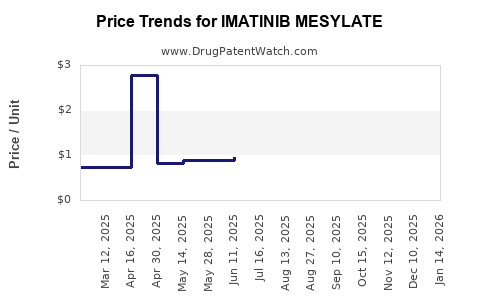
Last updated: September 1, 2026
Imatinib mesylate is a mature, globally genericized tyrosine kinase inhibitor with durable clinical demand in chronic myeloid leukemia (CML), gastrointestinal stromal tumors (GIST) and several rarer cancers. Its U.S. compound and market-exclusivity protections have expired, generic entry has materially reduced pricing, and Novartis’ branded Gleevec revenue is now a fraction of its peak. The drug remains commercially relevant because of long treatment duration, broad geographic use, established physician familiarity and continuing demand in lower-cost markets.
What is the current market status of imatinib mesylate?
Imatinib mesylate is the mesylate salt of imatinib, marketed by Novartis as Gleevec in the United States and Glivec in many international markets. It inhibits BCR-ABL, KIT and PDGFRA tyrosine kinases.
The main commercial indications are:
| Indication |
Commercial relevance |
| Philadelphia chromosome-positive CML |
Core long-term maintenance market |
| Ph-positive acute lymphoblastic leukemia |
Smaller but important hematology segment |
| KIT-positive GIST |
Major solid-tumor indication |
| PDGFRA-mutant GIST |
High response rates in a molecularly defined subgroup |
| Dermatofibrosarcoma protuberans |
Rare-tumor use |
| Systemic mastocytosis |
Niche indication |
| Hypereosinophilic syndrome and chronic eosinophilic leukemia |
Rare-disease use |
| Myelodysplastic or myeloproliferative disease with PDGFR rearrangements |
Small biomarker-defined market |
The U.S. Food and Drug Administration originally approved Gleevec in 2001 for CML and expanded the label to GIST and other indications over subsequent years (FDA, 2024a).
Imatinib differs from newer oncology products because it is a small-molecule oral therapy with no biosimilar pathway. Competition occurs through abbreviated new drug applications (ANDAs), not 351(k) biosimilar applications.
When did imatinib mesylate lose exclusivity?
U.S. market exclusivity ended in stages rather than on one date.
| Protection |
Key date or status |
Commercial effect |
| FDA approval of Gleevec |
May 10, 2001 |
Originator launch |
| U.S. compound patent, U.S. Patent No. 5,521,184 |
2015 nominal expiration |
Core composition protection ended |
| Pediatric exclusivity extension |
January 2016 |
Delayed full generic availability for certain protected uses |
| First major U.S. generic launches |
February 2016 |
Rapid price and share erosion |
| Product and formulation protections |
Expired or no longer commercially blocking in the U.S. |
Limited residual protection |
| Current U.S. status |
Genericized |
Multiple ANDA suppliers |
The compound patent’s nominal expiry was extended by six months under pediatric exclusivity. Novartis reached settlements with several generic manufacturers, allowing commercial launches in early 2016 rather than waiting for all patent disputes to run through trial.
Generic competition became commercially meaningful in February 2016. FDA records identify multiple approved imatinib mesylate tablets, including products from Teva, Sun Pharmaceutical, Apotex, Dr. Reddy’s Laboratories and other manufacturers (FDA, 2024b).
What patents protect imatinib mesylate?
The principal historical patent estate consisted of compound, salt, formulation and use claims.
Compound and salt patents
The central U.S. patent was U.S. Patent No. 5,521,184, assigned to Novartis or its predecessor interests. It covered the imatinib compound and related pharmaceutical applications. This patent provided the main barrier to generic entry.
A later U.S. patent, No. 6,894,051, covered crystalline forms of imatinib mesylate and related solid-state subject matter. The patent was litigated as part of Novartis’ effort to preserve commercial protection after the compound patent approached expiry.
The practical value of the crystalline-form patent was narrower than the compound patent. Generic manufacturers could challenge the validity, enforceability or infringement scope of the later patent, and formulation workarounds reduced its ability to maintain long-term market exclusivity.
Formulation patents
Gleevec is primarily an oral tablet product. Formulation-related protection historically addressed:
- Imatinib mesylate tablet compositions
- Crystalline forms and solid-state characteristics
- Pharmaceutical excipients and dosage strength
- Manufacturing and dissolution characteristics
Formulation patents were commercially relevant during the transition to generic entry, but they did not preserve a durable U.S. monopoly after 2016.
Method-of-use patents
The product label covers multiple cancers and molecularly defined disorders. Method-of-use protection applied to treatment of:
- BCR-ABL-positive CML
- KIT-positive GIST
- PDGFRA-rearranged disease
- Ph-positive ALL
- Dermatofibrosarcoma protuberans
- Certain rare hematologic disorders
Method-of-use patents can support label carve-outs under the ANDA pathway. They have limited practical value when the principal indications are already off-patent and generic manufacturers can sell for non-protected uses.
What is the Orange Book status of Gleevec?
Gleevec is an FDA-approved small molecule listed in the Orange Book. Its historic patents included the compound and crystalline-form protections associated with imatinib mesylate.
The current commercial position is generic competition, not Orange Book exclusivity. Approved generic products can rely on ANDA certifications against listed patents. Paragraph IV certifications were central to the patent disputes that preceded generic entry.
The Orange Book remains relevant for tracking listed patents, dosage forms and therapeutic equivalence. It does not mean that every historical patent continues to block approval or sale. Patent expiration, settlement terms, delisting and claim scope determine the actual barrier to entry (FDA, 2024c).
Which companies challenged the imatinib mesylate patents?
The U.S. generic challenge involved several major manufacturers. Publicly reported litigants and commercial entrants included:
- Sun Pharmaceutical Industries
- Teva Pharmaceuticals
- Apotex
- Dr. Reddy’s Laboratories
- Other ANDA applicants
Novartis brought patent litigation under the Hatch-Waxman framework after receiving Paragraph IV certifications. The disputes addressed infringement and validity of the Gleevec patent estate, especially claims involving the compound, salt and crystalline form.
Settlement agreements allowed certain generic companies to launch before the latest asserted patent dates. The specific launch dates and commercial terms varied by manufacturer. These agreements reduced litigation uncertainty for both sides but accelerated the transition from branded monopoly pricing to multi-source generic supply.
What patent litigation affects imatinib mesylate?
The most consequential litigation was Novartis’ Hatch-Waxman litigation against generic applicants in the period before 2016.
The litigation had three commercial outcomes:
- It confirmed that generic entry would occur substantially before the end of every asserted patent term.
- It created negotiated launch dates for selected generic companies.
- It prevented the later crystalline-form patent from functioning as a durable market barrier.
U.S. patent litigation no longer represents the primary risk to generic imatinib. The relevant risks are manufacturing compliance, product quality, supply continuity, pricing pressure and competition among established suppliers.
In other jurisdictions, patent outcomes varied. India became a major legal market for imatinib patent policy after the Supreme Court rejected Novartis’ patent claim for the beta crystalline form in 2013. The decision applied India’s Section 3(d) standard and had major implications for pharmaceutical patentability and secondary patents (Supreme Court of India, 2013).
How many patents cover imatinib mesylate today?
The historical patent family contains multiple U.S. and international filings, but the number of documents is less useful than the remaining enforceable claims.
The commercially important U.S. protections were:
| Patent category |
Historical role |
Current market impact |
| Basic compound patent |
Primary exclusivity barrier |
Expired |
| Mesylate or crystalline-form patent |
Secondary protection |
No longer a durable U.S. barrier |
| Formulation patents |
Product and manufacturing differentiation |
Limited |
| Method-of-use patents |
Indication-specific coverage |
Limited because of mature generic use |
| Process patents |
Manufacturing protection |
Potentially relevant only if claims are narrow and enforceable |
The patent estate is therefore weak as a current U.S. exclusivity asset but remains relevant for freedom-to-operate analysis in countries with different patent terms, supplementary protection certificates, enforcement standards or delayed generic penetration.
How strong is the imatinib mesylate patent estate?
The patent estate is strong historically and weak commercially today.
| Factor |
Assessment |
| Core compound protection |
Expired in the U.S. |
| Secondary crystalline-form protection |
Insufficient to prevent broad genericization |
| Method-of-use protection |
Narrow and vulnerable to label carve-outs |
| Formulation differentiation |
Low strategic value for standard tablets |
| Manufacturing patents |
Potentially relevant to individual suppliers |
| International coverage |
Uneven by jurisdiction |
| Current U.S. exclusivity |
None of material commercial significance |
| Litigation risk |
Low compared with pre-2016 levels |
Novartis’ strongest protection was the original compound patent combined with regulatory approval and physician adoption. Secondary patents extended legal pressure but did not preserve the original revenue model.
What generic entry risks exist for imatinib mesylate?
Generic launch risk is no longer a future event in the United States. It is an established market condition.
The main risks for manufacturers and investors are:
- Price erosion from multiple ANDA-approved suppliers
- Wholesaler and pharmacy substitution
- Supply interruptions caused by concentrated manufacturing
- FDA warning letters or manufacturing remediation
- Shortages of specific tablet strengths
- Hospital and payer tender pressure
- Competition from other TKIs in newly diagnosed CML
- Treatment switching from branded Gleevec to lower-cost generic imatinib
For the originator, the largest risk is continued volume migration rather than a single patent event. For generic suppliers, the opportunity is stable demand but low differentiation.
How does imatinib compare with competing tyrosine kinase inhibitors?
Imatinib remains the reference treatment for many CML patients, but newer TKIs compete for first-line and later-line use.
| Drug |
Company or originator |
Position relative to imatinib |
| Imatinib |
Novartis, now genericized |
Lowest-cost established TKI; long safety record |
| Dasatinib |
Bristol Myers Squibb |
More potent, different adverse-event profile |
| Nilotinib |
Novartis |
Used in CML; branded and generic competition varies |
| Bosutinib |
Pfizer |
Alternative CML TKI |
| Ponatinib |
Takeda |
Important for resistant mutations, including T315I |
| Asciminib |
Novartis |
Allosteric BCR-ABL inhibitor; premium modern competitor |
Imatinib’s price advantage supports continued use in cost-sensitive systems. Newer agents can displace it when clinicians prioritize deeper molecular responses, resistance management or specific mutation coverage.
What is the financial trajectory for Gleevec and imatinib mesylate?
Gleevec generated multibillion-dollar revenue before U.S. and international generic entry. Novartis’ annual reports show a steep decline after genericization. The product moved from a strategic growth asset to a mature, declining brand.
Novartis reported Gleevec sales of approximately $400 million in 2023, compared with several billion dollars at its pre-generic peak. The exact annual figure varies by reporting period, currency and geographic classification (Novartis, 2024).
The financial trajectory has four phases:
2001-2012: rapid expansion
Regulatory approvals in CML and GIST created a broad, high-value oncology franchise. Long treatment duration supported recurring revenue. Imatinib became one of the company’s most important products.
2013-2015: pre-expiry defense
Novartis pursued secondary patents, lifecycle management and settlement strategies. The company also developed newer TKIs, including Tasigna and later Scemblix, to protect the broader CML franchise.
2016-2019: generic shock
U.S. generic entry caused substantial price and share erosion. International markets followed at different speeds. Branded Gleevec retained some demand among patients and physicians, but the product lost monopoly economics.
2020 onward: mature residual brand
Revenue is supported by remaining branded prescriptions, markets with slower generic substitution, and patients stable on branded therapy. The product no longer drives Novartis’ oncology growth. Its commercial role is defensive and cash-generative rather than expansionary.
The important financial distinction is between Gleevec revenue and the total imatinib market. Generic manufacturers collectively capture demand that previously accrued to Novartis, while the originator’s reported sales decline sharply.
What licensing deals affect imatinib mesylate?
The key commercial asset was developed within the Ciba-Geigy and Novartis research organization rather than through a widely disclosed current external license structure. Publicly visible market activity is dominated by patent settlements and generic supply, not royalty-bearing licensing.
Licensing and collaboration analysis should distinguish among:
- Original research and corporate succession involving Ciba-Geigy and Novartis
- Patent settlements with generic applicants
- Local distribution arrangements
- Generic manufacturing and marketing authorizations
- Patient-assistance or access programs
No current licensing arrangement appears to restore branded exclusivity in the United States. Settlement agreements reduced patent litigation exposure but did not create a durable premium market.
What is the FDA regulatory status of imatinib mesylate?
Gleevec remains FDA-approved, and multiple generic imatinib mesylate products have FDA approval. The standard U.S. products are oral tablets in multiple strengths, including 100 mg and 400 mg presentations.
Regulatory considerations include:
- ANDA approval for generic tablets
- Therapeutic-equivalence ratings where assigned
- Bioequivalence to the reference listed drug
- Label carve-outs for patent-protected uses, where applicable
- Manufacturing and supply-chain compliance
- Pediatric and adult dosing across approved indications
There is no biosimilar risk category because imatinib is a chemical drug. The relevant regulatory threat is generic substitution.
What geographic markets remain commercially attractive?
The United States is a mature, low-price generic market. Commercial opportunity is more dependent on volume, tenders and supply reliability than on patent exclusivity.
| Region |
Market characteristics |
| United States |
Mature ANDA market; intense price competition |
| Western Europe |
Genericized; national reimbursement and tender pressure |
| Japan |
Mature market with local regulatory and pricing dynamics |
| China |
Large patient base; centralized procurement can reduce prices sharply |
| India |
Strong domestic generic competition; significant patent-policy history |
| Latin America |
Variable generic penetration and public-sector procurement |
| Africa and lower-income markets |
Access-driven demand; donor, tender and supply constraints |
Geographic patent coverage is no longer a major U.S. value driver. In emerging markets, demand growth can persist even as prices fall. The commercial winner is often the supplier with regulatory approvals, reliable active pharmaceutical ingredient sourcing and public-procurement access.
What manufacturing and intellectual-property barriers remain?
The active pharmaceutical ingredient is established, but manufacturing remains subject to quality and supply requirements. Barriers include:
- Consistent production of imatinib mesylate API
- Control of polymorphic and crystalline characteristics
- Tablet dissolution and stability
- Good manufacturing practice compliance
- Reliable supply of multiple strengths
- Registration in local jurisdictions
- Pharmacovigilance and post-market reporting
Manufacturing patents may still affect particular synthetic routes or crystalline forms in selected countries. In the U.S., these barriers are unlikely to support meaningful product-level exclusivity without a new patented formulation or delivery system.
What generic launch scenarios are plausible?
The U.S. launch scenario has already occurred. Future market outcomes are more likely to involve consolidation and price stabilization than a new wave of exclusivity litigation.
Base case
Generic imatinib remains widely available, branded Gleevec continues to decline gradually, and demand remains stable in CML and GIST.
Downside case for suppliers
Additional entrants, procurement consolidation or aggressive pricing create further erosion. Lower margins increase the risk that smaller suppliers exit.
Upside case for suppliers
A competitor experiences a manufacturing disruption or regulatory action. Approved suppliers gain temporary volume, but the market remains structurally generic.
Originator case
Novartis preserves a smaller branded base through physician familiarity, patient continuity and selected international markets. Gleevec does not return to its pre-2016 revenue level without a new exclusivity mechanism.
Key Takeaways
- Imatinib mesylate is a mature generic oncology market with durable clinical demand.
- U.S. compound exclusivity ended after the 2015 patent expiry and six-month pediatric extension.
- Generic launches began in February 2016 following Paragraph IV litigation and settlements.
- Gleevec’s U.S. commercial position is no longer protected by meaningful exclusivity.
- Novartis’ Gleevec revenue has fallen from multibillion-dollar peak levels to roughly hundreds of millions of dollars annually.
- There is no biosimilar pathway; ANDA-approved generics define the competitive landscape.
- The strongest remaining commercial barriers are manufacturing quality, supply reliability, regulatory approvals and market access.
- Newer TKIs compete clinically, but generic imatinib retains a cost advantage and a large installed patient base.
- International revenue potential depends on volume, tender access and patent enforcement rather than premium pricing.
FAQs
Is imatinib mesylate still profitable after generic entry?
Yes, but profitability has shifted from originator economics to high-volume, low-margin generic supply. Branded Gleevec remains commercially viable in selected markets, but its revenue is far below its pre-generic peak.
Does imatinib mesylate have biosimilar competition?
No. Imatinib mesylate is a chemically synthesized small molecule. Competition occurs through generic ANDA products, not biosimilars.
Can a new imatinib formulation obtain patent protection?
Potentially. A novel formulation, dosage regimen, delivery system or combination could receive patent protection if it satisfies novelty, non-obviousness and other statutory requirements. A routine reformulation would face substantial validity risk.
Which companies manufacture generic imatinib in the United States?
Approved or historically active suppliers include Teva, Sun Pharmaceutical, Apotex and Dr. Reddy’s Laboratories, along with other ANDA holders. Supplier status can change because of manufacturing, commercial or regulatory decisions.
Is generic imatinib therapeutically equivalent to Gleevec?
FDA-approved generic products must satisfy applicable quality and bioequivalence requirements. Therapeutic-equivalence designations and product-specific approval information are listed in FDA databases and the Orange Book.
References
-
Food and Drug Administration. (2024a). Gleevec (imatinib mesylate) prescribing information. U.S. Department of Health and Human Services.
-
Food and Drug Administration. (2024b). Drugs@FDA: Imatinib mesylate ANDA approvals. U.S. Department of Health and Human Services.
-
Food and Drug Administration. (2024c). Approved drug products with therapeutic equivalence evaluations. U.S. Department of Health and Human Services.
-
Novartis AG. (2024). Annual report 2023. Basel, Switzerland: Novartis.
-
Supreme Court of India. (2013). Novartis AG v. Union of India & Others, Civil Appeal Nos. 2706-2716 of 2013.
-
U.S. Patent and Trademark Office. (1996). U.S. Patent No. 5,521,184: Pyrimidine derivatives and processes for their preparation. Washington, DC: U.S. Department of Commerce.
-
U.S. Patent and Trademark Office. (2005). U.S. Patent No. 6,894,051: Crystal modification of a pharmaceutical compound. Washington, DC: U.S. Department of Commerce.