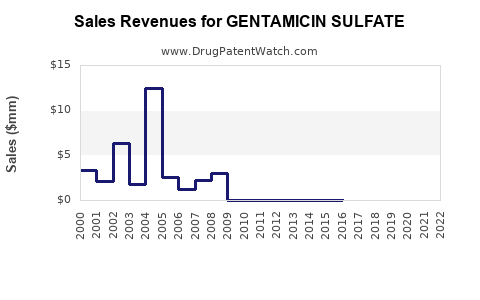
Last updated: August 7, 2026
Gentamicin sulfate is a mature, low-cost aminoglycoside antibiotic with continuing demand in hospital injection, ophthalmic, topical, and veterinary markets. Its commercial profile is defined by generic competition, low unit pricing, procurement-driven purchasing, antimicrobial-resistance constraints, and periodic supply disruptions. The product has no meaningful remaining composition-of-matter patent protection, no biosimilar pathway, and limited standalone revenue disclosure by manufacturers. Financial performance depends more on manufacturing reliability, hospital contracts, shortage pricing, and veterinary volume than on brand premiums or clinical differentiation.
What is the current market position of gentamicin sulfate?
Gentamicin sulfate is used primarily for serious gram-negative bacterial infections and, in selected cases, synergistic treatment of gram-positive infections such as enterococcal endocarditis. It is available in several dosage forms:
| Segment |
Main dosage forms |
Principal buyers |
Commercial characteristics |
| Hospital systemic use |
Injection and intravenous solution |
Hospitals, group purchasing organizations, distributors |
Largest clinical value segment; highly price-sensitive |
| Ophthalmology |
Eye drops and ointments |
Retail pharmacies, ophthalmologists, hospitals |
Fragmented generic market |
| Dermatology |
Creams, ointments, and topical preparations |
Retail and institutional channels |
Low-priced, often combined with corticosteroids or antifungals |
| Veterinary medicine |
Injectable and topical products |
Veterinary hospitals, farms, animal-health distributors |
Important volume market with separate regulatory and pricing dynamics |
| Compounding |
Sterile and nonsterile compounded preparations |
Specialty pharmacies and hospitals |
Smaller but relevant during shortages or product discontinuations |
Gentamicin is usually purchased as a generic active pharmaceutical ingredient or finished dosage form. The principal competitive variables are availability, sterility assurance, concentration options, vial size, preservative status, shipping reliability, and contract price.
The product’s clinical importance remains higher than its commercial value. Hospitals retain gentamicin for empiric or targeted therapy, neonatal care, urinary tract infections, intra-abdominal infections, endocarditis synergy, and selected surgical or ophthalmic uses. Its narrow therapeutic index and nephrotoxicity and ototoxicity risks limit broad use and support therapeutic-drug monitoring in many treatment settings [1][2].
How large is the gentamicin sulfate market?
No authoritative public source reports a globally audited, gentamicin-specific revenue figure across human, ophthalmic, topical, and veterinary products. Manufacturers generally report gentamicin within broader generic injectable, anti-infective, ophthalmic, or animal-health categories rather than as a separate product line.
The economic profile can be summarized as follows:
| Metric |
Assessment |
| Product maturity |
Mature, post-patent generic |
| Pricing power |
Low |
| Prescriber differentiation |
Limited |
| Hospital purchasing concentration |
High |
| Manufacturing complexity |
Moderate to high for sterile injectable products |
| Demand volatility |
Moderate; affected by resistance, outbreaks, shortages, and formularies |
| Revenue growth potential |
Low without a differentiated formulation or supply advantage |
| Margin potential |
Higher for reliable sterile supply than for standard commodity products |
| Patent-driven exclusivity |
Effectively absent |
| Biosimilar exposure |
Not applicable |
The highest-value commercial opportunity is not a branded gentamicin product. It is dependable supply of sterile injectable presentations, specialized concentrations, preservative-free products, premixed bags, or combination products that reduce preparation costs. Retail topical and ophthalmic products generally face stronger substitution and lower barriers to entry.
When did gentamicin sulfate lose exclusivity?
Gentamicin sulfate is an older small-molecule antibiotic and has no commercially meaningful remaining composition-of-matter exclusivity. The original discovery and development period dates to the 1960s. Gentamicin was isolated from Micromonospora species and entered clinical use before the modern Hatch-Waxman framework was established [3].
Its core active ingredient protection has therefore expired for decades. Any current exclusivity is product-specific and may arise from:
- A newly approved delivery system.
- A combination product.
- A novel concentration or premixed presentation.
- A manufacturing process.
- A limited method-of-use patent.
- Regulatory exclusivity attached to a new formulation or indication.
These rights would not restore exclusivity to conventional gentamicin sulfate injection, ophthalmic drops, or standard topical products.
What patents protect gentamicin sulfate products?
Conventional gentamicin sulfate products have little practical patent protection. The active ingredient is long off-patent, and standard formulations generally rely on established pharmaceutical technology.
| Patent category |
Current commercial relevance |
| Gentamicin composition-of-matter patents |
Expired |
| Conventional injection formulations |
Generally expired or commercially immaterial |
| Standard ophthalmic drops and ointments |
Generally expired |
| Standard topical cream or ointment |
Generally expired |
| Manufacturing processes |
Possible in narrow cases, but unlikely to block ordinary generic supply |
| Drug-device combinations |
Potentially relevant if a new delivery device is used |
| Combination products |
Potentially relevant where a new formulation or use is claimed |
| Veterinary formulations |
Product-specific rights may exist, but do not create broad human-market exclusivity |
A patent search should distinguish between patents covering gentamicin itself and patents covering a particular carrier, device, preservative system, dosing schedule, or combination. A patent directed to a liposomal or implantable delivery system would not necessarily block a conventional injectable generic.
What is the FDA regulatory status of gentamicin sulfate?
Gentamicin sulfate is an established FDA-regulated active ingredient marketed through multiple approved prescription products. Human products include injectable, ophthalmic, and topical formulations. FDA-approved labeling identifies the principal safety risks as nephrotoxicity, ototoxicity, neuromuscular blockade, and hypersensitivity reactions [1][2].
Systemic gentamicin is commonly administered under hospital protocols that consider:
- Renal function.
- Patient weight.
- Serum drug concentrations.
- Concomitant nephrotoxic medicines.
- Duration of treatment.
- Infection site and organism susceptibility.
The FDA regulatory environment is mature. New entrants generally pursue an abbreviated new drug application for a pharmaceutically equivalent generic product, subject to product-specific requirements. The primary regulatory burden for injections is manufacturing quality, sterility, container closure integrity, particulate control, and consistent potency.
Is gentamicin sulfate a biosimilar?
No. Gentamicin sulfate is a chemically synthesized or fermentation-derived small-molecule antibiotic, not a biologic. Competitors use the generic drug approval pathway rather than the biosimilar pathway under the Public Health Service Act.
What is the Orange Book status of gentamicin sulfate?
The Orange Book may include multiple approved gentamicin sulfate products, depending on dosage form, strength, sponsor, and current marketing status. Standard gentamicin products do not have a commercially significant patent barrier comparable to newer branded drugs.
Orange Book review should be conducted at the product level because:
- Injectable and ophthalmic products may have different application numbers.
- Some listed products may be discontinued but remain in historical records.
- Patent listings can differ by application and formulation.
- A listed patent may cover a narrow method of use rather than the core product.
For conventional gentamicin sulfate products, the practical market conclusion is that generic entry is already established. Paragraph IV litigation is therefore not the principal commercial risk.
Which companies manufacture or compete with gentamicin sulfate?
The market is fragmented among generic pharmaceutical manufacturers, contract manufacturers, specialty injectable suppliers, ophthalmic companies, and veterinary drug companies. Publicly visible suppliers have changed over time because of acquisitions, discontinuations, facility transfers, and shortages.
Competitive categories include:
| Competitor group |
Examples of competitive products |
| Aminoglycosides |
Amikacin, tobramycin, streptomycin, plazomicin |
| Beta-lactam combinations |
Piperacillin-tazobactam, ampicillin-sulbactam |
| Cephalosporins |
Cefepime, ceftazidime, ceftriaxone |
| Carbapenems |
Meropenem, imipenem-cilastatin |
| Topical alternatives |
Neomycin-containing and polymyxin-containing products |
| Veterinary alternatives |
Species-specific aminoglycoside and beta-lactam products |
Gentamicin competes less on molecule-for-molecule price than on institutional treatment protocols. Amikacin is often preferred when resistance to gentamicin is a concern. Tobramycin may be selected for particular organisms or indications. Newer agents such as plazomicin have a stronger resistance-oriented positioning but are priced and used differently.
How does gentamicin sulfate compare with amikacin and tobramycin?
| Factor |
Gentamicin |
Amikacin |
Tobramycin |
| Generic maturity |
Very high |
High |
High |
| Typical price position |
Low |
Usually higher |
Usually higher than gentamicin in some channels |
| Resistance profile |
More resistance limitations in some pathogens |
Often retained against gentamicin-resistant organisms |
Useful in selected gram-negative infections |
| Monitoring burden |
High |
High |
High |
| Hospital use |
Broad but selective |
Often reserved for resistant infections |
Selected clinical and ophthalmic use |
| Commercial differentiation |
Limited |
Resistance utility |
Organism and indication-specific utility |
| Patent risk |
Minimal |
Minimal for conventional products |
Minimal for conventional products |
Gentamicin retains cost advantages, but its use is constrained by toxicity and local susceptibility patterns. Amikacin can capture higher-value use in resistant infections. Tobramycin competes in hospital, inhaled, and ophthalmic applications, with some formulations carrying more specialized economics.
What patent litigation and Paragraph IV challenges affect gentamicin sulfate?
No major current patent litigation is generally associated with conventional gentamicin sulfate products. The product’s patent risk is structurally different from that of a recent branded medicine:
- The active ingredient is long off-patent.
- Multiple generic products have reached the market.
- Standard dosage forms have established regulatory precedents.
- Commercial disputes are more likely to concern supply, manufacturing quality, or contract terms than patent validity.
- A novel delivery system could create a separate patent dispute, but that would concern the delivery technology rather than ordinary gentamicin sulfate.
Paragraph IV challenges are therefore not a central market event for standard gentamicin. If a company introduces a proprietary gentamicin formulation, litigation risk would depend on the Orange Book-listed patents for that specific product.
What formulation patents could protect gentamicin sulfate?
Potentially defensible formulation areas include:
- Liposomal gentamicin.
- Sustained-release implants.
- Inhaled pulmonary delivery.
- Ophthalmic depot systems.
- Thermosensitive gels.
- Nanoparticle carriers.
- Premixed intravenous bags with extended stability.
- Device-enabled dosing systems.
- Reduced-toxicity formulations.
- Veterinary long-acting injections.
These technologies could support higher pricing if they demonstrate a clear clinical or operational benefit. Patent strength would depend on claim breadth, freedom-to-operate analysis, clinical data, manufacturing reproducibility, and whether the product qualifies for a distinct FDA approval pathway.
A formulation patent covering only a narrow excipient ratio or laboratory preparation may have limited commercial blocking power. A patent covering a clinically validated delivery system, device, or manufacturing process may create stronger protection.
How strong is the gentamicin sulfate patent estate?
The conventional gentamicin sulfate patent estate is weak from an exclusivity perspective and strong only in the sense that generic substitution is legally established.
| Patent-strength factor |
Assessment |
| Core molecule protection |
None of practical significance |
| Standard injection protection |
Low |
| Standard ophthalmic protection |
Low |
| Standard topical protection |
Low |
| New formulation protection |
Potentially moderate to strong |
| Manufacturing patent risk |
Usually narrow and product-specific |
| Freedom to launch a conventional generic |
Generally favorable, subject to regulatory approval |
| Litigation exposure |
Low for conventional products |
The main barriers are operational rather than legal. Sterile manufacturing capacity, validated supply chains, FDA inspection outcomes, active-ingredient availability, and hospital contracting can matter more than patents.
What manufacturing and supply risks affect gentamicin sulfate?
Sterile injectable gentamicin has higher supply risk than many oral generic medicines. Manufacturing constraints include:
- Sterile filling capacity.
- Raw-material and active-ingredient supply.
- Vial and stopper availability.
- Quality-control release testing.
- Facility remediation or inspection findings.
- Limited redundancy among approved suppliers.
- Low prices that reduce incentives for capacity expansion.
A shortage can temporarily improve supplier economics, but the effect may be short-lived. Hospitals often respond by switching to amikacin, tobramycin, alternative beta-lactams, or compounded products. Substitution can reduce the duration of any price benefit after supply normalizes.
FDA shortage records should be checked by presentation and strength rather than by active ingredient alone because a shortage may affect one vial size or concentration while other products remain available [4].
What licensing deals affect gentamicin sulfate?
No major, publicly disclosed licensing transaction appears to define the conventional gentamicin sulfate market. Licensing activity is more plausible in:
- Long-acting injectable systems.
- Inhaled antibiotic delivery.
- Ophthalmic implants.
- Veterinary extended-release products.
- Combination products.
- Contract manufacturing and regional commercialization.
For standard gentamicin injection, commercial agreements are more likely to be supply, distribution, contract manufacturing, or private-label arrangements than asset-level intellectual-property licenses.
What is the financial trajectory for gentamicin sulfate?
The financial trajectory is mature and structurally low growth.
Historical phase
Gentamicin generated its principal economic value during the branded and early post-generic periods. Once generic competition expanded, price erosion reduced the value of conventional products. Clinical demand persisted, but revenue shifted from brand economics to volume economics.
Current phase
Current revenues are distributed across many suppliers. Product-level reporting is limited, and the market is unlikely to support blockbuster economics. The strongest financial positions belong to companies that combine:
- Reliable sterile injectable capacity.
- Hospital and government contracts.
- Broad generic portfolios.
- Veterinary distribution.
- Geographic manufacturing diversification.
- The ability to maintain supply during shortages.
Forward trajectory
Base-case revenue is likely to remain stable to modestly declining in conventional human formulations. Unit demand may remain resilient, but pricing pressure and antimicrobial stewardship limit growth. Faster growth would require a differentiated product, such as a long-acting delivery system, inhaled formulation, or clinically superior combination.
| Scenario |
Demand |
Pricing |
Margin outlook |
| Base case |
Stable to mildly declining |
Continued generic pressure |
Low to moderate |
| Shortage-driven case |
Temporarily higher |
Elevated during constrained supply |
Higher but volatile |
| Differentiated formulation case |
Higher in targeted indications |
Premium pricing possible |
Moderate to high if protected |
| Resistance-driven downside |
Lower in susceptible indications |
Limited pricing benefit |
Margin pressure |
| Veterinary expansion case |
Stable or growing by geography |
Better segmentation |
Variable |
What generic launch risks exist for gentamicin sulfate?
A new conventional generic faces low patent risk but meaningful execution risk. The principal launch barriers are:
- FDA approval and inspection readiness.
- Bioequivalence or equivalence requirements for the dosage form.
- Sterility and container-closure validation.
- Competition from existing ANDA holders.
- Hospital formulary access.
- Group purchasing organization contracts.
- Low market price.
- Small addressable revenue per presentation.
- Supply reliability requirements.
A new entrant is more likely to win share through dependable supply, a missing concentration, preservative-free presentation, convenient packaging, or a contract-manufacturing advantage than through clinical branding.
How does geographic coverage affect the market?
The United States is heavily procurement-driven and regulated through FDA-approved products, hospital contracts, and shortage management. European markets operate through national and regional reimbursement systems, tendering, and parallel supply structures. Emerging markets may have higher unit demand but lower realized prices and greater variation in quality standards.
Veterinary demand is geographically broad and can be commercially meaningful, particularly where livestock and companion-animal medicine use injectable antibiotics. Regulatory restrictions on antimicrobial use in food-producing animals may reduce some applications while shifting demand toward veterinary-supervised, indication-specific treatment.
Key Takeaways
- Gentamicin sulfate is a mature, off-patent generic antibiotic with continuing clinical demand.
- Conventional products have little meaningful patent protection.
- Paragraph IV litigation is not a major current market risk.
- The product is not a biosimilar and uses generic drug regulatory pathways.
- Injectable supply reliability is more important than patent exclusivity.
- Revenue is fragmented and generally not separately disclosed by manufacturers.
- Conventional human-product growth is likely to be low, with periodic volatility from shortages.
- Differentiated delivery systems offer the clearest route to pricing power.
- Amikacin and tobramycin are the closest high-level aminoglycoside comparators.
- Veterinary, ophthalmic, and specialized injectable products create the main adjacent commercial opportunities.
FAQs
What is the main commercial use of gentamicin sulfate?
The main commercial use is hospital treatment with injectable gentamicin sulfate, followed by ophthalmic, topical, and veterinary products.
Does gentamicin sulfate have an active composition-of-matter patent?
No commercially meaningful composition-of-matter patent remains for conventional gentamicin sulfate.
Can a generic company launch gentamicin sulfate without a patent settlement?
For a conventional product, patent settlement is generally not the central launch issue because the core product is long off-patent. FDA approval, manufacturing compliance, and market access are more important.
Is gentamicin sulfate vulnerable to antimicrobial-resistance-related revenue decline?
Yes. Resistance can reduce use in particular pathogens or institutions, although low cost and clinical familiarity preserve demand in susceptible infections.
What type of gentamicin product could command a premium price?
A product with validated clinical or operational advantages, such as long-acting delivery, inhaled administration, reduced toxicity, premixed stability, or a specialized ophthalmic system, has the best prospect of premium pricing.
References
-
U.S. Food and Drug Administration. (2023). Gentamicin sulfate injection prescribing information. FDA-approved labeling.
-
U.S. National Library of Medicine. (2024). Gentamicin sulfate ophthalmic and topical product labeling. DailyMed.
-
Weinstein, M. J., Luedemann, G. M., Oden, E. M., Wagman, G. H., Rosselet, J. P., & Marquez, J. A. (1963). Gentamicin, a new antibiotic complex from Micromonospora. The Journal of Medicinal Chemistry, 6(4), 463-464.
-
U.S. Food and Drug Administration. (2024). Drug shortages database. FDA.