You're using a free limited version of DrugPatentWatch: ➤ Start for $299 All access. No Commitment.

Last Updated: January 4, 2026

FUROSEMIDE - Generic Drug Details


✉ Email this page to a colleague

« Back to Dashboard


What are the generic sources for furosemide and what is the scope of patent protection?

Furosemide is the generic ingredient in four branded drugs marketed by Abraxis Pharm, Accord Hlthcare, Am Regent, Amneal Pharms Co, Apotex, Areva Pharms, Aspiro, Astrazeneca, Avet Lifesciences, Baxter Hlthcare Corp, Eugia Pharma, Fresenius Kabi Usa, Gland, Hikma, Hospira, Igi Labs Inc, Intl Medication, Mankind Pharma, Marsam Pharms Llc, Meitheal, Saba Ilac Sanayive, Sagent, Smith And Nephew, Warner Chilcott, Watson Labs, Wyeth Ayerst, Sanofi Aventis Us, Pharmobedient Cnsltg, Scpharmaceuticals, Sq Innovation, Ani Pharms, Aurobindo Pharma Ltd, Chartwell Rx, Epic Pharma Llc, Esjay Pharma, Graviti Pharms, Ipca Labs Ltd, Kalapharm, Leading, Pharmobedient, Prinston Inc, Sun Pharm Inds Inc, Sun Pharm Industries, Superpharm, Watson Labs Teva, and Validus Pharms, and is included in seventy-two NDAs. There are four patents protecting this compound. Additional information is available in the individual branded drug profile pages.

Furosemide has twenty-four patent family members in fifteen countries.

There are twenty-two drug master file entries for furosemide. Fifty-four suppliers are listed for this compound.

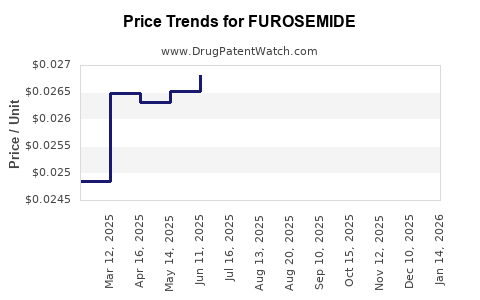
Drug Prices for FUROSEMIDE

See drug prices for FUROSEMIDE

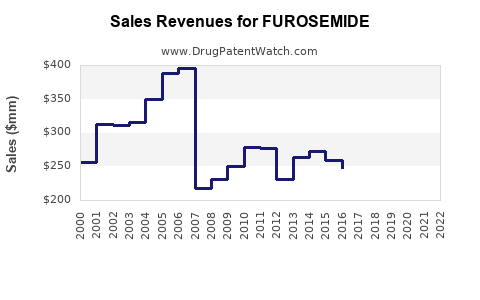
Drug Sales Revenue Trends for FUROSEMIDE

See drug sales revenues for FUROSEMIDE

Recent Clinical Trials for FUROSEMIDE

Identify potential brand extensions & 505(b)(2) entrants

SponsorPhase
University of California, IrvinePHASE4
Stacy JohnsonPHASE3
Centre Hospitalier Universitaire, AmiensNA

See all FUROSEMIDE clinical trials

Pharmacology for FUROSEMIDE
Drug ClassLoop Diuretic
Physiological EffectIncreased Diuresis at Loop of Henle
Medical Subject Heading (MeSH) Categories for FUROSEMIDE
Anatomical Therapeutic Chemical (ATC) Classes for FUROSEMIDE

US Patents and Regulatory Information for FUROSEMIDE

Applicant Tradename Generic Name Dosage NDA Approval Date TE Type RLD RS Patent No. Patent Expiration Product Substance Delist Req. Exclusivity Expiration
Sun Pharm Inds Inc FUROSEMIDE furosemide TABLET;ORAL 018790-001 Nov 29, 1983 DISCN No No ⤷  Get Started Free ⤷  Get Started Free ⤷  Get Started Free
Ipca Labs Ltd FUROSEMIDE furosemide TABLET;ORAL 078010-003 Sep 18, 2006 AB RX No No ⤷  Get Started Free ⤷  Get Started Free ⤷  Get Started Free
Hikma FUROSEMIDE furosemide INJECTABLE;INJECTION 071439-001 Sep 14, 1990 DISCN No No ⤷  Get Started Free ⤷  Get Started Free ⤷  Get Started Free
Aurobindo Pharma Ltd FUROSEMIDE furosemide TABLET;ORAL 218831-003 Jul 17, 2025 AB RX No No ⤷  Get Started Free ⤷  Get Started Free ⤷  Get Started Free
>Applicant >Tradename >Generic Name >Dosage >NDA >Approval Date >TE >Type >RLD >RS >Patent No. >Patent Expiration >Product >Substance >Delist Req. >Exclusivity Expiration

Expired US Patents for FUROSEMIDE

Applicant Tradename Generic Name Dosage NDA Approval Date Patent No. Patent Expiration
Sanofi Aventis Us LASIX furosemide INJECTABLE;INJECTION 016363-001 Approved Prior to Jan 1, 1982 4,324,779 ⤷  Get Started Free
Validus Pharms LASIX furosemide TABLET;ORAL 016273-003 Approved Prior to Jan 1, 1982 4,324,779 ⤷  Get Started Free
Validus Pharms LASIX furosemide TABLET;ORAL 016273-001 Approved Prior to Jan 1, 1982 4,324,779 ⤷  Get Started Free
Sanofi Aventis Us LASIX furosemide SOLUTION;ORAL 017688-001 Approved Prior to Jan 1, 1982 4,324,779 ⤷  Get Started Free
>Applicant >Tradename >Generic Name >Dosage >NDA >Approval Date >Patent No. >Patent Expiration

International Patents for FUROSEMIDE

Country Patent Number Title Estimated Expiration
Spain 2823589 ⤷  Get Started Free
South Korea 102493735 ⤷  Get Started Free
Mexico 367165 FORMULACIONES FARMACÉUTICAS PARA ADMINISTRACIÓN SUBCUTÁNEA DE FUROSEMIDA. (PHARMACEUTICAL FORMULATIONS FOR SUBCUTANEOUS ADMINISTRATION OF FUROSEMIDE.) ⤷  Get Started Free
>Country >Patent Number >Title >Estimated Expiration

Market Dynamics and Financial Trajectory of Furosemide

Last updated: January 1, 2026

Executive Summary

Furosemide, a loop diuretic primarily used to treat edema associated with heart failure, liver disease, and renal dysfunction, remains a cornerstone in cardiovascular and fluid management. Despite being introduced over five decades ago, its market sustainability is evident due to its broad clinical utility, generic availability, and established manufacturing landscape. This analysis explores the current market dynamics, regulatory influences, competitive environment, and financial trajectory for furosemide, offering strategic insights for stakeholders aiming to capitalize on or navigate the drug’s future.


What Are the Current Market Dynamics for Furosemide?

1. Global Sales Performance

Furosemide’s worldwide market size was valued at approximately USD 200 million in 2022, with steady growth projections (~2% CAGR until 2030). The dominant markets include North America, Europe, and Asia-Pacific, accounting for over 70% of global sales.

Region 2022 Revenue (USD Million) CAGR (2023-2030) Key Factors
North America 70 2% Established healthcare infrastructure, generic availability
Europe 50 1.8% Aging population, chronic disease prevalence
Asia-Pacific 55 3% Growing healthcare expenditure, expanding access
Rest of World 25 2.2% Emerging markets, local manufacturing growth

2. Market Drivers

  • High Clinical Adoption: Furosemide’s proven efficacy in managing fluid overload conditions sustains consistent prescribing patterns.
  • Cost-Effectiveness: As a long-established generic, its affordability bolsters market penetration, especially in resource-limited settings.
  • Regulatory Approvals and Formulation Developments: Approvals for new formulations (e.g., injectable, sustained-release) extend usage possibilities.

3. Market Restraints

  • Generic Competition: The presence of numerous generic manufacturers sustains low prices, compressing margins for branded producers.
  • Emerging Alternatives: Novel agents such as torsemide (a more potent loop diuretic with better bioavailability) are gaining ground.
  • Pricing and Reimbursement Policies: Variations in healthcare policies impact profit margins, especially in heavily regulated markets.

4. Regulatory Environment

  • FDA & EMA Approvals: Furosemide remains on essential medicines lists (WHO, 2019), simplifying approval pathways.
  • Patent Status: Its patent expired in the 1980s, shifting focus toward manufacturing and distribution rather than innovation.

How Is the Competitive Landscape Evolving?

1. Key Manufacturers and Market Share

Manufacturer Approximate Global Market Share Notable Features
Teva Pharmaceutical 30% Large generic portfolio
Mylan (now part of Viatris) 20% Cost leadership, wide distribution
Sun Pharmaceutical 15% Focus on emerging markets
Other Generics 35% Fragmented, low barriers to entry

2. Innovative Formulations and Delivery Systems

  • Injectable/Faster-Absorbing Forms: Increasing demand for hospital use.
  • Combination Therapies: Combining furosemide with other cardiovascular drugs to improve outcomes.
  • Novel Delivery Devices: Liposomal formulations and transdermal patches under research.

3. Regulatory and Patent Challenges

Consolidation in manufacturing and regulatory compliance costs influence manufacturing scale and profitability. No recent patent protections mean market competition hinges on price and distribution logistics.


What Is the Financial Trajectory for Furosemide?

1. Revenue Forecast and Growth Drivers

Projected incremental revenue growth (~2-3% CAGR) driven by demographic aging, especially in the U.S. and Europe, and expanding healthcare access in emerging markets.

Year Estimated Global Revenue (USD Million) Key Assumptions
2023 205 Continued generic competition, stable demand
2025 215 Slight increase from new formulations, expanded access
2030 240 Aging populations, rising chronic disease burden

2. Margin Expectations

Margins typically range 10-15% due to high generic competition, with leading manufacturers maintaining slightly higher margins through economies of scale and supply chain efficiencies.

3. Investment Opportunities

  • Manufacturing Expansion: Increasing capacity in emerging markets to capitalize on local demand.
  • Formulation Innovation: R&D investment in improved delivery systems, potentially commanding premium pricing.
  • Quality Assurance: Ensuring compliance to avoid recalls and sustain sales.

4. Risks and Challenges

  • Price erosion: Intensified by increasing generics and price controls.
  • Market Entry Barriers: Regulatory hurdles in some markets can impede expansion.
  • Substitutes: Adoption of alternative diuretics with better pharmacokinetic profiles.

How Do Policy and Market Trends Impact Furosemide?

1. Global Healthcare Policies

  • WHO Essential Medicines List (EML): Furosemide’s inclusion sustains global demand.
  • Reimbursement Policies: Countries with comprehensive reimbursement boost usage; conversely, austerity measures suppress it.

2. Price Control Regulations

  • European Union: Price caps and tender systems in countries like Italy and France influence margins.
  • United States: Market-Driven pricing, with hospitals favoring low-cost generics.

3. Supply Chain Dynamics

  • Global Manufacturing: Concentration in India and China; supply disruptions could influence availability.
  • Regulatory Compliance: Stringent quality standards necessitate continual investment in manufacturing quality controls.

Deep Dive: Comparing Furosemide to Its Alternatives

Feature Furosemide Torsemide Bumetanide
Bioavailability 50-70% >90% 80-90%
Duration of Action 6 hours 12 hours 4–6 hours
Indications Edema, HF Edema, HF, hypertension Edema, HF
Patent Status Expired No patent, branded options exist Patent expired
Market Penetration Widely used Growing, niche indications Limited, niche market

Note: The relatively lower bioavailability and shorter duration of furosemide contribute to its substitution risk by torsemide, which offers better pharmacokinetics.


FAQs

1. What factors could disrupt the market trajectory of furosemide?

Market disruption could arise from patent resurgence, regulatory hurdles sharply tightening quality standards, or the emergence of superior diuretics with enhanced safety profiles and convenience.

2. Are there any notable innovations in furosemide formulations?

Yes. Developments include sustained-release tablets, injectable forms with improved stability, and combination therapies—but these are primarily in the research phase or niche markets, not yet disrupting the main market.

3. How significant is the role of emerging markets in the furosemide market?

Crucial. Countries such as India, China, and parts of Southeast Asia are experiencing rapid growth in demand due to expanding healthcare infrastructure, local manufacturing, and affordability considerations.

4. What is the outlook for branded vs. generic manufacturers?

Generics dominate due to low barriers to entry, compressing profit margins. Branded manufacturers focusing on formulation innovations or targeted indications have limited competitive advantages but can sustain profitability via niche markets.

5. How do regulatory policies in developed vs. developing countries affect furosemide?

In developed markets, strict quality and safety standards are enforced, often increasing manufacturing costs but ensuring quality. In developing markets, regulatory environments may be less stringent, enabling lower-cost manufacturing but possibly risking quality compliance.


Key Takeaways

  • Market Size & Growth: Furosemide remains vital within a ~$200 million global market with moderate growth projections (~2% annually).
  • Competitive Landscape: Predominantly commoditized with intense price competition among generics; innovation and differentiated formulations present growth avenues.
  • Revenue Drivers & Risks: Demographic aging and chronic disease prevalence underpin demand; price erosion and alternative diuretics pose ongoing risks.
  • Regulatory & Policy Impact: WHO inclusion benefits global access; regional reimbursement and price controls influence profitability.
  • Future Outlook: Continued modest growth driven by emerging markets, with potential for expansion through formulation innovations and targeted indications.

References

[1] World Health Organization. (2019). Essential medicines list 21st edition.
[2] IMS Health. (2022). Global Pharmaceutical Market Report.
[3] Fitch Solutions. (2023). Global Diuretic Market Analysis.
[4] US Food and Drug Administration. (2022). Approved Drugs Database.
[5] European Medicines Agency. (2022). Market Authorizations.

More… ↓

⤷  Get Started Free

Make Better Decisions: Try a trial or see plans & pricing

Drugs may be covered by multiple patents or regulatory protections. All trademarks and applicant names are the property of their respective owners or licensors. Although great care is taken in the proper and correct provision of this service, thinkBiotech LLC does not accept any responsibility for possible consequences of errors or omissions in the provided data. The data presented herein is for information purposes only. There is no warranty that the data contained herein is error free. We do not provide individual investment advice. This service is not registered with any financial regulatory agency. The information we publish is educational only and based on our opinions plus our models. By using DrugPatentWatch you acknowledge that we do not provide personalized recommendations or advice. thinkBiotech performs no independent verification of facts as provided by public sources nor are attempts made to provide legal or investing advice. Any reliance on data provided herein is done solely at the discretion of the user. Users of this service are advised to seek professional advice and independent confirmation before considering acting on any of the provided information. thinkBiotech LLC reserves the right to amend, extend or withdraw any part or all of the offered service without notice.