Last updated: September 27, 2026
Furosemide is a mature, off-patent loop diuretic with stable clinical demand, low unit pricing, and limited branded revenue. Its commercial value is concentrated in hospital injection supply, generic oral tablets, and institutional purchasing contracts rather than patent-protected pricing. The principal business risks are manufacturing concentration, procurement pricing, injectable shortages, and substitution by other diuretics, not generic patent litigation.
Furosemide Market Dynamics, Patent Status, Competitive Landscape, and Financial Trajectory
What is the current market position of furosemide?
Furosemide is a low-cost loop diuretic used to treat edema associated with heart failure, hepatic disease, renal disease, and hypertension. It is marketed in oral tablets, oral solutions, and parenteral formulations, including intravenous and intramuscular injection products.[1]
The U.S. market is predominantly generic. Sanofi’s Lasix brand established the historical commercial franchise, but generic furosemide has replaced branded volume in most retail and institutional channels. The drug remains clinically important because it is inexpensive, familiar to prescribers, available in multiple dosage strengths, and widely used in emergency and inpatient settings.
| Market characteristic |
Furosemide assessment |
| Therapeutic class |
Loop diuretic |
| Principal indications |
Edema and hypertension |
| Common oral strengths |
20 mg, 40 mg, 80 mg |
| Common injection strengths |
10 mg/mL and 50 mg/5 mL |
| U.S. regulatory status |
Approved prescription drug; multiple generic ANDAs and legacy branded products |
| Patent status |
Mature, off-patent product |
| Biosimilar exposure |
None; furosemide is a small molecule |
| Pricing power |
Very low for oral products; higher but still limited for injectable supply |
| Key purchasers |
Retail pharmacies, hospitals, wholesalers, group purchasing organizations |
| Primary commercial risk |
Price compression and supply disruption |
When did furosemide lose exclusivity?
Furosemide lost meaningful market exclusivity decades ago. The active ingredient was developed and commercialized long before the modern Hatch-Waxman framework, and generic products have been available for many years.
The current U.S. furosemide market does not depend on a live composition-of-matter patent. Any remaining intellectual-property value is more likely to relate to a specific formulation, delivery system, manufacturing process, or combination product than to furosemide itself.
The original Lasix franchise has no current blockbuster-style exclusivity profile. The FDA-approved labeling for Lasix identifies the product as an established prescription medicine, while generic furosemide products are approved through abbreviated new drug applications.[1,2]
Furosemide patent expiration dates
A single commercially relevant U.S. patent expiration date does not define the market. Core compound and product protections expired long ago. Current commercial competition is based on:
- ANDA approval status;
- manufacturing cost;
- active pharmaceutical ingredient supply;
- hospital and wholesaler contracts;
- product availability;
- packaging and dosage-form breadth;
- regulatory compliance.
Any secondary patent covering an extended-release, combination, or specialized delivery product would apply only to that product and would not restore exclusivity for conventional furosemide tablets or injection.
What is the Orange Book status of furosemide?
Furosemide is an established generic product with multiple FDA-approved dosage forms and manufacturers. The Orange Book is relevant for identifying reference listed drugs, approved generic equivalents, and any current listed patents or exclusivity entries.[2]
For standard furosemide tablets and injection products, the commercial question is generally not whether a generic can enter. It is whether a manufacturer can obtain approval, maintain supply, and compete at acceptable margins.
| Orange Book issue |
Commercial relevance |
| Reference listed drug |
Relevant for ANDA equivalence |
| Paragraph IV challenge |
Limited strategic value because core exclusivity has expired |
| Listed patent protection |
Not generally the primary barrier for conventional products |
| 30-month stay risk |
Low relative to newer branded drugs |
| Generic substitution |
High for ordinary tablets |
| Formulation-specific patents |
Relevant only where the product differs materially from standard dosage forms |
How many patents cover furosemide?
The number of historical patents associated with furosemide is less important than whether any unexpired patent blocks a commercially meaningful product. Conventional immediate-release furosemide tablets and standard injectable products are mature generic technologies.
Patent analysis should distinguish among:
- Compound patents, which expired after the original development period.
- Formulation patents, which may cover modified-release or stability characteristics.
- Manufacturing patents, which may cover synthesis, purification, crystallization, or sterile processing.
- Method-of-use patents, which may claim a particular disease, dose, or patient population.
- Device patents, which could apply to specialized delivery systems.
For standard furosemide, none of these categories has created a durable U.S. monopoly comparable with current branded cardiovascular drugs. Manufacturing know-how can still affect cost and supply, but it is an operational barrier rather than a broad exclusionary right.
What formulations are protected by furosemide patents?
The commercially important formulations are conventional immediate-release tablets, oral solutions, and sterile injections. These dosage forms are widely supplied by generic manufacturers.
Potentially differentiated products include:
- sustained-release or modified-release oral formulations;
- concentrated solutions for specialized administration;
- premixed intravenous products;
- ready-to-use hospital containers;
- combination products;
- novel delivery systems;
- products designed to improve bioavailability or reduce dosing variability.
A formulation patent would need to provide a meaningful clinical, operational, or regulatory advantage to support premium pricing. For a low-cost diuretic, incremental formulation improvements face a difficult reimbursement environment. Hospitals and pharmacies generally prioritize price, availability, dose flexibility, and validated supply over modest formulation differentiation.
What is the FDA regulatory status of furosemide?
The FDA regulates furosemide as a prescription drug. Approved products include oral tablets, oral solutions, and injectable formulations. The drug carries established labeling for edema and hypertension, with warnings concerning fluid and electrolyte depletion, dehydration, ototoxicity, and renal effects.[1]
Generic manufacturers use ANDAs when they demonstrate pharmaceutical equivalence and bioequivalence to an approved reference product. Injectable products also require compliance with sterile manufacturing, container-closure, particulate, sterility, and stability requirements.
The regulatory burden is therefore higher for injections than for conventional tablets. That difference supports a more resilient pricing profile for hospital injection products, although contract purchasing limits the upside.
Which companies compete in the furosemide market?
Competition varies by country and dosage form. In the United States, generic and hospital suppliers have included companies such as Hikma Pharmaceuticals, Fresenius Kabi, Pfizer or Hospira, Teva Pharmaceutical Industries, Sagent Pharmaceuticals, and other ANDA holders. Retail tablet supply is more fragmented than injectable supply.
| Supplier type |
Typical furosemide exposure |
Competitive position |
| Large generic companies |
Tablets, solutions, injections |
Scale and broad distribution |
| Hospital injectable suppliers |
Vials, ampules, premixed products |
Supply reliability and contracts |
| Regional generic manufacturers |
Primarily oral products |
Low-cost production |
| Branded originator |
Historical Lasix franchise |
Limited current pricing power |
| API manufacturers |
Bulk furosemide supply |
Influence cost and continuity |
Supplier rankings can change because of contract awards, product discontinuations, manufacturing observations, and temporary shortages. A manufacturer with a small market share can become strategically important if competing injectable suppliers experience capacity constraints.
What patent litigation affects furosemide?
Furosemide has little current patent litigation comparable with recently launched branded medicines. The standard product is too mature for a conventional Paragraph IV strategy to generate significant value unless a challenger targets a specific newer formulation or combination product.
The more relevant legal matters are likely to involve:
- manufacturing quality investigations;
- product recalls;
- supply contracts;
- antitrust claims concerning generic pricing;
- labeling and product-liability disputes;
- hospital procurement disputes;
- secondary patents for differentiated delivery systems.
The absence of major active patent litigation reduces legal uncertainty for generic entry. It does not eliminate supply-chain risk. A manufacturer can hold regulatory approval and still lose commercial access through manufacturing disruption, quality remediation, or failure to meet institutional delivery requirements.
Are there biosimilar risks for furosemide?
Furosemide has no biosimilar risk because it is a small-molecule chemical drug, not a biologic. Competitive pressure comes from ordinary generic substitution, therapeutic alternatives, and procurement competition.
The main substitutes include other loop diuretics such as bumetanide and torsemide, as well as thiazide-type diuretics and potassium-sparing agents in selected patients. Substitution is clinically constrained because potency, duration, renal response, and patient status differ across products.
Torsemide can exert competitive pressure in heart-failure management, particularly where longer duration or outpatient dosing convenience is valued. Bumetanide is relevant when clinicians require a different potency or absorption profile. These products do not eliminate furosemide demand because furosemide remains widely used in acute care and routine edema treatment.
What is the financial trajectory of furosemide?
Furosemide’s financial trajectory is mature and volume-driven:
| Period |
Financial pattern |
| Original branded period |
High value supported by product innovation and brand recognition |
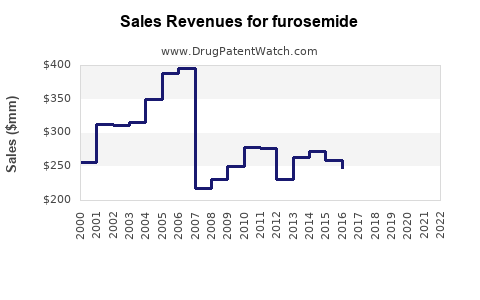
| Early generic entry |
Rapid price erosion and market-share transfer |
| Mature generic period |
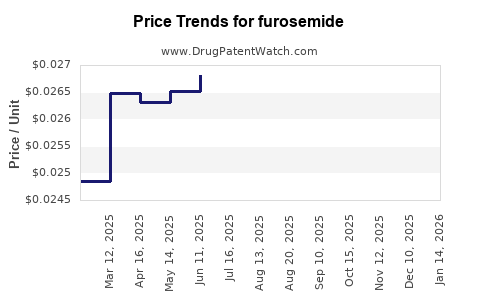
Stable or gradually rising unit demand with low revenue per unit |
| Current market |
Low-margin oral business and more concentrated injectable economics |
| Forward outlook |
Stable clinical demand, limited revenue growth, periodic supply-driven price movement |
Public companies generally do not report furosemide revenue as a separate material line item. Sales are typically aggregated within generic pharmaceuticals, hospital products, or injectable portfolios. As a result, company-level valuation cannot reliably attribute a distinct furosemide revenue stream without product-level disclosures or market-data subscriptions.
The highest-value commercial segment is usually injectable furosemide. Hospitals require dependable availability, and sterile manufacturing reduces the number of viable suppliers relative to oral tablets. Even in that segment, group purchasing organizations and wholesalers impose substantial pricing pressure.
Revenue exposure by dosage form
| Dosage form |
Demand profile |
Margin outlook |
| Immediate-release tablets |
Broad, recurring, highly substitutable |
Low |
| Oral solution |
Smaller volume, useful for selected patients |
Low to moderate |
| Vials and ampules |
Hospital and emergency-care demand |
Moderate relative to tablets |
| Premixed injection |
Operational convenience |
Potentially higher, dependent on contracts |
| Novel formulations |
Limited market penetration |
Uncertain; requires differentiation |
What generic entry risks exist for furosemide?
Generic entry risk is high in the oral market because approval pathways are established and manufacturing technology is mature. The risk of new entrants is moderated by low expected returns, which can discourage investment in products with limited revenue potential.
For injectable furosemide, the principal risk is not patent-based entry but capacity-based competition. A new supplier can pressure prices if it secures FDA approval and hospital contracts. Conversely, an approved supplier can gain temporary pricing leverage if competitors face shortages or manufacturing interruptions.
Generic launch scenarios
| Scenario |
Likely effect |
| New oral ANDA entrant |
Lower prices and limited incumbent share loss |
| New injectable entrant |
Greater contract pressure if supply is reliable |
| Competitor manufacturing disruption |
Temporary volume and pricing benefit for available suppliers |
| API shortage |
Margin pressure, allocation, and potential hospital backorders |
| New delivery technology |
Limited impact unless it improves workflow or clinical outcomes |
| Hospital contract loss |
Rapid volume decline for affected supplier |
How strong is the furosemide patent estate?
The patent estate is weak as a source of market exclusivity but relevant as a defensive and technical asset. Conventional furosemide products have no meaningful compound-level barrier to generic competition.
Patent strength can still exist in a narrow product context where a company owns:
- a clinically differentiated extended-release formulation;
- a proprietary premixed injectable presentation;
- a delivery device;
- a manufacturing process that reduces impurities or improves yield;
- a combination therapy with separate regulatory value.
Those rights would protect a defined product, not the broader furosemide market. Their commercial strength would depend on claim scope, validity, freedom-to-operate analysis, FDA substitution rules, and whether payers recognize the product’s operational or clinical benefit.
How does furosemide compare with torsemide and bumetanide?
| Attribute |
Furosemide |
Torsemide |
Bumetanide |
| Market maturity |
Very high |
High |
High |
| Generic availability |
Broad |
Broad |
Broad |
| Acute-care use |
Extensive |
More limited |
Extensive |
| Oral dosing flexibility |
Broad |
Broad |
Broad |
| Patent-driven pricing |
Minimal |
Minimal |
Minimal |
| Hospital supply importance |
High |
Moderate |
Moderate |
| Main commercial advantage |
Low cost and familiarity |
Longer duration in selected use |
High potency in small doses |
Furosemide retains the largest practical market footprint because of its extensive hospital use, low acquisition cost, and broad dosage-form availability. Torsemide and bumetanide compete through pharmacologic characteristics rather than patent exclusivity.
What licensing deals affect furosemide?
There is no widely recognized current licensing transaction that materially changes the global furosemide market. Commercial relationships are more likely to involve contract manufacturing, API sourcing, hospital distribution, co-promotion, or regional supply agreements.
Licensing has limited strategic value for a mature generic unless it provides one of four advantages:
- Access to regulated-market manufacturing capacity.
- A differentiated formulation.
- A reliable API source.
- Hospital distribution and procurement access.
What geographic markets are most important for furosemide?
Furosemide is sold globally as a generic medicine. Market economics differ by region:
- United States: strong hospital demand, intense generic price competition, and meaningful injectable supply risk.
- European Union: country-level reimbursement and tender systems drive price.
- Emerging markets: broader retail use but greater variability in regulatory enforcement, distribution, and product quality.
- Hospital-heavy markets: injectable reliability has greater commercial value.
- Retail-heavy markets: tablet price competition is most severe.
Manufacturing and IP barriers are generally more important in regulated injectable markets than in standard oral products. International expansion requires local registration, pharmacopoeial compliance, serialization or traceability obligations, and country-specific tender access.
Key Takeaways
- Furosemide is a mature, off-patent loop diuretic with stable medical demand.
- Standard tablets and injections face extensive generic competition.
- Core patent protection expired long ago; current patent value is limited to specialized formulations, devices, or manufacturing processes.
- There is no meaningful biosimilar threat because furosemide is a small molecule.
- Oral products are low-margin and highly price-sensitive.
- Injectable products have better strategic value because sterile manufacturing and hospital supply reliability limit competition.
- Public companies rarely disclose furosemide revenue separately, making product-level revenue attribution difficult.
- The principal commercial risks are supply disruption, API concentration, sterile manufacturing failures, and hospital contract losses.
- The principal competitive alternatives are torsemide and bumetanide, but neither has displaced furosemide’s broad acute-care role.
- Future growth is more likely to come from volume stability, supply contracts, and differentiated delivery formats than from pricing power.
FAQs
Is furosemide still profitable for generic drug manufacturers?
Yes, but profitability depends on scale, manufacturing efficiency, and supply reliability. Oral tablets typically generate limited margins, while injectable products can produce better economics when supply is constrained or contracts reward dependable delivery.
Can a company obtain a new patent on a furosemide formulation?
Yes. A new formulation, delivery system, combination, or manufacturing process can qualify for patent protection if it meets applicable patentability requirements. Such a patent would protect the claimed product or process, not conventional furosemide generally.
Is Lasix still a major branded drug?
No. Lasix has historical brand recognition, but generic furosemide controls most routine U.S. volume. The brand does not retain the commercial position associated with an actively protected specialty medicine.
Could furosemide experience another shortage?
Yes. Injectable supply is vulnerable to sterile manufacturing interruptions, quality remediation, API constraints, and supplier concentration. Oral products are generally easier to source but can also experience temporary disruptions.
Does furosemide have a realistic blockbuster revenue opportunity?
No. Its mature patent position, broad generic supply, low pricing, and established therapeutic alternatives make blockbuster economics unlikely. A commercial opportunity would require a differentiated delivery product, a major supply contract, or a clinically valuable combination rather than conventional furosemide sales.
References
-
Sanofi. (2023). Lasix (furosemide) tablets and oral solution prescribing information. U.S. Food and Drug Administration labeling repository.
-
U.S. Food and Drug Administration. (2024). Approved drug products with therapeutic equivalence evaluations: Orange Book. https://www.fda.gov
-
U.S. Food and Drug Administration. (2024). Drugs@FDA: FDA-approved drugs database. https://www.accessdata.fda.gov/scripts/cder/daf/
-
U.S. Food and Drug Administration. (2024). Drug shortages database. https://www.accessdata.fda.gov/scripts/drugshortages/
-
U.S. Food and Drug Administration. (2014). Guidance for industry: ANDAs for certain highly purified synthetic peptide drug products that reference peptide drug products. https://www.fda.gov