Last updated: October 26, 2026
Clobetasol propionate is a mature, genericized ultra-high-potency topical corticosteroid. Its commercial value is driven by prescription volume, formulation mix, manufacturing efficiency, pharmacy contracting, and dermatology demand rather than by exclusivity. The active ingredient has no biosimilar risk, and the principal U.S. market barriers are regulatory approval, formulation development, supply reliability, and physician substitution.
What is the current market position of clobetasol propionate?
Clobetasol propionate is a topical corticosteroid used for short-term treatment of corticosteroid-responsive dermatoses, including psoriasis, eczema, dermatitis, and lichen planus. It is generally classified as a super-high-potency, or Class I, topical corticosteroid in the United States.
The product is marketed in multiple dosage forms:
| Dosage form |
Typical concentration |
Commercial role |
| Cream |
0.05% |
Largest and most commoditized segment |
| Ointment |
0.05% |
High-potency treatment for thick or lichenified lesions |
| Gel |
0.05% |
Niche formulation for selected dermatologic uses |
| Solution |
0.05% |
Scalp and hair-bearing areas |
| Foam |
0.05% |
Premium delivery system with convenience advantages |
| Shampoo |
0.05% |
Scalp psoriasis and short-contact therapy |
| Lotion |
0.05% |
Spreadability and patient-convenience positioning |
| Lower-strength cream |
0.025% |
Newer formulation segment with reduced potency |
The market is fragmented among branded legacy products, authorized generics, generic equivalents, contract-manufactured products, and private-label dermatology products. The active pharmaceutical ingredient is not difficult to distinguish chemically from competing products. Commercial differentiation therefore depends on vehicle, packaging, tolerability, delivery characteristics, payer status, and supply continuity.
When does clobetasol propionate lose exclusivity?
Clobetasol propionate lost meaningful compound-level exclusivity decades ago. The commercial market is now generic and formulation-driven.
The original U.S. brands included Temovate and later products such as Cormax, Clobex, Olux, and Impoyz. Those products entered the market through separate formulations and regulatory applications rather than through one continuing period of molecule-level protection.
U.S. exclusivity timeline
| Milestone |
Commercial significance |
| Early clobetasol propionate approvals |
Established the active ingredient and core topical indications |
| Generic cream and ointment approvals |
Shifted the market toward price competition |
| Foam, shampoo, solution, and lotion approvals |
Created formulation-specific branded niches |
| Impoyz 0.025% approval |
Expanded product differentiation through lower concentration |
| Current market |
Generic active ingredient with formulation-level competition |
No meaningful market exclusivity remains for the clobetasol propionate molecule itself. Any current exclusivity analysis must be performed at the individual product, formulation, or indication level.
What patents protect clobetasol propionate products?
The core active ingredient is not the principal patent issue. Relevant protection, where present, has historically focused on:
- topical vehicles;
- foam delivery systems;
- shampoos and short-contact formulations;
- particle size and suspension characteristics;
- emulsion stability;
- packaging and dispensing systems;
- lower-concentration formulations;
- treatment methods involving specific disease populations or treatment durations.
The earliest patents associated with the active ingredient and conventional topical formulations are expired or commercially ineffective. Later formulation patents may have had value during the launch period for products such as foam, shampoo, or lower-strength cream formulations, but they do not restore exclusivity to the active ingredient.
How strong is the patent estate for clobetasol propionate?
The overall patent estate is weak from an originator-protection perspective and moderate only for individual delivery systems. Conventional 0.05% cream and ointment products have limited patent defensibility because generic manufacturers can rely on established formulations and abbreviated regulatory pathways.
The strongest potential barriers are formulation-specific. A company seeking to defend a premium product would need to show that the claimed vehicle, manufacturing process, or delivery system produces a legally meaningful distinction from prior topical corticosteroid products.
Patent strength by product category is generally as follows:
| Product category |
Patent strength |
Main reason |
| Conventional 0.05% cream |
Low |
Mature formulation and extensive generic substitution |
| Conventional 0.05% ointment |
Low |
Long-established dosage form |
| Solution |
Low to moderate |
Vehicle and scalp-delivery differences |
| Foam |
Moderate historically |
More complex vehicle and manufacturing process |
| Shampoo |
Moderate historically |
Short-contact delivery and formulation limitations |
| 0.025% cream |
Moderate during launch |
Concentration and formulation-specific claims |
| New drug-delivery platform |
Potentially moderate to high |
Depends on validated clinical or pharmaceutical differentiation |
A complete patent-number assessment requires product-specific review of the FDA Orange Book, USPTO Patent Center, and relevant litigation records. The broad commercial conclusion remains unchanged: clobetasol propionate is primarily a generic market.
What is the Orange Book status of clobetasol propionate?
The FDA Orange Book lists approved prescription products and, where applicable, patent and regulatory exclusivity information. Clobetasol propionate is represented through multiple reference-listed drugs and generic equivalents, including cream, ointment, solution, foam, shampoo, gel, and lotion products.
Orange Book status varies by dosage form and NDA. A product may have no active listed patents even when its brand name remains commercially available. Brand presence does not establish continuing patent protection.
Orange Book implications
For conventional clobetasol propionate cream and ointment:
- ANDA competition is established;
- substitution pressure is high;
- brand-only pricing is difficult to sustain;
- Paragraph IV litigation risk is generally limited unless a later formulation patent is listed.
For later-generation products:
- the number of approved equivalents may be lower;
- vehicle-specific development can slow generic entry;
- patent listings, if active, must be evaluated by NDA;
- a generic applicant may challenge listed patents under Paragraph IV or wait for expiration.
Are there Paragraph IV challenges to clobetasol propionate?
Paragraph IV risk is product-specific rather than molecule-wide. Conventional clobetasol propionate creams and ointments have been exposed to generic competition for many years, so the commercial significance of new Paragraph IV filings is limited.
The more relevant targets have historically been differentiated products, including:
- foam;
- shampoo;
- proprietary lotions;
- lower-concentration cream;
- products with specialized vehicles or dispensing systems.
A Paragraph IV certification alleges that a listed patent is invalid, unenforceable, or will not be infringed by the proposed generic. If the reference product has active listed patents, the certification can trigger a 30-month stay under the Hatch-Waxman framework, subject to statutory exceptions and litigation developments. If no relevant patent remains listed, the generic applicant may proceed through the ordinary ANDA pathway.
There is no molecule-wide Paragraph IV barrier comparable to the protection surrounding a newly launched small-molecule drug.
What formulations are protected by clobetasol propionate patents?
Formulation protection is more commercially relevant than active-ingredient protection. The main technical variables include:
Foam formulations
Foam products can command higher prices because they offer rapid spreading, lower residue, and improved use on scalp or large surface areas. Their manufacturing requirements are more complex than those for a standard cream or ointment. Potential patent claims may cover:
- propellant systems;
- emulsifying agents;
- solvent ratios;
- foam stability;
- container and valve configuration;
- delivery performance.
The commercial advantage is vulnerable to generic entry once the formulation can be replicated without infringing valid claims.
Shampoo formulations
Clobetasol shampoo is a short-contact product generally used on the scalp. Formulation development must address:
- uniform drug distribution;
- cleansing performance;
- short residence time;
- rinsability;
- scalp tolerability;
- stability during storage.
Shampoo products can retain a niche premium, but their addressable patient population is smaller than that of cream and ointment products.
Lower-concentration cream
The 0.025% cream category creates a product distinction from the traditional 0.05% strength. Its value depends on prescribing behavior, payer coverage, clinical positioning, and the ability to reduce exposure to an ultra-potent corticosteroid while maintaining efficacy.
The lower concentration does not create molecule-level exclusivity. Any protection depends on formulation and method claims that satisfy patentability and infringement requirements.
What is the FDA regulatory status of clobetasol propionate?
Clobetasol propionate is an FDA-approved prescription drug. It is not an interchangeable biologic and does not proceed through the biosimilar pathway.
The main U.S. regulatory routes are:
| Route |
Use |
| NDA |
Branded or novel formulation approval |
| ANDA |
Generic equivalent relying on an approved reference product |
| 505(b)(2) NDA |
Potential route for a modified formulation or different clinical use |
A conventional generic cream or ointment usually competes through an ANDA. A materially differentiated delivery system may require an NDA or 505(b)(2) strategy, depending on the formulation and reliance on prior findings.
What biosimilar risk exists for clobetasol propionate?
There is no biosimilar risk because clobetasol propionate is a chemically synthesized small molecule, not a biologic. The relevant threat is generic substitution.
This distinction matters commercially:
- no biologic manufacturing complexity exists;
- no biosimilar interchangeability framework applies;
- generic applicants can use ANDAs;
- price erosion can occur across multiple manufacturers;
- formulation-specific products may face slower substitution than standard creams.
Which companies compete in the clobetasol propionate market?
Competition is distributed across branded dermatology companies, large generic manufacturers, specialty pharmaceutical companies, and contract manufacturers. The competitive field can change by dosage form and country.
Known U.S. brand associations include:
| Product |
Formulation |
Historical brand association |
| Temovate |
Cream, ointment, solution |
Galderma and predecessor commercial organizations |
| Cormax |
Solution |
Specialty dermatology market |
| Clobex |
Shampoo, lotion, spray, other forms |
Galderma |
| Olux |
Foam |
Stiefel and later GlaxoSmithKline commercial organizations |
| Impoyz |
0.025% cream |
Promius Pharma and associated specialty commercial operations |
Generic competition includes manufacturers such as Taro, Perrigo, Fougera, Glenmark, Amneal, Teva, and other approved suppliers, depending on formulation and market. Manufacturer participation is not uniform across all dosage forms.
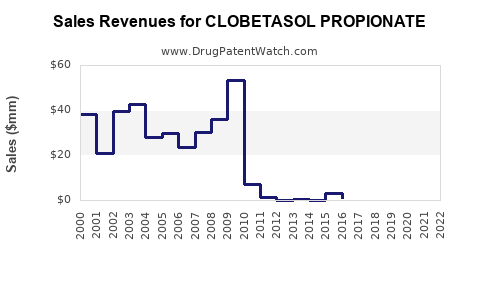
What is the financial trajectory of clobetasol propionate?
Clobetasol propionate has a mature-product financial profile:
- Early branded products generated premium pricing from high potency and prescription demand.
- Generic entry reduced average selling prices for conventional cream and ointment.
- Branded revenue migrated toward differentiated formulations such as foam, shampoo, lotion, and lower-strength products.
- Generic volume became more important than brand price.
- Current profitability depends on manufacturing cost, pharmacy access, contract terms, and product availability.
Public company filings generally do not report clobetasol propionate revenue as a separate line item. The market is too fragmented for a reliable global revenue figure based solely on public filings. Product-level financial estimates from prescription databases can also vary according to whether they measure gross sales, net sales, prescriptions, or units.
Revenue exposure by formulation
| Segment |
Revenue outlook |
Main driver |
| Generic cream |
Stable volume, declining or constrained pricing |
Prescription demand and payer substitution |
| Generic ointment |
Stable niche demand |
Potency and lesion type |
| Branded foam |
Higher unit economics, limited volume |
Convenience and vehicle differentiation |
| Shampoo |
Niche revenue |
Scalp psoriasis demand |
| Lotion and spray |
Moderate niche opportunity |
Patient preference and coverage |
| 0.025% cream |
Potential premium positioning |
Clinical differentiation and payer acceptance |
The long-term revenue trajectory is best described as volume-stable but price-pressured for standard forms, with selective premium opportunities in differentiated delivery systems.
What generic entry risks exist for clobetasol propionate?
Generic entry risk is high for standard 0.05% cream and ointment. The leading risks are:
- additional ANDA approvals;
- therapeutic substitution within topical corticosteroids;
- payer-mandated generic dispensing;
- pharmacy purchasing concentration;
- contract price competition;
- supply interruptions that shift market share among manufacturers.
Risk is lower, but not absent, for foam, shampoo, and specialized lotion products. These products require greater formulation expertise and may have fewer approved competitors. Their pricing can remain above conventional generics until equivalent products establish reliable supply and payer access.
What patent litigation affects clobetasol propionate?
Clobetasol propionate has a history of formulation-focused patent disputes associated with differentiated topical products, but the market does not have the type of active, molecule-wide patent litigation seen in recently launched oral drugs or biologics.
Current litigation risk should be assessed by:
- reference product NDA;
- listed Orange Book patents;
- ANDA filer;
- Paragraph IV certification date;
- formulation overlap;
- proposed launch date;
- settlement terms;
- authorized-generic strategy.
Settlement agreements, where reached, are likely to be product-specific and may govern launch timing, authorized-generic supply, or license rights. No broad settlement can be assumed to cover all clobetasol propionate dosage forms.
Are there licensing deals involving clobetasol propionate?
Commercial rights to clobetasol propionate products have changed through corporate acquisitions, dermatology portfolio transfers, and product licensing. These transactions generally concern branded products or commercial rights rather than ownership of the active ingredient.
The most important economic distinction is between:
- rights to sell an established brand;
- rights to manufacture a formulation;
- rights to distribute a generic;
- rights to use a patented delivery platform;
- rights to develop a new indication.
A product-level licensing agreement can preserve a premium formulation without creating a durable barrier to generic competition in conventional clobetasol propionate products.
How does clobetasol propionate compare with competing topical corticosteroids?
| Drug |
Potency class |
Market position |
Generic pressure |
| Clobetasol propionate |
Super-high |
High-potency specialist therapy |
High |
| Betamethasone dipropionate |
High to super-high, depending on formulation |
Broad topical competitor |
High |
| Fluocinonide |
High |
Established generic alternative |
High |
| Halobetasol propionate |
Super-high |
Premium or differentiated competitor |
High |
| Mometasone furoate |
Medium to high, depending on form |
Broader chronic-use positioning |
High |
| Triamcinolone acetonide |
Medium |
High-volume primary-care product |
Very high |
Clobetasol competes on potency rather than broad chronic-use suitability. Its strength supports rapid control of severe localized disease but also limits duration and body-surface-area use. Physicians may select lower-potency corticosteroids for maintenance therapy or sensitive anatomical sites.
What manufacturing and geographic barriers affect the market?
Manufacturing barriers are modest for cream and ointment but higher for foam, shampoo, spray, and complex lotion products. Key requirements include:
- control of particle size and drug distribution;
- emulsion and suspension stability;
- microbial control;
- rheology and spreadability;
- container-closure compatibility;
- propellant handling for foam;
- validated scale-up;
- comparative performance testing.
Geographic coverage varies. The United States has a highly genericized prescription market with Orange Book substitution. European markets often use national or decentralized approvals, reference pricing, and tendering. Emerging markets may have greater brand fragmentation and lower regulatory barriers, but price levels are generally lower.
Key Takeaways
- Clobetasol propionate is a mature, genericized topical corticosteroid.
- Compound-level patent protection has expired; formulation patents are the main remaining IP issue.
- Standard 0.05% cream and ointment face high generic substitution risk.
- Foam, shampoo, lotion, spray, and 0.025% cream can support higher pricing but have smaller markets.
- The drug has no biosimilar risk because it is a small molecule.
- Financial performance depends on volume, manufacturing cost, payer access, and formulation mix.
- Public filings do not generally disclose reliable product-level clobetasol revenue.
- Current commercial defenses are regulatory execution, supply reliability, formulation know-how, and distribution rather than broad patent exclusivity.
FAQs
Is clobetasol propionate still patent protected?
The active ingredient is not protected by meaningful current compound-level exclusivity. Some product-specific formulation or method patents may have applied to later-developed products.
Can clobetasol propionate be purchased over the counter?
In the United States, clobetasol propionate is a prescription drug. It is an ultra-high-potency corticosteroid and is not generally marketed as an OTC product.
Is clobetasol propionate interchangeable with hydrocortisone?
No. Clobetasol propionate is substantially more potent than hydrocortisone and has different duration, safety, and anatomical-use limitations.
Which clobetasol formulation has the strongest commercial potential?
Foam and other convenience-oriented formulations generally have the strongest premium potential. Cream and ointment have larger volumes but greater price competition.
Does clobetasol propionate have an authorized generic?
Authorized-generic availability depends on the specific branded product and commercial agreement. It cannot be assumed across all clobetasol formulations.
References
-
U.S. Food and Drug Administration. (n.d.). Orange Book: Approved drug products with therapeutic equivalence evaluations. https://www.accessdata.fda.gov/scripts/cder/ob/
-
U.S. Food and Drug Administration. (n.d.). Drugs@FDA: FDA-approved drugs. https://www.accessdata.fda.gov/scripts/cder/daf/
-
U.S. Food and Drug Administration. (n.d.). Clobetasol propionate prescribing information and product labeling. https://www.accessdata.fda.gov/scripts/cder/daf/
-
DailyMed. (n.d.). Clobetasol propionate drug labels. National Library of Medicine. https://dailymed.nlm.nih.gov/
-
U.S. Food and Drug Administration. (2016). Abbreviated new drug application process under the Federal Food, Drug, and Cosmetic Act. https://www.fda.gov/drugs/types-applications/abbreviated-new-drug-application-anda
-
U.S. Patent and Trademark Office. (n.d.). Patent Center. https://patentcenter.uspto.gov/