Last updated: July 22, 2026
Clobex (clobetasol propionate) is a topical corticosteroid positioned for chronic plaque psoriasis and other steroid-responsive dermatoses. Its financial trajectory is driven by a mature, largely generic market, with remaining upside tied to brand demand persistence, payer contracting, and any product-specific supply or formulation differentiation that can hold price. In the near term, brand revenue tends to face sustained margin pressure from generic clobetasol propionate products unless CLOBEX retains meaningful formulary placement, rebates, and patient acquisition through brand advertising or dermatology channel access.
What is CLOBEX and what revenue drivers matter most for clobetasol propionate brands?
Clobex is a clobetasol propionate topical corticosteroid. Like most topical steroids in psoriasis/dermatology, utilization is sensitive to (1) dermatology prescribing habits and (2) payer step edits that push prescribers toward lower-cost equivalents.
Key market dynamics that affect sales
- Formulary placement vs generic substitution
- Topical corticosteroids are widely covered and often tiered to generics.
- Brand retention typically depends on rebate leverage and payer comfort with clinical interchangeability.
- Indication breadth and prescribing patterns
- Dermatology tends to use topical steroids episodically and chronically for flares, but long-term use is limited by safety concerns and guideline positioning.
- Channel competition
- Pharmacy benefit mixes heavily to “most favorable” price after rebate.
- Dermatology practices may support brand selection if patients are non-responsive to alternatives, but the low barrier to substitution limits brand pricing power.
- Switching friction
- Switching from brand to generic is often low-cost for payers and pharmacies, but may be higher for patients tied to a specific base (vehicle) and dosing comfort.
Where CLOBEX tends to fit in contracting
- PBM tiering and rebate-driven economics
- The dominant lever is the net price after rebates and formulary fees.
- Brands in saturated topical categories compete more on contracting terms than on incremental clinical differentiation.
When does CLOBEX lose exclusivity and how does that affect the financial trajectory?
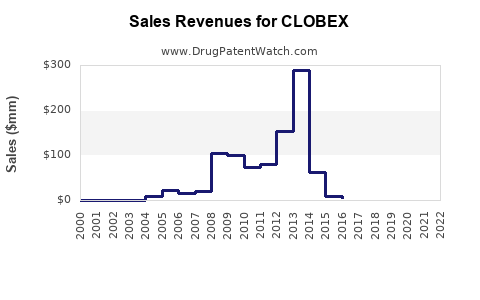
CLOBEX market dynamics are shaped primarily by the expiry of relevant listed patents and any pediatric exclusivity and orphan-type extensions if applicable. For a mature topical steroid brand, the typical pattern is: initial brand lifecycle, patent expiry, then generic erosion. The resulting revenue profile is usually a step-down after key exclusivity or patent-driven barriers end, followed by slower decline as generics become fully entrenched.
How exclusivity timing impacts sales curves (typical for saturated topical steroids)
- Patent expiry on active ingredient or composition claims
- Usually triggers full generic competition across major strengths and pack formats.
- If remaining product-specific patents exist (vehicle/formulation)
- Generic entry can be delayed in narrower segments, but top-line brand protection remains limited because prescribers can switch between clobetasol formulations with comparable steroid potency.
What to monitor for trajectory turning points
- Orange Book listings changing status
- Patent expirations and “suitability” of generic labeling.
- Generic launches in the same strength/pack/vehicle
- Revenue impact correlates with the availability of multiple AB-labeled products at low acquisition cost.
What is the Orange Book status of CLOBEX and which patents drive protection?
Orange Book protection governs Hatch-Wax exclusivity and patent-mediated generic entry risk. For CLOBEX specifically, the protection landscape is determined by the active ingredient clobetasol propionate and any listed formulation, method-of-use, or device-related patents tied to the branded product.
What generally matters in Orange Book for a topical steroid
- Composition/vehicle patents
- These can affect whether generics match the branded base.
- Method-of-use patents
- Often less protective for generic competition if the label is broad and uses are covered in the AB reference.
- Manufacturing process patents
- Rarely provide strong real-world barriers for topicals after launch because formulation equivalence can often be achieved.
Which companies sell competing clobetasol propionate products and how strong is generic pressure?
The competitive set for CLOBEX is broad: generics and authorized equivalents across clobetasol propionate topical strengths and vehicles are common. Generic pressure typically comes from:
- Multiple ANDA entrants
- PBM preference steering
- Wholesale acquisition cost discounts
- Pack-size optimization that improves net pharmacy economics
Competitive intensity indicators
- Number of AB-rated equivalents
- Higher count increases substitution probability.
- Net price compression
- Brands often remain on formulary but with reduced unit share.
- Therapeutic class substitutability
- Potent topical steroids compete on potency and skin tolerability more than on brand identity.
How does CLOBEX compare with other topical corticosteroids on pricing, access, and switching risk?
CLOBEX competes with other high-potency topical corticosteroids (clobetasol, betamethasone dipropionate, halobetasol, augmented formulations depending on the market). In payer terms, switching risk depends on:
- Vehicle match
- Strength labeling and potency equivalence
- Patient tolerability and adherence
Relative brand advantage in saturated classes
- If a brand has a unique vehicle or easier application
- It can retain share modestly, especially with dermatology follow-up.
- If generic vehicles are clinically and cosmetically comparable
- Brand share typically erodes faster.
What generic entry risks exist for CLOBEX, including Paragraph IV challenges?
For CLOBEX, the main generic entry risk is post-expiry ANDA competition rather than continuous litigation-style barriers, unless specific Orange Book patents remain active and are challenged. Paragraph IV challenges can accelerate generic entry to the extent they overturn or design around relevant patents or force settlements that grant controlled entry timing.
How Paragraph IV events usually change the market
- Court loss or settlement
- Can bring earlier generic launch and accelerate price compression.
- If patents remain strong
- Litigation can delay launches and preserve brand revenue longer, but typically only at the margin for mature topical steroids.
What patent litigation affects CLOBEX and how does it map to launch timing?
Litigation affects:
- Whether generics enter at initial ANDA approval
- Whether launch is delayed by automatic stays
- Whether settlement creates a defined “no-AB” period or carve-outs by strength/pack
Litigation-driven timeline mechanics
- Filing date of Paragraph IV
- Typically determines the start of a 30-month stay when applicable.
- Final court outcomes or settlement terms
- Determines whether entry occurs at the end of stay or later.
What are the FDA regulatory milestones for CLOBEX that influence commercial availability?
Commercial trajectory also depends on FDA lifecycle events:
- ANDA approvals for AB-rated generics
- Labeling updates that broaden or narrow covered uses
- Postmarketing commitments affecting supply reliability
Typical FDA-driven impacts on sales
- Generic approvals at scale
- Label changes that enable broader generic labeling
- Increase payer comfort and switching.
What formulations are protected by CLOBEX patents and how does that affect substitution?
Topical steroid brands can lose protection if generics match active ingredient, strength, and vehicle. Formulation-level protection matters when:
- The brand vehicle is hard to replicate
- The formulation includes specific excipients or rheology features that improve adherence
- The patent claims are tied to a distinct composition
Substitution effects by formulation granularity
- Same vehicle and strength
- Highest substitution, fastest revenue decline.
- Different vehicle
- Sometimes slower switch if clinicians consider vehicle differences, but potent topical steroids often remain interchangeable for coverage purposes.
What settlement agreements or licensing deals shaped CLOBEX competition?
For clobetasol propionate topical brands, settlements typically reflect one of two commercial outcomes:
- Early generic entry in exchange for royalties
- Delayed entry in exchange for dismissal or standstill terms
Because these agreements are case-specific and depend on the Orange Book and litigation docket, the key market impact is whether controlled entry delayed erosion beyond the normal post-expiry timeline.
How does CLOBEX perform financially: sales trend, net price, and gross margin exposure?
For a mature brand in a heavily generic topical corticosteroid category, the expected financial profile is:
- Declining net sales after generic saturation
- Net price compression from PBM contracting and competition
- Gross margin volatility from share loss and promotional intensity
- Opex pressure if marketing spend must rise to sustain share while price erodes
What typically drives the remaining brand revenue
- Dermatology preference pockets
- Patient-specific tolerability
- Channel relationships with prescribers
- Managed care rebate dynamics that keep the brand on preferred tiers even after generic entrants
Revenue exposure scenarios for CLOBEX based on generic launch timing
A practical way to frame the commercial downside is around “launch intensity” and “time-to-inclusion” in PBM formularies.
Scenario framework (directional)
- High launch intensity, rapid PBM inclusion
- Steep quarterly decline and sustained margin pressure.
- Staggered generic launches
- More gradual sales decline; brand may retain incremental share longer.
- Narrow generic scope tied to strengths/vehicles
- Brand retains protection in remaining niches, but overall revenue still trends down as substitutes broaden.
Key takeaways
- CLOBEX sits in a mature, highly substitutable topical steroid market where generic competition and formulary contracting dominate the revenue curve.
- The financial trajectory is most sensitive to Orange Book-driven patent expiry windows, followed by generic ANDA saturation and PBM tier shifts.
- Long-term upside is structurally limited unless CLOBEX retains meaningful vehicle-specific differentiation that materially reduces switching or maintains preferential coverage through contracting.
FAQs
- Does clobetasol propionate topical therapy require prior authorization, and how does that affect CLOBEX utilization?
- What happens to CLOBEX market share after major generic entrants are fully stocked across chain pharmacies?
- How do rebate and net price dynamics in dermatology topical steroids influence brand profitability after patent expiry?
- Which CLOBEX strengths or vehicle formats typically face the fastest generic substitution?
- How does FDA labeling parity between CLOBEX and AB-rated generics change payer willingness to switch?
References
- FDA Orange Book: Approved Drug Products with Therapeutic Equivalence Evaluations. (n.d.). U.S. Food and Drug Administration. https://www.accessdata.fda.gov/scripts/cder/daf/
- FDA Approved Drug Products: ANDA Drug Approvals. (n.d.). U.S. Food and Drug Administration. https://www.accessdata.fda.gov/scripts/cder/daf/