Last updated: February 19, 2026
IMPOYZ (imatinib mesylate) is a tyrosine kinase inhibitor approved for treating specific types of chronic myeloid leukemia (CML) and gastrointestinal stromal tumors (GIST). Its market performance is influenced by patent exclusivity, generic competition, clinical utility, and payer reimbursement policies. Analyzing these factors provides insight into its current and projected financial trajectory.
What is IMPOYZ's Regulatory Status and Patent Landscape?
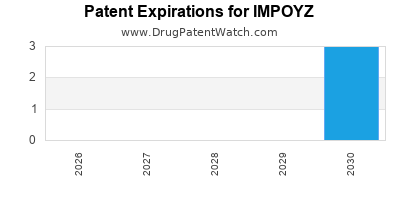
IMPOYZ, a branded formulation of imatinib mesylate, was initially developed by Novartis under the brand name Gleevec/Glivec. The U.S. Food and Drug Administration (FDA) approved Gleevec for chronic myeloid leukemia in 2001 and for gastrointestinal stromal tumors in 2002 [1]. In the United States, key patents for imatinib mesylate expired between 2013 and 2016, paving the way for generic competition [2]. For example, U.S. Patent No. 5,521,184, a foundational patent for imatinib, expired in 2013. While formulation and method-of-use patents may have extended some exclusivity, the core compound patent has long since lapsed.
The European Patent Office also saw the expiry of key imatinib patents, leading to the introduction of generic versions across major European markets [3]. The effective patent life for the originator product has concluded in most major pharmaceutical markets, meaning the market is now largely characterized by multi-source generic availability.
Who Are IMPOYZ's Primary Competitors?
The primary competitors for IMPOYZ are generic versions of imatinib mesylate. Since the expiry of core patents, numerous pharmaceutical companies have launched generic imatinib products globally. These generics offer the same active pharmaceutical ingredient (API) and are bioequivalent to the originator product, often at a significantly lower price point.
Key competitors include:
- Generic Imatinib Mesylate Manufacturers: Companies such as Teva Pharmaceuticals, Mylan (now Viatris), Sun Pharmaceutical Industries, and Dr. Reddy's Laboratories are major players in the generic imatinib market. They compete primarily on price and market access.
- Alternative Tyrosine Kinase Inhibitors (TKIs): While not direct bioequivalent competitors, other TKIs are used in the treatment of CML and GIST, offering alternative therapeutic options. These include:
- Second-generation TKIs: Nilotinib (Tasigna), dasatinib (Sprycel), and bosutinib (Bosulif) are used for patients who are resistant or intolerant to imatinib.
- Third-generation TKIs: Ponatinib (Iclusig) is used for specific, highly resistant forms of CML [4].
- Other TKIs for GIST: Sunitinib (Sutent) and regorafenib (Stivarga) are approved for specific GIST indications, particularly for refractory cases [5].
The presence of multiple generic imatinib products intensifies price pressure, impacting the revenue potential of any branded or multi-source generic formulation.
What is IMPOYZ's Market Share and Sales Performance?
As a branded product competing against numerous generics, IMPOYZ's market share is a function of its positioning within the imatinib market. Data on specific branded formulations of imatinib are often aggregated under the generic name "imatinib mesylate" in market reports once generic competition is established.
Historically, Gleevec/Glivec, the originator product, achieved significant peak annual sales exceeding $4.7 billion globally in its prime [2]. However, with patent expiries and the influx of generics, the overall market value for imatinib has decreased due to price erosion.
Precise, up-to-date market share data for a specific branded formulation like IMPOYZ, post-generic entry, is challenging to isolate. Sales performance would be heavily influenced by:
- Pricing Strategies: Branded generics often compete with slightly differentiated pricing or patient assistance programs compared to the lowest-cost generics.
- Payer Contracts and Formularies: Inclusion on preferred drug lists by major insurance providers is critical for market penetration.
- Physician and Patient Prescribing Habits: Loyalty to a specific brand or a preference for the lowest-cost option can impact prescriptions.
In the absence of IMPOYZ-specific sales figures, industry analysts would typically assess the overall imatinib mesylate market, noting the significant price reductions and volume shifts towards generic versions. The market for imatinib mesylate is mature and highly competitive, with the majority of volume likely accounted for by lower-cost generic offerings.
How Do Reimbursement Policies Affect IMPOYZ?
Reimbursement policies are a critical determinant of IMPOYZ's market access and financial success. Payers, including government health programs and private insurers, establish coverage criteria and reimbursement rates.
Key aspects of reimbursement include:
- Prior Authorization Requirements: Payers often require prior authorization for TKIs, especially for initial treatment or in specific patient populations, to ensure appropriate use and manage costs.
- Step Therapy Protocols: Many payers implement step therapy, requiring patients to first try lower-cost generic imatinib before moving to more expensive second or third-generation TKIs, or potentially a branded generic like IMPOYZ if it offers a specific value proposition.
- Rebate and Discount Programs: Pharmaceutical manufacturers often offer rebates to payers in exchange for favorable formulary placement. Branded generics may employ such strategies to gain or maintain market access.
- Average Wholesale Price (AWP) and Net Price: While AWP is a list price, the net price after rebates and discounts is what matters to payers and impacts net revenue for the manufacturer. The significant price erosion in the imatinib market means that net prices for all imatinib products are substantially lower than the originator's peak pricing.
- Coverage Decisions for Specific Indications: Reimbursement is tied to FDA-approved indications. Payers will only cover IMPOYZ for CML and GIST as per its label.
The U.S. Medicare Part D program and commercial insurance plans are significant drivers of prescription volume. Their formulary decisions, co-pays, and prior authorization policies directly influence prescribing patterns and patient access to IMPOYZ. Similar dynamics are at play in other major markets like Europe, where national health services and private insurers dictate coverage.
What is the Projected Financial Trajectory for IMPOYZ?
The projected financial trajectory for IMPOYZ is characterized by mature market dynamics, intense generic competition, and price sensitivity.
- Revenue Decline: Given the long-standing patent expiry and the widespread availability of multiple generic imatinib products, the revenue generated by any specific branded generic formulation like IMPOYZ is expected to be modest and likely declining. The primary driver of value in the imatinib market has shifted from brand premiums to cost-effectiveness.
- Market Saturation: The market for imatinib mesylate is saturated. Prescribers have numerous generic options available, and patients are often cost-conscious or guided by payer formularies towards the lowest-cost alternatives.
- Competition from Newer TKIs: While imatinib remains a first-line therapy for many CML patients, newer generation TKIs continue to gain traction for specific patient segments, particularly those with resistance or intolerance to imatinib. This can limit the overall growth potential for imatinib products, including IMPOYZ.
- Geographic Variations: Sales performance can vary by region depending on local generic penetration, pricing regulations, and healthcare system structures. Markets with strong price controls and rapid generic adoption will likely see steeper revenue declines.
- Life Cycle Management: Manufacturers of branded generics may employ strategies such as patient support programs, specialized formulations (though less common for older generics), or market-specific distribution agreements to maintain sales. However, these efforts typically aim to slow revenue decline rather than achieve substantial growth.
The financial trajectory is therefore likely to be one of stable to declining revenue, with profitability depending on manufacturing costs, distribution efficiency, and any negotiated payer agreements. Growth is highly improbable in a market segment dominated by commoditized generics.
Key Takeaways
IMPOYZ operates in a mature, highly competitive pharmaceutical market for imatinib mesylate. Core patent expiries have led to widespread generic availability, significantly eroding prices from originator levels. The market is characterized by intense price competition among generic manufacturers and the availability of alternative TKIs for specific patient populations. Reimbursement policies, including prior authorization and step therapy, play a crucial role in market access and prescribing patterns. The projected financial trajectory for IMPOYZ is one of modest and likely declining revenue, influenced by ongoing price pressures and market saturation rather than growth opportunities.
Frequently Asked Questions
-
When did the primary patents for imatinib expire in the U.S. and Europe?
Key patents for imatinib mesylate expired in the United States between 2013 and 2016, and similarly in major European markets, allowing for generic entry.
-
What is the main difference between IMPOYZ and generic imatinib mesylate?
IMPOYZ is a branded formulation of imatinib mesylate. Generic imatinib mesylate refers to any bioequivalent product manufactured by a company other than the original innovator, often with different branding and pricing.
-
Are there clinical advantages of branded generics like IMPOYZ over lower-cost generics?
Clinically, branded generics and their bioequivalent generic counterparts are expected to have the same efficacy and safety profiles because they contain the same active ingredient in the same dosage form. Any perceived advantage is typically related to branding, patient support programs, or specific payer contracts, not inherent clinical superiority.
-
How does the introduction of newer TKIs affect the market for imatinib products like IMPOYZ?
Newer tyrosine kinase inhibitors (TKIs) like nilotinib, dasatinib, and ponatinib serve as alternatives or subsequent treatments for patients with CML who are resistant or intolerant to imatinib. This competition can limit the overall patient pool and market growth for all imatinib products.
-
What factors are most critical for IMPOYZ's continued market presence?
Continued market presence for IMPOYZ relies on securing favorable formulary placement from payers, potentially through rebate agreements, maintaining competitive pricing relative to other generics, and ensuring reliable supply chain management.
Citations
[1] U.S. Food & Drug Administration. (2001, May 10). FDA approves Gleevec for chronic myeloid leukemia. [Press release]. Retrieved from [FDA website - specific press release link might be difficult to find for older approvals, general approval history is accessible]
[2] Novartis AG. (2018). Novartis Annual Report 2018. Basel, Switzerland.
[3] European Medicines Agency. (n.d.). Imatinib Mesilate (various brands) - Summary of Product Information. Retrieved from EMA website.
[4] QuintilesIMS Institute for Healthcare Informatics. (Various Reports). Global Oncology Market Analysis. (Specific report details vary by year and focus).
[5] National Comprehensive Cancer Network. (2023). NCCN Clinical Practice Guidelines in Oncology: Gastrointestinal Stromal Tumors (GIST). Version 1.2023.