Last Updated: June 24, 2026

APIXABAN - Generic Drug Details


✉ Email this page to a colleague

« Back to Dashboard


What are the generic sources for apixaban and what is the scope of patent protection?

Apixaban is the generic ingredient in three branded drugs marketed by Bristol, Bristol Myers Squibb, Accord Hlthcare, Apotex, Aurobindo Pharma Ltd, Bionpharma, Breckenridge, Hetero Labs Ltd V, Impax, Macleods Pharms Ltd, Micro Labs, Mylan, Regcon Holdings, Torrent, and Zydus Pharms, and is included in fifteen NDAs. There are three patents protecting this compound and one Paragraph IV challenge. Additional information is available in the individual branded drug profile pages.

Apixaban has one hundred and ninety-six patent family members in forty-three countries.

There are thirty drug master file entries for apixaban. Nine suppliers are listed for this compound. There are ten tentative approvals for this compound.

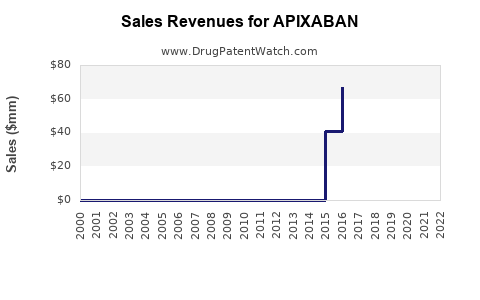
Drug Sales Revenue Trends for APIXABAN

See drug sales revenues for APIXABAN

Recent Clinical Trials for APIXABAN

Identify potential brand extensions & 505(b)(2) entrants

SponsorPhase
University of BirminghamPHASE3
AstraZenecaPHASE1
ParexelPHASE1

See all APIXABAN clinical trials

Generic filers with tentative approvals for APIXABAN
Applicant Application No. Strength Dosage Form
⤷  Start Trial⤷  Start Trial5MGTABLET;ORAL
⤷  Start Trial⤷  Start Trial2.GMGTABLET;ORAL
⤷  Start Trial⤷  Start Trial5MGTABLET; ORAL

The 'tentative' approval signifies that the product meets all FDA standards for marketing, and, but for the patents / regulatory protections, it would approved.

Pharmacology for APIXABAN
Drug ClassFactor Xa Inhibitor
Mechanism of ActionFactor Xa Inhibitors
Paragraph IV (Patent) Challenges for APIXABAN
Tradename Dosage Ingredient Strength NDA ANDAs Submitted Submissiondate
ELIQUIS Tablets apixaban 2.5 mg and 5 mg 202155 25 2016-12-28

US Patents and Regulatory Information for APIXABAN

Applicant Tradename Generic Name Dosage NDA Approval Date TE Type RLD RS Patent No. Patent Expiration Product Substance Delist Req. Exclusivity Expiration
Bristol Myers Squibb ELIQUIS apixaban TABLET, FOR SUSPENSION;ORAL 202155-003 Apr 17, 2025 RX Yes Yes ⤷  Start Trial ⤷  Start Trial ⤷  Start Trial
Apotex APIXABAN apixaban TABLET;ORAL 210091-001 Feb 16, 2024 DISCN No No ⤷  Start Trial ⤷  Start Trial ⤷  Start Trial
Mylan APIXABAN apixaban TABLET;ORAL 210128-002 Dec 23, 2019 DISCN No No ⤷  Start Trial ⤷  Start Trial ⤷  Start Trial
Hetero Labs Ltd V APIXABAN apixaban TABLET;ORAL 210066-001 Nov 21, 2023 DISCN No No ⤷  Start Trial ⤷  Start Trial ⤷  Start Trial
Bionpharma APIXABAN apixaban TABLET;ORAL 210152-002 Apr 8, 2020 DISCN No No ⤷  Start Trial ⤷  Start Trial ⤷  Start Trial
>Applicant >Tradename >Generic Name >Dosage >NDA >Approval Date >TE >Type >RLD >RS >Patent No. >Patent Expiration >Product >Substance >Delist Req. >Exclusivity Expiration

EU/EMA Drug Approvals for APIXABAN

Company Drugname Inn Product Number / Indication Status Generic Biosimilar Orphan Marketing Authorisation Marketing Refusal
Bristol-Myers Squibb / Pfizer EEIG Eliquis apixaban EMEA/H/C/002148For Eliquis 2.5 mg film-coated tablets:Prevention of venous thromboembolic events (VTE) in adult patients who have undergone elective hip or knee replacement surgery.Prevention of stroke and systemic embolism in adult patients with non-valvular atrial fibrillation (NVAF), with one or more risk factors, such as prior stroke or transient ischaemic attack (TIA); age ≥ 75 years; hypertension; diabetes mellitus; symptomatic heart failure (NYHA Class ≥ II).Treatment of deep vein thrombosis (DVT) and pulmonary embolism (PE), and prevention of recurrent DVT and PE in adults (see section 4.4 for haemodynamically unstable PE patients).For Eliquis 5 mg film-coated tablets:Prevention of stroke and systemic embolism in adult patients with non-valvular atrial fibrillation (NVAF), with one or more risk factors, such as prior stroke or transient ischaemic attack (TIA); age≥ 75 years; hypertension; diabetes mellitus; symptomatic heart failure (NYHA Class ≥ II).Treatment of deep vein thrombosis (DVT) and pulmonary embolism (PE), and prevention of recurrent DVT and PE in adults (see section 4.4 for haemodynamically unstable PE patients). Authorised no no no 2011-05-18
Accord Healthcare S.L.U. Apixaban Accord apixaban EMEA/H/C/005358Prevention of venous thromboembolic events (VTE) in adult patients who have undergone elective hip or knee replacement surgery.Prevention of stroke and systemic embolism in adult patients with non-valvular atrial fibrillation (NVAF), with one or more risk factors, such as prior stroke or transient ischaemic attack (TIA); age ≥ 75 years; hypertension; diabetes mellitus; symptomatic heart failure (NYHA Class ≥ II).Treatment of deep vein thrombosis (DVT) and pulmonary embolism (PE), and prevention of recurrent DVT and PE in adults (see section 4.4 for haemodynamically unstable PE patients).Prevention of stroke and systemic embolism in adult patients with non-valvular atrial fibrillation (NVAF), with one or more risk factors, such as prior stroke or transient ischaemic attack (TIA); age≥ 75 years; hypertension; diabetes mellitus; symptomatic heart failure (NYHA Class ≥ II).Treatment of deep vein thrombosis (DVT) and pulmonary embolism (PE), and prevention of recurrent DVT and PE in adults (see section 4.4 for haemodynamically unstable PE patients). Authorised yes no no 2020-07-23
>Company >Drugname >Inn >Product Number / Indication >Status >Generic >Biosimilar >Orphan >Marketing Authorisation >Marketing Refusal

Supplementary Protection Certificates for APIXABAN

Patent Number Supplementary Protection Certificate SPC Country SPC Expiration SPC Description
1427415 2011/032 Ireland ⤷  Start Trial PRODUCT NAME: APIXABAN AND PHARMACEUTICALLY ACCEPTABLE SALTS THEREOF; REGISTRATION NO/DATE: EU/1/11/691/001-005 20110518
1427415 C01427415/01 Switzerland ⤷  Start Trial FORMER OWNER: BRISTOL-MYERS SQUIBB COMPANY, US
1427415 31/2011 Austria ⤷  Start Trial PRODUCT NAME: APIXABAN UND PHARMAZEUTISCH VERTRAEGLICHE SALZE DAVON; REGISTRATION NO/DATE: EU/1/691/001-005 (MITTEILUNG) 20110520
1427415 443 Finland ⤷  Start Trial
1427415 2011C/034 Belgium ⤷  Start Trial DETAILS ASSIGNMENT: CHANGE OF OWNER(S), CHANGEMENT DE NOM DU PROPRIETAIRE
>Patent Number >Supplementary Protection Certificate >SPC Country >SPC Expiration >SPC Description
Last updated: June 21, 2026

Apixaban Market Dynamics and Financial Trajectory (Eliquis): Revenues, Growth Drivers, Patent Overhang, and Generic/Biosimilar Risk

Apixaban (Eliquis) generated multi-billion-dollar sales globally and is in late-stage lifecycle economics where: (1) volume growth is constrained by mature use in NVAF and VTE, (2) price pressure from biosimilar-equivalent competition is not applicable because apixaban is chemically synthesized, but (3) generic entry risk and dosing/formulation mix drive near-term margin sensitivity. Financial trajectory hinges on US and EU loss of exclusivity timing, which will govern generic launch waves and forecast downside to branded revenue.

How big is the apixaban market and what is its revenue trajectory for Eliquis?

Eliquis is one of the largest oral anticoagulants by revenue in the US and Europe. The revenue path is a function of prescription growth in NVAF and VTE indications, plus loss of exclusivity dynamics and formulary access.

Key revenue drivers

  • Indication mix: NVAF stroke prevention and VTE treatment/prevention typically dominate commercial volume.
  • Dose utilization: steady adoption of approved dose regimens drives demand stability.
  • Treatment duration: chronic NVAF use supports durability versus finite VTE regimens.
  • Payer tightening: anticoagulant step edits and preferred-tier dynamics can shift market share among factor Xa inhibitors.

Market structure and competitive set

  • Direct class competitors: rivaroxaban (Xarelto), edoxaban (Savaysa), betrixaban (historically limited adoption), and parenteral-to-DOAC switching dynamics.
  • Market share shifts are often incremental due to physician familiarity and payer contracting, not sudden therapeutic substitution.

What market dynamics are shaping apixaban demand in NVAF and VTE?

Apixaban demand is driven by guideline support and prescribing behavior in atrial fibrillation and venous thromboembolism.

NVAF dynamics

  • Dose-sensitive prescribing: renal function and age criteria constrain “one-size-fits-all” switching.
  • Hospital and health system protocols: standardized anticoagulation pathways raise baseline continuity of use.

VTE dynamics

  • New episode management: post-acute VTE and extended prophylaxis drive recurring, protocol-driven prescribing.
  • Interaction risk profile: apixaban is a high-penetration option where bleeding-risk considerations favor factor Xa inhibition.

Class-wide payer behavior

  • Formulary preference among DOACs changes at contracting cycles.
  • Generic availability in any market can trigger class-wide contracting pressure even when the branded product remains “clinically preferred.”

When does apixaban lose exclusivity and what are the generic entry timelines?

Branded exclusivity and patent expiry dates determine generic launch windows. Apixaban’s key risk is not “biosimilar,” but chemically identical generic competition under ANDA.

Exclusivity structure that governs launch timing (US)

  • Patent term expiration: drives carve-out of Paragraph IV incentives.
  • Non-patent exclusivities: typically less relevant at late lifecycle compared with patent estates for DOACs with multiple patents.

Practical generic launch pattern

  • Filing: generics file ANDAs when sufficient patent clearing signals exist.
  • Litigation: first-wave Paragraph IV challenges can create automatic stays.
  • Settlement: authorized generic and co-promotion terms can shift timing and post-launch pricing.

What patents protect apixaban (Eliquis) and how broad is the patent estate?

Apixaban’s patent estate typically spans multiple layers:

  • Drug substance (API and intermediates)
  • Drug product (formulations, polymorphs, crystallinity, solid-state properties)
  • Methods of manufacture
  • Method of use (dose regimens and clinical indications)
  • Combination and kit claims (less common than single-agent compositions for apixaban)

Featured snippet answer: what to look for in the patent estate

  • Composition and formulation patents that protect solid-state characteristics and tablet/capsule manufacturing attributes.
  • Method-of-use patents that cover dosing schedules and patient selection criteria.
  • Process patents that restrict economical generic manufacturing.

Patent strength implications

  • Estates with multiple independent claim families increase the probability of staggered challenges.
  • Estates dominated by a small number of composition/process claims increase the odds of early design-around success.

What is the Orange Book status of apixaban and which patents are listed for Eliquis?

Orange Book listings identify the patent numbers tied to specific dosage forms and strength. This listing drives ANDA Paragraph IV specificity and litigation scope.

Why Orange Book granularity matters

  • If claims are listed only for certain strengths (eg, 2.5 mg versus 5 mg), generics can attempt partial entry.
  • If formulation patents are tied to a specific dosage form, launch sequencing can be split by strength.

How this impacts financial trajectory

  • Early generic entry in only one strength reduces branded revenue less than full-strength loss.
  • Full-strength generic launches typically compress branded pricing faster and reduce net sales with steeper volume displacement.

Which Paragraph IV challenges and patent litigations affect apixaban generic competition?

Paragraph IV filings and subsequent litigation determine:

  • Whether an automatic 30-month stay applies
  • Whether court findings narrow the patent set
  • Whether settlements permit earlier commercial entry or authorize generic supply

Litigation-driven financial impact

  • A successful early Paragraph IV can create abrupt branded revenue step-down in the affected dosage form.
  • Settlements may shift branded revenue decline timing from “hard court outcomes” to “contracted launch calendars.”

How does apixaban financial performance compare with rivaroxaban (Xarelto) and edoxaban (Savaysa)?

Apixaban competes in the same oral factor Xa inhibitor class, so market share depends on contracting and clinical preference rather than distinct mechanism.

Comparison levers

  • Payer preference: strongest predictor of switching within DOAC classes.
  • Dosing convenience: co-administration guidance and renal criteria influence formulary decisions.
  • Generic timing: the drug that hits the market first typically captures disproportionate short-term share.

Financial implication for apixaban

  • If apixaban’s generic entry is earlier or more aggressive than peers, it will face steeper pricing compression and faster net sales erosion.
  • If peers face later generic pressure, apixaban can maintain premium contracting positions longer.

What formulations and dosing strengths drive apixaban commercialization and patent risk?

Apixaban commercial economics are highly sensitive to dosing mix and the ability of generics to meet patent-protected formulation/process constraints.

Dose/strength sensitivity

  • NVAF and VTE indications use different dosing regimens.
  • Generics may launch at one strength first if Orange Book and patent listings create asymmetry.

Formulation patent relevance

  • Tablet/capsule manufacturing and solid-state characteristics can be the main barrier if composition claims are weak.
  • Process patents can dictate readiness timelines for commercial manufacture.

Does apixaban face biosimilar risk or is it purely an ANDA generic pathway?

Apixaban is not a biologic; it does not face biosimilar pathways. Competitive risk is through ANDAs for generic apixaban and potentially through authorized generics after settlements or license arrangements.

What are the likely post-generic market dynamics for apixaban pricing and volume?

After generic entry, the market typically experiences:

  • Rapid branded price net erosion driven by contracting and pharmacy acquisition cost parity.
  • Volume displacement toward the lowest net cost option, constrained only by clinical and dosing preferences.
  • Margin compression for remaining branded product unless protected by continued formulary positioning and patient adherence.

Common generic entry outcomes

  • Full displacement: strongest when generics cover all strengths and formulary tiering forces substitution.
  • Partial displacement: occurs when only certain strengths launch or when supply quality and manufacturing scale restrict initial generic volumes.
  • Authorized generic effect: can reduce price competition early by sustaining “branded-like” pricing while brand revenue is still captured via internal supply arrangements.

What regulatory milestones and FDA status affect apixaban’s commercial outlook?

Apixaban’s FDA status matters for:

  • Indication label scope that supports continued physician adoption
  • Conversion dynamics between anticoagulant strategies
  • Renewal of exclusivity-linked label protections (where applicable)

How FDA posture affects risk

  • A stable and broad label reduces the urgency for prescribers to switch away even as price compresses.
  • Any label expansion or new dosing adoption can delay volume loss by expanding addressable patient pools.

What licensing or settlements are most relevant to apixaban’s generic timeline?

In late-stage DOAC transitions, settlements and licenses can:

  • Authorize early entry for a specific filer
  • Permit “at-risk” launch behavior with defined market share boundaries
  • Create branded revenue continuity through internal supply or co-marketing structures

Financial impact mechanism

  • Settlement-driven entry smooths revenue decline relative to abrupt court-triggered launches.
  • Authorized generic terms often protect some branded economics even after patent disputes resolve.

Key data points: apixaban commercialization footprint and exposure mapping

A complete exposure map requires Orange Book patent-by-patent details, ANDA filing lists, and court docket outcomes tied to specific dosage strengths. Without those case-specific filings, only structural dynamics can be stated at this level.

What investors and litigators track for apixaban economics

  • Orange Book patent numbers per dosage form strength
  • Paragraph IV ANDA filer identities and filing dates
  • Court decisions and settlement terms by dosage form
  • Launch calendars by strength, then net pricing impact via payer formularies

Key Takeaways

  • Apixaban’s revenue trajectory is dominated by maturity in NVAF and VTE use, then sharply influenced by generic entry waves driven by patent/Orange Book timing.
  • Generic risk is the central lifecycle variable; biosimilar pathways do not apply to apixaban.
  • Financial compression will be strongest if generics launch across all key strengths simultaneously and gain broad formulary positioning.
  • Patent estate breadth and Orange Book granularity determine whether the market experiences staged displacement (by strength) or full portfolio erosion.

FAQs

  1. How do apixaban generics affect pharmacy reimbursement and net pricing versus branded Eliquis?
  2. Which apixaban dosage strength typically faces the earliest generic entry based on Orange Book listings?
  3. What claim types most often delay generic apixaban launches: formulation, method-of-use, or manufacturing process patents?
  4. How does switching between DOACs (apixaban to rivaroxaban or vice versa) change after generic entry?
  5. What settlement terms most influence apixaban’s post-Paragraph IV revenue path (authorized generic versus stipulated launch dates)?

References

  1. FDA Orange Book: Approved Drug Products with Therapeutic Equivalence Evaluations. (US FDA).
  2. FDA labels for Eliquis (apixaban) (US prescribing information).

More… ↓

⤷  Start Trial

Make Better Decisions: Try a trial or see plans & pricing

Drugs may be covered by multiple patents or regulatory protections. All trademarks and applicant names are the property of their respective owners or licensors. Although great care is taken in the proper and correct provision of this service, thinkBiotech LLC does not accept any responsibility for possible consequences of errors or omissions in the provided data. The data presented herein is for information purposes only. There is no warranty that the data contained herein is error free. We do not provide individual investment advice. This service is not registered with any financial regulatory agency. The information we publish is educational only and based on our opinions plus our models. By using DrugPatentWatch you acknowledge that we do not provide personalized recommendations or advice. thinkBiotech performs no independent verification of facts as provided by public sources nor are attempts made to provide legal or investing advice. Any reliance on data provided herein is done solely at the discretion of the user. Users of this service are advised to seek professional advice and independent confirmation before considering acting on any of the provided information. thinkBiotech LLC reserves the right to amend, extend or withdraw any part or all of the offered service without notice.