Last updated: February 19, 2026
Temozolomide is an alkylating agent used in the treatment of specific brain tumors, primarily glioblastoma multiforme (GBM) and anaplastic astrocytoma. Its market trajectory is characterized by established brand performance, significant generic competition, and ongoing research into new therapeutic applications.
What is Temozolomide's Primary Therapeutic Application and Market Position?
Temozolomide's primary therapeutic application is in the treatment of adult patients with newly diagnosed glioblastoma multiforme (GBM) concomitant with radiotherapy, and for the treatment of patients with recurrent or progressive anaplastic astrocytoma who have had a disease progression on alkylating agents.
The drug achieved significant market penetration following its approval by the U.S. Food and Drug Administration (FDA) in 1999 for anaplastic astrocytoma and in 2005 for glioblastoma multiforme [1]. Its efficacy in extending survival and improving quality of life in these aggressive brain cancers solidified its position as a standard of care for many years.
The branded version, Temodar (Schering-Plough, now Merck & Co.), experienced strong sales during its patent exclusivity period. However, with the expiration of key patents, the market has seen a substantial influx of generic versions. This has led to a significant decrease in pricing and a shift in market dynamics, with generic manufacturers capturing a majority of the market share by volume.
How Have Patent Expirations Impacted Temozolomide Pricing and Market Share?
The expiration of key patents for Temodar has fundamentally reshaped the temozolomide market. The primary U.S. patent for temozolomide expired in 2013, followed by other related patents and exclusivity periods. This opened the door for generic manufacturers to enter the market.
Key Impacts of Patent Expiration:
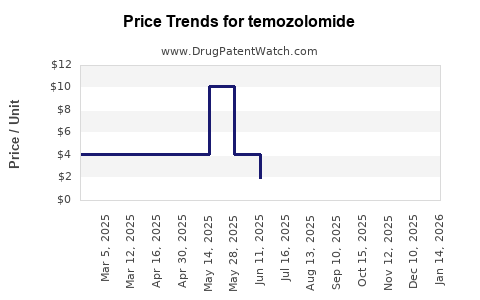
- Price Erosion: Generic entry typically leads to aggressive price competition. For temozolomide, the average selling price (ASP) has declined substantially since the advent of generics. While specific pricing varies by dosage, formulation, and payer contracts, a substantial percentage decrease from the branded price has been observed. Data from sources like GoodRx and insurance formularies illustrate this trend, with generic temozolomide capsules (e.g., 5mg, 20mg, 100mg, 140mg, 250mg) available at a fraction of the historical branded cost. For instance, a typical 140mg capsule that may have cost upwards of $150-$200 under patent protection can now be sourced generically for a significantly lower figure.
- Market Share Shift: Prior to patent expiration, Temodar held near-exclusive market share. Post-expiration, generic temozolomide products now dominate the market by volume. Pharmaceutical market data providers, such as IQVIA, report that generic temozolomide constitutes over 90% of the dispensed units for the indication. This shift is driven by cost-effectiveness, a critical factor for both healthcare providers and patients, particularly within healthcare systems focused on budget constraints.
- Increased Accessibility: The lower cost of generic temozolomide has improved patient access to this critical therapy, especially in regions or for patient populations with limited financial resources. This wider accessibility can contribute to increased overall treatment rates, albeit at a lower revenue per unit.
What is the Current Global Market Size and Revenue Trajectory for Temozolomide?
Estimating the precise global market size and revenue trajectory for temozolomide requires granular data that accounts for both branded and generic sales, regional variations in pricing, and prescription volumes. However, an analysis of trends indicates a mature market characterized by steady but declining revenue growth due to price compression.
Market Size and Trajectory Observations:
- Mature Market: The temozolomide market is considered mature. The core indications are well-established, and while treatment protocols may evolve, the drug remains a key option.
- Declining Revenue Growth: While the volume of temozolomide prescriptions has remained relatively stable or may even see marginal increases due to accessibility, the overall revenue is projected to decline or show very modest growth. This is a direct consequence of the significant price reduction driven by generic competition.
- Global Revenue Estimates: Based on industry reports and extrapolations from market analytics firms, the global market for temozolomide (including both branded and generic forms) was estimated to be in the range of $500 million to $700 million annually in recent years [2, 3]. This figure represents a substantial decrease from peak branded sales, which likely exceeded $1 billion during the patent-protected period for Temodar.
- Projected Trajectory: The market is expected to continue on a trajectory of stable prescription volumes with ongoing revenue decline or stagnation, unless new high-value indications or formulations emerge. The majority of this revenue is now generated by generic manufacturers.
Who are the Key Players in the Temozolomide Market?
The temozolomide market is now a bifurcated landscape, comprising the original innovator (Merck & Co., through its acquisition of Schering-Plough) and a multitude of generic pharmaceutical companies.
Key Market Participants:
- Innovator/Branded Manufacturer:
- Merck & Co. (formerly Schering-Plough): Remains a player with its branded product, Temodar, though its market share is minimal compared to generics.
- Major Generic Manufacturers: The generic market is highly competitive, with numerous companies supplying temozolomide. Prominent players include:
- Teva Pharmaceutical Industries: A major global generic drug manufacturer.
- Sun Pharmaceutical Industries: Another significant international generic pharmaceutical company.
- Dr. Reddy's Laboratories: An Indian multinational pharmaceutical company with a strong generics portfolio.
- Mylan N.V. (now Viatris): A large player in the generics market.
- Accord Healthcare: A significant supplier in various international markets.
- Various other regional and international generic suppliers.
The competitive landscape among generic manufacturers is characterized by intense price competition to secure contracts with wholesalers, distributors, and pharmacy benefit managers.
What are the Ongoing Research and Development (R&D) Trends for Temozolomide?
Despite being a mature drug, research into temozolomide continues, focusing on optimizing its use, overcoming resistance, and exploring novel combinations.
R&D Focus Areas:
- Combination Therapies: A significant area of research is the combination of temozolomide with other therapeutic agents to enhance efficacy or overcome treatment resistance. This includes:
- Immunotherapy: Investigating combinations with checkpoint inhibitors (e.g., PD-1/PD-L1 inhibitors) to potentially enhance the immune system's ability to target tumor cells, especially in the context of DNA damage induced by temozolomide [4].
- Targeted Therapies: Exploring combinations with drugs that target specific molecular pathways involved in tumor growth or resistance mechanisms.
- Radiosensitization: Further research into how temozolomide interacts with radiotherapy to optimize dose and scheduling.
- Overcoming Resistance Mechanisms: Understanding and addressing the molecular mechanisms by which tumors develop resistance to temozolomide, such as alterations in DNA repair pathways (e.g., MGMT methylation status), is a crucial R&D area [5]. Strategies aim to re-sensitize tumors or bypass these resistance mechanisms.
- Novel Formulations and Delivery Systems: While less common for an established oral drug, research might explore novel formulations for improved bioavailability, reduced side effects, or alternative delivery routes, though significant breakthroughs in this area are less anticipated compared to combination strategies.
- Repurposing and New Indications: Although primarily indicated for brain tumors, there is ongoing exploration, albeit limited, into temozolomide's potential in other cancer types or rare neurological conditions where alkylating agents might show activity. However, its established toxicity profile and the availability of more targeted agents limit broad repurposing efforts.
- Pediatric Applications: While temozolomide is used off-label in some pediatric brain tumor settings, ongoing research aims to establish clearer efficacy and safety profiles, potentially leading to formal approvals and standardized treatment guidelines for younger patient populations.
The financial incentives for R&D in temozolomide are primarily driven by the potential for new intellectual property around novel combinations or formulations, rather than the drug itself, given its generic status. Companies pursuing these avenues aim to secure market exclusivity for new therapeutic regimens.
What are the Regulatory and Market Access Considerations for Temozolomide?
Regulatory and market access considerations are critical for temozolomide, particularly given its generic status and the nature of its indications.
Key Considerations:
- Regulatory Approvals:
- FDA and EMA: Temozolomide is approved by major regulatory bodies like the U.S. Food and Drug Administration (FDA) and the European Medicines Agency (EMA) for its established indications. Generic versions require Abbreviated New Drug Application (ANDA) approval in the U.S., demonstrating bioequivalence to the reference listed drug (RLD) [6].
- Global Harmonization: Regulatory pathways vary globally, and manufacturers must navigate country-specific requirements for generic drug approval.
- Pharmacoeconomic Value: Due to significant price reductions from generic entry, temozolomide offers a strong pharmacoeconomic value proposition for healthcare systems. Its established efficacy and lower cost make it a preferred treatment option when clinically appropriate.
- Payer Negotiations and Formulary Placement:
- Generic Dominance: Payers (insurance companies, national health services) negotiate aggressively with generic manufacturers. Formulary placement is typically favorable due to cost-effectiveness.
- Cost Management: Payers often implement policies to encourage the use of generics, such as step-therapy requirements or preferred formulary tiers for generic temozolomide.
- Off-Label Use: Temozolomide is sometimes used off-label for other oncological indications or in pediatric patients. While not directly affecting the approved market, this represents a potential, albeit unquantified, volume. Regulatory bodies do not endorse off-label use, and coverage for such uses can vary significantly by payer.
- Post-Market Surveillance: Like all pharmaceuticals, temozolomide is subject to ongoing post-market surveillance for safety and efficacy. Any new safety signals or emerging resistance patterns could influence prescribing practices and payer policies.
What are the Key Risks and Opportunities in the Temozolomide Market?
The temozolomide market, despite its maturity, presents distinct risks and opportunities for stakeholders.
Key Risks:
- Intensified Generic Competition: The large number of generic manufacturers leads to perpetual pricing pressure, squeezing profit margins for all players in the generic space.
- Emergence of Superior Therapies: Advancements in oncology, particularly in targeted therapies and immunotherapies, could lead to the development of new treatments that demonstrate superior efficacy or safety profiles, potentially displacing temozolomide even in its current indications.
- Resistance Development: The inherent development of tumor resistance to temozolomide remains a significant clinical challenge, limiting its long-term effectiveness in a subset of patients.
- Regulatory Scrutiny: Any adverse safety findings or manufacturing quality issues could lead to regulatory actions, impacting supply and market access.
- Reimbursement Pressures: While currently cost-effective, evolving healthcare economics and payer policies could introduce new pressures on pricing and access.
Key Opportunities:
- Combination Therapies: Developing and gaining approval for novel combination regimens that include temozolomide could create new market segments or extend its therapeutic relevance and potential for premium pricing if IP is secured on the combination.
- Emerging Markets: Increased access to healthcare and diagnostic capabilities in developing economies may create new demand for established and cost-effective treatments like temozolomide.
- Lifecycle Management: While patent exclusivity has passed, there remain opportunities for formulation improvements or novel delivery methods that could offer incremental benefits and potentially secure limited market advantages.
- Contract Manufacturing: For generic manufacturers, the opportunity lies in efficient, large-scale production and robust supply chain management to capture market share through competitive pricing and reliable supply.
- Research into Resistance Mechanisms: A deeper understanding of resistance can lead to diagnostic tools or companion therapies that, while not directly temozolomide, are closely linked to its use and represent ancillary opportunities.
Key Takeaways
Temozolomide operates within a mature pharmaceutical market, characterized by the extensive impact of patent expirations and the subsequent dominance of generic manufacturers. Its primary indications for glioblastoma multiforme and anaplastic astrocytoma have established it as a vital treatment, but the influx of generics has led to significant price erosion and a shift in market share dynamics. While the branded product has a negligible market presence, the global revenue for temozolomide, estimated between $500 million and $700 million annually, is driven by generic sales. Ongoing research focuses on optimizing its use through combination therapies and overcoming resistance mechanisms, offering potential avenues for future value creation, albeit with R&D incentives tied to novel regimens rather than the drug itself. Key players include innovator Merck & Co. and a competitive landscape of global generic manufacturers such as Teva, Sun Pharma, and Dr. Reddy's. Risks are primarily associated with intensified generic competition and the emergence of superior therapies, while opportunities lie in combination therapies, emerging markets, and efficient manufacturing.
Frequently Asked Questions
1. Will temozolomide eventually become obsolete due to new cancer therapies?
Temozolomide remains a standard of care for its specific indications due to its established efficacy and favorable cost-effectiveness as a generic drug. While newer therapies are continuously emerging, the development of truly superior alternatives that can entirely displace temozolomide for all eligible patients across all treatment lines is a complex and lengthy process. It is more likely that temozolomide will continue to be used, potentially in combination with novel agents or for specific patient populations, rather than becoming entirely obsolete in the short to medium term.
2. What is the most significant factor driving the decline in temozolomide prices?
The most significant factor driving the decline in temozolomide prices is the expiration of its primary patents, which has allowed for the widespread entry of generic manufacturers. This increased competition among multiple suppliers inevitably leads to aggressive price reductions to gain market share.
3. Are there any significant new indications for temozolomide on the horizon?
While research continues, there are no widely anticipated major new indications for temozolomide that are close to regulatory approval. The primary focus of current R&D is on optimizing its use in existing indications, particularly through combination therapies, rather than identifying entirely new disease targets for the drug itself.
4. How does the MGMT methylation status of a tumor affect temozolomide treatment?
The methylation status of the O-6-methylguanine-DNA methyltransferase (MGMT) gene is a critical predictive biomarker for response to temozolomide. Tumors with methylated MGMT promoters have reduced levels of the MGMT enzyme, which repairs DNA damage caused by temozolomide. Consequently, patients with MGMT-methylated tumors are more likely to respond favorably to temozolomide treatment, experiencing longer progression-free survival and overall survival. Tumors with unmethylated MGMT promoters are generally less responsive to temozolomide.
5. What is the typical duration of temozolomide treatment for glioblastoma multiforme?
For newly diagnosed glioblastoma multiforme, temozolomide is typically administered concurrently with radiotherapy for six weeks. This is followed by adjuvant therapy, which usually consists of six additional cycles of temozolomide alone, with each cycle lasting 28 days. The total duration can extend up to approximately one year, depending on patient tolerance and disease response. For recurrent or progressive anaplastic astrocytoma, treatment duration is determined by disease progression, toxicity, and the treating physician's judgment.
Citations
[1] U.S. Food and Drug Administration. (1999). FDA Approves Temodar (temozolomide) Capsules. [Press Release].
[2] Global Market Insights, Inc. (2023). Temozolomide Market Size, Share & Industry Trends Report.
[3] Grand View Research. (2023). Temozolomide Market Size, Share & Trends Analysis Report.
[4] Touat, M., Idbaih, A., Barnik, D., Crémoux, O., Delattre, J. Y., & Marie, Y. (2017). Update on the role of temozolomide in glioblastoma. Expert Review of Neurotherapeutics, 17(6), 611-623.
[5] Hegi, M. E., Liu, G., Pan, H., Zwinderman, A. H., Feng, Z., Chuang, E., ... & Wick, W. (2008). Combination of temozolomide plus radiotherapy followed by two different maintenance regimens of temozolomide in patients with newly diagnosed glioblastoma: a randomized controlled trial. The Lancet Oncology, 9(3), 227-238.
[6] U.S. Food and Drug Administration. (n.d.). Abbreviated New Drug Applications (ANDAs). Retrieved from [FDA Website on ANDAs]