You're using a free limited version of DrugPatentWatch: Upgrade for Complete Access

Last Updated: December 31, 2025

JUVISYNC Drug Patent Profile


✉ Email this page to a colleague

« Back to Dashboard


When do Juvisync patents expire, and when can generic versions of Juvisync launch?

Juvisync is a drug marketed by Merck Sharp Dohme and is included in one NDA. There is one patent protecting this drug and three Paragraph IV challenges.

This drug has fifty-two patent family members in forty countries.

The generic ingredient in JUVISYNC is simvastatin; sitagliptin phosphate. There are forty drug master file entries for this compound. Additional details are available on the simvastatin; sitagliptin phosphate profile page.

DrugPatentWatch® Generic Entry Outlook for Juvisync

By analyzing the patents and regulatory protections it appears that the earliest date for generic entry will be October 11, 2026. This may change due to patent challenges or generic licensing.

There have been thirty-three patent litigation cases involving the patents protecting this drug, indicating strong interest in generic launch. Recent data indicate that 63% of patent challenges are decided in favor of the generic patent challenger and that 54% of successful patent challengers promptly launch generic drugs.

Indicators of Generic Entry

< Available with Subscription >

  Get Started Free

AI Deep Research
Questions you can ask:
  • What is the 5 year forecast for JUVISYNC?
  • What are the global sales for JUVISYNC?
  • What is Average Wholesale Price for JUVISYNC?
Summary for JUVISYNC
International Patents:52
US Patents:1
Applicants:1
NDAs:1
Patent Litigation and PTAB cases: See patent lawsuits and PTAB cases for JUVISYNC
DailyMed Link:JUVISYNC at DailyMed
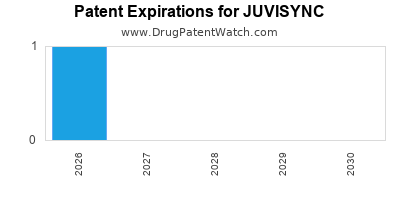
Drug patent expirations by year for JUVISYNC
DrugPatentWatch® Estimated Loss of Exclusivity (LOE) Date for JUVISYNC
Generic Entry Date for JUVISYNC*:
Constraining patent/regulatory exclusivity:
NDA:
Dosage:
TABLET;ORAL

*The generic entry opportunity date is the latter of the last compound-claiming patent and the last regulatory exclusivity protection. Many factors can influence early or later generic entry. This date is provided as a rough estimate of generic entry potential and should not be used as an independent source.

Paragraph IV (Patent) Challenges for JUVISYNC
Tradename Dosage Ingredient Strength NDA ANDAs Submitted Submissiondate
JUVISYNC Tablets simvastatin; sitagliptin phosphate 50 mg/10 mg 50 mg/20 mg 50 mg/40 mg 202343 1 2012-11-06
JUVISYNC Tablets simvastatin; sitagliptin phosphate 100 mg/20 mg 202343 1 2012-06-25
JUVISYNC Tablets simvastatin; sitagliptin phosphate 100 mg/10 mg and 100 mg/40 mg 202343 1 2012-06-19

US Patents and Regulatory Information for JUVISYNC

JUVISYNC is protected by one US patents.

Based on analysis by DrugPatentWatch, the earliest date for a generic version of JUVISYNC is ⤷  Get Started Free.

This potential generic entry date is based on patent ⤷  Get Started Free.

Generics may enter earlier, or later, based on new patent filings, patent extensions, patent invalidation, early generic licensing, generic entry preferences, and other factors.

Applicant Tradename Generic Name Dosage NDA Approval Date TE Type RLD RS Patent No. Patent Expiration Product Substance Delist Req. Exclusivity Expiration
Merck Sharp Dohme JUVISYNC simvastatin; sitagliptin phosphate TABLET;ORAL 202343-004 Sep 18, 2012 DISCN Yes No ⤷  Get Started Free ⤷  Get Started Free Y ⤷  Get Started Free
Merck Sharp Dohme JUVISYNC simvastatin; sitagliptin phosphate TABLET;ORAL 202343-002 Oct 7, 2011 DISCN Yes No ⤷  Get Started Free ⤷  Get Started Free Y ⤷  Get Started Free
Merck Sharp Dohme JUVISYNC simvastatin; sitagliptin phosphate TABLET;ORAL 202343-001 Oct 7, 2011 DISCN Yes No ⤷  Get Started Free ⤷  Get Started Free Y ⤷  Get Started Free
Merck Sharp Dohme JUVISYNC simvastatin; sitagliptin phosphate TABLET;ORAL 202343-005 Sep 18, 2012 DISCN Yes No ⤷  Get Started Free ⤷  Get Started Free Y ⤷  Get Started Free
Merck Sharp Dohme JUVISYNC simvastatin; sitagliptin phosphate TABLET;ORAL 202343-003 Oct 7, 2011 DISCN Yes No ⤷  Get Started Free ⤷  Get Started Free Y ⤷  Get Started Free
>Applicant >Tradename >Generic Name >Dosage >NDA >Approval Date >TE >Type >RLD >RS >Patent No. >Patent Expiration >Product >Substance >Delist Req. >Exclusivity Expiration

Expired US Patents for JUVISYNC

International Patents for JUVISYNC

See the table below for patents covering JUVISYNC around the world.

Country Patent Number Title Estimated Expiration
Germany 04029691 ⤷  Get Started Free
Taiwan 200524610 Phosphoric acid salt of a dipeptidyl peptidase-IV inhibitor ⤷  Get Started Free
Denmark 1084705 ⤷  Get Started Free
Japan 2002501889 ⤷  Get Started Free
New Zealand 544026 Phosphoric acid salt of 4-oxo-4-[3-(trifluoromethyl)-5,6-dihydro[1,2,4]triazolo[4,3-a]pyrazin-7(8H)-yl]-1-(2,4,5-trifluorophenyl)butan-2-amine ⤷  Get Started Free
>Country >Patent Number >Title >Estimated Expiration

Supplementary Protection Certificates for JUVISYNC

Patent Number Supplementary Protection Certificate SPC Country SPC Expiration SPC Description
1412357 C300357 Netherlands ⤷  Get Started Free PRODUCT NAME: SITAGLIPTINE, DESGEWENST IN DE VORM VAN EEN FARMACEUTISCH AANVA ARDBAAR ZOUT, IN HET BIJZONDER HET MONOFOSFAAT, EN METFORMINE DESGEWENST IN DE VORM VAN EEN FARMACEUTISCH AANVAARDBAAR ZOUT, IN HET BIJZONDER HET HYDROCHLORIDE; REGISTRATION NO/DATE: EU/1/08/455/001-014 20080716
1412357 C300287 Netherlands ⤷  Get Started Free PRODUCT NAME: SITAGLIPTINE, DESGEWENST IN DE VORM VAN EEN FARMACEUTISCH AANVAARDBAAR ZOUT, IN HET BIJZONDER SITAGLIPTINE FOSFAAT MONOHYDRAAT; REGISTRATION NO/DATE: EU/1/07/383/001-018 20070321
1084705 PA2014042 Lithuania ⤷  Get Started Free PRODUCT NAME: VILDAGLIPTINUM; REGISTRATION NO/DATE: EU/1/07/414/001-010, 2007 09 26 EU/1/07/414/018 20070926
1412357 2007/029 Ireland ⤷  Get Started Free PRODUCT NAME: SITAGLIPTIN, OPTIONALLY IN THE FORM OF A PHARMACEUTICALLY ACCEPTABLE SALT; REGISTRATION NO/DATE: EU/1/07/383/001-018 20070321
1084705 CA 2014 00063 Denmark ⤷  Get Started Free PRODUCT NAME: SITAGLIPTIN OG FARMACEUTISK SALTE DERAF, HERUNDER SITAGLIPTIN PHOSPHAT MONOHYDRAT; REG. NO/DATE: EU/1/07/383/001-024 AND EU/1/07/382/001-024 20070321
>Patent Number >Supplementary Protection Certificate >SPC Country >SPC Expiration >SPC Description

Market Dynamics and Financial Trajectory for JUVISYNC

Last updated: July 27, 2025

Introduction
JUVISYNC, a pioneering pharmaceutical product, is poised to reshape the aesthetic and dermatological sectors with its innovative formulation targeting skin revitalization. As the global anti-aging and cosmetic markets expand, understanding JUVISYNC’s market dynamics and financial outlook becomes crucial for stakeholders evaluating its commercial potential. This analysis synthesizes current market trends, competitive positioning, regulatory landscapes, and financial projections to inform strategic decisions.

Market Overview and Trends
The global aesthetic medicine market, valued at approximately USD 16.3 billion in 2021, is expected to grow at a compound annual growth rate (CAGR) of around 11.2% through 2028 (source: Grand View Research). This growth is driven by increasing demand for non-invasive aesthetic procedures, aging populations in developed regions, and rising consumer awareness regarding skin health.

Additionally, the burgeoning interest in bioengineered skin therapies—particularly injectable hyaluronic acid and peptide-based treatments—demonstrates a robust trajectory for products like JUVISYNC. Consumer preference shifts from invasive surgeries toward minimally invasive procedures bolster market acceptance. The COVID-19 pandemic accelerated digital marketing and tele-dermatology, further enhancing access and visibility for innovative dermal products.

Product Positioning and Differentiators
JUVISYNC distinguishes itself through its unique formulation, integrating synthetic peptides, growth factors, and biocompatible carriers designed to stimulate collagen synthesis, improve skin elasticity, and reduce wrinkles. Unlike traditional hyaluronic acid fillers, JUVISYNC emphasizes cellular rejuvenation at a molecular level, targeting long-term skin health rather than merely volumizing.

Its innovative profile aligns with increasing clinician and consumer preferences for regenerative, multi-functional aesthetic solutions. The product’s patent portfolio, clinical validation, and potential for repeat treatment cycles position JUVISYNC favorably against current market incumbents such as Restylane and Juvederm.

Regulatory Landscape and Market Access
JUVISYNC has advanced through pivotal regulatory milestones. In key markets like the US, submission of a Biologics License Application (BLA) to the FDA signals imminent approval. The European Medicines Agency (EMA) evaluation is underway, with potential CE marking upon approval.

Regulatory approval quality and timing significantly impact revenue forecasts. Market access strategies include establishing partnerships with leading aesthetic clinics, leveraging key opinion leaders, and engaging in targeted medical aesthetics trade shows. Payment models favoring elective procedures, coupled with insurance reimbursement schemes where applicable, influence uptake dynamics.

Competitive Environment
JUVISYNC faces competition from established dermal filler brands and emerging regenerative skin therapies. Key competitors include:

  • Fillers (e.g., Restylane, Juvederm): Primarily volumizers with extensive market penetration.
  • Bio-scaffolds and Peptide-based Therapies: Ramping up R&D investments to capture regenerative niches.

Differentiation hinges on efficacy, duration, safety profile, and patient comfort. JUVISYNC’s minimized adverse effects and regenerative benefits are core selling points.

Market Penetration and Adoption
Initial adoption will likely be driven by high-volume aesthetic clinics and dermatology practices. Education campaigns emphasizing its long-term benefits and safety enhance clinician confidence. Adoption rates are projected to accelerate as safety data and local approvals expand.

Forecasts estimate that in developed markets, JUVISYNC could secure a 5-10% share within five years post-launch, translating to sales of USD 500 million to over USD 1 billion in mature stages. These figures depend on regulatory success, marketing effectiveness, and competitive responses.

Financial Projections and Trajectory
The financial merits of JUVISYNC hinge on multiple variables:

  • Pricing Strategy: Premium pricing for advanced regenerative products, estimated at USD 600-900 per syringe.
  • Sales Volume: Initial units sold to high-end clinics, scaling rapidly with broader market adoption.
  • Cost of Goods Sold (COGS): Investment in proprietary manufacturing and quality assurance influences margins.

Assuming a conservative entry into select markets with an average price point of USD 750 and initial sales of 10,000 units in the first year, revenues could approximate USD 7.5 million. Year-on-year growth could surpass 30% as market expansion occurs, reaching USD 100 million within 3-4 years post-launch.

Margins are expected to stabilize around 60-70% once production scales. R&D investments for ongoing innovation and regulatory compliance will influence overall profitability. Strategic partnerships with aesthetic networks can accelerate commercialization and revenue realization.

Risks and Challenges
Market entry risks include delayed regulatory approvals, clinician skepticism, competitive responses, and reimbursement constraints. Additionally, manufacturing scalability and supply chain robustness are critical for financial stability.

Emerging competitors or technological disruptions could impact market share. Moreover, patient safety concerns or adverse outcomes could undermine brand reputation and revenue streams.

Conclusion
JUVISYNC is positioned to benefit from favorable macro trends in regenerative aesthetics. Its innovative formulation and initial regulatory momentum offer promising financial prospects. However, success hinges on strategic regulatory navigation, effective commercialization, and ongoing innovation to maintain competitive advantages.


Key Takeaways

  • The expanding aesthetic medicine market offers a fertile landscape for JUVISYNC, driven by demand for minimally invasive, regenerative skin treatments.
  • Differentiation through long-term skin rejuvenation and safety profiles is vital for market penetration.
  • Regulatory approvals in key jurisdictions will significantly influence JUVISYNC’s financial trajectory; timely clearance could catalyze rapid adoption.
  • Financial forecasts suggest potential revenues exceeding USD 100 million within several years, assuming effective commercialization.
  • Vigilant management of regulatory, competitive, and manufacturing risks is essential to realize projected growth.

FAQs

1. What factors could influence JUVISYNC’s market adoption?
Clinician and patient perceptions of efficacy and safety, regulatory approvals, marketing strategies, treatment costs, and reimbursement policies are primary factors influencing adoption rates.

2. How does JUVISYNC compare financially to existing dermal fillers?
While traditional fillers often generate higher immediate revenue per treatment, JUVISYNC’s regenerative benefits may foster long-term patient retention and higher cumulative revenue if it gains widespread acceptance for skin rejuvenation.

3. What regulatory hurdles does JUVISYNC face?
JUVISYNC must secure approvals from authorities like the FDA and EMA, demonstrating safety, efficacy, and manufacturing quality. Labeling, clinical trial requirements, and post-market surveillance are critical components.

4. What is the long-term revenue potential for JUVISYNC?
If successfully commercialized, JUVISYNC could generate hundreds of millions to over a billion USD annually once firmly established in key markets, given the expanding demand for regenerative aesthetic treatments.

5. How might competitive dynamics evolve in the regenerative skin therapy segment?
Innovative entrants focusing on molecular regenerative mechanisms will intensify competition. Continuous product differentiation, clinical validation, and strategic partnerships will be vital to maintaining market share.


References

  1. Grand View Research. Aesthetic Medicine Market Size, Trends & Forecasts. 2022.
  2. MarketsandMarkets. Regenerative Medicine Market. 2021.
  3. Regulatory filings and announcements from respective authorities.

More… ↓

⤷  Get Started Free

Make Better Decisions: Try a trial or see plans & pricing

Drugs may be covered by multiple patents or regulatory protections. All trademarks and applicant names are the property of their respective owners or licensors. Although great care is taken in the proper and correct provision of this service, thinkBiotech LLC does not accept any responsibility for possible consequences of errors or omissions in the provided data. The data presented herein is for information purposes only. There is no warranty that the data contained herein is error free. We do not provide individual investment advice. This service is not registered with any financial regulatory agency. The information we publish is educational only and based on our opinions plus our models. By using DrugPatentWatch you acknowledge that we do not provide personalized recommendations or advice. thinkBiotech performs no independent verification of facts as provided by public sources nor are attempts made to provide legal or investing advice. Any reliance on data provided herein is done solely at the discretion of the user. Users of this service are advised to seek professional advice and independent confirmation before considering acting on any of the provided information. thinkBiotech LLC reserves the right to amend, extend or withdraw any part or all of the offered service without notice.