GLAXOSMITHKLINE Company Profile
✉ Email this page to a colleague
What is the competitive landscape for GLAXOSMITHKLINE
GLAXOSMITHKLINE has one hundred and fifty-one approved drugs.
There are thirty-six US patents protecting GLAXOSMITHKLINE drugs.
There are seven hundred and sixty-eight patent family members on GLAXOSMITHKLINE drugs in sixty-two countries and one hundred and eighty-four supplementary protection certificates in twenty-one countries.
Summary for GLAXOSMITHKLINE
| International Patents: | 768 |
| US Patents: | 36 |
| Tradenames: | 106 |
| Ingredients: | 92 |
| NDAs: | 151 |
| Drug Master File Entries: | 8 |
| Patent Litigation for GLAXOSMITHKLINE: | See patent lawsuits for GLAXOSMITHKLINE |
| PTAB Cases with GLAXOSMITHKLINE as petitioner: | See PTAB cases with GLAXOSMITHKLINE as petitioner |
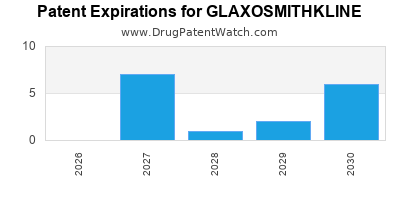
Drugs and US Patents for GLAXOSMITHKLINE
| Applicant | Tradename | Generic Name | Dosage | NDA | Approval Date | TE | Type | RLD | RS | Patent No. | Patent Expiration | Product | Substance | Delist Req. | Exclusivity Expiration |
|---|---|---|---|---|---|---|---|---|---|---|---|---|---|---|---|
| Glaxosmithkline | PENTACEF | ceftazidime | INJECTABLE;INJECTION | 064008-001 | Mar 31, 1992 | DISCN | No | No | ⤷ Start Trial | ⤷ Start Trial | |||||
| Glaxosmithkline | ZEJULA | niraparib tosylate | CAPSULE;ORAL | 208447-001 | Mar 27, 2017 | DISCN | Yes | No | 8,071,579 | ⤷ Start Trial | ⤷ Start Trial | ||||
| Glaxosmithkline Llc | RYTHMOL SR | propafenone hydrochloride | CAPSULE, EXTENDED RELEASE;ORAL | 021416-002 | Sep 4, 2003 | DISCN | Yes | No | ⤷ Start Trial | ⤷ Start Trial | |||||
| Glaxosmithkline | ZEJULA | niraparib tosylate | TABLET;ORAL | 214876-003 | Apr 26, 2023 | RX | Yes | Yes | 11,673,877 | ⤷ Start Trial | Y | ⤷ Start Trial | |||
| Glaxosmithkline | JESDUVROQ | daprodustat | TABLET;ORAL | 216951-001 | Feb 1, 2023 | DISCN | Yes | No | 8,324,208 | ⤷ Start Trial | Y | Y | ⤷ Start Trial | ||
| Glaxosmithkline | FLOVENT | fluticasone propionate | AEROSOL, METERED;INHALATION | 020548-001 | Mar 27, 1996 | DISCN | No | No | ⤷ Start Trial | ⤷ Start Trial | |||||
| >Applicant | >Tradename | >Generic Name | >Dosage | >NDA | >Approval Date | >TE | >Type | >RLD | >RS | >Patent No. | >Patent Expiration | >Product | >Substance | >Delist Req. | >Exclusivity Expiration |
Expired US Patents for GLAXOSMITHKLINE
| Applicant | Tradename | Generic Name | Dosage | NDA | Approval Date | Patent No. | Patent Expiration |
|---|---|---|---|---|---|---|---|
| Glaxosmithkline | WELLBUTRIN | bupropion hydrochloride | TABLET;ORAL | 018644-003 | Dec 30, 1985 | 3,885,046 | ⤷ Start Trial |
| Glaxosmithkline | TAGAMET | cimetidine | TABLET;ORAL | 017920-004 | Dec 14, 1983 | 3,950,333 | ⤷ Start Trial |
| Glaxosmithkline | TAGAMET | cimetidine | TABLET;ORAL | 017920-004 | Dec 14, 1983 | 4,024,271 | ⤷ Start Trial |
| Glaxosmithkline | WELLBUTRIN | bupropion hydrochloride | TABLET;ORAL | 018644-002 | Dec 30, 1985 | 4,435,449 | ⤷ Start Trial |
| Glaxosmithkline | AGENERASE | amprenavir | CAPSULE;ORAL | 021007-001 | Apr 15, 1999 | 5,585,397 | ⤷ Start Trial |
| Glaxosmithkline | TAGAMET | cimetidine | TABLET;ORAL | 017920-005 | Apr 30, 1986 | 3,950,333 | ⤷ Start Trial |
| >Applicant | >Tradename | >Generic Name | >Dosage | >NDA | >Approval Date | >Patent No. | >Patent Expiration |
Paragraph IV (Patent) Challenges for GLAXOSMITHKLINE drugs
| Drugname | Dosage | Strength | Tradename | Submissiondate |
|---|---|---|---|---|
| ➤ Subscribe | Extended-release Tablets | 12 mg | ➤ Subscribe | 2009-02-05 |
| ➤ Subscribe | Extended-release Tablets | 6 mg | ➤ Subscribe | 2009-07-22 |
| ➤ Subscribe | Tablets | 150 mg | ➤ Subscribe | 2007-10-30 |
| ➤ Subscribe | Orally Disintegrating Tablets | 25 mg, 50 mg, 100 mg, and 200 mg | ➤ Subscribe | 2009-12-21 |
| ➤ Subscribe | Injection | 6 mg/0.5 mL, 0.5 mL (prefilled syringes) | ➤ Subscribe | 2006-05-09 |
| ➤ Subscribe | Tablets | 3 mg, 4 mg and 5 mg | ➤ Subscribe | 2005-02-04 |
| ➤ Subscribe | Tablets | 250 mg/100 mg | ➤ Subscribe | 2009-04-03 |
| ➤ Subscribe | Extended-release Capsules | 325 mg | ➤ Subscribe | 2006-11-07 |
| ➤ Subscribe | Oral Suspension | 750 mg/5 mL | ➤ Subscribe | 2009-10-20 |
| ➤ Subscribe | Extended-release Tablets | 4 mg | ➤ Subscribe | 2008-10-31 |
| ➤ Subscribe | Extended-release Tablets | 3 mg | ➤ Subscribe | 2009-01-08 |
| ➤ Subscribe | Extended-release Tablets | 2 mg | ➤ Subscribe | 2008-10-14 |
| ➤ Subscribe | Extended-release Tablets | 3 mg | ➤ Subscribe | 2009-01-08 |
| ➤ Subscribe | Injection | 6 mg/0.5 mL, 0.5 mL vials | ➤ Subscribe | 2004-10-25 |
| ➤ Subscribe | Tablets | 0.25 mg, 0.5 mg, 1 mg and 2 mg | ➤ Subscribe | 2004-12-22 |
| ➤ Subscribe | Tablets | 100 mg | ➤ Subscribe | 2007-10-31 |
| ➤ Subscribe | Tablets | 62.5 mg/25 mg | ➤ Subscribe | 2010-09-14 |
| ➤ Subscribe | Extended-release Capsules | 225 mg and 425 mg | ➤ Subscribe | 2006-10-11 |
| ➤ Subscribe | Extended-release Tablets | 25 mg, 50 mg, 100 mg, 200 mg, 250 mg, and 300 mg | ➤ Subscribe | 2014-02-12 |
| ➤ Subscribe | Extended-release Tablets | 8 mg | ➤ Subscribe | 2008-11-03 |
International Patents for GLAXOSMITHKLINE Drugs
| Country | Patent Number | Estimated Expiration |
|---|---|---|
| European Patent Office | 3432892 | ⤷ Start Trial |
| South Korea | 101387352 | ⤷ Start Trial |
| Morocco | 31554 | ⤷ Start Trial |
| Portugal | 1660095 | ⤷ Start Trial |
| Morocco | 27758 | ⤷ Start Trial |
| Japan | 5466814 | ⤷ Start Trial |
| >Country | >Patent Number | >Estimated Expiration |
Supplementary Protection Certificates for GLAXOSMITHKLINE Drugs
| Patent Number | Supplementary Protection Certificate | SPC Country | SPC Expiration | SPC Description |
|---|---|---|---|---|
| 2506844 | C201830030 | Spain | ⤷ Start Trial | PRODUCT NAME: UN PRODUCTO FARMACEUTICO QUE COMPRENDE LA COMBINACION DE UNA SAL FARMACEUTICAMENTE ACEPTABLE DE UMECLIDINIO (P.EJ. BROMURO DE UMECLIDINIO), VILANTEROL O UNA SAL FARMACEUTICAMENTE ACEPTABLE DEL MISMO (P.EJ. TRIFENATATO DE VILANTEROL) Y FUROATO DE FLUTICASONA; NATIONAL AUTHORISATION NUMBER: EU/1/17/1236; DATE OF AUTHORISATION: 20171115; NUMBER OF FIRST AUTHORISATION IN EUROPEAN ECONOMIC AREA (EEA): EU/1/17/1236; DATE OF FIRST AUTHORISATION IN EEA: 20171115 |
| 0933372 | PA2008006,C0933372 | Lithuania | ⤷ Start Trial | PRODUCT NAME: FOSAMPRENAVIR CALCIUM; REGISTRATION NO/DATE: EU/1/04/282/001-002 20040712 |
| 0382526 | 96C0035 | Belgium | ⤷ Start Trial | PRODUCT NAME: LAMIVUDINE; NAT. REGISTRATION NO/DATE: EU/1/96/015/001 19960808; FIRST REGISTRATION: CH 53 662 013 19960228 |
| 2240466 | 2018/020 | Ireland | ⤷ Start Trial | PRODUCT NAME: NIRAPARIB TOSYLATE OR A HYDRATE THEREOF, ESPECIALLY THE TOSYLATE MONOHYDRATE; REGISTRATION NO/DATE: EU/1/17/1235 20171116 |
| 2109608 | 201840015 | Slovenia | ⤷ Start Trial | PRODUCT NAME: NIRAPARIB OR ITS PHARMACEUTICALY ACCEPTABLE SALT, STEREOISOMER OR TAUTOMER, ESPECIALLY TOSYLATE OR HYDRATE, ESPECIALLY TOSYLATE MONOHYDRATE; NATIONAL AUTHORISATION NUMBER: EU/1/17/1235; DATE OF NATIONAL AUTHORISATION: 20171116; AUTHORITY FOR NATIONAL AUTHORISATION: EU |
| 1633724 | CR 2015 00012 | Denmark | ⤷ Start Trial | PRODUCT NAME: OLAPARIB, OG SALTE OG SOLVATER DERAF; REG. NO/DATE: EU/1/14/959/001 20141216 |
| >Patent Number | >Supplementary Protection Certificate | >SPC Country | >SPC Expiration | >SPC Description |
Similar Applicant Names
Applicants may be listed under multiple names.
Here is a list of applicants with similar names.
Here is a list of applicants with similar names.
