Glaxo Grp Ltd Company Profile
✉ Email this page to a colleague
What is the competitive landscape for GLAXO GRP LTD
GLAXO GRP LTD has eight approved drugs.
There are four US patents protecting GLAXO GRP LTD drugs.
Summary for Glaxo Grp Ltd
| US Patents: | 4 |
| Tradenames: | 13 |
| Ingredients: | 4 |
| NDAs: | 8 |
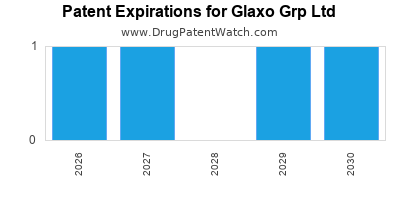
Drugs and US Patents for Glaxo Grp Ltd
| Applicant | Tradename | Generic Name | Dosage | NDA | Approval Date | TE | Type | RLD | RS | Patent No. | Patent Expiration | Product | Substance | Delist Req. | Exclusivity Expiration |
|---|---|---|---|---|---|---|---|---|---|---|---|---|---|---|---|
| Glaxo Grp Ltd | ADVAIR DISKUS 500/50 | fluticasone propionate; salmeterol xinafoate | POWDER;INHALATION | 021077-003 | Aug 24, 2000 | AB | RX | Yes | Yes | ⤷ Start Trial | ⤷ Start Trial | ||||
| Glaxo Grp Ltd | ZANTAC 150 | ranitidine hydrochloride | TABLET, EFFERVESCENT;ORAL | 020251-001 | Mar 31, 1994 | DISCN | No | No | ⤷ Start Trial | ⤷ Start Trial | |||||
| Glaxo Grp Ltd | ZANTAC 150 | ranitidine hydrochloride | TABLET;ORAL | 018703-001 | Jun 9, 1983 | DISCN | Yes | No | ⤷ Start Trial | ⤷ Start Trial | |||||
| Glaxo Grp Ltd | ZANTAC 300 | ranitidine hydrochloride | TABLET;ORAL | 018703-002 | Dec 9, 1985 | DISCN | Yes | No | ⤷ Start Trial | ⤷ Start Trial | |||||
| Glaxo Grp Ltd | ADVAIR DISKUS 100/50 | fluticasone propionate; salmeterol xinafoate | POWDER;INHALATION | 021077-001 | Aug 24, 2000 | AB | RX | Yes | Yes | ⤷ Start Trial | ⤷ Start Trial | ||||
| Glaxo Grp Ltd | BREO ELLIPTA | fluticasone furoate; vilanterol trifenatate | POWDER;INHALATION | 204275-001 | May 10, 2013 | RX | Yes | Yes | 8,534,281*PED | ⤷ Start Trial | Y | ⤷ Start Trial | |||
| >Applicant | >Tradename | >Generic Name | >Dosage | >NDA | >Approval Date | >TE | >Type | >RLD | >RS | >Patent No. | >Patent Expiration | >Product | >Substance | >Delist Req. | >Exclusivity Expiration |
Expired US Patents for Glaxo Grp Ltd
| Applicant | Tradename | Generic Name | Dosage | NDA | Approval Date | Patent No. | Patent Expiration |
|---|---|---|---|---|---|---|---|
| Glaxo Grp Ltd | ZANTAC | ranitidine hydrochloride | SYRUP;ORAL | 019675-001 | Dec 30, 1988 | 4,128,658 | ⤷ Start Trial |
| Glaxo Grp Ltd | ZANTAC 150 | ranitidine hydrochloride | TABLET;ORAL | 018703-001 | Jun 9, 1983 | 4,128,658 | ⤷ Start Trial |
| Glaxo Grp Ltd | BREO ELLIPTA | fluticasone furoate; vilanterol trifenatate | POWDER;INHALATION | 204275-002 | Apr 30, 2015 | 7,101,866 | ⤷ Start Trial |
| Glaxo Grp Ltd | BREO ELLIPTA | fluticasone furoate; vilanterol trifenatate | POWDER;INHALATION | 204275-002 | Apr 30, 2015 | RE44874 | ⤷ Start Trial |
| Glaxo Grp Ltd | ADVAIR DISKUS 250/50 | fluticasone propionate; salmeterol xinafoate | POWDER;INHALATION | 021077-002 | Aug 24, 2000 | RE40045 | ⤷ Start Trial |
| Glaxo Grp Ltd | ADVAIR HFA | fluticasone propionate; salmeterol xinafoate | AEROSOL, METERED;INHALATION | 021254-003 | Jun 8, 2006 | 9,861,771 | ⤷ Start Trial |
| >Applicant | >Tradename | >Generic Name | >Dosage | >NDA | >Approval Date | >Patent No. | >Patent Expiration |
Paragraph IV (Patent) Challenges for GLAXO GRP LTD drugs
| Drugname | Dosage | Strength | Tradename | Submissiondate |
|---|---|---|---|---|
| ➤ Subscribe | Tablets | 150 mg | ➤ Subscribe | 2007-10-30 |
International Patents for Glaxo Grp Ltd Drugs
| Country | Patent Number | Estimated Expiration |
|---|---|---|
| Japan | 2005533582 | ⤷ Start Trial |
| Brazil | 0312725 | ⤷ Start Trial |
| Australia | 2006324478 | ⤷ Start Trial |
| European Patent Office | 4578502 | ⤷ Start Trial |
| Spain | 2734302 | ⤷ Start Trial |
| China | 101336118 | ⤷ Start Trial |
| >Country | >Patent Number | >Estimated Expiration |
Supplementary Protection Certificates for Glaxo Grp Ltd Drugs
| Patent Number | Supplementary Protection Certificate | SPC Country | SPC Expiration | SPC Description |
|---|---|---|---|---|
| 2506844 | SPC/GB18/020 | United Kingdom | ⤷ Start Trial | PRODUCT NAME: A PHARMACEUTICAL COMBINATION PRODUCT COMPRISING A PHARMACEUTICALLY ACCEPTABLE SALT OF UMECLIDINIUM (E.G. UMECLIDINIUM BROMIDE), VILANTEROL OR A PHARMACEUTICALLY ACCETPABLE SALT THEREOF (E.G. VILANTEROL TRIFENATATE), AND FLUTICASONE FUROATE; REGISTERED: UK EU/1/17/1236/001(NI) 20171117; UK EU/1/17/1236/002(NI) 20171117; UK EU/1/17/1236/003(NI) 20171117; UK PLGB 19494/0287 20171117 |
| 2506844 | 132018000000341 | Italy | ⤷ Start Trial | PRODUCT NAME: UN PRODOTTO DI COMBINAZIONE FARMACEUTICA COMPRENDENTE UN SALE FARMACEUTICAMENTE ACCETTABILE DI UMECLIDINIO (AD ESEMPIO BROMURO DI UMECLIDINIO), VILANTEROLO O UN SUO SALE FARMACEUTICAMENTE ACCETTABILE (AD ESEMPIO VILANTEROLO TRIFENATATO) E UN FUROATO(TRELEGY ELLIPTA - FLUTICASONE FUROATO/UMECLIDINIO/VILANTEROLO); AUTHORISATION NUMBER(S) AND DATE(S): EU/1/17/1236, 20171117 |
| 1305329 | SPC/GB08/026 | United Kingdom | ⤷ Start Trial | PRODUCT NAME: FLUTICASONE FUROATE AND SOLVATES THEREOF; REGISTERED: UK EU/1/07/434/001 20080116; UK EU/1/07/434/002 20080116; UK EU/1/07/434/003 20080116 |
| 1519731 | 13C0067 | France | ⤷ Start Trial | PRODUCT NAME: AZELASTINE OU SES SELS PHARMACEUTIQUEMENT ACCEPTABLES ET UN ESTER PHARMACEUTIQUEMENT ACCEPTABLE DE FLUTICASONE; NAT. REGISTRATION NO/DATE: NL41755 20130925; FIRST REGISTRATION: SK - 24/0055/13-S 20130215 |
| 1519731 | 92269 | Luxembourg | ⤷ Start Trial | PRODUCT NAME: AZELASTINE,OU UN SEL PHARMACEUTIQUEMENT ACCEPTABLE DE CELUICI,ET UN ESTER PHARMACEUTIQUEMENT ACCEPTABLE DE FLUTICASONE |
| 2506844 | 1890025-8 | Sweden | ⤷ Start Trial | PRODUCT NAME: COMBINATION OF A PHARMACEUTICALLY ACCEPTABLE SALT OF UMECLIDINIUM (E.G. UMECLIDINIUM BROMIDE), VILANTEROL OR A PHARMACEUTICALLY ACCEPTABLE SALT THEROF (E.G. VILANTEROL TRIFENATATE) AND FLUTICASONE FUROATE.; REG. NO/DATE: EU/1/17/1236 20171117 |
| >Patent Number | >Supplementary Protection Certificate | >SPC Country | >SPC Expiration | >SPC Description |
Similar Applicant Names
Applicants may be listed under multiple names.
Here is a list of applicants with similar names.
Here is a list of applicants with similar names.
