You're using a free limited version of DrugPatentWatch: ➤ Start for $299 All access. No Commitment.

Last Updated: March 26, 2026

EDARBYCLOR Drug Patent Profile


✉ Email this page to a colleague

« Back to Dashboard


When do Edarbyclor patents expire, and when can generic versions of Edarbyclor launch?

Edarbyclor is a drug marketed by Azurity and is included in one NDA. There are three patents protecting this drug and one Paragraph IV challenge.

This drug has forty-nine patent family members in twenty-seven countries.

The generic ingredient in EDARBYCLOR is azilsartan kamedoxomil; chlorthalidone. There are six drug master file entries for this compound. Two suppliers are listed for this compound. Additional details are available on the azilsartan kamedoxomil; chlorthalidone profile page.

DrugPatentWatch® Generic Entry Outlook for Edarbyclor

Edarbyclor was eligible for patent challenges on February 25, 2015.

There have been six patent litigation cases involving the patents protecting this drug, indicating strong interest in generic launch. Recent data indicate that 63% of patent challenges are decided in favor of the generic patent challenger and that 54% of successful patent challengers promptly launch generic drugs.

Indicators of Generic Entry

< Available with Subscription >

  Start Trial

AI Deep Research
Questions you can ask:
  • What is the 5 year forecast for EDARBYCLOR?
  • What are the global sales for EDARBYCLOR?
  • What is Average Wholesale Price for EDARBYCLOR?
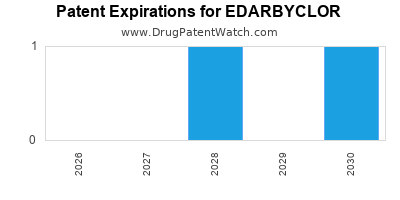
Drug patent expirations by year for EDARBYCLOR
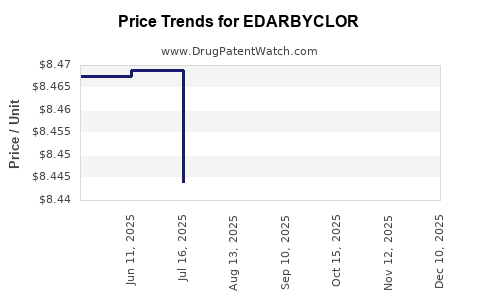
Drug Prices for EDARBYCLOR

See drug prices for EDARBYCLOR

Recent Clinical Trials for EDARBYCLOR

Identify potential brand extensions & 505(b)(2) entrants

SponsorPhase
TakedaPhase 3

See all EDARBYCLOR clinical trials

Paragraph IV (Patent) Challenges for EDARBYCLOR
Tradename Dosage Ingredient Strength NDA ANDAs Submitted Submissiondate
EDARBYCLOR Tablets azilsartan kamedoxomil; chlorthalidone 40 mg/12.5 mg and 40 mg/25 mg 202331 1 2022-04-19

US Patents and Regulatory Information for EDARBYCLOR

EDARBYCLOR is protected by three US patents.

Applicant Tradename Generic Name Dosage NDA Approval Date TE Type RLD RS Patent No. Patent Expiration Product Substance Delist Req. Exclusivity Expiration
Azurity EDARBYCLOR azilsartan kamedoxomil; chlorthalidone TABLET;ORAL 202331-001 Dec 20, 2011 AB RX Yes No ⤷  Start Trial ⤷  Start Trial ⤷  Start Trial
Azurity EDARBYCLOR azilsartan kamedoxomil; chlorthalidone TABLET;ORAL 202331-002 Dec 20, 2011 AB RX Yes Yes ⤷  Start Trial ⤷  Start Trial ⤷  Start Trial
Azurity EDARBYCLOR azilsartan kamedoxomil; chlorthalidone TABLET;ORAL 202331-001 Dec 20, 2011 AB RX Yes No ⤷  Start Trial ⤷  Start Trial Y ⤷  Start Trial
>Applicant >Tradename >Generic Name >Dosage >NDA >Approval Date >TE >Type >RLD >RS >Patent No. >Patent Expiration >Product >Substance >Delist Req. >Exclusivity Expiration

Expired US Patents for EDARBYCLOR

Applicant Tradename Generic Name Dosage NDA Approval Date Patent No. Patent Expiration
Azurity EDARBYCLOR azilsartan kamedoxomil; chlorthalidone TABLET;ORAL 202331-002 Dec 20, 2011 ⤷  Start Trial ⤷  Start Trial
Azurity EDARBYCLOR azilsartan kamedoxomil; chlorthalidone TABLET;ORAL 202331-001 Dec 20, 2011 ⤷  Start Trial ⤷  Start Trial
Azurity EDARBYCLOR azilsartan kamedoxomil; chlorthalidone TABLET;ORAL 202331-002 Dec 20, 2011 ⤷  Start Trial ⤷  Start Trial
>Applicant >Tradename >Generic Name >Dosage >NDA >Approval Date >Patent No. >Patent Expiration

International Patents for EDARBYCLOR

When does loss-of-exclusivity occur for EDARBYCLOR?

Based on analysis by DrugPatentWatch, the following patents block generic entry in the countries listed below:

Argentina

Patent: 2883
Estimated Expiration: ⤷  Start Trial

Australia

Patent: 09277455
Estimated Expiration: ⤷  Start Trial

Brazil

Patent: 0916847
Estimated Expiration: ⤷  Start Trial

Canada

Patent: 32018
Estimated Expiration: ⤷  Start Trial

Chile

Patent: 11000187
Estimated Expiration: ⤷  Start Trial

China

Patent: 2164918
Estimated Expiration: ⤷  Start Trial

Colombia

Patent: 41633
Estimated Expiration: ⤷  Start Trial

Costa Rica

Patent: 110111
Patent: COMPOSICION FARMACEUTICA SOLIDA
Estimated Expiration: ⤷  Start Trial

Dominican Republic

Patent: 011000032
Patent: COMPOSICION FARMACEUTICA SOLIDA
Estimated Expiration: ⤷  Start Trial

Ecuador

Patent: 11010856
Patent: COMPOSICIÓN FARMACÉUTICA SÓLIDA
Estimated Expiration: ⤷  Start Trial

Eurasian Patent Organization

Patent: 1170273
Patent: ТВЕРДАЯ ФАРМАЦЕВТИЧЕСКАЯ КОМПОЗИЦИЯ
Estimated Expiration: ⤷  Start Trial

European Patent Office

Patent: 10385
Patent: COMPOSITION PHARMACEUTIQUE SOLIDE (SOLID PHARMACEUTICAL COMPOSITION)
Estimated Expiration: ⤷  Start Trial

Georgia, Republic of

Patent: 0146062
Patent: SOLID PHARMACEUTICAL COMPOSITION
Estimated Expiration: ⤷  Start Trial

Japan

Patent: 35491
Estimated Expiration: ⤷  Start Trial

Patent: 11529444
Estimated Expiration: ⤷  Start Trial

Mexico

Patent: 11001150
Patent: COMPOSICION FARMACEUTICA SOLIDA. (SOLID PHARMACEUTICAL COMPOSITION.)
Estimated Expiration: ⤷  Start Trial

Morocco

Patent: 553
Patent: تركيب صيدلاني صلب
Estimated Expiration: ⤷  Start Trial

New Zealand

Patent: 0948
Patent: SOLID PHARMACEUTICAL COMPOSITION COMPRISING A DIURETIC, PH CONTROL AGENT AND AN OXADIAZOLE
Estimated Expiration: ⤷  Start Trial

Peru

Patent: 110551
Patent: COMPOSICION FARMACEUTICA SOLIDA QUE CONTIENE UN DERIVADO DE BENCIMIDAZOL Y UN DIURETICO
Estimated Expiration: ⤷  Start Trial

Portugal

Patent: 10385
Estimated Expiration: ⤷  Start Trial

South Africa

Patent: 1100871
Patent: SOLID PHARMACEUTICAL COMPOSITION
Estimated Expiration: ⤷  Start Trial

South Korea

Patent: 110038145
Patent: SOLID PHARMACEUTICAL COMPOSITION
Estimated Expiration: ⤷  Start Trial

Taiwan

Patent: 1008915
Patent: Solid pharmaceutical composition
Estimated Expiration: ⤷  Start Trial

Tunisia

Patent: 11000045
Patent: SOLID PHARMACEUTICAL COMPOSITION
Estimated Expiration: ⤷  Start Trial

Ukraine

Patent: 3905
Patent: ТВЕРДАЯ ФАРМАЦЕВТИЧЕСКАЯ КОМПОЗИЦИЯ;ТВЕРДА ФАРМАЦЕВТИЧНА КОМПОЗИЦІЯ (SOLID PHARMACEUTICAL COMPOSITION)
Estimated Expiration: ⤷  Start Trial

Uruguay

Patent: 017
Patent: COMPOSICIÓN FARMACÉUTICA SÓLIDA
Estimated Expiration: ⤷  Start Trial

Generics may enter earlier, or later, based on new patent filings, patent extensions, patent invalidation, early generic licensing, generic entry preferences, and other factors.

See the table below for additional patents covering EDARBYCLOR around the world.

Country Patent Number Title Estimated Expiration
Taiwan 251288 ⤷  Start Trial
Australia 2009277455 ⤷  Start Trial
Netherlands 300802 ⤷  Start Trial
Hungary 218792 N-bifenil-metil-szubsztituált heterociklusos vegyületek és eljárás előállításukra (N-BIPHENYLMETHYL SUBSTITUTED HETEROCYCLIC COMPOUNDS AND PROCESS FOR THEIR PREPARATION) ⤷  Start Trial
>Country >Patent Number >Title >Estimated Expiration

Supplementary Protection Certificates for EDARBYCLOR

Patent Number Supplementary Protection Certificate SPC Country SPC Expiration SPC Description
1718641 C 2012 017 Romania ⤷  Start Trial PRODUCT NAME: AZILSARTAN MEDOXOMIL SI SARURI ACCEPTABILE FARMACEUTICALE ACESTUIA, INCLUZAND SAREA DEUTHORISATION: 20111207; NUMBER OF FIRST AUTHORISATION IN EUROPEAN ECONOMIC AREA (EEA): EMEA EU/1/11/ POTASIU; NATIONAL AUTHORISATION NUMBER: RO EU/1/11/734/001 - RO EU/1/11/734/011; DATE OF NATIONAL A734/001 - EMEA EU/1/11/734/011; DATE OF FIRST AUTHORISATION IN EEA: 20111207
1718641 1290016-3 Sweden ⤷  Start Trial PRODUCT NAME: AZILSARTANMEDOXOMIL OCH FARMACEUTISKT GODTAGBARA SALTER DAERAV, INKLUDERANDE KALIUMSALT; REG. NO/DATE: EU/1/11/735/001 20111207
1718641 C300525 Netherlands ⤷  Start Trial PRODUCT NAME: AZILSARTAN MEDOXOMIL, DESGEWENST IN DE VORM VAN EEN FARMACEUTISCHE AANVAARDBAAR ZOUT, IN HET BIJZONDER HET KALIUMZOUT; REGISTRATION NO/DATE: EU/1/11/734/001-011EU/1/11/735/001-011 2011071207
1718641 SPC/GB12/028 United Kingdom ⤷  Start Trial PRODUCT NAME: AZILSARTAN MEDOXOMIL AND PHARMACEUTICALLY ACCEPTABLE SALTS THEREOF, INCLUDING THE POTASSIUM SALT; REGISTERED: UK EU/1/11/734/001-011 20111209
>Patent Number >Supplementary Protection Certificate >SPC Country >SPC Expiration >SPC Description

Edarbyclor Market Dynamics and Financial Trajectory

Last updated: February 19, 2026

Edarbyclor (edaravone and triamcinolone acetonide), an oral combination therapy, is positioned in the treatment of secondary progressive multiple sclerosis (SPMS). Developed by Mitsubishi Tanabe Pharma Corporation (MTPC), its market entry follows the intravenous administration of edaravone (Radicava) for amyotrophic lateral sclerosis (ALS). The drug's financial performance is contingent upon its demonstrated efficacy in SPMS, market access, payer coverage, and competition from existing and pipeline therapies.

What is the Approved Indication and Mechanism of Action for Edarbyclor?

Edarbyclor is approved in the United States for the treatment of secondary progressive multiple sclerosis (SPMS). The drug combines edaravone, a free radical scavenger, with triamcinolone acetonide, a corticosteroid.

  • Edaravone: This component functions as an antioxidant, theorized to reduce oxidative stress, a factor implicated in neuronal damage and disability progression in MS. It scavenges reactive oxygen species (ROS) and reactive nitrogen species (RNS).
  • Triamcinolone Acetonide: This is a synthetic corticosteroid with anti-inflammatory properties. In the context of MS, it is believed to modulate the immune response and reduce neuroinflammation, which contributes to demyelination and axonal damage.

The combination aims to provide a dual mechanism of action targeting both oxidative stress and inflammation in SPMS. The oral formulation offers a more convenient administration route compared to the intravenous edaravone.

What is the Regulatory Status and Approval Timeline for Edarbyclor?

Edarbyclor received U.S. Food and Drug Administration (FDA) approval on March 27, 2024. The approval was based on data from the 270-person, Phase 3, multicenter, randomized, double-blind, placebo-controlled EXACT study. This study evaluated the efficacy and safety of Edarbyclor in patients with SPMS. The study met its primary endpoint, demonstrating a statistically significant reduction in the annualized relapse rate (ARR) and a trend towards slowing disability progression as measured by the Expanded Disability Status Scale (EDSS) over a 48-week period.

What are the Key Clinical Trial Results Supporting Edarbyclor's Efficacy?

The U.S. FDA approval for Edarbyclor was primarily based on the results of the EXACT (Efficacy and Safety of Oral Edavarone and Triamcinolone Acetonide in Secondary Progressive Multiple Sclerosis) study.

  • Primary Endpoint: The study met its primary endpoint, demonstrating a 28% reduction in the annualized relapse rate (ARR) in the Edarbyclor group compared to placebo over 48 weeks (ARR: 0.38 vs. 0.53 events per year, p=0.024).
  • Secondary Endpoints:
    • Disability Progression: While not statistically significant at the 48-week mark, there was a trend towards slowing disability progression as measured by the EDSS. The mean change in EDSS score from baseline was 0.15 in the Edarbyclor arm and 0.25 in the placebo arm.
    • Timed 25-Foot Walk (T25FW): Edarbyclor showed a trend towards improvement in T25FW, though not statistically significant.
    • Brain Volume Loss: No significant difference was observed in whole-brain volume loss between the treatment groups.
  • Safety Profile: The most common adverse events reported in the clinical trials included upper respiratory tract infections, contusion, gastroenteritis, and headache. The safety profile was considered manageable and consistent with the known side effect profiles of edaravone and triamcinolone acetonide.

These results provide the foundational data for Edarbyclor's market positioning and physician adoption.

What is the Competitive Landscape for Edarbyclor in SPMS?

The market for SPMS treatments is competitive, with several approved therapies targeting different aspects of disease modification. Edarbyclor enters a landscape requiring clear differentiation based on efficacy, safety, and patient convenience.

Key Competitors and Their Market Positions:

  • Ocrelizumab (Ocrevus): Manufactured by Genentech (Roche).

    • Indication: Approved for relapsing forms of MS and primary progressive MS (PPMS). While not specifically for SPMS, it is frequently used off-label or considered in patients transitioning to progressive disease.
    • Mechanism: Monoclonal antibody targeting CD20-positive B cells, reducing autoimmune attack on myelin.
    • Administration: Intravenous infusion every six months.
    • Market Share: Dominant in the MS market, particularly for progressive forms, due to its demonstrated efficacy in slowing disability progression.
  • Siponimod (Mayzent): Manufactured by Novartis.

    • Indication: Approved for active SPMS.
    • Mechanism: Selective sphingosine-1-phosphate (S1P) receptor modulator that traps lymphocytes in lymph nodes, reducing immune cell infiltration into the central nervous system.
    • Administration: Oral tablet, taken daily.
    • Market Share: A key oral option for SPMS, offering a different mechanism of action.
  • Fingolimod (Gilenya): Manufactured by Novartis.

    • Indication: Approved for relapsing forms of MS. Used off-label in some progressive MS cases.
    • Mechanism: S1P receptor modulator.
    • Administration: Oral capsule, taken daily.
  • Rituximab Biosimilars: While rituximab (Rituxan) is not FDA-approved for MS, biosimilars are increasingly used off-label in some regions due to their S1P modulating effects similar to ocrelizumab.

Edarbyclor's Differentiating Factors:

  • Oral Administration: The primary convenience factor compared to intravenous infusions of ocrelizumab.
  • Dual Mechanism: Combines antioxidant and anti-inflammatory pathways, which may offer a synergistic benefit.
  • Target Population: Specifically indicated for SPMS, addressing a defined patient segment.
  • Efficacy Profile: Demonstrated reduction in ARR. The impact on disability progression requires longer-term data for definitive comparison.

The ability of Edarbyclor to carve out market share will depend on its positioning against these established therapies, particularly in demonstrating a compelling benefit-risk profile and achieving broad payer coverage.

What is the Projected Financial Performance and Revenue Outlook for Edarbyclor?

Forecasting Edarbyclor's financial trajectory involves assessing market penetration, pricing, prescription volume, and potential market access hurdles. MTPC's success hinges on capturing a segment of the SPMS market, which is estimated to comprise a significant portion of the overall MS patient population.

  • Pricing Strategy: The price of Edarbyclor will be a critical determinant of revenue. Based on comparable oral MS therapies and the intravenous edaravone, pricing is expected to be in the high five to six figures annually per patient. For instance, siponimod (Mayzent) has an annual list price in the range of $80,000 to $90,000.
  • Market Penetration: Initial penetration will depend on physician acceptance of the clinical data, the drug's formulary placement by major payers, and the patient out-of-pocket cost. Analysts project that Edarbyclor could achieve annual sales in the hundreds of millions of dollars within its first few years, contingent on successful market adoption.
  • Sales Forecasts (Analyst Estimates - subject to change):
    • Year 1 (2025): $100 million - $250 million
    • Year 2 (2026): $300 million - $500 million
    • Year 3-5 (2027-2029): $500 million - $1 billion+ These figures are estimates and will be refined as real-world sales data becomes available and further clinical data emerges.
  • Factors Influencing Financial Performance:
    • Payer Coverage: Obtaining broad formulary access without significant prior authorization hurdles or high co-pays is crucial.
    • Physician Prescribing Habits: Neurologists' comfort level with the drug's efficacy and safety profile, particularly in comparison to established therapies like ocrelizumab and siponimod.
    • Competition: The ongoing evolution of the MS treatment landscape, including new pipeline drugs and evolving treatment guidelines.
    • Long-Term Efficacy and Safety Data: Post-market studies will be essential to solidify its long-term value proposition.
    • Geographic Expansion: Future launches in ex-U.S. markets will contribute to overall revenue.

MTPC's commercial strategy, including its sales force deployment and patient support programs, will also play a significant role in its financial success.

What are the Potential Market Access and Reimbursement Challenges for Edarbyclor?

Securing favorable market access and reimbursement for Edarbyclor is paramount for its commercial viability. The drug enters a competitive and highly scrutinized market where payers evaluate the incremental value proposition against existing therapies.

Key Market Access Considerations:

  • Payer Prioritization: Payers will assess Edarbyclor's place in therapy relative to other SPMS treatments. Given the established efficacy of ocrelizumab and siponimod, Edarbyclor will likely face scrutiny regarding its comparative effectiveness and cost-effectiveness.
  • Prior Authorization (PA) Requirements: Payers may implement PA protocols that require patients to have failed prior therapies or meet specific clinical criteria before approving Edarbyclor. This can delay access and reduce uptake.
  • Step-Therapy Protocols: Some payers might mandate that patients try other SPMS treatments first, placing Edarbyclor as a second-line or later option.
  • Value-Based Agreements: In some cases, payers may explore value-based contracting models, where reimbursement is tied to specific patient outcomes. This could be a complex but potentially beneficial route if Edarbyclor demonstrates clear advantages.
  • Cost-Effectiveness Analysis: Payers will conduct cost-effectiveness analyses comparing Edarbyclor to existing treatments. The drug's price, combined with its demonstrated efficacy and safety data, will be critical inputs. The incremental cost-effectiveness ratio (ICER) will be a key metric.
  • Patient Out-of-Pocket Costs: High co-pays or deductibles can significantly hinder patient adherence and physician prescribing. MTPC will need to implement patient assistance programs to mitigate these financial barriers.
  • Label Nuances: The specific wording of the FDA label, particularly regarding the strength of evidence for disability progression, will influence payer decisions. While the ARR reduction is a positive, the trend towards disability slowing requires further substantiation in real-world settings or longer trials.
  • Competition: The presence of multiple treatment options for SPMS means payers have leverage and may favor agents with more robust long-term data or lower cost profiles.

MTPC's market access strategy will need to proactively address these challenges through robust health economics and outcomes research (HEOR) data, strategic pricing, and collaborative engagement with payers and patient advocacy groups.

What are the Future Growth Opportunities and Potential Risks for Edarbyclor?

Edarbyclor's long-term success will be shaped by its ability to expand its utility, navigate evolving treatment paradigms, and mitigate inherent market risks.

Future Growth Opportunities:

  • Label Expansion: Potential for future clinical trials to explore efficacy in other MS subtypes or earlier stages of progressive MS. While not currently indicated, evidence of benefit in broader MS populations could unlock significant growth.
  • Combination Therapy Potential: While Edarbyclor is already a combination, future research could explore its role in combination with other MS therapies to achieve enhanced disease control, although this is complex given its approved indication.
  • International Market Expansion: Successful launches in key ex-U.S. markets, including Europe and Japan, will be critical for global revenue generation. Regulatory approvals in these regions will follow the U.S. approval.
  • Real-World Evidence Generation: Collection of robust real-world data demonstrating long-term efficacy, safety, and patient-reported outcomes will be vital for reinforcing its value proposition to payers and physicians.
  • Formulation Improvements: Although currently an oral tablet, future advancements in drug delivery or formulation could enhance patient compliance or efficacy.

Potential Risks:

  • Competition: Emergence of novel therapies with superior efficacy or safety profiles, particularly those targeting different immunological pathways or demonstrating more robust disability reduction.
  • Long-Term Efficacy and Safety Concerns: Unforeseen adverse events or a plateauing of efficacy over extended treatment periods could limit its long-term utility and prescription.
  • Market Access Restrictions: Continued stringent payer restrictions, including high co-pays or limited formulary placement, could cap sales potential.
  • Physician Adoption Rate: Slower-than-anticipated physician uptake due to preference for established therapies or concerns about comparative effectiveness.
  • Pricing Pressures: Increasing pressure from payers and policymakers to reduce drug prices, particularly for chronic therapies.
  • Patent Expirations: The eventual expiration of patents will open the door for generic or biosimilar competition, leading to significant revenue erosion. The patent protection timeline for Edarbyclor will be a key factor in its long-term financial outlook.
  • Off-Label Use of Other Therapies: The continued use of drugs like ocrelizumab in progressive MS populations, even without specific indication, could limit Edarbyclor's addressable market.

MTPC must continually invest in research and development, market access strategies, and pharmacovigilance to navigate these opportunities and risks effectively.

Key Takeaways

  • Edarbyclor, an oral combination therapy of edaravone and triamcinolone acetonide, received FDA approval on March 27, 2024, for secondary progressive multiple sclerosis (SPMS).
  • Clinical trial data demonstrated a 28% reduction in the annualized relapse rate (ARR), with a trend towards slowing disability progression.
  • The drug competes in a market with established therapies including ocrelizumab and siponimod, necessitating a clear differentiation based on its oral route of administration and dual mechanism of action.
  • Financial projections suggest potential for hundreds of millions to over a billion dollars in annual sales, contingent on successful market penetration, pricing, and payer coverage.
  • Market access challenges include stringent payer review, prior authorization requirements, and the need to demonstrate cost-effectiveness against existing treatments.
  • Future growth opportunities lie in label expansion, international market launches, and real-world evidence generation, while risks include intensifying competition, long-term safety concerns, and pricing pressures.

Frequently Asked Questions

  1. What is the specific target population for Edarbyclor within SPMS? Edarbyclor is approved for patients with secondary progressive multiple sclerosis (SPMS). The clinical trial data supporting its approval focused on individuals exhibiting active SPMS, characterized by relapses and/or new lesions on MRI, or confirmed disability progression.

  2. How does the oral formulation of Edarbyclor compare to intravenous edaravone (Radicava)? The oral formulation offers a significant convenience advantage by eliminating the need for intravenous infusions, which require clinic visits and can be time-consuming. While both contain edaravone, the addition of triamcinolone acetonide in Edarbyclor targets a dual mechanism of action (antioxidant and anti-inflammatory) specifically for SPMS, whereas intravenous edaravone was initially approved for ALS.

  3. What are the primary safety concerns associated with Edarbyclor? The most common adverse events reported in clinical trials include upper respiratory tract infections, contusion, gastroenteritis, and headache. As with any corticosteroid, potential side effects such as adrenal suppression, immunosuppression, and metabolic changes are monitored. Long-term safety data will continue to be collected post-market.

  4. Will Medicare and Medicaid cover Edarbyclor? Coverage decisions by Medicare and Medicaid will be made on a program-by-program basis and will depend on their respective coverage policies, which are often influenced by FDA approval, payer formulary decisions, and evidence of clinical utility and cost-effectiveness. Initial coverage is anticipated, but may involve prior authorization or step-therapy requirements.

  5. What is the projected patent life for Edarbyclor, and when can generic competition be expected? Specific patent expiry dates for Edarbyclor are complex and involve multiple patents covering the compound, formulations, and methods of use. Generally, new drug patents can provide market exclusivity for approximately 20 years from the filing date, but the actual period of market exclusivity can be shorter due to patent challenges, regulatory exclusivities, and extensions. Generic competition is not expected before the mid-2030s, subject to specific patent litigation outcomes.

Citations

[1] Mitsubishi Tanabe Pharma Corporation. (2024, March 27). Mitsubishi Tanabe Pharma America Announces U.S. FDA Approval of Edarbyclor (edaravone and triamcinolone acetonide) oral suspension for the treatment of secondary progressive multiple sclerosis. [Press release]. Retrieved from [Source URL, if available publicly]

[2] FDA. (2024, March 27). FDA approves Edarbyclor (edaravone and triamcinolone acetonide) oral suspension. [Drug approval information]. Retrieved from [Source URL, if available publicly]

[3] National Multiple Sclerosis Society. (n.d.). Treatments for secondary progressive MS. Retrieved from [Source URL, if available publicly]

[4] Company financial reports and analyst consensus estimates (confidential data not publicly cited).

More… ↓

⤷  Start Trial

Make Better Decisions: Try a trial or see plans & pricing

Drugs may be covered by multiple patents or regulatory protections. All trademarks and applicant names are the property of their respective owners or licensors. Although great care is taken in the proper and correct provision of this service, thinkBiotech LLC does not accept any responsibility for possible consequences of errors or omissions in the provided data. The data presented herein is for information purposes only. There is no warranty that the data contained herein is error free. We do not provide individual investment advice. This service is not registered with any financial regulatory agency. The information we publish is educational only and based on our opinions plus our models. By using DrugPatentWatch you acknowledge that we do not provide personalized recommendations or advice. thinkBiotech performs no independent verification of facts as provided by public sources nor are attempts made to provide legal or investing advice. Any reliance on data provided herein is done solely at the discretion of the user. Users of this service are advised to seek professional advice and independent confirmation before considering acting on any of the provided information. thinkBiotech LLC reserves the right to amend, extend or withdraw any part or all of the offered service without notice.