Almirall Company Profile
✉ Email this page to a colleague
What is the competitive landscape for ALMIRALL
ALMIRALL has ten approved drugs.
There are thirteen US patents protecting ALMIRALL drugs.
Summary for Almirall
| US Patents: | 13 |
| Tradenames: | 9 |
| Ingredients: | 8 |
| NDAs: | 10 |
| Patent Litigation for Almirall: | See patent lawsuits for Almirall |
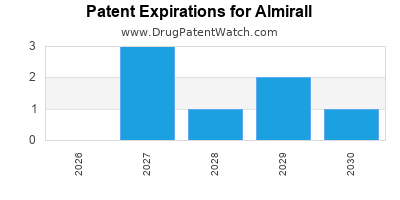
Drugs and US Patents for Almirall
| Applicant | Tradename | Generic Name | Dosage | NDA | Approval Date | TE | Type | RLD | RS | Patent No. | Patent Expiration | Product | Substance | Delist Req. | Exclusivity Expiration |
|---|---|---|---|---|---|---|---|---|---|---|---|---|---|---|---|
| Almirall | SEYSARA | sarecycline hydrochloride | TABLET;ORAL | 209521-001 | Oct 1, 2018 | RX | Yes | No | 8,318,706 | ⤷ Start Trial | Y | Y | ⤷ Start Trial | ||
| Almirall | SEYSARA | sarecycline hydrochloride | TABLET;ORAL | 209521-002 | Oct 1, 2018 | RX | Yes | No | 9,481,639 | ⤷ Start Trial | ⤷ Start Trial | ||||
| Almirall | AZELEX | azelaic acid | CREAM;TOPICAL | 020428-001 | Sep 13, 1995 | RX | Yes | Yes | ⤷ Start Trial | ⤷ Start Trial | |||||
| Almirall | SEYSARA | sarecycline hydrochloride | TABLET;ORAL | 209521-002 | Oct 1, 2018 | RX | Yes | No | 8,318,706 | ⤷ Start Trial | Y | Y | ⤷ Start Trial | ||
| Almirall | KLISYRI | tirbanibulin | OINTMENT;TOPICAL | 213189-001 | Dec 14, 2020 | RX | Yes | Yes | 10,669,236 | ⤷ Start Trial | Y | Y | ⤷ Start Trial | ||
| Almirall | SEYSARA | sarecycline hydrochloride | TABLET;ORAL | 209521-002 | Oct 1, 2018 | RX | Yes | No | 9,255,068 | ⤷ Start Trial | Y | Y | ⤷ Start Trial | ||
| Almirall | KLISYRI | tirbanibulin | OINTMENT;TOPICAL | 213189-001 | Dec 14, 2020 | RX | Yes | Yes | 12,667,576 | ⤷ Start Trial | ⤷ Start Trial | ||||
| >Applicant | >Tradename | >Generic Name | >Dosage | >NDA | >Approval Date | >TE | >Type | >RLD | >RS | >Patent No. | >Patent Expiration | >Product | >Substance | >Delist Req. | >Exclusivity Expiration |
Expired US Patents for Almirall
| Applicant | Tradename | Generic Name | Dosage | NDA | Approval Date | Patent No. | Patent Expiration |
|---|---|---|---|---|---|---|---|
| Almirall | KLISYRI | tirbanibulin | OINTMENT;TOPICAL | 213189-001 | Dec 14, 2020 | 8,980,890 | ⤷ Start Trial |
| Almirall | TAZORAC | tazarotene | GEL;TOPICAL | 020600-002 | Jun 13, 1997 | 5,089,509 | ⤷ Start Trial |
| Almirall | AVAGE | tazarotene | CREAM;TOPICAL | 021184-003 | Sep 30, 2002 | 5,089,509 | ⤷ Start Trial |
| Almirall | ACZONE | dapsone | GEL;TOPICAL | 207154-001 | Feb 24, 2016 | 5,863,560 | ⤷ Start Trial |
| Almirall | ACZONE | dapsone | GEL;TOPICAL | 207154-001 | Feb 24, 2016 | 6,060,085 | ⤷ Start Trial |
| Almirall | ACZONE | dapsone | GEL;TOPICAL | 021794-001 | Jul 7, 2005 | 6,620,435 | ⤷ Start Trial |
| Almirall | TAZORAC | tazarotene | CREAM;TOPICAL | 021184-002 | Sep 29, 2000 | 5,089,509 | ⤷ Start Trial |
| >Applicant | >Tradename | >Generic Name | >Dosage | >NDA | >Approval Date | >Patent No. | >Patent Expiration |
Paragraph IV (Patent) Challenges for ALMIRALL drugs
| Drugname | Dosage | Strength | Tradename | Submissiondate |
|---|---|---|---|---|
| ➤ Subscribe | Gel | 7.5% | ➤ Subscribe | 2017-02-13 |
International Patents for Almirall Drugs
| Country | Patent Number | Estimated Expiration |
|---|---|---|
| Spain | 2644342 | ⤷ Start Trial |
| Slovenia | 3592355 | ⤷ Start Trial |
| Spain | 2559687 | ⤷ Start Trial |
| Japan | 2010514771 | ⤷ Start Trial |
| South Africa | 202106139 | ⤷ Start Trial |
| Japan | 2012020998 | ⤷ Start Trial |
| Croatia | P20260002 | ⤷ Start Trial |
| >Country | >Patent Number | >Estimated Expiration |
Supplementary Protection Certificates for Almirall Drugs
| Patent Number | Supplementary Protection Certificate | SPC Country | SPC Expiration | SPC Description |
|---|---|---|---|---|
| 0284288 | SPC/GB98/002 | United Kingdom | ⤷ Start Trial | PRODUCT NAME: TAZAROTENE : ETHYL 6-(2-(4,4-DIMETHYLTHIOCHROMAN-6-YL) ETHYNYL) NICOTINOATE; REGISTERED: DE 37393.00.00 19961203; DE 37393.01.00 19961203; UK 00426/0097 19970730; UK 00426/0096 19970730 |
| 1836169 | 21C1064 | France | ⤷ Start Trial | PRODUCT NAME: TIRBANIBULINE; REGISTRATION NO/DATE: EU/1/21/1558 20210719 |
| 1836169 | C01836169/01 | Switzerland | ⤷ Start Trial | FORMER OWNER: ATHENEX, INC., US |
| 1028961 | C01028961/01 | Switzerland | ⤷ Start Trial | PRODUCT NAME: RETAPAMULIN; REGISTRATION NUMBER/DATE: SWISSMEDIC 58641 04.08.2009 |
| 1836169 | C202130061 | Spain | ⤷ Start Trial | PRODUCT NAME: TIRBANIBULINA; NATIONAL AUTHORISATION NUMBER: EU/1/21/1558; DATE OF AUTHORISATION: 20210716; NUMBER OF FIRST AUTHORISATION IN EUROPEAN ECONOMIC AREA (EEA): EU/1/21/1558; DATE OF FIRST AUTHORISATION IN EEA: 20210716 |
| 0031058 | 98C0008 | Belgium | ⤷ Start Trial | PRODUCT NAME: TAZAROTENE; NAT. REGISTRATION NO/DATE: NL22604 19970922; FIRST REGISTRATION: DE - 37393.00.00 19961203 |
| 1028961 | SPC/GB07/061 | United Kingdom | ⤷ Start Trial | PRODUCT NAME: RETAPAMULIN OPTIONALLY IN THE FORM OF A PHARMACEUTICALLY ACCEPTABLE SALT; REGISTERED: UK EU/1/07/390/001 20070524; UK EU/1/07/390/002 20070524; UK EU/1/07/390/003 20070524; UK EU/1/07/390/004 20070524 |
| >Patent Number | >Supplementary Protection Certificate | >SPC Country | >SPC Expiration | >SPC Description |
Similar Applicant Names
Applicants may be listed under multiple names.
Here is a list of applicants with similar names.
Here is a list of applicants with similar names.
