Last Updated: July 13, 2026

ALTABAX Drug Patent Profile


✉ Email this page to a colleague

« Back to Dashboard


Which patents cover Altabax, and what generic alternatives are available?

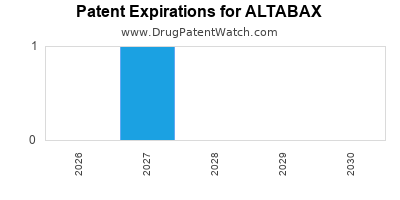
Altabax is a drug marketed by Almirall and is included in one NDA. There is one patent protecting this drug.

This drug has thirteen patent family members in six countries.

The generic ingredient in ALTABAX is retapamulin. Additional details are available on the retapamulin profile page.

DrugPatentWatch® Generic Entry Outlook for Altabax

Altabax was eligible for patent challenges on April 12, 2011.

By analyzing the patents and regulatory protections it appears that the earliest date for generic entry will be February 14, 2027. This may change due to patent challenges or generic licensing.

Indicators of Generic Entry

< Available with Subscription >

  Start Trial

AI Deep Research
Questions you can ask:
  • What is the 5 year forecast for ALTABAX?
  • What are the global sales for ALTABAX?
  • What is Average Wholesale Price for ALTABAX?
Summary for ALTABAX
International Patents:13
US Patents:1
Applicants:1
NDAs:1
Raw Ingredient (Bulk) Api Vendors: 73
Clinical Trials: 5
Drug Prices: Drug price information for ALTABAX
What excipients (inactive ingredients) are in ALTABAX?ALTABAX excipients list
DailyMed Link:ALTABAX at DailyMed
DrugPatentWatch® Estimated Loss of Exclusivity (LOE) Date for ALTABAX
Generic Entry Date for ALTABAX*:
Constraining patent/regulatory exclusivity:
NDA:
Dosage:

OINTMENT;TOPICAL

*The generic entry opportunity date is the latter of the last compound-claiming patent and the last regulatory exclusivity protection. Many factors can influence early or later generic entry. This date is provided as a rough estimate of generic entry potential and should not be used as an independent source.

Recent Clinical Trials for ALTABAX

Identify potential brand extensions & 505(b)(2) entrants

SponsorPhase
Agency for Healthcare Research and Quality (AHRQ)Phase 4
University of California, IrvinePhase 4
The University of Texas Health Science Center, HoustonPhase 4

See all ALTABAX clinical trials

US Patents and Regulatory Information for ALTABAX

ALTABAX is protected by one US patents.

Based on analysis by DrugPatentWatch, the earliest date for a generic version of ALTABAX is ⤷  Start Trial.

This potential generic entry date is based on patent 7,875,630.

Generics may enter earlier, or later, based on new patent filings, patent extensions, patent invalidation, early generic licensing, generic entry preferences, and other factors.

Applicant Tradename Generic Name Dosage NDA Approval Date TE Type RLD RS Patent No. Patent Expiration Product Substance Delist Req. Exclusivity Expiration
Almirall ALTABAX retapamulin OINTMENT;TOPICAL 022055-001 Apr 12, 2007 DISCN Yes No 7,875,630 ⤷  Start Trial Y ⤷  Start Trial
>Applicant >Tradename >Generic Name >Dosage >NDA >Approval Date >TE >Type >RLD >RS >Patent No. >Patent Expiration >Product >Substance >Delist Req. >Exclusivity Expiration

Expired US Patents for ALTABAX

Applicant Tradename Generic Name Dosage NDA Approval Date Patent No. Patent Expiration
Almirall ALTABAX retapamulin OINTMENT;TOPICAL 022055-001 Apr 12, 2007 8,207,191 ⤷  Start Trial
Almirall ALTABAX retapamulin OINTMENT;TOPICAL 022055-001 Apr 12, 2007 RE43390 ⤷  Start Trial
Almirall ALTABAX retapamulin OINTMENT;TOPICAL 022055-001 Apr 12, 2007 RE39128 ⤷  Start Trial
>Applicant >Tradename >Generic Name >Dosage >NDA >Approval Date >Patent No. >Patent Expiration

EU/EMA Drug Approvals for ALTABAX

Company Drugname Inn Product Number / Indication Status Generic Biosimilar Orphan Marketing Authorisation Marketing Refusal
Glaxo Group Ltd Altargo retapamulin EMEA/H/C/000757Short term treatment of the following superficial skin infections:, , , impetigo;, infected small lacerations, abrasions or sutured wounds., , , See sections 4.4 and 5.1 for important information regarding the clinical activity of retapamulin against different types of Staphylococcus aureus., , Consideration should be given to official guidance on the appropriate use of antibacterial agents., Withdrawn no no no 2007-05-24
>Company >Drugname >Inn >Product Number / Indication >Status >Generic >Biosimilar >Orphan >Marketing Authorisation >Marketing Refusal

International Patents for ALTABAX

See the table below for patents covering ALTABAX around the world.

Country Patent Number Title Estimated Expiration
Austria 450535 ⤷  Start Trial
Germany 602004024417 ⤷  Start Trial
European Patent Office 1663220 NOUVEAU PROCEDE POUR LA FABRICATION DE DERIVES DE LA PLEUROMUTILINE (NOVEL PROCESS FOR THE PREPARATION OF PLEUROMUTILIN DERIVATIVES) ⤷  Start Trial
European Patent Office 2181995 Sels et forme crystalline de mutilin 14-(exo-8-methyl-8-azabicyclo[3.2.1]oct-3-yl-sufanyl)-acetate (Salts and crystalline form of mutilin 14-(exo-8-methyl-8-azabicyclo[3.2.1]oct-3-yl-sufanyl)-acetate) ⤷  Start Trial
Spain 2335284 ⤷  Start Trial
Japan 2007504231 ⤷  Start Trial
Japan 2012020998 NOVEL PROCESS, SALT, COMPOSITION AND USE ⤷  Start Trial
>Country >Patent Number >Title >Estimated Expiration

Supplementary Protection Certificates for ALTABAX

Patent Number Supplementary Protection Certificate SPC Country SPC Expiration SPC Description
1028961 CA 2007 00052 Denmark ⤷  Start Trial
1028961 91372 Luxembourg ⤷  Start Trial 91372, EXPIRES: 20220524
1028961 SPC042/2007 Ireland ⤷  Start Trial SPC042/2007: 20080415, EXPIRES: 20220523
1028961 07C0057 France ⤷  Start Trial PRODUCT NAME: RETAPAMULIN; REGISTRATION NO/DATE IN FRANCE: EU/1/07/390/001 DU 20070524; REGISTRATION NO/DATE AT EEC: EU/1/07/390/001 DU 20070524
1028961 SPC/GB07/061 United Kingdom ⤷  Start Trial PRODUCT NAME: RETAPAMULIN OPTIONALLY IN THE FORM OF A PHARMACEUTICALLY ACCEPTABLE SALT; REGISTERED: UK EU/1/07/390/001 20070524; UK EU/1/07/390/002 20070524; UK EU/1/07/390/003 20070524; UK EU/1/07/390/004 20070524
1028961 306 Finland ⤷  Start Trial
1028961 C01028961/01 Switzerland ⤷  Start Trial PRODUCT NAME: RETAPAMULIN; REGISTRATION NUMBER/DATE: SWISSMEDIC 58641 04.08.2009
>Patent Number >Supplementary Protection Certificate >SPC Country >SPC Expiration >SPC Description
Last updated: July 12, 2026

Altabax (tobramycin topical) market dynamics and financial trajectory

Altabax is a topical tobramycin sulfate product for impetigo and other superficial skin infections. On the US market, financial trajectory is driven by (1) share-of-need within superficial bacterial skin infections, (2) competitive substitution among topical antibiotics and antiseptics, (3) payer coverage and prior authorization patterns, and (4) patent and exclusivity-driven pricing power at the brand level. In practice, Altabax’s revenue profile is constrained by an aging product, limited differentiation versus established generics and multi-source topical antibacterials, and cyclical demand tied to impetigo incidence and seasonal peaks in certain geographies.

What is Altabax (tobramycin topical) used for and where does demand come from?

Altabax is indicated for localized superficial skin infections. Demand is largely tied to diagnosis volumes for impetigo and related pediatric and outpatient dermatology needs.

Primary demand drivers

  • Pediatric and primary care prescribing for limited, localized infections.
  • Outpatient urgent care utilization where impetigo is common.
  • Seasonal incidence effects in settings with close-contact transmission.
  • “Step-down” patterns where clinicians choose topical therapy over systemic antibiotics when disease is localized.

Where Altabax sits in treatment selection

  • Competes in an outpatient dermatology pocket with topical antibiotic/antiseptic regimens.
  • In many formularies, topical antibacterials are treated as interchangeable at class level, which pressures brand pricing if payer tiers and step therapy do not favor the brand.

How does the competitive landscape for topical tobramycin affect Altabax pricing and share?

Altabax competes against multiple topical antibacterials and antiseptics used for superficial skin infections. Competitive pressure tends to increase when:

  • Multiple ANDA brands or generics are available at lower prices.
  • Payers move topical antibiotic agents into preferred tiers with less favorable brand coverage.
  • Clinicians use fewer distinct products within an episode and switch based on cost and availability.

Key competitive vectors

  • Ingredient class substitutability: topical antibiotics and antiseptics with overlapping clinical use.
  • Formulary tiering: brand placement on higher cost-share tiers reduces conversion.
  • Wholesale and pharmacy channel dynamics: rebates and channel contracts can shift net prices quickly.

Implication for financial trajectory

  • Net sales typically compress as competitive formularies favor generics or other topical options, especially after exclusivity erosion.

What is the Orange Book status of Altabax and what does it imply for generic entry risk?

Altabax is a branded drug with an active US presence, but the economics depend on whether the brand is protected by patents listed in the Orange Book and whether those patents remain enforceable against ANDA entrants.

Generic entry risk channels

  • If relevant Orange Book patents have expired, ANDA entry can occur without Paragraph IV litigation.
  • If patents remain listed, potential ANDA filers may use Paragraph IV challenges to clear the way for launch.
  • Even when patents remain, litigation outcomes and settlement terms determine launch timing.

Financial impact pathways

  • If brand exclusivity is no longer the binding constraint, Altabax net price and volume generally face a step-down in a generic launch window.
  • If litigation delays entry, brand sales can remain insulated longer but at the cost of ongoing legal expense and eventual “cliff” when patents fall.

When does Altabax lose exclusivity and how does that map to revenue exposure?

Altabax’s revenue exposure is driven by the date when:

  • Key Orange Book patents expire or are invalidated.
  • Any remaining exclusivity (regulatory or patent-based) ends.
  • A generic or AB-rated alternative launches and takes share.

Revenue exposure framework

  • Pre-expiry: brand pricing power persists but faces gradual payer tightening and formulary drift.
  • Launch window: sales drop from volume share loss and price competition via net price compression.
  • Post-launch: residual brand demand persists only where payers maintain preference or where prescribers show strong inertia due to clinical comfort.

What patent estate protects Altabax formulations and delivery characteristics?

Altabax’s IP posture for financial modeling hinges on:

  • Composition of matter protections for tobramycin formulations if still active.
  • Formulation patents covering topical base, concentrations, or stability/vehicle properties.
  • Method-of-use patents if present (less common for legacy topical antibacterials).

How patent scope affects economics

  • Narrow formulation claims can allow “design-around” generics that use different vehicles while remaining bioequivalent in topical performance metrics.
  • Broad claims that bind key manufacturing parameters can increase IP barriers and delay entry.

What patent litigation affects Altabax (Paragraph IV, settlements, injunctions)?

Altabax’s near-term economics depend on whether US patent litigation exists around Orange Book listings, including:

  • Paragraph IV certifications by ANDA filers.
  • Court outcomes that determine whether a generic can launch.
  • Settlement agreements that fix launch dates or noninfringement positions.

Financial effect

  • If litigation blocks entry, brand sales can hold longer, but legal outcomes can still drive delayed uncertainty discounts in future forecasting.
  • If settlement accelerates a launch date, the brand experiences an earlier revenue cliff relative to a “no settlement” scenario.

What formulations and strengths are most relevant to Altabax commercial competition?

For revenue and competitive assessment, the key is whether Altabax’s marketed configuration is directly covered by:

  • Patents on specific strengths/concentrations.
  • Patents on the vehicle and manufacturing process.
  • Patent-protected shelf-life and stability.
  • Any pediatric-adjacent dosing constraints that affect substitution.

Substitution sensitivity

  • If competing products have the same strength and similar vehicle performance, substitution tends to be faster.
  • If formulation differences impact clinician preference, brand demand can persist at reduced penetration.

How does Altabax FDA regulatory status shape market access and net sales?

Altabax’s FDA status affects market dynamics through:

  • Approved label constraints that determine eligible patient populations.
  • Any post-approval label changes affecting prescriber comfort.
  • Data package strength relative to generic approvals.

Market access implications

  • If the brand label supports broad, clearly defined use while competitors require narrower or different use, Altabax can retain formulary support.
  • If label indications are narrow or overlap fully with alternatives, payers can treat the brand as substitutable at class level.

How does Altabax compare with other topical antibiotics in market performance?

A useful competitive comparison for investors and litigators is whether Altabax is competing primarily on:

  • Clinical distinction (rare for legacy topical antibacterials).
  • Payer preference and net price.
  • Availability (supply and pharmacy stocking).
  • Prescriber familiarity.

Typical pattern for legacy topical antibacterials

  • Once generics exist, brand sales often shift from “choice product” to “coverage-dependent fallback.”

Which companies sell competing drugs to Altabax and how does that affect reimbursement?

Competitive reimbursement depends on the number of AB-rated alternatives and whether large distributors and PBMs run aggressive formulary bidding for topical antibacterials. More bidders usually means:

  • More price competition and rebate pressure.
  • Less brand leverage in formulary negotiation.

What generic entry scenarios pose the highest financial risk for Altabax?

The highest-risk scenario is direct AB substitution with no meaningful differentiation that payers can defend against.

  • Generic launch with multiple competitors increases pricing pressure.
  • A low-cost entrant can force rapid formulary tier reclassification.

Risk ranking criteria

  1. Launch timing that coincides with peak seasonal demand.
  2. Net price compression that outpaces rebates and channel retention.
  3. Multiple ANDA launches that prevent brand recovery through a single competitor strategy.

How much market is Altabax exposed to in US superficial skin infections?

Financial trajectory is a function of diagnosis-driven utilization. Altabax exposure scales with:

  • Impetigo and other superficial bacterial infection outpatient volume.
  • Relative prescribing share versus other topical or systemic regimens.
  • Payer constraints that limit antibiotic topical use.

Because topical antibiotic demand is diagnosis-episode driven, share loss after a generic launch typically translates quickly into net sales decline.

Key takeaways

  • Altabax’s market dynamics are dominated by payer substitution risk in topical antibacterials and by the structural pressure that comes with legacy branded products.
  • Financial trajectory depends on the Orange Book and patent enforcement window, because generic or AB-substitution can cause sharp volume and net price declines.
  • Competitive landscape and formulary tiering matter as much as clinical use, often determining whether Altabax sustains any premium or becomes a coverage-dependent fallback.
  • The most material financial risks are generic entry windows that coincide with seasonal demand and widespread AB-rated availability.

FAQs

Is Altabax available as a generic or AB-rated equivalent?

What does Orange Book listing on Altabax indicate for Paragraph IV risk?

Does Altabax have pediatric market sensitivity due to impetigo incidence?

How do payer formularies typically tier topical antibiotics used for superficial infections?

What factors influence physician switching from Altabax to other topical antibacterials?

References

  1. FDA Orange Book: Approved Drug Products with Therapeutic Equivalence Evaluations. US Food and Drug Administration. https://www.accessdata.fda.gov/scripts/cder/daf/
  2. FDA Prescribing Information and Drug Labeling Database. US Food and Drug Administration. https://dailymed.nlm.nih.gov/dailymed/

More… ↓

⤷  Start Trial

Make Better Decisions: Try a trial or see plans & pricing

Drugs may be covered by multiple patents or regulatory protections. All trademarks and applicant names are the property of their respective owners or licensors. Although great care is taken in the proper and correct provision of this service, thinkBiotech LLC does not accept any responsibility for possible consequences of errors or omissions in the provided data. The data presented herein is for information purposes only. There is no warranty that the data contained herein is error free. We do not provide individual investment advice. This service is not registered with any financial regulatory agency. The information we publish is educational only and based on our opinions plus our models. By using DrugPatentWatch you acknowledge that we do not provide personalized recommendations or advice. thinkBiotech performs no independent verification of facts as provided by public sources nor are attempts made to provide legal or investing advice. Any reliance on data provided herein is done solely at the discretion of the user. Users of this service are advised to seek professional advice and independent confirmation before considering acting on any of the provided information. thinkBiotech LLC reserves the right to amend, extend or withdraw any part or all of the offered service without notice.