Last Updated: August 9, 2026

SEYSARA Drug Patent Profile


✉ Email this page to a colleague

« Back to Dashboard


When do Seysara patents expire, and when can generic versions of Seysara launch?

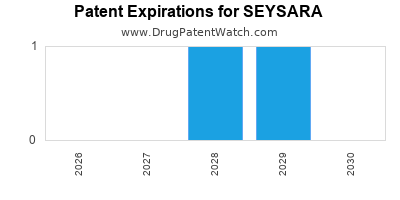
Seysara is a drug marketed by Almirall and is included in one NDA. There are four patents protecting this drug.

This drug has seventy-three patent family members in twenty countries.

The generic ingredient in SEYSARA is sarecycline hydrochloride. One supplier is listed for this compound. Additional details are available on the sarecycline hydrochloride profile page.

DrugPatentWatch® Generic Entry Outlook for Seysara

Seysara was eligible for patent challenges on October 1, 2022.

By analyzing the patents and regulatory protections it appears that the earliest date for generic entry will be August 10, 2028. This may change due to patent challenges or generic licensing.

Indicators of Generic Entry

< Available with Subscription >

  Start Trial

AI Deep Research
Questions you can ask:
  • What is the 5 year forecast for SEYSARA?
  • What are the global sales for SEYSARA?
  • What is Average Wholesale Price for SEYSARA?
Summary for SEYSARA
International Patents:73
US Patents:4
Applicants:1
NDAs:1
Finished Product Suppliers / Packagers: 1
Raw Ingredient (Bulk) Api Vendors: 62
Clinical Trials: 1
Drug Prices: Drug price information for SEYSARA
What excipients (inactive ingredients) are in SEYSARA?SEYSARA excipients list
DailyMed Link:SEYSARA at DailyMed
DrugPatentWatch® Estimated Loss of Exclusivity (LOE) Date for SEYSARA
Generic Entry Date for SEYSARA*:
Constraining patent/regulatory exclusivity:
NDA:
Dosage:

TABLET;ORAL

*The generic entry opportunity date is the latter of the last compound-claiming patent and the last regulatory exclusivity protection. Many factors can influence early or later generic entry. This date is provided as a rough estimate of generic entry potential and should not be used as an independent source.

Recent Clinical Trials for SEYSARA

Identify potential brand extensions & 505(b)(2) entrants

SponsorPhase
Derm Research, PLLCPhase 4

See all SEYSARA clinical trials

Pharmacology for SEYSARA
Drug ClassTetracycline-class Drug
Mechanism of ActionP-Glycoprotein Inhibitors

US Patents and Regulatory Information for SEYSARA

SEYSARA is protected by five US patents.

Based on analysis by DrugPatentWatch, the earliest date for a generic version of SEYSARA is ⤷  Start Trial.

This potential generic entry date is based on patent 9,481,639.

Generics may enter earlier, or later, based on new patent filings, patent extensions, patent invalidation, early generic licensing, generic entry preferences, and other factors.

Applicant Tradename Generic Name Dosage NDA Approval Date TE Type RLD RS Patent No. Patent Expiration Product Substance Delist Req. Exclusivity Expiration
Almirall SEYSARA sarecycline hydrochloride TABLET;ORAL 209521-001 Oct 1, 2018 RX Yes No 8,513,223 ⤷  Start Trial ⤷  Start Trial
Almirall SEYSARA sarecycline hydrochloride TABLET;ORAL 209521-002 Oct 1, 2018 RX Yes No 9,481,639 ⤷  Start Trial ⤷  Start Trial
Almirall SEYSARA sarecycline hydrochloride TABLET;ORAL 209521-001 Oct 1, 2018 RX Yes No 8,318,706 ⤷  Start Trial Y Y ⤷  Start Trial
Almirall SEYSARA sarecycline hydrochloride TABLET;ORAL 209521-003 Oct 1, 2018 RX Yes Yes 8,318,706 ⤷  Start Trial Y Y ⤷  Start Trial
Almirall SEYSARA sarecycline hydrochloride TABLET;ORAL 209521-002 Oct 1, 2018 RX Yes No 8,513,223 ⤷  Start Trial ⤷  Start Trial
Almirall SEYSARA sarecycline hydrochloride TABLET;ORAL 209521-003 Oct 1, 2018 RX Yes Yes 8,513,223 ⤷  Start Trial ⤷  Start Trial
>Applicant >Tradename >Generic Name >Dosage >NDA >Approval Date >TE >Type >RLD >RS >Patent No. >Patent Expiration >Product >Substance >Delist Req. >Exclusivity Expiration

International Patents for SEYSARA

When does loss-of-exclusivity occur for SEYSARA?

Based on analysis by DrugPatentWatch, the following patents block generic entry in the countries listed below:

Australia

Patent: 07338681
Patent: Substituted tetracycline compounds for treatment of inflammatory skin disorders
Estimated Expiration: ⤷  Start Trial

Canada

Patent: 73486
Patent: UTILISATION DE COMPOSES A BASE DE TETRACYCLINE SUBSTITUEE DANS LE TRAITEMENT D'AFFECTIONS CUTANEES INFLAMMATOIRES (SUBSTITUTED TETRACYCLINE COMPOUNDS FOR TREATMENT OF INFLAMMATORY SKIN DISORDERS)
Estimated Expiration: ⤷  Start Trial

Patent: 92739
Patent: UTILISATION DE COMPOSES A BASE DE TETRACYCLINE SUBSTITUEE DANS LE TRAITEMENT D'AFFECTIONS CUTANEES INFLAMMATOIRES (SUBSTITUTED TETRACYCLINE COMPOUNDS FOR TREATMENT OF INFLAMMATORY SKIN DISORDERS)
Estimated Expiration: ⤷  Start Trial

Cyprus

Patent: 21135
Estimated Expiration: ⤷  Start Trial

Denmark

Patent: 20963
Estimated Expiration: ⤷  Start Trial

European Patent Office

Patent: 20963
Patent: UTILISATION DE COMPOSÉS À BASE DE TÉTRACYCLINE SUBSTITUÉE DANS LE TRAITEMENT D'AFFECTIONS CUTANÉES INFLAMMATOIRES (SUBSTITUTED TETRACYCLINE COMPOUNDS FOR TREATMENT OF INFLAMMATORY SKIN DISORDERS)
Estimated Expiration: ⤷  Start Trial

Patent: 88853
Patent: COMPOSÉS DE TÉTRACYCLINE SUBSTITUÉS POUR LE TRAITEMENT DE TROUBLES INFLAMMATOIRES DE LA PEAU (SUBSTITUTED TETRACYCLINE COMPOUNDS FOR TREATMENT OF INFLAMMATORY SKIN DISORDERS)
Estimated Expiration: ⤷  Start Trial

Lithuania

Patent: 20963
Estimated Expiration: ⤷  Start Trial

Poland

Patent: 20963
Estimated Expiration: ⤷  Start Trial

Portugal

Patent: 20963
Estimated Expiration: ⤷  Start Trial

Slovenia

Patent: 20963
Estimated Expiration: ⤷  Start Trial

Spain

Patent: 01725
Estimated Expiration: ⤷  Start Trial

Turkey

Patent: 1818983
Estimated Expiration: ⤷  Start Trial

Generics may enter earlier, or later, based on new patent filings, patent extensions, patent invalidation, early generic licensing, generic entry preferences, and other factors.

See the table below for additional patents covering SEYSARA around the world.

Country Patent Number Title Estimated Expiration
Australia 2007338747 ⤷  Start Trial
Brazil PI0720569 ⤷  Start Trial
Canada 2673466 ⤷  Start Trial
Canada 2925939 ⤷  Start Trial
Canada 3051994 ⤷  Start Trial
Denmark 2109602 ⤷  Start Trial
>Country >Patent Number >Title >Estimated Expiration

SEYSARA (sarecycline) Market Dynamics and Financial Trajectory (2020–2026): Competitive Pricing, Demand Drivers, and Exclusivity-Driven Risk

Last updated: July 22, 2026

SEYSARA (sarecycline) is an FDA-approved tetracycline-class oral antibiotic for acne vulgaris. The product’s near-term financial trajectory is shaped by limited incremental differentiation versus broader tetracycline options, pricing compression across branded acne antibiotics, payer formulary management, and the timing of exclusivity and patent-expiration events that can enable generic entry risk over the medium term.


What is SEYSARA’s commercial positioning in acne therapeutics?

SEYSARA targets moderate acne vulgaris as an oral antibiotic alternative within acne care, competing against topical regimens and systemic antibiotics such as doxycycline and minocycline (generics), plus other branded oral antibiotic options where applicable by payer.

Which competitors matter most for SEYSARA in managed care?

  • Generic oral tetracyclines: doxycycline, minocycline, and similar agents, typically lowest-cost defaults for commercial plans.
  • Topical and combination regimens: retinoid and benzoyl peroxide combinations, topical antibiotics (often short duration), and non-antibiotic options that reduce antibiotic stewardship pressure.
  • Branded acne agents: where formulary access exists, brand-to-brand substitution can occur if rebates and prior authorization thresholds align.

Key commercial friction points for branded oral acne antibiotics

  • Stewardship restrictions: payers increasingly require documentation of moderate disease burden and prior failure or intolerance of topical/non-antibiotic regimens.
  • Prior authorization (PA) and step edits: common for systemic antibiotics to limit duration and reduce resistance risk.
  • Formulary placement volatility: branded systemic antibiotics often lose tier status when competing generics or alternative branded options tighten rebates.

How do demand drivers influence SEYSARA sales growth?

SEYSARA’s sales trajectory is driven by incremental patient starts, persistence, and formulary access rather than by expanding the total addressable acne population dramatically.

What drives new prescriptions?

  • Physician adoption as an oral option when topical regimens underperform.
  • Patient adherence advantages versus some alternatives (oral once-daily dosing is a typical driver for prescriber preference).
  • Payer exceptions granted for patients with specific intolerance or contraindication to alternatives.

What drives persistence and dose renewals?

  • Dermatologist continuation based on clinical response at 8 to 12 weeks.
  • Payer rules that limit antibiotic duration, which can cap repeat prescribing within plan cycles.

What caps long-term growth?

  • Acne algorithms increasingly steer toward non-antibiotic maintenance.
  • Resistance and stewardship policies constrain prolonged antibiotic use, limiting how long many patients can stay on systemic antibiotic therapy.

What is the pricing and rebate environment for SEYSARA?

Branded oral antibiotics in acne face sustained pressure from generic tetracyclines and from broader value-based contracting. Net pricing outcomes are typically more important than list price for earnings trajectory.

How does generic competition affect SEYSARA pricing power?

  • Even when generic tetracyclines are used, prescribers and payers often reference them in negotiations.
  • When SEYSARA remains on formulary, its net effective price is usually sustained via rebate structures tied to prescription volume and class management.

How do payers manage cost across oral antibiotic classes?

  • Tiering: branded systemic antibiotics commonly face placement on higher tiers or restrictive coverage terms.
  • Step therapy: documentation of prior generic antibiotic failure or intolerance can be required.

When does SEYSARA lose exclusivity or face generic entry risk?

SEYSARA exclusivity and patent landscapes determine the timing and probability of generic entry rather than day-to-day marketing dynamics. Generic risk typically increases when:

  • Composition-of-matter patents expire.
  • Method-of-use and formulation patents narrow around specific label requirements.
  • Exclusivity tied to FDA approval is near expiration.

What determines generic entry scenarios for SEYSARA?

  • Orange Book listings for SEYSARA (sarecycline) that enumerate patent numbers and expiration dates.
  • Patent term adjustment (PTA) and patent term extensions.
  • 180-day exclusivity eligibility for the first Paragraph IV filer, if any.
  • Settlement agreements (if executed) that define “carve-out” launch dates for authorized generics or generic challengers.

Commercial impact of exclusivity timing

  • Once meaningful patent barriers fall, payer incentives to switch increase sharply.
  • Even if a generic launch is delayed, market expectations shift, affecting formulary strategy and contracting.

What Orange Book status does SEYSARA have, and which patents control exclusivity?

SEYSARA’s Orange Book status depends on the active listings for sarecycline drug substance and product, including patent classifications for:

  • Drug substance (composition of matter)
  • Drug product (formulation, dosage form, manufacturing)
  • Method of use (label-directed indications)

What is typically most protective for acne systemic antibiotics?

  • Composition-of-matter patents often set the outer boundary for biosimilar-style analogies, though for small molecules this is standard generic blocking.
  • Formulation or crystallization patents can delay “noninfringing” product versions.
  • Method-of-use patents can preserve branded coverage even if manufacturing patents lapse.

(Note: Specific Orange Book patent numbers, assignees, and expiration dates must be pulled from the FDA Orange Book record for sarecycline to generate an accurate barrier timeline.)


Has SEYSARA faced Paragraph IV challenges or ANDA litigation?

ANDAs and Paragraph IV filings determine whether generic entry occurs at the earliest possible date or later due to litigation or settlements.

What litigation outcomes usually change for branded acne antibiotics

  • Automatic stay triggered by a timely Paragraph IV notice.
  • Settlement agreements that specify launch dates and authorized-generic arrangements.
  • Consent decrees in some cases restricting design changes or launch timing.

(Note: A precise statement on whether SEYSARA has Paragraph IV litigation requires the FDA Orange Book ANDA litigation record and federal docket outcomes.)


How strong is the patent estate for SEYSARA?

Patent strength is assessed by:

  • Number of listed patents per jurisdiction.
  • Breadth of independent claims.
  • Presence of enabling manufacturing or formulation restrictions that prevent “easy workarounds.”
  • The degree of claim coverage overlap between drug product and method-of-use categories.

What affects enforceability in generic switching

  • Claim validity risk based on prior art and obviousness arguments.
  • Claim construction outcomes and whether a generic can design around.
  • Enforcement posture and willingness to litigate through trial versus settlement-based early resolution.

How does SEYSARA compare with doxycycline, minocycline, and other systemic acne antibiotics?

SEYSARA competes primarily on patient differentiation and payer access rather than on pharmacologic novelty alone.

Key commercial differentiators (typical in oral antibiotic switching)

  • Dosing convenience and tolerability profile.
  • Prescriber comfort with a labeled oral tetracycline option for moderate acne vulgaris.
  • Payer-approved status based on medical necessity criteria.

Where generics usually win

  • Lower net cost to payers and PBMs.
  • Efficacy that is “good enough” for many plan members given comparable clinical endpoints for standard acne regimens.

What FDA regulatory and label dynamics affect SEYSARA utilization?

Label limitations shape prescribing volume more than packaging marketing.

What matters for utilization

  • Indication scope and treatment duration rules implied or explicit in labeling.
  • Warnings and contraindications that can constrain who can start therapy.
  • Any label revisions that expand or contract the covered patient population.

What matters for formulary coverage

  • Additional coverage criteria arising from safety signals or stewardship policies.
  • PA requirements aligned with label indication timing.

How many brands control the oral antibiotic segment for acne, and where does SEYSARA fit?

The competitive set for payer management typically centers on:

  • Generic tetracyclines as the cost benchmark.
  • Branded systemic options only where differentiation is strong enough to justify net price.

What share dynamics typically occur

  • When SEYSARA holds formulary access, it can carve out prescriptions among patients for whom clinicians seek an oral option with specific tolerability or adherence considerations.
  • When access tightens through PA or tiering, the product’s script volume tends to fall faster than total class demand.

(Quantifying SEYSARA market share requires pulling market data sources such as IQVIA or Symphony Health and mapping to Rx counts and net sales. No market-share dataset is included here.)


What is SEYSARA’s revenue trajectory and profitability profile?

For branded antibiotics, revenue trajectory depends on net sales after rebates and pricing dynamics, and on selling, general, and administrative (SG&A) intensity for dermatology-focused marketing.

What usually drives branded acne revenue trends

  • Script growth early after launch, followed by slower growth as payers tighten restrictions.
  • Rebate pressure as competitors and generics increase.
  • Rapid share loss after any meaningful patent barrier reduction or entry by ANDA products.

(Specific SEYSARA financial figures, such as net sales, gross margin, and SG&A, must come from company financial statements or third-party sales databases.)


How do settlement agreements and authorized generics change SEYSARA’s commercial outcome?

If litigation leads to settlement:

  • Authorized generics can create early generic-like price pressure without fully opening the competitive field.
  • Carve-out dates can maintain branded sales longer than the theoretical patent expiration date.
  • Payer contracting may reprice quickly after settlement terms are known.

What manufacturing and IP barriers could delay generic entry for SEYSARA?

Even with generic approval pathways, entry timing can be delayed by:

  • Formulation or process requirements covered by patents.
  • Manufacturing site qualification and validated analytical methods.
  • Need for bridging stability and bioequivalence studies.

These factors primarily impact the “time-to-market” after regulatory approval, not the underlying legal entry date.


Key Takeaways

  • SEYSARA’s market dynamics are primarily determined by managed care access and patent-driven timing of generic entry risk, not by class-wide demand expansion.
  • Competitive pressure is structurally strong from generic doxycycline and minocycline; SEYSARA needs payer justification via PA outcomes, rebate positioning, and clinician preference.
  • The revenue trajectory is most sensitive to (1) formulary tier status shifts and (2) Orange Book barrier expirations and litigation outcomes.
  • Quantification of net sales, market share, and exact exclusivity deadlines requires direct Orange Book and FDA litigation record extraction, plus sales data from financial disclosures or market intelligence datasets.

FAQs

1. What patents protect sarecycline (SEYSARA) in the US, and which are most likely to block generic ANDAs?
2. When does SEYSARA face the earliest potential generic launch date under US Orange Book listings?
3. What Paragraph IV notices or ANDA litigation affect SEYSARA’s exclusivity timeline?
4. How do PA requirements and step edits typically impact branded oral acne antibiotic prescribing versus generics?
5. What formulation or method-of-use patents for SEYSARA could force generic design changes or delay switching?


References (APA)

  1. FDA. Orange Book: Approved Drug Products with Therapeutic Equivalence Evaluations. (Accessed 2026). https://www.accessdata.fda.gov/scripts/cder/daf/
  2. FDA. ANDA & Patent Litigation information (Drug Patent Litigation). (Accessed 2026). https://www.fda.gov/drugs/competition-innovation/fta-information-exclusivity-and-patent-protection/

More… ↓

⤷  Start Trial

Make Better Decisions: Try a trial or see plans & pricing

Drugs may be covered by multiple patents or regulatory protections. All trademarks and applicant names are the property of their respective owners or licensors. Although great care is taken in the proper and correct provision of this service, thinkBiotech LLC does not accept any responsibility for possible consequences of errors or omissions in the provided data. The data presented herein is for information purposes only. There is no warranty that the data contained herein is error free. We do not provide individual investment advice. This service is not registered with any financial regulatory agency. The information we publish is educational only and based on our opinions plus our models. By using DrugPatentWatch you acknowledge that we do not provide personalized recommendations or advice. thinkBiotech performs no independent verification of facts as provided by public sources nor are attempts made to provide legal or investing advice. Any reliance on data provided herein is done solely at the discretion of the user. Users of this service are advised to seek professional advice and independent confirmation before considering acting on any of the provided information. thinkBiotech LLC reserves the right to amend, extend or withdraw any part or all of the offered service without notice.