Last updated: September 5, 2026
Tolterodine tartrate is a mature, largely commoditized antimuscarinic used for overactive bladder, urinary urgency, frequency, and urge incontinence. Pfizer’s branded Detrol and Detrol LA products lost their principal commercial protection in the early 2010s, allowing generic immediate-release and extended-release tolterodine to capture most prescription volume. Current market value is driven by low-cost generic supply, payer substitution, regional prescribing patterns, and continued use in patients who cannot tolerate or access newer beta-3 adrenergic agonists.
The drug’s financial profile has shifted from blockbuster brand economics to a fragmented, low-margin generic market. The main commercial risks are substitution by mirabegron and vibegron, growing concern over anticholinergic cognitive burden, and continued consolidation among generic manufacturers.
What is tolterodine tartrate and how does it work?
Tolterodine tartrate is the tartrate salt of tolterodine, a competitive muscarinic receptor antagonist. It reduces involuntary detrusor contractions and bladder urgency by inhibiting cholinergic stimulation of the bladder.
| Attribute |
Tolterodine tartrate |
| Primary brand |
Detrol |
| Extended-release brand |
Detrol LA |
| Drug class |
Antimuscarinic |
| Main indications |
Overactive bladder, urgency urinary incontinence, urinary urgency and frequency |
| Immediate-release dosing |
Commonly 2 mg twice daily, subject to labeling and patient factors |
| Extended-release dosing |
Commonly 4 mg once daily |
| Original innovator |
Pharmacia, later acquired by Pfizer |
| FDA approval |
Detrol approved in 1998; Detrol LA approved in 2000 |
| Generic status |
Widely available in immediate-release and extended-release forms |
| Key alternatives |
Oxybutynin, solifenacin, trospium, darifenacin, fesoterodine, mirabegron, vibegron |
The drug is metabolized primarily through CYP2D6 and CYP3A4 pathways. Patients with hepatic or renal impairment, or those receiving strong CYP3A4 inhibitors, may require dose reduction under product labeling. The pharmacologic limitations include dry mouth, constipation, blurred vision, urinary retention and potential cognitive effects associated with anticholinergic exposure.
When did tolterodine lose exclusivity?
Tolterodine lost meaningful branded exclusivity after expiration of the core composition and product patents covering Detrol. Generic competition became commercially significant during the early 2010s.
Tolterodine exclusivity timeline
| Milestone |
Approximate timing |
Commercial effect |
| Detrol FDA approval |
1998 |
Pfizer entered the U.S. overactive-bladder market |
| Detrol LA approval |
2000 |
Extended-release formulation expanded once-daily positioning |
| Core patent term ended |
Early 2010s |
Immediate-release generic entry became possible |
| Extended-release generic approvals |
Early-to-mid 2010s |
Generic substitution expanded across dosage forms |
| Current market |
Mature generic period |
Brand pricing power is limited |
The principal U.S. composition patent associated with tolterodine is commonly identified as U.S. Patent No. 5,382,600. Its effective exclusivity period ended around the early 2010s after adjustment and regulatory timing considerations. Later patents and regulatory protections related to extended-release products did not preserve a durable branded monopoly once generic extended-release products reached the market.
The commercial conclusion is straightforward: tolterodine is no longer a protected branded-growth product in the United States. Any remaining patent value is concentrated in narrow formulation, manufacturing, or jurisdiction-specific rights rather than the active pharmaceutical ingredient itself.
What patents protect tolterodine tartrate products?
The original patent estate covered the tolterodine chemical entity and pharmaceutical use. Later intellectual property addressed dosage forms and extended-release delivery.
Core patent categories
| Patent category |
Subject matter |
Current commercial relevance |
| Composition of matter |
Tolterodine and related chemical forms |
Largely expired in major markets |
| Pharmaceutical composition |
Tolterodine salts and dosage forms |
Limited blocking value after generic entry |
| Method of use |
Treatment of overactive bladder and urinary symptoms |
Generally weak against approved generic sale unless specifically listed and enforceable |
| Extended-release formulation |
Controlled release of tolterodine |
Historically important for Detrol LA; largely eroded by generic ER products |
| Manufacturing process |
Production, purification or crystallization methods |
May remain relevant to API suppliers but rarely blocks all generic manufacture |
| Regulatory exclusivity |
New-drug approval protections |
Expired |
Tolterodine tartrate is not protected today by a single commercially decisive patent barrier in the United States. The remaining strength of any patent estate depends on claim scope, jurisdiction, prosecution history, validity, and whether the claims cover the active product rather than a readily avoidable process or formulation.
What is the Orange Book status of tolterodine?
The FDA Orange Book historically listed Detrol and Detrol LA patents and associated generic certifications. The Orange Book remains the primary U.S. source for determining whether a listed patent is active, expired, delisted, or relevant to an abbreviated new drug application.
For mature tolterodine products, the practical Orange Book position is:
- The original Detrol product has long passed its principal patent exclusivity period.
- Detrol LA-related protection has also been overtaken by generic extended-release competition.
- Generic applicants could use Paragraph III certifications after patent expiration or Paragraph IV certifications when asserting that listed patents were invalid or would not be infringed.
- Orange Book listings do not prevent generic competition once all relevant enforceable barriers have expired or been successfully challenged.
A current diligence review should distinguish historical listed patents from patents that retain enforceable blocking power. A listed patent can remain visible in regulatory records without creating a meaningful commercial barrier.
Which companies challenged tolterodine patents?
Tolterodine generic competition developed through the standard abbreviated new drug application pathway. Generic manufacturers that have marketed or pursued tolterodine products have included major U.S. and international suppliers such as Teva, Mylan, Sandoz, Dr. Reddy’s Laboratories, Apotex, Lupin and other regional manufacturers.
The commercial challenge was directed at both:
- The immediate-release Detrol product.
- The extended-release Detrol LA product.
Paragraph IV litigation was relevant during the transition from branded to generic supply, particularly for extended-release products and formulation patents. Once multiple ANDAs were approved, the litigation risk shifted from a single first-filer contest to price competition among several suppliers.
What formulation patents protect Detrol LA?
Detrol LA used an extended-release delivery system designed to maintain tolterodine exposure over a 24-hour dosing interval. The formulation reduced dosing frequency relative to immediate-release tolterodine.
The relevant intellectual property risks involved:
- Release-control technology.
- Polymer or matrix systems.
- Capsule or bead architecture.
- Dissolution profiles.
- Bioequivalence requirements.
- Manufacturing processes that produce the required release pattern.
These patents had greater commercial value than broad method-of-use claims because they were linked to the specific extended-release product. Their value declined rapidly after generic manufacturers developed bioequivalent extended-release products and obtained FDA approval.
Generic extended-release entry is technically more difficult than immediate-release entry because applicants must demonstrate comparable release behavior and exposure. Even so, those technical barriers did not preserve Detrol LA as a durable high-margin product after the major formulation patents expired or were overcome.
How strong is the tolterodine patent estate?
The patent estate is weak from a current branded-market perspective and moderate from a narrow manufacturing perspective.
| Dimension |
Assessment |
Reason |
| Active ingredient protection |
Very weak |
Core patent protection expired |
| Immediate-release product protection |
Weak |
Multiple generic products are established |
| Extended-release protection |
Weak to moderate |
Formulation complexity existed, but generic ER products are available |
| Method-of-use protection |
Weak |
Broad overactive-bladder treatment claims have limited blocking effect |
| Manufacturing protection |
Moderate in narrow cases |
Specific processes may remain protected but are usually avoidable |
| Litigation leverage |
Low |
Market is mature and genericized |
| Licensing value |
Low |
Limited opportunity for broad exclusivity |
| Global protection |
Generally weak |
Timing differs by country, but major markets have experienced generic entry |
The estate may still have value in a licensing transaction involving a differentiated delivery system, combination product, or new use. Existing tolterodine tartrate rights alone are unlikely to support premium valuation.
How has tolterodine’s financial trajectory changed?
Tolterodine generated substantial branded revenue before generic entry because Detrol occupied a major position in the overactive-bladder market. The launch of Detrol LA improved convenience and supported brand retention through once-daily dosing.
The revenue trajectory followed four phases:
1. Launch and market expansion
From 1998 through the early 2000s, Detrol benefited from increasing diagnosis and treatment of overactive bladder. Pfizer’s commercial strategy emphasized efficacy, tolerability and twice-daily or once-daily convenience depending on formulation.
2. Extended-release migration
Detrol LA shifted patients toward once-daily therapy and delayed some erosion of the immediate-release franchise. Extended-release delivery also created a formulation-based distinction from older antimuscarinics such as oxybutynin.
3. Generic entry
Generic immediate-release and extended-release products entered after the principal patent barriers ended. Net prices fell, formularies increased substitution, and branded Detrol prescriptions declined.
4. Mature generic market
Tolterodine now produces economic value mainly through aggregate generic volume rather than branded pricing. Manufacturer profitability depends on API costs, regulatory compliance, manufacturing scale, supply reliability and contracting position.
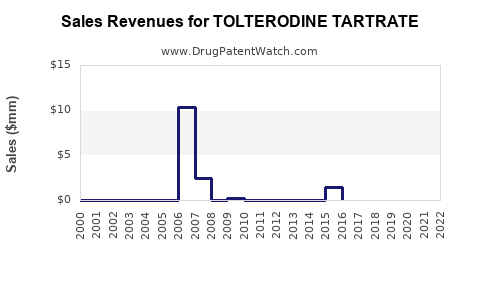
Standalone current revenue for tolterodine tartrate is not generally reported by public pharmaceutical companies because sales are distributed across generic portfolios and often included within broader therapeutic or geographic categories.
How does tolterodine compare with mirabegron and vibegron?
| Factor |
Tolterodine |
Mirabegron |
Vibegron |
| Drug class |
Antimuscarinic |
Beta-3 adrenergic agonist |
Beta-3 adrenergic agonist |
| Generic availability |
Broad |
Market-dependent and historically more limited |
Limited compared with tolterodine |
| Price |
Low |
Higher |
Higher |
| Dry mouth and constipation |
Common class concerns |
Lower anticholinergic burden |
Lower anticholinergic burden |
| Blood-pressure concern |
Less central |
Important labeling consideration |
Requires clinical monitoring, but no anticholinergic burden |
| Cognitive-risk concern |
Relevant |
Not an anticholinergic |
Not an anticholinergic |
| Payer position |
Favored by low cost |
Often step-edit or prior authorization |
Often step-edit or prior authorization |
| Commercial growth |
Low |
Greater branded opportunity |
Greater branded opportunity |
Mirabegron and vibegron compete by avoiding anticholinergic adverse effects. Their higher prices preserve tolterodine’s role in formularies that prioritize cost or require antimuscarinic failure before beta-3 therapy.
What generic entry risks exist for tolterodine?
Generic entry risk is already realized rather than prospective. The main market risks are now price erosion and supplier concentration.
Current competitive risks
- Additional generic entrants can reduce prices further.
- Retail and mail-order substitution can move volume between suppliers rapidly.
- API disruptions can create temporary shortages or price spikes.
- Extended-release manufacturing requires more technical control than immediate-release production.
- Payers can prefer one generic supplier through rebate or contract arrangements.
- Prescribers may shift patients to beta-3 agonists when anticholinergic tolerability becomes a concern.
The residual opportunity is strongest for manufacturers with low-cost API access, robust quality systems, reliable extended-release manufacturing and distribution contracts.
What is the FDA regulatory status of tolterodine?
Tolterodine tartrate is an FDA-approved prescription drug available in immediate-release and extended-release products. The regulatory pathway for new generic entrants is an ANDA demonstrating pharmaceutical equivalence and bioequivalence to the relevant reference-listed drug.
Regulatory risks include:
- Bioequivalence failure for extended-release products.
- Dissolution-profile variability.
- Manufacturing deviations.
- FDA inspection findings.
- Labeling differences involving renal or hepatic impairment.
- Supply interruptions affecting controlled-release capsules or tablets.
The regulatory environment is mature. A new entrant does not receive meaningful innovation-based exclusivity merely by launching a standard generic tolterodine product.
What licensing and settlement opportunities exist?
Tolterodine has limited licensing value as a standalone mature molecule. Potential transactions are more likely to involve:
- Regional commercialization rights.
- Supply agreements for tolterodine API.
- Contract manufacturing of extended-release products.
- Portfolio acquisitions combining tolterodine with other urology generics.
- Authorized-generic arrangements.
- Technology licenses for modified-release platforms.
Historical patent settlements, where applicable, had value mainly because they controlled the timing of generic entry. Their economic importance diminished after several manufacturers entered the market. New settlements would generally have limited strategic value unless tied to a new formulation, combination product or jurisdiction with delayed generic access.
What is the global market outlook for tolterodine?
Tolterodine remains commercially relevant in Europe, North America, Asia-Pacific and Latin America, but its role differs by reimbursement system.
In high-income markets, low-cost generic substitution limits revenue per prescription. In emerging markets, branded generics can retain share through physician familiarity, local distribution and price segmentation. The principal geographic variables are:
- Local patent expiration dates.
- National generic-substitution rules.
- Availability of mirabegron and vibegron.
- Public reimbursement policies.
- Local manufacturing requirements.
- Pharmacy and hospital tender structures.
The most durable demand comes from patients who respond to tolterodine, cannot access newer agents, or are treated under cost-sensitive formularies.
Key Takeaways
- Tolterodine tartrate is a mature generic antimuscarinic with limited remaining patent leverage.
- Detrol and Detrol LA lost meaningful commercial exclusivity in the early 2010s.
- The core active-ingredient patent estate is expired in major markets.
- Extended-release formulation patents created historical value but no longer prevent broad generic competition.
- Current economics depend on manufacturing scale, API cost, supply reliability and payer contracts.
- Mirabegron and vibegron are the main therapeutic competitors because they avoid anticholinergic exposure.
- Tolterodine remains commercially useful because of its low price and established clinical use.
- The strongest remaining opportunities are regional generic supply, contract manufacturing and differentiated delivery technologies.
FAQs
Is tolterodine tartrate still profitable for generic manufacturers?
It can be profitable at scale, but margins are generally lower than for protected or limited-competition products. Profitability depends on procurement cost, manufacturing efficiency, contract access and the number of active suppliers.
Can a company obtain new patents on tolterodine tartrate?
New patents may be available for novel formulations, delivery systems, combinations or manufacturing processes. A routine tablet or capsule containing known tolterodine tartrate is unlikely to support strong new patent protection.
Is Detrol still protected by patents?
Detrol’s principal composition and product protections have expired or lost practical blocking effect in major markets. Any residual listing must be evaluated against the specific product, patent claim and jurisdiction.
Are tolterodine and oxybutynin interchangeable?
They are in the same broad antimuscarinic treatment category but are not automatically interchangeable. Formulation, dose, tolerability, patient response and prescriber judgment determine substitution.
Does tolterodine have biosimilar competition?
No. Tolterodine is a small-molecule drug, not a biologic. Its competitors are generics and branded small-molecule alternatives rather than biosimilars.
References
- U.S. Food and Drug Administration. (1998). Detrol (tolterodine tartrate) prescribing information.
- U.S. Food and Drug Administration. (2000). Detrol LA (tolterodine tartrate extended release) prescribing information.
- U.S. Food and Drug Administration. (2024). Approved drug products with therapeutic equivalence evaluations: Orange Book.
- U.S. Food and Drug Administration. (2024). Electronic Orange Book patent and exclusivity information.
- Pfizer Inc. (2000–2012). Annual reports and Form 10-K filings.
- American Urological Association. (2024). Diagnosis and treatment of idiopathic overactive bladder guideline.
- U.S. Patent and Trademark Office. (1995). U.S. Patent No. 5,382,600.