Last updated: February 19, 2026
What is the Market Size for Tolterodine Tartrate?
Tolterodine Tartrate, a muscarinic receptor antagonist, treats overactive bladder (OAB). The global OAB treatment market was valued at approximately $5.2 billion in 2022 and is projected to grow at a compound annual growth rate (CAGR) of 6.2% through 2030 [1].
The proportion attributable to Tolterodine in this market is estimated at 15%, given its status as one of the first-generation antimuscarinics. Its market share is challenged by newer agents, but it remains a standard therapy. Estimated annual sales for Tolterodine Tartrate are around $780 million as of 2022.
Regional distribution indicates North America accounts for 55% of Tolterodine use, driven by high prevalence of OAB and insurance coverage. Europe accounts for 25%, with the rest spread across Asia-Pacific, Latin America, and Africa.
Competitive Landscape
Major competitors include:
- Detrol (AbbVie): Market leader in North America.
- Tolterodine generics: Multiple manufacturers offering generic formulations, lowering pricing pressure.
- Newer agents: Mirabegron (Beta-3 adrenergic agonist) and other second-generation antimuscarinics are gaining market share, impacting Tolterodine's growth.
Generic versions became widely available post-patent expiry in 2016-2017, significantly reducing prices.
Pricing Trends and Projections
Current pricing (U.S., retail):
- Brand-name Detrol (AbbVie): $5-$8 per tablet.
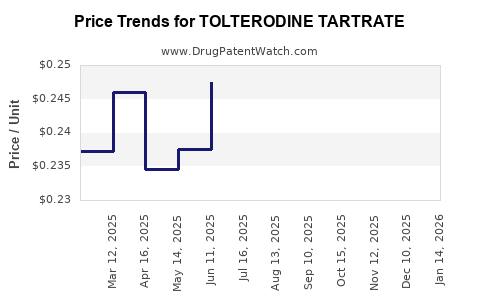
- Generic Tolterodine Tartrate: $0.30-$0.50 per tablet.
Pricing evolution:
- 2016: Brand Detrol, $6 per tablet; after patent expiration, generics emerged, dropping price to $0.40.
- 2022: Average retail price for generic Tolterodine Tartrate: around $0.30-$0.50 per tablet.
Projected pricing (2025-2030):
- Due to increased market penetration of generics, prices are expected to stabilize or decline slightly to $0.20-$0.35 per tablet.
- The advent of biosimilars or novel formulations might influence future pricing; however, no expected major price hikes are forecasted given current competition.
Market Dynamics Influencing Price
- Patent expiration: Led to a surge in generic versions, driving prices downward.
- Regulatory approvals: Generics comply with bioequivalence standards, enabling widespread market entry.
- Market penetration of newer therapies: Mirabegron and combination therapies could reduce demand, pressuring prices.
- Manufacturing costs: Marginal in generics, supporting low retail prices.
Future Market Drivers
- Rising prevalence of OAB due to aging populations.
- Increased awareness and diagnosis.
- Potential approval of new formulations (transdermal, extended-release), which could influence pricing strategies.
- Patent stabilization on certain formulations could temporarily stabilize prices but unlikely to reverse downward trend.
Summary Table: Price Projection (U.S. Retail, per tablet)
| Year |
Brand Price |
Generic Price |
Notes |
| 2022 |
$5-$8 |
$0.30-$0.50 |
Lead-in prices post-patent expiry |
| 2025 |
$4-$6 |
$0.20-$0.35 |
Slight decline expected due to market saturation |
| 2030 |
$3-$5 |
$0.20-$0.30 |
Prices stabilize, competition remains intense |
Key Takeaways
- The global OAB market is expanding, but Tolterodine Tartrate faces pricing pressure from generics and newer therapies.
- Current retail prices for generics are roughly $0.30-$0.50 per tablet, trending toward stabilization or slight decline.
- Patent expiry and market saturation limit the potential for significant price increases.
- The U.S. remains the dominant market, influencing global pricing trends.
FAQs
Q1: How does patent expiry affect Tolterodine Tartrate pricing?
Patent expiry allows generic manufacturers to produce lower-cost alternatives, drastically reducing prices and increasing market competition.
Q2: Are new formulations expected to impact market prices?
Yes, formulations such as transdermal patches or extended-release tablets can command higher prices temporarily, but their impact on generic prices remains limited.
Q3: Will Tolterodine Tartrate remain relevant with newer drugs available?
Yes, especially in regions with limited access to newer agents. Costs and formulary preferences influence continued use.
Q4: What factors could reverse the price decline trend?
Patent protections, approval of proprietary formulations, or regulatory barriers to generics could temporarily stabilize or raise prices.
Q5: How does regulatory environment impact future pricing?
Streamlined approval processes for generics and biosimilars support low prices, while patent litigations or delays could impede price reductions.
References
[1] MarketDataForecast. (2022). Overactive Bladder Market Size, Trends & Forecasts. Retrieved from https://marketdataforecast.com