Last updated: June 25, 2026
Tadalafil (multiple brands; most importantly Cialis) is in late-lifecycle generic competition across major markets. The financial trajectory is dominated by (1) patent and exclusivity sunsets completed years ago in many regions, (2) intense oral-dosage pricing pressure, (3) share shifts driven by SKU-level differentiation (dose, formulation, and pack size), and (4) supply and manufacturing scale among high-volume generic and branded manufacturers. Near-term industry economics hinge less on IP and more on trade-down behavior by prescribers and patients, pharmacy channel dynamics, and emerging “premium” use cases in BPH/LUTS and ED combination therapy.
What is the tadalafil market size and revenue trajectory across ED and BPH indications?
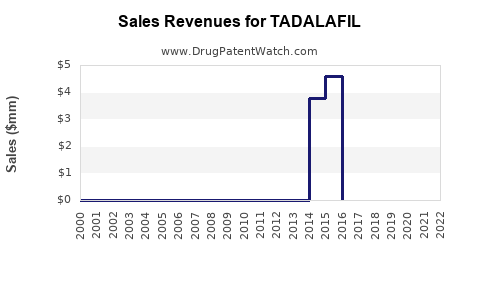
Featured snippet answer: Tadalafil revenues peak early to mid-cycle under branded exclusivity and then compress sharply as generics enter. Current market performance is characterized by high volume, lower unit prices, and strong regional dispersion: mature markets are mostly generic-dominated while select geographies still show pockets of brand premium in specific channels and dose strengths.
Which indications drive tadalafil demand (ED vs BPH/LUTS vs combination care)?
Tadalafil’s commercial engine is split between:
- Erectile dysfunction (ED): repeat demand but highly price elastic.
- Benign prostatic hyperplasia (BPH) and lower urinary tract symptoms (LUTS): more stable chronic use patterns.
- Off-label or adjacent overlaps with comorbidity management (cardiovascular risk counseling and medication interactions drive prescribing behavior and switching frequency).
How do dose and formulation choices change revenue outcomes?
SKU economics matter. Revenue resilience is typically strongest in:
- Daily dosing vs on-demand packs
- Specific dose strengths that anchor payer formularies
- Larger pack sizes that align with adherence expectations (especially for chronic BPH/LUTS)
How have patent expirations and exclusivity timelines shaped tadalafil financial performance?
Featured snippet answer: Tadalafil’s branded era ended well before today’s generic-dominant market structure in the US and most developed markets. Financial performance transitions from brand-driven growth to volume-led, margin-compressed generic distribution, with periodic rebounds tied to channel contracts, supply availability, and occasional settlement-driven delays in specific jurisdictions.
When does tadalafil lose exclusivity in the US and key regions?
In the US, major branded-exclusivity windows are already lapsed for tadalafil products, meaning revenue exposure now depends on:
- Remaining method-of-use or formulation patents (where applicable)
- Litigation outcomes that delay specific generic entries in niche SKUs
- Commercially relevant supply chains (API and finished dose capacity), which can temporarily tighten supply and lift realized net pricing
Does method-of-use or formulation IP still matter commercially?
Yes, but with diminishing impact versus generic competition at scale. Any residual IP that blocks certain:
- daily dosing regimens,
- specific formulation technologies,
- or pediatric labeling expansions,
tends to affect adoption rates and pharmacy substitutions more than it restores branded-level pricing.
What patents protect tadalafil, and which ones matter for market exclusivity today?
Featured snippet answer: Patent estates around tadalafil historically cover active ingredient claims, formulations, and methods of use. In current market conditions, practical protection is usually limited to specific jurisdictions, specific dosage forms, and sometimes specific clinical claims, with most active-ingredient compositions broadly available.
How do formulation patents affect pricing and substitution risk?
Formulation and manufacturing patents can delay “fully interchangeable” generic launches, especially when challengers must redesign:
- dissolution profiles,
- excipient systems,
- or bioequivalence strategy.
In mature markets, the effect is typically short-lived and manifests as a timing bump or a transient pricing premium until multiple ANDA entrants normalize pricing.
How do method-of-use patents affect payer behavior?
Method-of-use claims matter if they change labeling-adoption. When they do not, switching becomes straightforward:
- ED labeling drives seasonal/behavioral prescribing.
- BPH/LUTS labeling drives chronic reimbursement stability.
Which companies dominate tadalafil revenue and market share in generic-heavy markets?
Featured snippet answer: Large-scale generic manufacturers with broad ANDA coverage and efficient manufacturing footprints dominate today’s tadalafil supply. Branded revenue persists mainly where payers and channels maintain brand-preferred positions, often for formulary simplicity, loyalty economics, or specific SKU pricing.
What archetypes of competitors win in tadalafil?
- High-volume generics: lowest landed cost, fastest supply responsiveness.
- Brand-adjacent sellers: maintain higher net prices in select channels via contract leverage.
- Regionally strong distributors: control pharmacy reach and channel compliance.
- Niche formulators: focus on specialty pack sizes, specific dose strengths, or logistics advantage.
Revenue concentration dynamics
Financial trajectory is influenced by whether the market is supplied by:
- a few large high-capacity suppliers (pricing steadier but vulnerable to outages), or
- many mid-tier suppliers (more fragmented pricing, more frequent price wars).
What generic entry risks exist for tadalafil (ANDA/Paragraph IV and litigation)?
Featured snippet answer: Generic entry risk for tadalafil is structurally high due to the availability of the active ingredient and the completed branded exclusivity timeline. The primary risk shifts from “will generic enter” to “when will competing generics and their specific SKUs enter and at what quality-adjusted price.”
How does Paragraph IV litigation influence entry timing and pricing?
When Paragraph IV challenges are filed or litigated for specific patents, outcomes usually determine:
- earliest launch date for a given strength/form,
- whether challengers can launch “at risk,”
- and settlement terms that can structure delayed entry.
In mature tadalafil markets, the commercial impact tends to be:
- short-term pricing stabilization before broader erosion,
- and SKU-level differentiation rather than system-wide branded comeback.
What matters commercially during settlement windows?
Settlement-driven delays reduce competitive intensity temporarily, which can:
- keep net pricing higher in constrained channels,
- extend volume for mid-priced sellers,
- and shift demand between strengths.
What is the Orange Book status of tadalafil products, and how does it affect launch calendars?
Featured snippet answer: The Orange Book for tadalafil includes listed patents for branded and product-specific entries, but most high-value exclusivity has already run. Remaining listings that still constrain specific launches tend to be limited to particular formulations or dosing regimens.
How do Orange Book listings translate into launch timing?
For ANDA applicants, Orange Book listings create launch calendars through:
- pediatric exclusivity considerations (if any applies to specific listings),
- expiration dates and terminal disclaimers,
- and patent-by-patent carve-outs after settlement.
Commercially, firms price-in launch dates:
- tight contracts use these dates for forecasting,
- procurement schedules and inventory planning depend on anticipated generic entry waves.
How does tadalafil compare with sildenafil and other ED drugs on revenue stability and price erosion?
Featured snippet answer: Tadalafil tends to experience strong generic-driven price erosion similar to sildenafil but often benefits from chronic-use framing in BPH/LUTS and a longer perceived “window of action,” which can support steadier volume in some segments. Still, unit price compression dominates in generics.
Key comparison axes that move financial trajectory
- Durability of prescribing: daily dosing supports more stable reorder cycles.
- Payer behavior: formulary restrictions and prior authorization patterns determine brand resistance.
- Pack economics: price per dose and pack size drive substitution.
- Safety and interaction profiles: clinician and patient confidence affects switching speed.
How do manufacturing capacity, supply constraints, and API sourcing affect tadalafil gross margins?
Featured snippet answer: Tadalafil margins are sensitive to supply chain throughput and API availability. When multiple generic entrants scale simultaneously, pricing drops quickly. When supply constricts, pricing can temporarily firm even with generic competition.
What production bottlenecks typically move tadalafil pricing?
- API availability and quality consistency
- Finished-dose GMP capacity and batch scheduling
- Regulatory actions affecting specific plants
- Quality deviations that trigger recalls or market withdrawals
Why stock-and-distribution strategy drives realized net revenue
Even if list prices fall, realized net revenue depends on:
- pharmacy reimbursement rates,
- wholesaler inventory turns,
- rebate and contract structure,
- and substitution restrictions set by payers or pharmacy benefit managers.
What FDA and regulatory milestones affect tadalafil commercialization today?
Featured snippet answer: For tadalafil, regulatory value today is mostly in maintaining approval status for ANDA products, avoiding enforcement actions, and securing labeling updates. New clinical trials rarely drive market-wide renewal because the base compound is established and generic substitution is the primary force.
ANDA and label-management dynamics
- Generic acceptance requires consistent bioequivalence and stable manufacturing.
- Label changes can trigger product-level competitive impacts, especially when they affect dosing instructions or contraindication language.
What are the most likely commercial scenarios for tadalafil over the next 24–48 months?
Featured snippet answer: The base case is continued margin compression offset by stable volume. Upside is possible from supply-tightness and channel contract repricing, while downside comes from additional entrants, intensified price competition in specific strengths, or enforcement/quality disruptions that create sudden supply imbalances.
Scenario map
1) Base case: steady volume, price erosion continues
- Strong generic volume offsets unit price declines
- SKU substitution increases as payers broaden formulary access
2) Upside: supply tightening
- Temporary price firmness, better net pricing
- Stronger performance for distributors with better inventory allocation
3) Downside: accelerated entry wave
- Multiple generic launches in key strengths drive sharp price compression
- Higher marketing and rebate intensity to defend channel share
Revenue and margin drivers table for tadalafil’s market economics
| Driver |
Direction in mature generic market |
Financial impact |
What to monitor |
| Generic unit price competition |
Down |
Lowers net price, increases volume dependence |
Wholesale pricing, PBM formulary changes |
| SKU differentiation (dose/pack) |
Mixed |
Can slow substitution in targeted strengths |
Strength-level sales, pack mix |
| Supply availability |
Mixed |
Can lift or depress realized gross margin |
API/plant performance, recall signals |
| Contracting and rebates |
Downward pressure |
Compresses net margins |
Contract renewals, rebate adjustments |
| Enforcement actions |
Rare but material |
Temporary pricing dislocations |
FDA warning letters, import alerts |
| Demand stability from BPH/LUTS |
More stable than ED |
Supports volume resilience |
Prescription persistence trends |
Key takeaway timeline: how tadalafil’s financial trajectory evolves with lifecycle stages
| Lifecycle stage |
Market structure |
Price level |
Revenue dynamics |
Typical risk |
| Branded growth |
Brand holds share |
Higher |
Growth driven by new users and dose expansion |
Patent/labeling challenges |
| Post-exclusivity |
First generics enter |
Falls quickly |
Revenue shifts to volume-led sellers |
Early generic quality/supply |
| Mature generic |
Many entrants |
Low to moderate |
Net revenue depends on scale, contracts |
Ongoing price wars and enforcement |
| SKU-optimized maturity |
Formularies refine |
Stabilizes |
Margin defense via mix and pack economics |
Strength-specific launch waves |
Key Takeaways
- Tadalafil’s financial trajectory is dominated by post-exclusivity generic competition, with demand stability in BPH/LUTS and higher elasticity in ED.
- Market economics shift from IP-driven growth to channel contracting, supply chain execution, and SKU-level mix management.
- Near-term performance is most sensitive to additional generic entry waves by strength and formulation, plus supply constraints that can temporarily tighten pricing.
- Competitive advantage concentrates among manufacturers and distributors with high-capacity, reliable compliance, and effective contracting with wholesalers and PBMs.
FAQs
- How does tadalafil pricing differ between ED-only and daily BPH/LUTS prescribing channels?
- Which tadalafil dose strengths face the fastest generic substitution risk?
- How do API supply disruptions typically impact tadalafil wholesaler and pharmacy pricing?
- What Orange Book patent listings most often drive delayed generic tadalafil launches by strength?
- How do rebate and formulary placement changes alter tadalafil net revenue even when list prices fall?
References (APA)
- FDA. Orange Book: Approved Drug Products with Therapeutic Equivalence Evaluations. U.S. Food and Drug Administration.
- FDA. ANDA (Abbreviated New Drug Application) approvals and labeling resources. U.S. Food and Drug Administration.
- FDA. Drug Safety-related communications and enforcement actions database. U.S. Food and Drug Administration.