Last updated: February 19, 2026
Risedronate sodium, a bisphosphonate medication primarily used for treating osteoporosis and Paget's disease of bone, has navigated a mature market characterized by generic competition and evolving treatment paradigms. Its financial trajectory is intrinsically linked to patent expiries, generic erosion, and the broader market for bone health therapeutics.
What is Risedronate Sodium's Current Market Position?
Risedronate sodium is established in the osteoporosis and bone resorption inhibitor market. The drug's primary indication is the prevention and treatment of osteoporosis in postmenopausal women, and to increase bone mass in men and women at risk of osteoporosis. It is also used for the treatment of glucocorticoid-induced osteoporosis and Paget's disease of bone.
Key Market Segments and Applications:
- Postmenopausal Osteoporosis: This remains the largest segment for risedronate sodium, driven by the aging global population and increasing awareness of osteoporosis.
- Glucocorticoid-Induced Osteoporosis: Risedronate sodium is a prescribed treatment for individuals on long-term corticosteroid therapy, a common practice in managing chronic inflammatory conditions.
- Paget's Disease of Bone: While less common, risedronate sodium is an effective treatment for this chronic disorder of abnormal bone remodeling.
Market Landscape:
The market for risedronate sodium is highly competitive, dominated by generic manufacturers following patent expiries. Brand-name products, such as Actonel, have seen significant sales decline due to generic entry. This has led to price compression and a market focused on cost-effectiveness for healthcare providers and patients.
- Generic Penetration: Risedronate sodium is widely available as a generic medication, with numerous pharmaceutical companies producing and marketing their versions. This generic availability has driven down prices substantially.
- Therapeutic Alternatives: The market also includes other bisphosphonates (e.g., alendronate, ibandronate, zoledronic acid), as well as newer classes of drugs like denosumab and teriparatide. These alternatives offer different dosing regimens, efficacy profiles, and safety considerations, influencing physician prescribing patterns.
- Dosing Regimens: Risedronate sodium is available in various dosing frequencies, including daily, weekly, and monthly oral formulations. This flexibility caters to different patient adherence preferences.
What is the Patent Landscape for Risedronate Sodium?
The original patent protection for risedronate sodium has long expired in major markets, leading to widespread generic availability.
Key Patent Milestones:
- Original Composition of Matter Patents: These patents, typically expiring in the early to mid-2000s, provided the initial market exclusivity for risedronate sodium. For example, key patents for the original formulation and use of risedronate by Procter & Gamble were granted in the 1980s and early 1990s, with expiry dates allowing for generic competition in the 2000s [1].
- Formulation and Polymorph Patents: Manufacturers often sought secondary patents related to specific formulations, crystal forms (polymorphs), or delivery methods to extend market exclusivity. However, these have also largely expired or been successfully challenged by generic competitors.
- Method of Use Patents: Patents covering specific uses or treatment protocols might have offered some protection, but the primary indication for osteoporosis is well-established, limiting the impact of such patents in the current market.
Current Patent Status:
As of the current date, there are no significant unexpired patents providing broad market exclusivity for risedronate sodium itself in its primary indications. The focus has shifted from new patent grants to the development of new therapeutic entities for bone health.
How Has Risedronate Sodium Performed Financially?
The financial performance of risedronate sodium has been marked by a peak during its branded exclusivity period, followed by a precipitous decline due to generic competition.
Brand-Name Performance (Pre-Generic Era):
- Peak Sales: Before the widespread availability of generics, brand-name risedronate sodium (e.g., Actonel) achieved significant annual sales. For instance, in the mid-2000s, Actonel generated over $1 billion in annual revenue for its manufacturer [2].
- Growth Drivers: Growth during this period was fueled by strong clinical trial data demonstrating efficacy in reducing fracture risk, increasing physician adoption, and effective marketing strategies.
Post-Generic Era Performance:
- Sales Erosion: Following the expiry of key patents and the entry of generic versions, sales of branded risedronate sodium have dramatically decreased. This erosion is typical for pharmaceuticals after patent protection lapses.
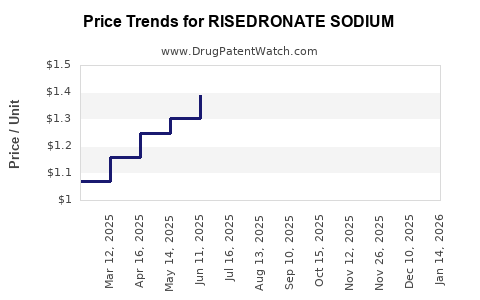
- Generic Market Dynamics: The generic market is characterized by price wars and high sales volumes at much lower profit margins per unit. The overall revenue generated by risedronate sodium globally is now a fraction of its peak branded sales.
- Market Share: Generic risedronate sodium holds a substantial market share in terms of prescriptions filled, reflecting its cost-effectiveness.
Financial Trajectory Summary:
The financial trajectory of risedronate sodium can be described as follows:
- Growth Phase (Branded Exclusivity): Sustained revenue growth driven by clinical adoption and market demand.
- Peak Sales: Achieved during the latter part of the branded exclusivity period.
- Rapid Decline (Generic Entry): Sharp drop in revenue for branded products as generics enter the market.
- Stabilization (Generic Market): Revenue from risedronate sodium, predominantly from generics, stabilizes at a lower level, driven by volume and competitive pricing.
What are the Key Market Trends Impacting Risedronate Sodium?
Several market trends influence the demand and accessibility of risedronate sodium.
Treatment Guidelines and Clinical Practice:
- First-Line Therapy: Risedronate sodium, particularly weekly oral formulations, continues to be recommended as a first-line treatment for postmenopausal osteoporosis by major clinical guidelines (e.g., American College of Rheumatology, National Osteoporosis Foundation) due to its established efficacy and safety profile [3].
- Shift Towards Newer Therapies: While still a staple, there is a growing trend towards the use of anabolic agents (e.g., teriparatide, abaloparatide) and monoclonal antibodies (e.g., denosumab) for patients with severe osteoporosis or those who have failed bisphosphonate therapy. This shift impacts the long-term growth potential for older drug classes.
- Oral Bisphosphonate Adherence: Adherence to oral bisphosphonates like risedronate remains a challenge due to dosing instructions (e.g., taking on an empty stomach with a full glass of water and remaining upright for 30-60 minutes) and potential gastrointestinal side effects. This has maintained interest in alternative dosing frequencies and delivery methods.
Healthcare Reimbursement and Cost Pressures:
- Generic Cost-Effectiveness: The low cost of generic risedronate sodium makes it an attractive option for healthcare systems and payers aiming to manage pharmaceutical expenditures.
- Formulary Placement: Risedronate sodium generally enjoys favorable formulary placement due to its generic status and efficacy, ensuring broad patient access.
Regulatory Landscape:
- Safety Monitoring: Regulatory agencies, such as the FDA and EMA, continue to monitor the safety of bisphosphonates, including risedronate. Concerns about rare but serious side effects like osteonecrosis of the jaw (ONJ) and atypical femoral fractures (AFFs) persist, requiring clear communication of risks and benefits to prescribers and patients. These safety communications can influence prescribing patterns, though the absolute risk remains low.
- Label Updates: Periodic updates to product labels reflect ongoing safety assessments and can influence prescribing decisions.
Competition from Biosimil/Biologic Equivalents:
- While risedronate sodium is a small molecule and thus not subject to biosimilarity in the same way as biologics, the development of novel biologic agents for osteoporosis represents a competitive threat. These biologics often target different pathways and may offer superior efficacy or different safety profiles, particularly for high-risk patients.
What is the Future Outlook for Risedronate Sodium?
The future outlook for risedronate sodium is one of continued relevance as a cost-effective generic option, but with limited growth prospects.
Market Position:
- Sustained Generic Demand: Risedronate sodium will likely remain a significant player in the generic osteoporosis market due to its established efficacy, safety profile, and low cost.
- Niche Applications: It will continue to be a go-to treatment for first-line management of osteoporosis and Paget's disease where cost is a primary consideration.
Potential Challenges:
- Competition from Novel Therapies: The increasing availability and adoption of anabolic agents and new biologic treatments for osteoporosis will likely capture market share, especially in moderate-to-severe cases or in patients who fail first-line therapies.
- Adherence Issues: Persistent challenges with patient adherence to oral bisphosphonate regimens may lead some prescribers to favor alternative treatments with simpler administration.
- Safety Perceptions: Ongoing scrutiny of rare but serious side effects, even if the absolute risk is low, can subtly influence prescribing preferences.
Opportunities:
- Emerging Markets: As healthcare access and awareness of osteoporosis grow in emerging markets, generic risedronate sodium can benefit from increased demand due to its affordability.
- Fixed-Dose Combinations: While not widely prevalent for risedronate sodium, the development of fixed-dose combinations with other agents could potentially improve adherence or offer added therapeutic benefits. However, this is less likely given the maturity of the molecule.
Key Takeaways
Risedronate sodium, a key bisphosphonate, occupies a mature market segment dominated by generic competition. Its financial trajectory peaked during branded exclusivity and has since declined significantly. Despite the emergence of newer therapeutic classes, risedronate sodium remains a cost-effective first-line treatment for osteoporosis and Paget's disease, driven by established clinical guidelines and healthcare cost pressures. The drug's future is characterized by sustained generic demand rather than growth, with its market position influenced by ongoing safety monitoring and competitive pressures from novel bone health therapies.
Frequently Asked Questions
-
What is the primary mechanism of action of risedronate sodium?
Risedronate sodium is a bisphosphonate that inhibits osteoclast-mediated bone resorption, thereby reducing bone turnover and increasing bone mineral density. It binds to hydroxyapatite in bone and is preferentially taken up by osteoclasts, where it disrupts their mevalonate pathway, leading to apoptosis.
-
What are the most common side effects associated with risedronate sodium?
Common side effects include gastrointestinal disturbances such as nausea, abdominal pain, indigestion, and diarrhea. Musculoskeletal pain and headache are also reported. More serious but rare side effects include osteonecrosis of the jaw and atypical femoral fractures.
-
How does risedronate sodium compare to other bisphosphonates like alendronate?
Risedronate sodium and alendronate are both oral bisphosphonates with similar efficacy in treating osteoporosis. Differences lie in their dosing regimens, absorption rates, and potential for gastrointestinal side effects. Risedronate sodium is available in daily, weekly, and monthly oral formulations, whereas alendronate is typically prescribed daily or weekly. Some studies suggest risedronate sodium may have a slightly better gastrointestinal tolerability profile for some patients.
-
Are there any specific patient populations for whom risedronate sodium is contraindicated?
Risedronate sodium is contraindicated in patients with hypocalcemia, uncorrected vitamin D deficiency, severe renal impairment (creatinine clearance <30 mL/min), and known hypersensitivity to risedronate or any of its excipients. It is also not recommended for patients unable to stand or sit upright for at least 30 minutes due to the risk of esophageal irritation.
-
What is the typical annual cost of generic risedronate sodium compared to newer osteoporosis treatments?
The annual cost of generic risedronate sodium can range from approximately $100 to $300, depending on the dosage and formulary. In contrast, newer anabolic agents and biologics for osteoporosis typically have annual costs ranging from $2,000 to $10,000 or more, highlighting the significant cost differential that positions generic bisphosphonates as a budget-friendly option.
Citations
[1] U.S. Patent and Trademark Office. (n.d.). Patent Search. Retrieved from https://patft.uspto.gov/
[2] Procter & Gamble Company. (2006). Annual Report.
[3] Compston, J., Cooper, A., Handelsman, S., et al. (2018). Fracture prevention, diagnosis and management of osteoporosis in postmenopausal women, older men, and secondary osteoporosis: international clinical practice guidelines. Clinical Cases in Mineral and Bone Metabolism, 15(3), 251–252.