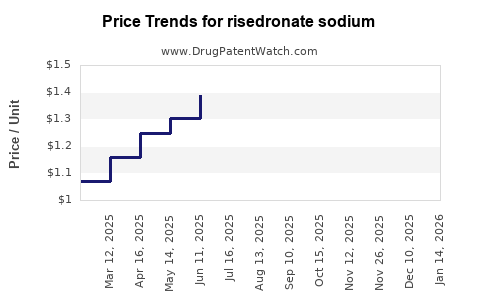
Last updated: September 7, 2026
Risedronate sodium is a mature, low-cost oral bisphosphonate with limited branded revenue and substantial generic competition. Its commercial trajectory is driven by osteoporosis prevalence, prescription pricing, adherence limitations, and competition from alendronate, zoledronic acid, denosumab, and newer anabolic therapies. The U.S. market has largely transitioned from brand-led sales to commodity generic supply.
What is the current market position of risedronate sodium?
Risedronate sodium is an oral nitrogen-containing bisphosphonate marketed primarily for osteoporosis and Paget's disease of bone. The original branded product, Actonel, was developed by Procter & Gamble and commercialized through partnerships that later involved Warner Chilcott, Actavis and Allergan. Generic risedronate sodium is available in immediate-release and delayed-release presentations.
| Market factor |
Current assessment |
| Active ingredient |
Risedronate sodium |
| Drug class |
Oral nitrogen-containing bisphosphonate |
| Main indications |
Postmenopausal osteoporosis, male osteoporosis, glucocorticoid-induced osteoporosis, Paget's disease |
| Principal U.S. brand |
Actonel |
| Generic status |
Widely available |
| Dosage forms |
5 mg, 30 mg, 35 mg, 75 mg and 150 mg tablets, depending on market |
| Delayed-release product |
Atelvia, 35 mg delayed-release tablet |
| Biosimilar exposure |
None; risedronate is a small molecule |
| Primary commercial issue |
Low price and substitution rather than patent exclusivity |
| Financial profile |
Mature, low-growth generic market |
FDA labeling recognizes daily, weekly, monthly and delayed-release dosing options, although availability differs by country and manufacturer. The delayed-release formulation is taken after breakfast, unlike conventional immediate-release tablets, which have strict fasting and administration requirements (FDA, 2023a; FDA, 2023b).
When did risedronate sodium lose exclusivity?
Risedronate sodium lost meaningful U.S. market exclusivity during the early 2010s. The core commercial patents protecting Actonel expired or reached the end of their enforceable life before generic competition became established. Generic versions subsequently entered the U.S. market through abbreviated new drug applications.
The practical exclusivity timeline is:
| Period |
Commercial event |
| 1990s |
Risedronate development and regulatory filings |
| 1998 |
U.S. approval of Actonel for postmenopausal osteoporosis |
| 2000s |
Expansion into additional osteoporosis and Paget's disease indications |
| 2010-2012 |
Core U.S. patent protection approached expiration |
| Early 2010s |
Generic competition expanded |
| 2014 onward |
Risedronate became a mature generic product |
| Current market |
No meaningful broad-based branded exclusivity |
The exact patent position depended on dosage form, formulation and use. The Orange Book distinguishes patents associated with approved products, but an old patent listing does not necessarily indicate a commercially meaningful barrier to generic entry. FDA's Orange Book is the controlling public source for listed patents and exclusivity associated with approved drug products (FDA, 2024a).
What patents protect risedronate sodium products?
The commercial patent estate for risedronate sodium historically covered the active compound, pharmaceutical compositions, dosing regimens and selected formulations. The estate is now largely expired or commercially exhausted in the United States.
Composition and active-ingredient patents
Early patent protection covered risedronate and related bisphosphonate chemistry. Those rights supported the original Actonel franchise but no longer provide a meaningful barrier to standard generic tablets.
Method-of-use patents
Method-of-use protection covered osteoporosis treatment and prevention, including dosing regimens intended to improve tolerability and adherence. These rights could affect the labeling strategy for an abbreviated new drug application, but they did not preserve broad market exclusivity after generic entry.
Formulation patents
Formulation protection addressed delayed release and dosing convenience. Atelvia was developed as a delayed-release risedronate product intended to permit administration after breakfast. The formulation created a distinct product opportunity, but its commercial value was constrained by:
- Low pricing for conventional risedronate
- Limited patient persistence with oral bisphosphonates
- Availability of alternative monthly and yearly treatment options
- The complexity of demonstrating clinical and bioequivalence for a differentiated formulation
- The absence of durable broad-market exclusivity
Manufacturing and process protection
Manufacturing know-how can still create supplier advantages. Relevant areas include control of polymorphs, particle size, tablet compression, coating, dissolution and impurity profiles. These process controls affect regulatory approval and batch economics but are not equivalent to a blocking patent estate.
What is the FDA regulatory status of risedronate sodium?
Risedronate sodium is an FDA-approved prescription drug. Generic products are approved through the ANDA pathway and must demonstrate pharmaceutical equivalence and bioequivalence to the relevant reference product.
FDA-approved use includes:
- Treatment and prevention of postmenopausal osteoporosis
- Treatment of osteoporosis in men
- Prevention and treatment of glucocorticoid-induced osteoporosis
- Treatment of Paget's disease of bone
Key labeling risks include esophageal irritation, hypocalcemia, musculoskeletal pain, osteonecrosis of the jaw and atypical femoral fractures. The label also emphasizes administration with plain water and restrictions on food, beverages and other medicines for immediate-release tablets (FDA, 2023a).
Risedronate has no biosimilar pathway because it is a chemically synthesized small molecule. Competitive entry occurs through generic drug approval, not the Public Health Service Act biosimilar pathway.
How many patents cover risedronate sodium?
The historical patent estate included multiple U.S. patents and foreign counterparts, but the number of currently relevant, unexpired, enforceable patents is limited. The commercial question is less the historical count than whether any unexpired patent blocks a standard immediate-release generic.
For the conventional risedronate tablet, the answer is generally no in the United States. Residual patent issues may remain relevant to particular delayed-release formulations, dosing instructions or jurisdiction-specific products, but they do not recreate the original Actonel monopoly.
The patent estate is therefore best classified as:
| Patent category |
Historical importance |
Current commercial strength |
| Active compound |
High |
Low |
| Standard tablet composition |
High |
Low |
| Osteoporosis method of use |
Medium |
Low |
| Delayed-release formulation |
Medium |
Low to moderate, product-specific |
| Manufacturing process |
Medium |
Moderate operational value |
| Device or delivery system |
Low |
Low |
What generic entry risks exist for risedronate sodium?
Generic entry risk is already realized rather than prospective. Standard risedronate sodium tablets face a high level of substitution risk, with price competition among generic manufacturers and limited patient switching costs.
Generic suppliers compete on:
- Acquisition cost of active pharmaceutical ingredient
- FDA manufacturing compliance
- Product availability
- Wholesaler and pharmacy contracts
- Dosage-form breadth
- Rebate and gross-to-net economics
- Ability to maintain supply during low-margin periods
The primary risk is not a new Paragraph IV wave against a protected brand. It is erosion of average selling price and supplier concentration. A manufacturer with a narrow product portfolio can also face disproportionate exposure to manufacturing interruptions because risedronate is often sold at low gross margins.
Which companies are challenging the risedronate sodium franchise?
The principal challengers are generic manufacturers rather than branded pharmaceutical companies. The competitive set has included large generic suppliers and regional manufacturers with ANDA-approved products. Relevant industry participants have included Teva, Mylan, Sandoz, Sun Pharmaceutical, Dr. Reddy's Laboratories, Apotex and other suppliers, although product availability varies by market and year.
The original branded franchise also faced therapeutic competition from:
- Alendronate sodium, including Fosamax and generic alendronate
- Ibandronate sodium, including Boniva and generic ibandronate
- Zoledronic acid, including Reclast and generic or follow-on supply
- Denosumab, marketed as Prolia
- Teriparatide and abaloparatide
- Romosozumab, marketed as Evenity
Alendronate is the closest low-cost oral competitor. Zoledronic acid competes through annual intravenous dosing, while denosumab competes through twice-yearly administration. Anabolic agents compete for high-risk patients despite substantially higher treatment costs.
How does risedronate compare with alendronate and denosumab?
| Attribute |
Risedronate |
Alendronate |
Denosumab |
| Drug type |
Oral bisphosphonate |
Oral bisphosphonate |
Monoclonal antibody |
| Generic availability |
Yes |
Yes |
Limited biosimilar and follow-on pressure relative to generics |
| Administration |
Daily, weekly or monthly options |
Usually weekly or daily |
Injection every six months |
| Price position |
Low |
Very low |
High |
| Adherence burden |
Fasting and administration restrictions |
Fasting and administration restrictions |
Injection-based |
| Patent risk |
Low |
Low |
Materially higher |
| Commercial growth |
Low or declining |
Mature |
Higher revenue opportunity |
| Main advantage |
Dosing flexibility |
Low cost and extensive use |
Convenience and efficacy positioning |
| Main limitation |
Oral adherence and gastrointestinal tolerability |
Oral adherence and gastrointestinal tolerability |
Cost and rebound vertebral-fracture risk after discontinuation |
Clinical guidelines generally recommend bisphosphonates as an initial treatment option for many patients at elevated fracture risk, with treatment selection based on fracture risk, renal function, contraindications, adherence and access (Endocrine Society, 2020; National Osteoporosis Foundation, 2022).
What is the financial trajectory for risedronate sodium?
Risedronate's financial trajectory is structurally mature:
- Branded revenue declined after patent expiry and generic entry.
- Generic volume remained supported by the aging population and osteoporosis screening.
- Unit prices fell as additional suppliers entered.
- Total market value shifted from brand economics to high-volume, low-margin supply.
- Delayed-release and differentiated dosage forms retained limited pricing opportunities.
- Growth became dependent on epidemiology and prescribing share rather than innovation.
No major manufacturer generally reports risedronate revenue as a standalone segment. The product is usually included in broader generic or established-products reporting. This makes company-specific revenue attribution difficult and limits the value of headline market-size estimates from commercial market-research firms.
The most relevant financial metrics are therefore:
| Metric |
Direction |
| Prescription volume |
Stable to modest growth in aging populations |
| Net price |
Declining or flat |
| Gross margin |
Low and under pressure |
| Branded revenue |
Minimal relative to historical peak |
| Generic competition |
High |
| Regulatory investment |
Maintenance-focused |
| Commercial differentiation |
Limited |
| Revenue volatility |
Driven by supply interruptions and contracts |
What is the Orange Book status of risedronate sodium?
The Orange Book remains relevant for the reference products Actonel and Atelvia and for determining listed patents and exclusivity. For conventional risedronate sodium generics, the principal commercial conclusion is that no active broad patent barrier preserves the original branded market.
The Orange Book should be reviewed at the product level because:
- Actonel and Atelvia have different formulation histories.
- Patent listings can differ by dosage form.
- A listed patent may concern only a specific method of use.
- Generic approval may proceed with a Paragraph IV certification, a section viii statement or after patent expiration.
- Patent listing status does not establish that a patent is valid or enforceable.
What patent litigation and settlement agreements affected risedronate?
Risedronate's major litigation cycle was associated with generic challenges to the original branded products and the expiration of core patent protection. The market is now primarily exposed to routine ANDA litigation risk, manufacturing disputes and supply-contract issues rather than a high-value branded patent war.
There is no current basis to treat risedronate as a major active patent-litigation asset. Settlement agreements, where used during the generic-entry period, would have had their greatest economic effect before broad generic availability. Their present value is limited unless they contain surviving obligations involving formulation, licensing, manufacturing or territory.
What geographic markets offer the strongest commercial opportunity?
The strongest volume opportunity is in markets with:
- High osteoporosis prevalence
- Aging populations
- Public reimbursement
- Generic substitution
- Broad fracture-prevention programs
The United States has the deepest generic infrastructure but limited pricing power. Europe has strong generic penetration and national reimbursement controls. Japan has an aging population and established bisphosphonate use, but pricing is regulated and local commercialization conditions matter. Emerging markets may offer volume growth, although access, diagnosis and reimbursement constrain adoption.
International commercial value depends more on registration coverage, local manufacturing and tender access than on patent exclusivity.
How strong is the risedronate sodium patent estate?
The estate is weak as a broad blocking portfolio and moderate as a formulation and manufacturing asset.
A prospective entrant faces little risk from the expired core compound protection but still must manage:
- Product-specific Orange Book records
- Formulation-specific patents
- ANDA certification strategy
- Bioequivalence requirements
- Stability and dissolution testing
- Good manufacturing practice compliance
- Supply-chain reliability
- Local patent law outside the United States
For a generic manufacturer, regulatory execution and cost control matter more than patent licensing.
Key Takeaways
- Risedronate sodium is a mature generic osteoporosis drug with low pricing power.
- Actonel's core commercial exclusivity ended in the early 2010s.
- Standard immediate-release risedronate faces limited current patent obstruction in the United States.
- Delayed-release formulations such as Atelvia created differentiated protection but did not support a durable broad-market monopoly.
- There is no biosimilar risk because risedronate is a small molecule.
- Alendronate is the closest low-cost oral competitor.
- Denosumab, zoledronic acid and anabolic agents compete through convenience, potency or high-risk-patient positioning.
- Revenue is generally reported within broader generic portfolios rather than as a standalone product.
- Future value depends on volume, manufacturing efficiency, supply reliability and geographic access.
- The principal commercial risk is price erosion, not a new branded patent cliff.
FAQs About Risedronate Sodium Market Economics
Is risedronate sodium still commercially attractive for generic manufacturers?
It can be attractive as part of a broad osteoporosis portfolio, but standalone economics are constrained by low prices, established competitors and limited differentiation.
Does risedronate sodium have biosimilar competition?
No. Risedronate sodium is a chemically synthesized small molecule and is subject to generic, not biosimilar, competition.
Can a new delayed-release risedronate product command a premium?
Possibly, but the premium would depend on enforceable formulation protection, clinical adherence benefits, reimbursement support and evidence that physicians will switch from low-cost alendronate or conventional risedronate.
Is risedronate sodium exposed to Medicare pricing pressure?
Yes. Generic reimbursement is already heavily controlled through pharmacy benefit contracting, formulary placement and generic substitution. Medicare policy can affect the broader osteoporosis market, but risedronate has limited branded pricing exposure.
What is the largest long-term threat to risedronate sodium demand?
The largest threat is therapeutic substitution by other bisphosphonates, annual zoledronic acid, denosumab and newer therapies, combined with poor persistence with oral osteoporosis treatment.
References
-
Endocrine Society. (2020). Pharmacological management of osteoporosis in postmenopausal women: Clinical practice guideline. Journal of Clinical Endocrinology & Metabolism.
-
Food and Drug Administration. (2023a). Risedronate sodium prescribing information. U.S. Department of Health and Human Services.
-
Food and Drug Administration. (2023b). Atelvia prescribing information. U.S. Department of Health and Human Services.
-
Food and Drug Administration. (2024a). Approved drug products with therapeutic equivalence evaluations: Orange Book. U.S. Department of Health and Human Services.
-
National Osteoporosis Foundation. (2022). Clinician's guide to prevention and treatment of osteoporosis. Osteoporosis International.