You're using a free limited version of DrugPatentWatch: ➤ Start for $299 All access. No Commitment.

Last Updated: December 12, 2025

ATELVIA Drug Patent Profile


✉ Email this page to a colleague

« Back to Dashboard


When do Atelvia patents expire, and when can generic versions of Atelvia launch?

Atelvia is a drug marketed by Apil and is included in one NDA. There are three patents protecting this drug and one Paragraph IV challenge.

This drug has eighty-five patent family members in thirty-three countries.

The generic ingredient in ATELVIA is risedronate sodium. There are nineteen drug master file entries for this compound. Ten suppliers are listed for this compound. Additional details are available on the risedronate sodium profile page.

DrugPatentWatch® Litigation and Generic Entry Outlook for Atelvia

A generic version of ATELVIA was approved as risedronate sodium by TEVA PHARMS USA on October 5th, 2007.

  Get Started Free

AI Deep Research
Questions you can ask:
  • What is the 5 year forecast for ATELVIA?
  • What are the global sales for ATELVIA?
  • What is Average Wholesale Price for ATELVIA?
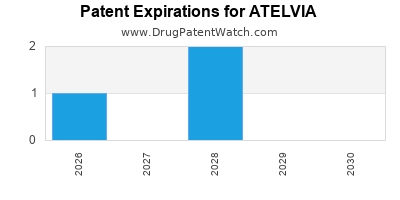
Drug patent expirations by year for ATELVIA
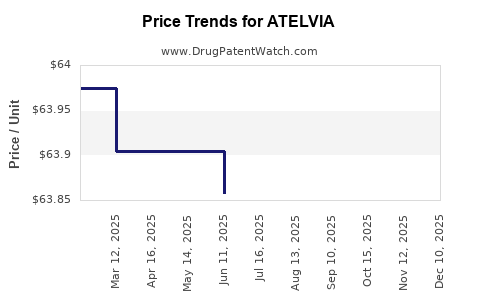
Drug Prices for ATELVIA

See drug prices for ATELVIA

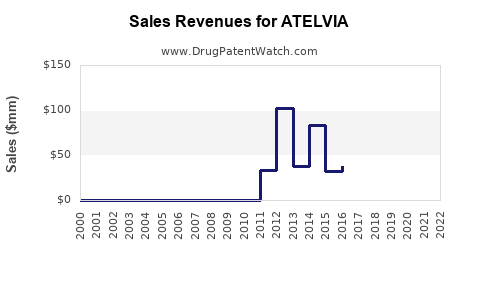
Drug Sales Revenue Trends for ATELVIA

See drug sales revenues for ATELVIA

Recent Clinical Trials for ATELVIA

Identify potential brand extensions & 505(b)(2) entrants

SponsorPhase
Wake Forest University Health SciencesPhase 3
Wake Forest University Health SciencesPhase 2
National Cancer Institute (NCI)Phase 2

See all ATELVIA clinical trials

Pharmacology for ATELVIA
Drug ClassBisphosphonate
Paragraph IV (Patent) Challenges for ATELVIA
Tradename Dosage Ingredient Strength NDA ANDAs Submitted Submissiondate
ATELVIA Delayed-release Tablets risedronate sodium 35 mg 022560 1 2011-06-09

US Patents and Regulatory Information for ATELVIA

ATELVIA is protected by three US patents.

Applicant Tradename Generic Name Dosage NDA Approval Date TE Type RLD RS Patent No. Patent Expiration Product Substance Delist Req. Exclusivity Expiration
Apil ATELVIA risedronate sodium TABLET, DELAYED RELEASE;ORAL 022560-001 Oct 8, 2010 AB RX Yes Yes ⤷  Get Started Free ⤷  Get Started Free Y ⤷  Get Started Free
>Applicant >Tradename >Generic Name >Dosage >NDA >Approval Date >TE >Type >RLD >RS >Patent No. >Patent Expiration >Product >Substance >Delist Req. >Exclusivity Expiration

Expired US Patents for ATELVIA

Applicant Tradename Generic Name Dosage NDA Approval Date Patent No. Patent Expiration
Apil ATELVIA risedronate sodium TABLET, DELAYED RELEASE;ORAL 022560-001 Oct 8, 2010 ⤷  Get Started Free ⤷  Get Started Free
>Applicant >Tradename >Generic Name >Dosage >NDA >Approval Date >Patent No. >Patent Expiration

Supplementary Protection Certificates for ATELVIA

Patent Number Supplementary Protection Certificate SPC Country SPC Expiration SPC Description
0186405 C300031 Netherlands ⤷  Get Started Free PRODUCT NAME: RISEDRONINEZUUR, DESGEWENST IN DE VORM VAN EEN FARMACEUTISCH AANVAARDBAAR ZOUT OF FARMACEUTISCH AANVAARDBARE ESTER, IN HET BIJZONDER NATRIUMRISEDRONAAT; NAT REGISTRATION NO/DATE: RVG 24990 20000609; FIRST REGISTRATION: SE 15290 - 15297 19991007
0186405 2000C/028 Belgium ⤷  Get Started Free PRODUCT NAME: NATRIUMRISEDRONAAT; NAT. REGISTRATION NO/DATE: 354 IS 498 F3 20000508; FIRST REGISTRATION: SE 15290 19991007
0186405 SPC/GB00/021 United Kingdom ⤷  Get Started Free PRODUCT NAME: (1-HYDROXY-2-(3-PYRIDINYL)ETHYLIDENE)BIS(PHOSPHONIC ACID) "RESIDRONATE" AND SALTS THEREOF, ESPECIALLY THE SODIUM SALT; REGISTERED: SE 15296 19991007; SE 15297 19991007; UK PL 00364/0070 20000316
>Patent Number >Supplementary Protection Certificate >SPC Country >SPC Expiration >SPC Description

Market Dynamics and Financial Trajectory for Atelvia

Last updated: July 27, 2025

Introduction

Atelvia (risedronate sodium extended-release), developed by Warner Chilcott (now part of AbbVie), is an oral bisphosphonate indicated primarily for the treatment of osteoporosis in postmenopausal women. Since its launch, Atelvia's market performance has been shaped by evolving market dynamics, competitive landscape, regulatory influences, and broader healthcare industry trends. This report analyzes the current market environment, future growth drivers, and financial outlook for Atelvia, providing insights critical for stakeholders navigating this segment of osteoporosis therapeutics.


Market Overview and Industry Landscape

Osteoporosis remains a significant public health concern, particularly among postmenopausal women, affecting an estimated 200 million women globally (1). The global osteoporosis drugs market was valued at approximately USD 12 billion in 2022, with a compound annual growth rate (CAGR) forecasted to be around 4.5% from 2023 to 2030 (2). Bisphosphonates, including Alendronate, Risedronate, Ibandronate, and Zoledronic acid, represent the mainstay treatments, accounting for a dominant market share owing to their proven efficacy and long-standing safety profiles.

Atelvia, characterized by its once-weekly extended-release formulation, differentiates itself through enhanced gastrointestinal tolerability compared to traditional immediate-release bisphosphonates, notably reducing esophageal irritation — a common adverse effect limiting compliance (3). Despite this advantage, its market share remains relatively modest within the bisphosphonate subset, primarily due to entrenched competition and clinician prescribing habits.

Key Market Drivers and Restraints

Drivers

  • Growing Osteoporosis Prevalence: Aging populations worldwide reinforce the demand for osteoporosis therapies, with postmenopausal women constituting the primary demographic (4).

  • Improved Patient Compliance: Atelvia’s once-weekly dosing and improved gastrointestinal tolerability foster better adherence, which correlates with improved clinical outcomes and reduced fracture risk (5).

  • Innovations in Formulation: Extended-release formulations are increasingly favored for their safety and tolerability benefits, with Atelvia positioned as a respective option (6).

  • Insurance Coverage and Reimbursement Policies: Favorable reimbursement schemes for osteoporosis medications, especially in developed markets, support continued prescription and sales growth.

Restraints

  • Intense Competition: The dominance of established bisphosphonates like Fosamax (alendronate) and generic formulations exerts price and market share pressures (7).

  • Generic Entry and Price Erosion: As patents expire or are challenged, generic versions of bisphosphonates lead to significant price declines, diminishing profitability.

  • Limited Differentiation: While Atelvia’s safety profile offers some advantage, its clinical efficacy is comparable to other bisphosphonates, limiting differentiation (8).

  • Concerns Over Rare Adverse Effects: Risks such as osteonecrosis of the jaw (ONJ) and atypical femoral fractures, though rare, influence prescribing practices and patient adherence.


Regulatory and Market Access Factors

The regulatory landscape impacts Atelvia's commercial prospects. The drug gained FDA approval in 2007 for osteoporosis treatment (9), and its positioning benefits from favorable label language emphasizing gastrointestinal tolerability. However, evolving guidelines emphasizing cost-effectiveness and safety profiles influence prescribing; the widespread adoption of newer agents like denosumab and anabolic therapies (e.g., teriparatide), as well as the emergence of biosimilars, challenge traditional bisphosphonate markets.

Market access challenges, including reimbursement restrictions and prescribing limits, particularly in European countries, further influence sales trajectories. Reimbursement policies increasingly favor drugs offering superior safety and adherence profiles, which could either favor Atelvia if it demonstrates clear benefits or hamper its growth if clinicians opt for alternatives.


Financial Trajectory and Forecast

Historical Performance

While specific sales figures for Atelvia are not publicly detailed due to AbbVie's aggregation of osteoporosis drugs within broader portfolios, industry estimates suggest modest revenues, constrained by competitive pressures. The drug’s launch provided a niche segment advantage, but subsequent price competition and the proliferation of generic bisphosphonates dampened margins.

Forecasting Future Trends

  • Short-Term Outlook (2023–2025):
    Market penetration is expected to remain flat or decline marginally, influenced by generic erosion and competition from newer agents like denosumab. Nevertheless, Atelvia may sustain a niche segment, especially in markets where clinicians prioritize gastrointestinal safety over cost.

  • Mid to Long-Term Outlook (2026–2030):
    Potential growth hinges on strategic moves such as formulations with improved dosing schedules, combination therapy protocols, or targeted marketing campaigns emphasizing safety advantages. Innovations to enhance adherence, patient education, and expanded indications may bolster revenues.

However, the increasing dominance of biologics and anabolic therapies (e.g., abaloparatide) could further encroach upon the bisphosphonate market. Additionally, patent expirations will likely intensify price competition, compress profit margins, and reduce overall sales potential for Atelvia.


Market Challenges and Opportunities

Challenges

  • Price erosion due to generics
  • Competition from newer therapeutic classes
  • Safety perceptions influencing prescribing habits
  • Regulatory shifts favoring innovative, high-efficacy agents

Opportunities

  • Targeted marketing emphasizing tolerability and adherence
  • Development of combination therapies to broaden indications
  • Expansion into emerging markets with rising osteoporosis prevalence
  • Formulation innovations offering further safety improvements

Conclusion

The financial trajectory of Atelvia is characterized by a challenging landscape dominated by intense competition, pricing pressures, and evolving clinical paradigms. While the drug offers specific advantages in tolerability, its long-term growth prospects depend on strategic differentiation, market expansion, and adaptation to therapeutic innovations. Stakeholders must closely monitor market trends, regulatory developments, and emerging treatment options to optimize the positioning and value of Atelvia within osteoporosis management.


Key Takeaways

  • Atelvia occupies a niche in the osteoporosis treatment market, primarily appealing to patients with gastrointestinal sensitivities.
  • Market growth is constrained by generic competition and the adoption of newer therapeutic agents offering superior efficacy or safety profiles.
  • Price erosion and reimbursement challenges threaten long-term revenue stability.
  • Innovation in drug formulations, targeted marketing, and geographic expansion are critical for sustaining and enhancing Atelvia’s financial footprint.
  • The broader osteoporosis drug market is evolving rapidly, emphasizing the need for continuous strategic assessment by stakeholders.

FAQs

  1. What are the unique advantages of Atelvia compared to other bisphosphonates?
    Atelvia’s extended-release formulation improves gastrointestinal tolerability, potentially increasing patient adherence and reducing esophageal irritation compared to traditional bisphosphonates.

  2. How does market competition impact Atelvia’s sales?
    Dominance of generic bisphosphonates and the rise of alternative treatments like denosumab diminish Atelvia's market share and exert downward pressure on pricing.

  3. Are there opportunities for Atelvia in emerging markets?
    Yes. Rising osteoporosis prevalence and increasing healthcare infrastructure investments in emerging markets present growth opportunities, provided regulatory and reimbursement frameworks align favorably.

  4. What are the primary risks facing Atelvia’s future profitability?
    Patent expirations, generic competition, safety concerns, and shifts toward newer therapeutic classes pose significant risks to revenue stability.

  5. Will innovations in osteoporosis treatments threaten Atelvia’s market position?
    Yes. The advent of biologics and anabolic agents, with their higher efficacy profiles, could further erode Atelvia’s market share unless it adapts through formulation improvements or expanded indications.


Sources

  1. [1] International Osteoporosis Foundation. "Osteoporosis Facts and Statistics." 2022.
  2. [2] MarketsandMarkets. "Osteoporosis Drugs Market by Drug Class, Route of Administration, and Region - Global Forecast to 2030." 2022.
  3. [3] FDA. "Labeling for Atelvia." 2007.
  4. [4] NIH. "Osteoporosis Overview." 2022.
  5. [5] García-Gavilán, J. F., et al. "Patient adherence to osteoporosis medication: a literature review." Rheumatology International, 2019.
  6. [6] McClung, M. R. "Bisphosphonates in Osteoporosis: Advances and Challenges." Current Rheumatology Reports, 2021.
  7. [7] IQVIA. "Pharmaceutical Market Trends and Competitive Dynamics," 2022.
  8. [8] Kanis, J. A., et al. "The Burden of Osteoporosis." Calcified Tissue International, 2021.
  9. FDA. "Approved Drug Products: Atelvia." 2007.

More… ↓

⤷  Get Started Free

Make Better Decisions: Try a trial or see plans & pricing

Drugs may be covered by multiple patents or regulatory protections. All trademarks and applicant names are the property of their respective owners or licensors. Although great care is taken in the proper and correct provision of this service, thinkBiotech LLC does not accept any responsibility for possible consequences of errors or omissions in the provided data. The data presented herein is for information purposes only. There is no warranty that the data contained herein is error free. We do not provide individual investment advice. This service is not registered with any financial regulatory agency. The information we publish is educational only and based on our opinions plus our models. By using DrugPatentWatch you acknowledge that we do not provide personalized recommendations or advice. thinkBiotech performs no independent verification of facts as provided by public sources nor are attempts made to provide legal or investing advice. Any reliance on data provided herein is done solely at the discretion of the user. Users of this service are advised to seek professional advice and independent confirmation before considering acting on any of the provided information. thinkBiotech LLC reserves the right to amend, extend or withdraw any part or all of the offered service without notice.