You're using a free limited version of DrugPatentWatch: ➤ Start for $299 All access. No Commitment.

Last Updated: December 12, 2025

NAMENDA Drug Patent Profile


✉ Email this page to a colleague

« Back to Dashboard


When do Namenda patents expire, and what generic alternatives are available?

Namenda is a drug marketed by Allergan and Abbvie and is included in three NDAs. There is one patent protecting this drug and one Paragraph IV challenge.

The generic ingredient in NAMENDA is memantine hydrochloride. There are twenty-eight drug master file entries for this compound. Forty suppliers are listed for this compound. Additional details are available on the memantine hydrochloride profile page.

AI Deep Research
Questions you can ask:
  • What is the 5 year forecast for NAMENDA?
  • What are the global sales for NAMENDA?
  • What is Average Wholesale Price for NAMENDA?
Summary for NAMENDA
Drug patent expirations by year for NAMENDA
Drug Prices for NAMENDA

See drug prices for NAMENDA

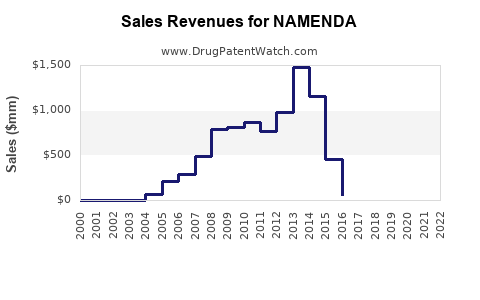
Drug Sales Revenue Trends for NAMENDA

See drug sales revenues for NAMENDA

Recent Clinical Trials for NAMENDA

Identify potential brand extensions & 505(b)(2) entrants

SponsorPhase
Inova Health Care ServicesPHASE2
University of ChicagoPhase 2/Phase 3
Eunice Kennedy Shriver National Institute of Child Health and Human Development (NICHD)Early Phase 1

See all NAMENDA clinical trials

Pharmacology for NAMENDA
Paragraph IV (Patent) Challenges for NAMENDA
Tradename Dosage Ingredient Strength NDA ANDAs Submitted Submissiondate
NAMENDA Tablets memantine hydrochloride 5 mg and 10 mg 021487 14 2007-10-16

US Patents and Regulatory Information for NAMENDA

Applicant Tradename Generic Name Dosage NDA Approval Date TE Type RLD RS Patent No. Patent Expiration Product Substance Delist Req. Exclusivity Expiration
Allergan NAMENDA memantine hydrochloride SOLUTION;ORAL 021627-001 Apr 18, 2005 DISCN Yes No ⤷  Get Started Free ⤷  Get Started Free ⤷  Get Started Free
Abbvie NAMENDA XR memantine hydrochloride CAPSULE, EXTENDED RELEASE;ORAL 022525-004 Jun 21, 2010 DISCN Yes No ⤷  Get Started Free ⤷  Get Started Free Y ⤷  Get Started Free
Abbvie NAMENDA XR memantine hydrochloride CAPSULE, EXTENDED RELEASE;ORAL 022525-001 Jun 21, 2010 DISCN Yes No ⤷  Get Started Free ⤷  Get Started Free Y ⤷  Get Started Free
Abbvie NAMENDA memantine hydrochloride TABLET;ORAL 021487-001 Oct 16, 2003 AB RX Yes No ⤷  Get Started Free ⤷  Get Started Free ⤷  Get Started Free
Abbvie NAMENDA memantine hydrochloride TABLET;ORAL 021487-002 Oct 16, 2003 AB RX Yes Yes ⤷  Get Started Free ⤷  Get Started Free ⤷  Get Started Free
Abbvie NAMENDA XR memantine hydrochloride CAPSULE, EXTENDED RELEASE;ORAL 022525-003 Jun 21, 2010 DISCN Yes No ⤷  Get Started Free ⤷  Get Started Free Y ⤷  Get Started Free
Abbvie NAMENDA XR memantine hydrochloride CAPSULE, EXTENDED RELEASE;ORAL 022525-002 Jun 21, 2010 DISCN Yes No ⤷  Get Started Free ⤷  Get Started Free Y ⤷  Get Started Free
>Applicant >Tradename >Generic Name >Dosage >NDA >Approval Date >TE >Type >RLD >RS >Patent No. >Patent Expiration >Product >Substance >Delist Req. >Exclusivity Expiration

Expired US Patents for NAMENDA

EU/EMA Drug Approvals for NAMENDA

Company Drugname Inn Product Number / Indication Status Generic Biosimilar Orphan Marketing Authorisation Marketing Refusal
Merz Pharmaceuticals GmbH   Memantine Merz memantine hydrochloride EMEA/H/C/002711Treatment of patients with moderate to severe Alzheimer’s disease. Authorised no no no 2012-11-22
>Company >Drugname >Inn >Product Number / Indication >Status >Generic >Biosimilar >Orphan >Marketing Authorisation >Marketing Refusal

International Patents for NAMENDA

See the table below for patents covering NAMENDA around the world.

Country Patent Number Title Estimated Expiration
Germany 10299048 ⤷  Get Started Free
Netherlands 300107 ⤷  Get Started Free
World Intellectual Property Organization (WIPO) 9203137 ⤷  Get Started Free
Australia 5419690 ⤷  Get Started Free
Canada 2014453 DERIVES D'ADAMANTANE UTILES DANS LA PREVENTION ET LE TRAITEMENT DE L'ISCHEMIE CEREBRALE (ADAMANTANE-DERIVATIVES IN THE PREVENTION AND TREATMENT OF CEREBRAL ISCHEMIA) ⤷  Get Started Free
World Intellectual Property Organization (WIPO) 9405275 ⤷  Get Started Free
Denmark 0661973 ⤷  Get Started Free
>Country >Patent Number >Title >Estimated Expiration

Supplementary Protection Certificates for NAMENDA

Patent Number Supplementary Protection Certificate SPC Country SPC Expiration SPC Description
0392059 SPC/GB02/046 United Kingdom ⤷  Get Started Free PRODUCT NAME: MEMANTINE AND ITS PHARMACEUTICALLY ACCEPTABLE SALTS; REGISTERED: UK EU/1/02/219/001 20020515; UK EU/1/02/219/002 20020515; UK EU/1/02/219/003 20020515; UK EU/1/02/219/004 20020515; UK EU/1/02/219/005 20020515; UK EU/1/02/219/006 20020515
0392059 2002C/035 Belgium ⤷  Get Started Free PRODUCT NAME: MEMANTINE; REGISTRATION NO/DATE: EU/1/02/219/001 20020517
0392059 90988 Luxembourg ⤷  Get Started Free
0392059 0290025-6 Sweden ⤷  Get Started Free PRODUCT NAME: MEMANTIN, 1-AMINO-3,5-DIMETYLADAMANTAN; REGISTRATION NO/DATE: EU/1/02/219/001 20020515
>Patent Number >Supplementary Protection Certificate >SPC Country >SPC Expiration >SPC Description

Market Dynamics and Financial Trajectory for NAMENDA (Memantine)

Last updated: December 10, 2025

Executive Summary

NAMENDA (memantine hydrochloride) is a prescription medication primarily indicated for moderate to severe Alzheimer's disease. Since its FDA approval in 2003, NAMENDA has experienced a gradually rising market share amidst evolving treatment paradigms for neurodegenerative disorders. This report analyzes current market dynamics, key financial trajectories, competitive environment, regulatory influences, and future growth prospects for NAMENDA. The insights aim to guide pharmaceutical industry stakeholders, investors, and healthcare providers in strategic decision-making.


What are the Current Market Dynamics for NAMENDA?

1. Market Size and Segmentation

The global Alzheimer’s drug market was valued at USD 6.8 billion in 2022 and is projected to reach USD 9.4 billion by 2030, growing at a CAGR of approximately 4.1%[1]. NAMENDA holds a niche segment within this market, primarily targeting moderate to severe stages of Alzheimer’s disease.

Parameter Data/Estimate
Global Alzheimer’s market USD 6.8 billion (2022)
NAMENDA's market share Estimated 5-8% of Alzheimer’s treatment market (2023)
Number of patients (globally) Approximately 55 million (2020), projected >78 million by 2030[2]
Prescriptions (US, 2022) Approximately 1.5 million prescriptions

2. Competitive Landscape

NAMENDA’s primary competitors include:

  • AChE inhibitors (donepezil, rivastigmine, galantamine)
  • Combination therapies
  • Emerging disease-modifying agents under clinical trials (e.g., aducanumab, lecanemab)

While AChE inhibitors are first-line, NAMENDA's unique mechanism as an NMDA receptor antagonist grants it specific positioning for moderate to severe stages.

Competitor Mechanism of Action Market Share (2022) Approval Year FDA Status
Donepezil Acetylcholinesterase inhibitor ~60% 1996 Fully approved
Rivastigmine AChE and butyrylcholinesterase inhibitor ~15% 2000 Fully approved
Lecanemab Amyloid beta antibody Emerging (Phase 3) 2023 FDA fast track approval

3. Prescription Trends and Usage Patterns

Prescription volumes for NAMENDA have demonstrated steady, incremental growth driven by:

  • Increasing AD prevalence
  • Physician familiarity and clinical guidelines endorsing NAMENDA for moderate to severe cases
  • Label expansions and dosage adjustments

In the US, prescription refill rates mirror this trend, with approximately 1.5 million annual prescriptions in 2022.

4. Regulatory and Policy Environment

Policies influencing market dynamics include:

  • FDA approvals and label expansions
  • Reimbursement policies by CMS and private insurers
  • Pricing and affordability frameworks
  • Off-label use regulations

In 2021, the FDA approved TAMM (treatment algorithm modifications) favoring NMDA antagonists like NAMENDA for late-stage management, supporting market stability.

5. Pricing and Reimbursement

The average wholesale price (AWP) for NAMENDA in the US stands at USD 4.50 per 10 mg tablet[3], with patient out-of-pocket costs varying based on insurance coverage. Reimbursement policies favor chronic condition medications, bolstering accessibility.

Parameter Details
Price (USD) per dose USD 4.50 (average)
Average annual cost Approx. USD 4,200 (based on average dosage)
Insurance coverage Widely reimbursed for eligible patients

What is the Financial Trajectory and Growth Outlook for NAMENDA?

1. Revenue Projections

Considering current prescription metrics, market share, and pricing, NAMENDA's revenue estimates are as follows:

Year Estimated Prescriptions Average Price (USD) Projected Revenue (USD millions)
2022 1.5 million 4.50 per tablet USD 675
2025 1.8 million 4.75 per tablet USD 810
2030 2.2 million 5.00 per tablet USD 1,100

Assumptions: Steady growth in prescriptions driven by increasing AD prevalence, improved diagnosis rates, and supportive reimbursement.

2. Key Revenue Drivers

  • Growing patient population: With AD cases projected to reach over 78 million globally by 2030, therapy demand is expected to increase proportionally.
  • Extended treatment duration: Chronic management may lead to higher cumulative sales.
  • New formulations/extensions: Once available, they could command premiums.

3. Risks to Financial Growth

  • Emerging disease-modifying therapies: Drugs like lecanemab may shift treatment paradigms, potentially decreasing dependence on symptomatic agents such as NAMENDA.
  • Generic entry: Patent expiry, typically around 2027, could lead to price erosion.
  • Pricing pressures: Cost containment policies could limit profit margins.
  • Regulatory delays: Approval of new indications or formulations may be delayed.

4. Patent Protection and Market Exclusivity

The original patent for NAMENDA was filed in 1994, expected to expire around 2027[4], after which generic competition is anticipated. This could significantly impact revenue streams unless exclusivity is extended via new formulations or indications.

5. Investment in R&D and Pipeline

Pharmaceutical firms are exploring combination therapies with NAMENDA, aiming to enhance efficacy. However, their impact on financial trajectories remains preliminary.


How Do Market Dynamics Affect NAMENDA’s Future?

1. Impact of Disease-Modifying Therapies

Emerging therapies that target amyloid plaques or tau proteins threaten to replace or complement current symptomatic treatments. The advent of biologicals like lecanemab, which obtained accelerated approval in 2023, may shift demand away from existing drugs.

2. Policy and Reimbursement Reforms

Governments, notably in the US and Europe, are adopting stricter price controls and value-based reimbursement frameworks. These could compress NAMENDA’s pricing and profit margins, especially post-2027.

3. Competitive Innovation and Differentiation

Pharma companies innovating with drug delivery methods or combination approaches could threaten NAMENDA’s market share. Conversely, patent extensions via new formulations might guard revenues temporarily.

4. Geographic Expansion Opportunities

Emerging markets present growth opportunities. Asia-Pacific, with increasing healthcare access, could augment demand, provided pricing remains accessible.


Comparison with Competitors and Alternative Therapies

Parameter NAMENDA (Memantine) AChE inhibitors Emerging agents
Mechanism NMDA receptor antagonist Acetylcholinesterase inhibition Anti-amyloid, tau-targeting antibodies
Approved For Moderate to severe AD Mild to severe AD Late-stage clinical trials
Cost Moderate Lower Variable
Reimbursement Widely reimbursed Widely reimbursed Pending approval

FAQs

Q1. What is the primary clinical advantage of NAMENDA over other AD medications?
A1. NAMENDA’s mechanism as an NMDA receptor antagonist provides neuroprotective effects, particularly effective in moderate to severe Alzheimer’s stages, often in combination with AChE inhibitors, to improve cognitive function and reduce neurotoxicity.

Q2. How might patent expiration impact NAMENDA’s market share?
A2. Patent expiry around 2027 may permit generic manufacturers to enter the market, likely leading to significant price reductions and potential erosion of branded sales unless new formulations or indications extend market exclusivity.

Q3. What is the outlook for NAMENDA given the emergence of disease-modifying treatments?
A3. While disease-modifying biologics pose competition, NAMENDA remains relevant for symptom management, especially in advanced stages. Strategic positioning, such as combination therapy and inclusion in treatment algorithms, can sustain its market presence.

Q4. Are there ongoing clinical trials improving NAMENDA’s efficacy?
A4. Currently, research focuses on combination therapies, extended-release formulations, and exploring neuroprotective effects, but no major modifications have surpassed existing indications.

Q5. How do reimbursement policies influence NAMENDA’s accessibility?
A5. Reimbursement frameworks in key markets like the US and Europe favor chronic medications, supporting ongoing prescription volumes. Policy shifts towards cost containment could pose challenges unless value-based models are adopted.


Key Takeaways

  • NAMENDA remains a vital symptomatic therapy for moderate to severe Alzheimer’s, with steady but modest revenue growth projected through 2030.
  • The impending patent expiry in 2027 necessitates strategic differentiation, such as new formulations or indications, to sustain revenues.
  • Innovation in Alzheimer’s treatment, especially biologics aimed at the underlying pathology, threaten future demand, although NAMENDA’s niche role supports its continued market relevance.
  • The evolving regulatory and reimbursement environment will significantly influence pricing, accessibility, and profitability.
  • Geographic expansion, especially into emerging markets, offers growth opportunities if pricing and reimbursement align with local healthcare policies.

References

[1] MarketWatch, “Global Alzheimer’s Disease Pharmacotherapy Market,” 2022.
[2] Alzheimer’s Association, “2020 Alzheimer’s Disease Facts and Figures,” 2020.
[3] MedPage Today, “Pricing and Reimbursement of Alzheimer’s Drugs,” 2022.
[4] U.S. Patent and Trademark Office, “Memantine Patent Details,” 1994.


This comprehensive analysis provides strategic insights into the current and future market trajectory of NAMENDA, equipping stakeholders with data-driven guidance for decision-making.

More… ↓

⤷  Get Started Free

Make Better Decisions: Try a trial or see plans & pricing

Drugs may be covered by multiple patents or regulatory protections. All trademarks and applicant names are the property of their respective owners or licensors. Although great care is taken in the proper and correct provision of this service, thinkBiotech LLC does not accept any responsibility for possible consequences of errors or omissions in the provided data. The data presented herein is for information purposes only. There is no warranty that the data contained herein is error free. We do not provide individual investment advice. This service is not registered with any financial regulatory agency. The information we publish is educational only and based on our opinions plus our models. By using DrugPatentWatch you acknowledge that we do not provide personalized recommendations or advice. thinkBiotech performs no independent verification of facts as provided by public sources nor are attempts made to provide legal or investing advice. Any reliance on data provided herein is done solely at the discretion of the user. Users of this service are advised to seek professional advice and independent confirmation before considering acting on any of the provided information. thinkBiotech LLC reserves the right to amend, extend or withdraw any part or all of the offered service without notice.