Share This Page
Drug Sales Trends for NAMENDA
✉ Email this page to a colleague
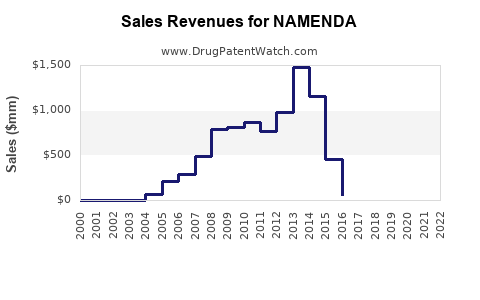
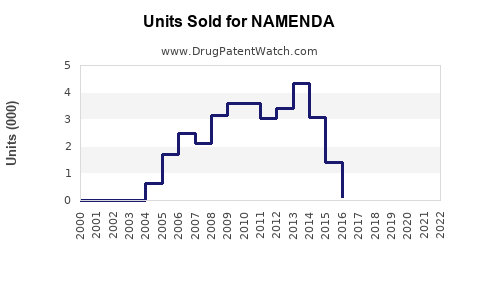
Annual Sales Revenues and Units Sold for NAMENDA
| Drug Name | Revenues (USD) | Units | Year |
|---|---|---|---|
| NAMENDA | ⤷ Start Trial | ⤷ Start Trial | 2022 |
| NAMENDA | ⤷ Start Trial | ⤷ Start Trial | 2021 |
| NAMENDA | ⤷ Start Trial | ⤷ Start Trial | 2020 |
| NAMENDA | ⤷ Start Trial | ⤷ Start Trial | 2019 |
| NAMENDA | ⤷ Start Trial | ⤷ Start Trial | 2018 |
| >Drug Name | >Revenues (USD) | >Units | >Year |
NAMENDA Market Analysis, Sales Projections, Patent Exclusivity, and Generic Competition
Namenda, the brand name for memantine hydrochloride, is a mature Alzheimer’s disease drug with limited remaining branded revenue potential. Immediate-release Namenda lost U.S. market exclusivity years ago, while Namenda XR competes with generic and alternative extended-release memantine products. The commercial market is now driven by low-cost generic prescriptions rather than brand sales.
The base-case forecast is for continued prescription-volume stability but falling market value. U.S. branded Namenda revenue is projected to remain below $10 million annually through 2030, while the broader U.S. memantine market is likely to generate approximately $40 million to $80 million in annual manufacturer revenue, depending on pricing, payer mix, and prescription volume.
What is Namenda and how is it used?
Namenda is memantine hydrochloride, an N-methyl-D-aspartate receptor antagonist approved for the treatment of moderate to severe dementia associated with Alzheimer’s disease. The immediate-release product is administered as tablets or oral solution. Namenda XR is an extended-release capsule formulation administered once daily.
| Product | Active ingredient | Dosage form | FDA status | Primary indication |
|---|---|---|---|---|
| Namenda | Memantine hydrochloride | Immediate-release tablets and oral solution | Approved | Moderate to severe Alzheimer’s dementia |
| Namenda XR | Memantine hydrochloride | Extended-release capsules | Approved | Moderate to severe Alzheimer’s dementia |
| Generic memantine | Memantine hydrochloride | Tablets, oral solution, extended-release capsules | Approved through ANDA and NDA pathways | Same general therapeutic use |
Namenda was originally developed by Merz Pharmaceuticals and commercialized in the United States by Forest Laboratories. Forest became part of Actavis through the 2014 acquisition, and Actavis later became part of Allergan. AbbVie acquired Allergan in 2020 and became the current corporate owner of the Allergan portfolio.[1][2]
Namenda is symptomatic therapy. It does not modify the underlying progression of Alzheimer’s disease. Its clinical role is separate from newer anti-amyloid antibodies such as Leqembi and Kisunla, which target early Alzheimer’s disease and operate under different regulatory and reimbursement conditions.
How large is the Namenda and memantine market?
The commercial opportunity has shifted from branded Namenda to generic memantine. Historical U.S. brand sales exceeded $1 billion annually before generic entry, but that revenue base was largely eliminated after immediate-release generic competition began.
Forest reported Namenda as one of its largest products before loss of exclusivity. Public company filings and transaction materials described annual Namenda sales in the billion-dollar range during the early 2010s.[1][3]
Historical market transition
| Period | Market condition | Commercial effect |
|---|---|---|
| 2003-2010 | Namenda held primary U.S. market position | Rapid brand adoption and rising revenue |
| 2010-2014 | Immediate-release product remained commercially protected through patent and regulatory barriers | Peak brand revenue |
| 2014-2015 | Generic competition approached; Forest changed commercial strategy toward Namenda XR | Brand-preservation effort |
| 2015 onward | Generic immediate-release memantine gained share | Large decline in Namenda revenue |
| 2020 onward | Generic market dominated; branded products had limited visibility | Low-value, high-volume mature market |
The market remains clinically relevant because Alzheimer’s prevalence is increasing and memantine is inexpensive. That demographic support has not restored brand pricing power. Generic substitution, Medicare coverage, pharmacy benefit management, and low unit prices constrain revenue.
What are the current sales projections for Namenda?
The following forecast separates branded Namenda revenue from total U.S. memantine market revenue. It is a scenario-based projection rather than a reported company forecast.
Base-case U.S. revenue projection
| Year | Branded Namenda revenue | Generic memantine revenue | Total U.S. memantine market |
|---|---|---|---|
| 2024A estimate | $5-$15 million | $45-$70 million | $50-$85 million |
| 2025E | $3-$10 million | $45-$68 million | $48-$78 million |
| 2026E | $2-$8 million | $44-$66 million | $46-$74 million |
| 2027E | $1-$7 million | $43-$65 million | $44-$72 million |
| 2028E | $1-$6 million | $42-$64 million | $43-$70 million |
| 2029E | Below $5 million | $41-$63 million | $42-$68 million |
| 2030E | Below $5 million | $40-$62 million | $40-$67 million |
The forecast assumes:
- Stable or modestly declining U.S. prescription volume.
- Continued generic substitution above 95% for immediate-release memantine.
- No major clinical expansion for memantine.
- No meaningful premium pricing for Namenda XR.
- Limited branded promotion by the current owner.
- Annual price erosion in the generic segment offset partly by an aging patient population.
The market can exceed the base case if Alzheimer’s diagnosis and treatment rates rise faster than expected. It can fall below the base case if newer therapies displace memantine in earlier treatment stages or if payers restrict combination use.
When did Namenda lose exclusivity?
Immediate-release Namenda lost practical U.S. exclusivity when generic memantine entered the market in 2015. Patent expiration alone does not determine commercial loss; the key event was FDA approval and launch of competing products.
Actavis launched a generic version of Namenda tablets in July 2015 after resolving patent litigation with Forest.[4] Generic entry followed an earlier dispute over Forest’s attempt to transition patients from immediate-release Namenda to Namenda XR.
The Namenda XR product had separate formulation patents and a later commercial life. Those patents did not preserve the original Namenda franchise because physicians and payers could move patients to generic immediate-release memantine.
What patents protect Namenda and Namenda XR?
Namenda’s patent estate was divided between the active pharmaceutical ingredient, immediate-release product, and extended-release formulation.
Immediate-release Namenda
The original memantine compound patents expired before the current period. The principal commercial protection for immediate-release Namenda has ended, and generic manufacturers now sell the product.
The relevant legal protection included:
- Compound and use patents covering memantine.
- FDA Orange Book listings associated with the approved Namenda NDA.
- Regulatory exclusivity and pediatric exclusivity periods.
- Litigation settlements governing the timing of generic entry.
Namenda XR
Namenda XR relied on formulation and extended-release delivery patents rather than a new active ingredient. These patents covered aspects of once-daily delivery and controlled release.
Patent listings and expiration dates can change as Orange Book records are corrected, delisted, or affected by terminal disclaimers. The FDA Orange Book should be used as the controlling commercial reference for currently listed patents and pediatric exclusivity.[5]
| Patent category | Namenda relevance | Current commercial impact |
|---|---|---|
| Memantine compound patents | Original Namenda | Expired |
| Immediate-release product patents | Tablet and oral-solution products | No meaningful barrier to generic entry |
| Extended-release formulation patents | Namenda XR | Potentially relevant only to XR-specific generic competition |
| Method-of-use patents | Alzheimer’s dementia treatment | Limited value where the indication is already broadly established |
| Manufacturing patents | API or dosage-form production | Can create process barriers but rarely restores brand pricing |
Patent strength is therefore low for the immediate-release franchise and moderate at most for specific Namenda XR formulation claims. The value of any surviving XR patent depends on claim scope, Orange Book listing, litigation history, and the number of approved competing extended-release products.
What is the Orange Book status of Namenda?
The FDA Orange Book identifies approved drug products, therapeutic equivalence ratings, patent information, and exclusivity information. Namenda and Namenda XR are associated with separate FDA applications and dosage forms.[5]
The commercial interpretation is:
- Immediate-release Namenda no longer has an effective exclusivity barrier.
- Generic immediate-release memantine products are therapeutically substitutable where rated AB by FDA.
- Namenda XR requires separate evaluation because extended-release products are not automatically interchangeable with immediate-release tablets.
- Orange Book patent listings do not guarantee enforceability or prevent generic entry.
- A listed patent can trigger a Paragraph IV notice and litigation, but the dispute may end in settlement or negotiated entry.
FDA approval of a generic does not mean that every generic competes identically with every Namenda presentation. Dosage form, release profile, strength, labeling, and pharmacy substitution rules remain relevant.
Which companies are challenging or competing with Namenda?
The principal competitive threat is generic memantine, not a branded Alzheimer’s product.
Generic manufacturers
The U.S. market has included generic suppliers such as:
- Teva Pharmaceuticals
- Amneal Pharmaceuticals
- Zydus Pharmaceuticals
- Dr. Reddy’s Laboratories
- Torrent Pharmaceuticals
- Solco Healthcare
- Rising Pharmaceuticals
- Alembic Pharmaceuticals
- Other approved ANDA holders and authorized distributors
Availability varies by strength, dosage form, wholesaler contract, and pharmacy inventory. Generic competition is fragmented at the manufacturer level but concentrated at the payer and distributor level.
Therapeutic competitors
Namenda also competes with:
- Donepezil
- Rivastigmine
- Galantamine
- Donepezil/memantine combinations
- Anti-amyloid antibodies for selected early Alzheimer’s patients
Namenda is most exposed to substitution by donepezil and combination therapy decisions. It is less directly exposed to anti-amyloid products because the therapies target different patient populations and carry different monitoring, infusion, diagnostic, and reimbursement requirements.
What Paragraph IV litigation and settlements affected Namenda?
The most commercially important litigation involved generic challenges to Forest’s Namenda patents and the timing of generic entry. A Paragraph IV certification asserts that a listed patent is invalid, unenforceable, or not infringed. Such a filing can trigger a 30-month stay under the Hatch-Waxman Act if the brand holder sues within the statutory period.[6]
Forest faced generic challenges while attempting to protect the franchise through Namenda XR. The company’s strategy of encouraging patients to switch from immediate-release Namenda before generic entry drew scrutiny from regulators and private plaintiffs. The Federal Trade Commission alleged that Forest’s conduct unlawfully delayed generic competition. The Second Circuit allowed the FTC’s antitrust case to proceed, and the dispute became a major example of “product hopping” risk in pharmaceutical competition.[7]
The commercial outcome was clear: generic immediate-release memantine entered in 2015, and the original Namenda revenue base contracted sharply.
How does Namenda compare with newer Alzheimer’s drugs?
| Attribute | Namenda | Leqembi | Kisunla |
|---|---|---|---|
| Active ingredient | Memantine | Lecanemab | Donanemab |
| Disease stage | Moderate to severe symptomatic disease | Early Alzheimer’s disease | Early Alzheimer’s disease |
| Mechanism | NMDA receptor antagonist | Anti-amyloid antibody | Anti-amyloid antibody |
| Administration | Oral | Intravenous infusion | Intravenous infusion |
| Generic competition | Extensive | None at present | None at present |
| Price structure | Low-cost generic | High-cost branded biologic | High-cost branded biologic |
| Key barriers | Generic price erosion | Diagnostic, infusion, safety, reimbursement | Diagnostic, infusion, safety, reimbursement |
Namenda is commercially disadvantaged by low pricing but benefits from broad physician familiarity, oral administration, and low payer friction. Newer drugs have higher revenue per patient but narrower eligibility and greater clinical infrastructure requirements. FDA approvals for Leqembi and Kisunla do not eliminate the need for symptomatic therapy in patients with more advanced disease.[8][9]
What generic entry risks exist through 2030?
The principal risk is further price erosion in the generic segment. The risk of a new immediate-release generic shock is low because the market is already genericized. The main risks are:
- Additional suppliers entering and reducing average selling prices.
- Wholesaler consolidation increasing rebate pressure.
- Payers preferring selected generic manufacturers.
- Lower persistence as treatment protocols evolve.
- Substitution by combination products or newer Alzheimer’s therapies.
- Shortages or manufacturing disruptions affecting individual suppliers rather than the whole market.
Namenda XR may retain a small niche if patients or prescribers prefer once-daily administration. That niche is unlikely to support historical brand economics.
What geographic markets remain commercially relevant?
The United States is the most important market for historical Namenda revenue and patent disputes. Outside the United States, memantine is widely genericized and sold under multiple brand names.
International revenue is shaped by:
- National reimbursement decisions.
- Reference pricing.
- Local generic approval pathways.
- Trademark ownership.
- Distribution agreements.
- Local manufacturing requirements.
- Currency movements.
The European market has little remaining opportunity for premium Namenda pricing. Emerging markets may produce volume growth as diagnosis expands, but low prices and local competition limit revenue.
What licensing deals and commercial transactions affect Namenda?
Forest’s acquisition by Actavis in 2014 transferred the Namenda franchise into the Actavis portfolio. Allergan’s subsequent combination with Teva’s generic business and AbbVie’s acquisition of Allergan changed ownership and portfolio structure, but no transaction restored Namenda’s lost exclusivity.[2][10]
The major commercial event was portfolio consolidation, not a new licensing arrangement. Generic supply agreements and authorized-distribution contracts have greater current importance than brand licensing.
How strong is the Namenda patent estate?
The Namenda estate is weak as a platform for protecting branded revenue and moderate only for narrow XR formulation claims.
| Factor | Assessment |
|---|---|
| Active-ingredient protection | Expired |
| Immediate-release protection | Ineffective against existing generic competition |
| XR formulation protection | Potentially relevant but commercially limited |
| Method-of-use protection | Limited incremental value |
| Manufacturing patents | Possible supplier-level barrier |
| Litigation leverage | Low for immediate-release; product-specific for XR |
| Revenue protection through 2030 | Minimal |
Patent strength should be assessed against actual market barriers. A patent that remains listed but does not block approved generic supply has limited economic value.
Key Takeaways
- Namenda is a mature memantine product with minimal remaining branded revenue potential.
- Immediate-release generic entry in 2015 ended the product’s historical U.S. exclusivity.
- Namenda XR has formulation-specific protection, but the product cannot reproduce the original Namenda franchise economics.
- Base-case U.S. memantine market revenue is projected at approximately $40 million to $80 million annually through 2030.
- Branded Namenda revenue is projected to remain below $10 million annually.
- Generic manufacturers, payer substitution, and low pricing are the primary competitive forces.
- New anti-amyloid therapies create limited direct substitution risk because they target earlier disease stages.
- The strongest remaining commercial value is in generic volume, supply reliability, and selected extended-release niches.
FAQs
Is Namenda still available in the United States?
Namenda may remain referenced in FDA-approved labeling and product databases, but commercial availability depends on the specific presentation and supplier. Generic memantine is the dominant source of U.S. supply.
Is generic memantine equivalent to Namenda?
FDA-rated generic immediate-release memantine products can be therapeutically equivalent to the corresponding Namenda immediate-release product. Extended-release products require separate evaluation because release characteristics differ.
Does Namenda XR still have patent protection?
Namenda XR has historically relied on extended-release formulation patents. The practical value of any remaining protection depends on current Orange Book listings, patent expiration, claim scope, and approved generic competition.
Could Namenda sales increase if Alzheimer’s prevalence rises?
Prescription volume could increase, but brand revenue is unlikely to rise proportionally because most prescriptions are generic and unit prices are low.
Is Namenda a biosimilar risk?
No. Memantine is a small-molecule drug, not a biologic. Competition occurs through the ANDA generic pathway rather than the biosimilar pathway.
References
-
Forest Laboratories, Inc. (2014). Annual report pursuant to Section 13 or 15(d) of the Securities Exchange Act of 1934.
-
AbbVie Inc. (2020). Annual report pursuant to Section 13 or 15(d) of the Securities Exchange Act of 1934.
-
Actavis plc. (2014). Annual report and Form 10-K.
-
Federal Trade Commission. (2015). FTC v. Actavis, Inc. and Forest Laboratories, Inc.: Generic memantine competition and product-hopping litigation materials.
-
U.S. Food and Drug Administration. (2024). Approved drug products with therapeutic equivalence evaluations: Orange Book.
-
U.S. Food and Drug Administration. (2024). Hatch-Waxman amendments and abbreviated new drug application patent certifications.
-
Federal Trade Commission v. Actavis, Inc., 868 F. Supp. 2d 10 (D.D.C. 2012); FTC v. Actavis, Inc., 570 U.S. 136 (2013).
-
U.S. Food and Drug Administration. (2023). FDA grants accelerated approval for Alzheimer’s disease treatment.
-
U.S. Food and Drug Administration. (2024). FDA approves treatment for adults with Alzheimer’s disease.
-
AbbVie Inc. (2019). AbbVie to acquire Allergan, creating a diversified biopharmaceutical company.
More… ↓
