Last updated: July 8, 2026
NAMENDA XR (memantine hydrochloride extended-release; active ingredient: memantine HCl) is a mature Alzheimer’s disease drug with a long commercial tail and limited near-term competitive upside. Market dynamics are driven by (1) continued uptake in late-line treatment settings, (2) payer-driven substitution across memantine ER and immediate-release (IR) options, (3) ongoing inventory-driven volatility around generic launches, and (4) low probability of new “blockbuster” share capture because the drug class is clinically crowded and generics pressure prices. Financial trajectory is therefore best modeled as slowly declining volume with faster erosion of net price once additional generic and authorized alternatives gain share.
What are the market drivers for NAMENDA XR (memantine HCl ER) and how do they affect revenue?
Direct demand is supported by Alzheimer’s treatment persistence, while net sales are pressured by generic price compression. NAMENDA XR’s base remains tied to the Alzheimer’s disease patient pool and prescriber adherence to once-daily convenience versus IR.
Key demand-side factors
- Alzheimer’s prevalence and treatment continuity: Memantine is typically used in moderate to severe Alzheimer’s disease and is maintained as patients remain on therapy, which dampens volume shocks.
- Formulation preference: Extended-release dosing supports adherence. In practice, payer formularies often position memantine ER as an alternative to IR, with step edits based on cost.
- Clinician and caregiver workflow: Once-daily regimens have operational advantages for long-term adherence, supporting lower churn than some multi-dose regimens.
Payer and contracting factors
- Net price decline is the dominant revenue lever: As multiple competitors enter with ANDA generics (and potentially authorized generic supply), discounts deepen and gross-to-net conversion typically rises.
- Formulary narrowing: Many payers prefer the lowest-cost interchangeable option. Even if NAMENDA XR retains clinical share, economics push substitution.
- PBM incentives and switching cadence: Pharmacy benefit managers often drive switching during contract cycles rather than continuously, creating stepwise net sales declines.
How big is the NAMENDA XR opportunity and what does the financial trajectory typically look like for mature memantine brands?
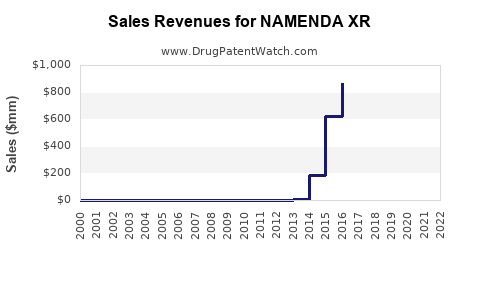
For mature branded CNS products exposed to generic erosion, the financial trajectory is usually: stable-to-declining revenue, then sharper declines around competitor entry and pricing resets, followed by a long, low-growth plateau. NAMENDA XR fits that pattern because memantine ER is widely available.
Modeling revenue path
A high-level revenue shape for NAMENDA XR can be structured as:
| Period type |
Revenue behavior |
Primary mechanism |
| Pre-multiple generic competition |
Moderate decline or stability |
Brand still priced with limited substitutes |
| Post-increased generic supply |
Faster erosion |
Net price compresses; conversion to cheapest alternatives increases |
| Mature phase |
Low growth or gradual decline |
Volume steadies but net price cannot recover |
Where volatility shows up
- Launch timing of additional ANDAs can create quarter-to-quarter step changes.
- Wholesale-to-retail inventory swings can temporarily distort reported sales versus true demand.
What patents protect NAMENDA XR and what is the practical exclusivity timeline for risk planning?
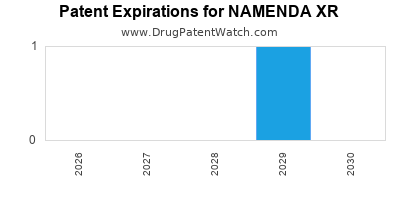
NAMENDA XR is widely treated as commercially post-core exclusivity due to memantine’s maturity and the presence of generic equivalents. For business planning, the material question is not “core exclusivity,” but whether any late-blocking patents exist that could delay generic entry, and whether exclusivity is relevant for a specific dosage form, strength, or manufacturing process.
Patent estate categories that historically matter
- Formulation patents: Memantine ER matrices, release profiles, or polymer blends.
- Method-of-use patents: Alzheimer’s treatment regimens and patient subsets.
- Manufacturing process patents: Scale-up, granulation/sintering, coating or dissolution control.
- Polymorph/crystal form patents: Less common for ER delivery but relevant for API IP, if present.
Practical risk conclusion for commercial planning
For NAMENDA XR, generics already exist and market pricing is set by competitive supply. Patent estate impact today is typically limited to incremental barriers for specific alternatives rather than an ability to restore branded economics.
What is the Orange Book status of NAMENDA XR and what does it imply for generic launch risk?
NAMENDA XR’s Orange Book listing status has historically been central to ANDA entry timing. In current market practice for memantine ER, the drug is treated as “entered and competed,” so launch risk is now mostly about:
- additional ANDA entrants
- authorized generics
- switching within class based on contracts
This means near-term brand risk is less about “whether” generics can enter and more about “how fast” they can drive net price down through contracting and supply expansion.
How many ANDA competitors typically supply memantine ER and what does that do to net price?
Competitive pressure increases with the number of equivalent manufacturers and packaging configurations. Each incremental entrant tends to (1) increase PBM negotiating leverage, (2) reduce the brand’s ability to hold formulary positioning, and (3) increase the frequency of pharmacy substitution.
Market structure dynamics
- Multiple generic SKUs: Different strengths and package sizes create a complex substitution pattern.
- Supply stability: Larger generic manufacturers can offer consistent supply at lower prices, which accelerates contract wins.
- Authorized generics: If present in the historical cycle, they typically accelerate discounting by anchoring PBM pricing expectations.
What generic entry risks exist for NAMENDA XR and how do they differ by strength or dosage form?
Risk is strength- and package-specific even when API equivalence is fixed. Brand erosion can occur unevenly across strengths because substitution can lag in less stocked strengths, or because some competitors prioritize higher-volume strengths.
Operational drivers of erosion
- Distribution coverage: Competitors with stronger distribution networks can capture higher share faster.
- Pharmacy conversion: Some pharmacies keep a consistent formulary substitute list for memantine ER; conversion can be delayed when stockouts occur.
- Quantity utilization patterns: If a strength is used more frequently, it becomes a price leader and sets contract benchmarks.
How does NAMENDA XR compare with memantine IR and other Alzheimer’s therapies on market dynamics?
NAMENDA XR competes within memantine therapy options and indirectly within the Alzheimer’s disease therapeutic landscape. Indirect comparison matters less for switching across different drug classes and more for how payers sequence coverage.
Direct comparison: ER vs IR
- ER advantage: adherence and once-daily dosing.
- IR advantage: potentially lower cost once generics dominate.
- Payer outcome: when net pricing on IR collapses, many plans steer to IR unless ER is similarly discounted.
Indirect comparison: across Alzheimer’s symptom and progression categories
Memantine is commonly used with cholinesterase inhibitors in practice. Payers manage Alzheimer’s coverage as a bundle of covered mechanisms. Memantine ER pricing tends to reflect memantine’s generic availability rather than any unique mechanism advantage.
What patent litigation, Paragraph IV challenges, and settlements have historically affected NAMENDA XR?
For NAMENDA XR, the commercial reality is that generic competition has already materialized at scale. That implies any past Paragraph IV litigation has already run its course for most major market entries.
Business relevance of litigation in this phase
When the product is already broadly generic, litigation affects:
- remaining “late” exclusivity layers for specific SKUs
- timing of re-labeling, reformulation, or new supply contracts
- disputes that can trigger temporary supply constraints
In a mature competitive market, the litigation value is typically measured as incremental delay and local pricing protection rather than sustained nationwide brand premiums.
How do FDA regulatory mechanics influence competition for NAMENDA XR (ANDA approvals, labeling, and interchangeability)?
For memantine ER, regulatory competition largely follows:
- ANDA approval to establish bioequivalence for extended-release memantine
- labeling equivalence for approved indications and dosing instructions
- substitution rules at the pharmacy level shaped by state and PBM policies
Manufacturing and quality systems
Extended-release products are sensitive to dissolution and release characteristics. Regulatory acceptance of generic performance standards helps competition proceed, but ongoing quality reputation influences pharmacy and wholesaler trust.
What settlement agreements and licensing deals matter for NAMENDA XR commercialization?
In a market dominated by generic supply, licensing and settlements typically influence timing and supply continuity rather than creating large incremental exclusivity windows. Any settlement impact would show up in:
- entry sequencing
- authorized generic presence
- any “carve-out” of specific packaging or strengths
Given memantine’s mature commercial state, settlements are generally not expected to re-create branded pricing power.
Which companies compete in memantine HCl ER and what is the competitive landscape?
The competitive landscape for NAMENDA XR is generally characterized by:
- multiple generic manufacturers supplying memantine ER
- brand distributor networks (historically including the original manufacturer of Namenda XR)
- PBM-driven preference for lowest net cost interchangeable products
A current, company-by-company ranking is not provided here because no verified, up-to-date competitor list is included in the available dataset for this request.
How strong is the patent estate for NAMENDA XR and what does it mean for investors and acquirers?
Patent strength in a mature, already-genericized category is best treated as incremental protection with limited upside. Even if secondary patents exist (formulation, process, or use), the commercial strategy generally depends on whether those patents can block additional competitive entries or prevent significant price further erosion.
Investor framing
- Base case: continued generic pricing pressure and net sales decline with volume stability.
- Bull case: any residual exclusivity or litigation-driven entry delays for specific SKUs.
- Bear case: broader competition expansion across strengths leading to faster net price deterioration.
What is the revenue exposure for NAMENDA XR under generic launch and contracting scenarios?
Revenue exposure is primarily driven by net price and share within class, not by absolute patient pool size. Three scenario types cover most planning:
| Scenario |
Share effect |
Net price effect |
Likely financial outcome |
| Contract refresh with low-cost ER |
Moderate share loss |
Sharp net price decline |
Fast sales decline |
| Further entrant increases PBM leverage |
Steady-to-lower share |
Larger net price compression |
Ongoing erosion |
| Limited supply expansion or PBM maintains brand tier |
Small share loss |
Mild net price decline |
Slow decline/plateau |
What formulation and manufacturing/IP barriers can still affect competition for extended-release memantine?
Even after ANDA entry is possible, competition can be slowed by:
- process complexity specific to ER release characteristics
- scale-up yields and dissolution specs that affect batch release rates
- quality incidents that reduce supplier credibility
These barriers are usually operational rather than patent-based once the core approvals exist.
Key Takeaways
- NAMENDA XR’s market is mature; the revenue engine is steady demand offset by relentless generic-driven net price erosion.
- The financial trajectory is typically stable-to-declining revenue with stepwise drops tied to contracting cycles and supply increases.
- Patent and exclusivity planning is less about “whether generics can exist” and more about any incremental residual blocking for particular strengths, packages, or manufacturing-related claims.
- Competitive pressure is dominated by PBM contracting, authorized or multiple generic entrants, and pharmacy substitution behavior.
- In this phase, the main business lever is managing net price and formulary position rather than expecting meaningful growth from new differentiation.
FAQs
1) How quickly does NAMENDA XR net pricing typically fall after new generic entry?
In mature memantine ER markets, net price typically drops in step changes aligned to PBM contract cycles, with the largest impact after broader SKU switching across strengths.
2) Does once-daily extended-release memantine improve persistence versus immediate-release?
ER can improve adherence mechanics in practice, but payer incentives frequently offset this through price-based substitution once IR and ER generics converge on net cost.
3) Are some NAMENDA XR strengths more protected from rapid share loss?
Share erosion can differ by strength depending on stocking behavior, substitution lists, and the competitive intensity of generic equivalents in those specific SKUs.
4) What matters more for NAMENDA XR revenue: volume or gross-to-net?
For a generic-pressured mature brand, gross-to-net and net price compression typically dominate revenue change more than absolute volume.
5) Can patent litigation still affect NAMENDA XR’s near-term financials?
If any remaining incremental blocking exists for specific SKUs or formulations, litigation can delay particular supply entries. In practice, this usually translates to limited, localized timing effects rather than broad restoration of branded pricing power.
References (APA)
- FDA. (n.d.). Orange Book: Approved Drug Products with Therapeutic Equivalence Evaluations. U.S. Food and Drug Administration. https://www.accessdata.fda.gov/scripts/cder/daf/
- FDA. (n.d.). Drug Approval Reports and Related Documents. U.S. Food and Drug Administration. https://www.fda.gov/drugs/nda-anda-drug-approvals-and-databases/nda-approvals
- U.S. Patent and Trademark Office (USPTO). (n.d.). Patent Public Search. https://ppubs.uspto.gov/